
The Emergency Management Network Podcast · Todd T. De Voe
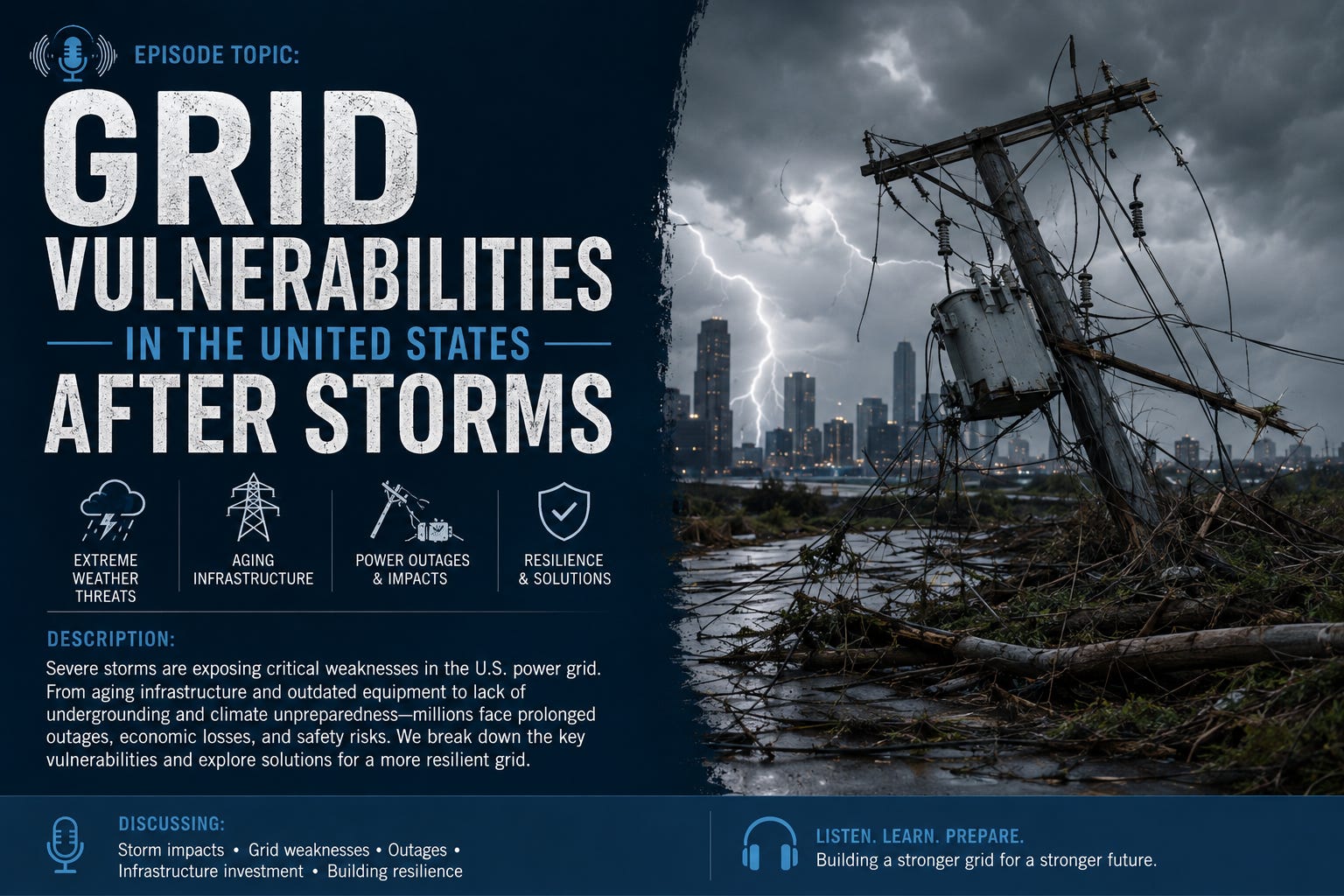
Episode Description The storm passes. The rain stops. The winds die down. And sometimes, that is when the real emergency begins. Electricity is the backbone of nearly every system modern communities depend upon. Communications, water and wastewater systems, hospitals, fuel distribution, traffic control, grocery stores, banking, transportation, emergency operations, and even our ability to receive warnings depend in some way on reliable power. In this episode of the Emergency Management Network Podcast, we examine the vulnerability of the American electrical grid following major storms and extreme weather events. The problem is bigger than a few downed power lines. Hurricanes, tornadoes, derechos, ice storms, flooding, wildfires, and extreme temperatures can damage generation, transmission, substations, and local distribution systems simultaneously. More importantly, we explore what happens next. What does a 24-hour outage mean for a community? What changes at 72 hours? What happens when backup generators begin running low on fuel, cellular sites lose power, medically vulnerable residents need assistance, grocery stores cannot refrigerate food, traffic signals stop working, and public safety agencies are operating on emergency power? For emergency managers, the electrical grid isn’t simply another piece of critical infrastructure. It is the infrastructure upon which much of the rest of our response system depends. We discuss where the vulnerabilities exist, why severe storms continue to expose them, and what emergency managers should be doing now to prepare for prolonged and cascading power failures. The question isn’t simply whether the lights will come back on. The question is: What can your community continue to do until they do? Show Notes This episode explores the intersection between extreme weather, electrical-grid reliability, critical infrastructure, and emergency management. We examine how severe storms can damage transmission and distribution infrastructure and why the consequences extend far beyond homes losing electricity. Major outages can quickly become cascading incidents affecting communications, healthcare, transportation, water systems, fuel supplies, businesses, food distribution, and government operations. Topics include: * Why severe weather remains one of the greatest threats to electrical reliability * The difference between generation, transmission, and distribution failures * How damaged substations, transmission lines, poles, transformers, and vegetation can complicate restoration * Why undergrounding electrical lines can help in some circumstances but is not a universal solution * The growing importance of microgrids, distributed generation, battery storage, and backup power * Generator dependence and the challenge of maintaining fuel supplies during prolonged outages * Telecommunications and cellular-system vulnerabilities when commercial power fails * The consequences of simultaneous power and communications...
0:02SPEAKER_01Welcome to the EMN Podcast,
0:04SPEAKER_01where philosophy meets disaster,
0:07SPEAKER_01and uncomfortable truths meet the profession we call emergency management.
0:11SPEAKER_01This is not safe space thinking, this is the arena.
0:15SPEAKER_02Let's begin.
0:22SPEAKER_01Good morning,
0:22SPEAKER_01good afternoon,
0:23SPEAKER_01depending on where we're at in this fine world,
0:25SPEAKER_01and of course,
0:25SPEAKER_01due to L.A.
0:27SPEAKER_01traffic or maybe to me getting out of my house a little bit later
0:31SPEAKER_01than I really wanted to start a little bit late today.
0:35SPEAKER_01So apologize about that, Andrew.
0:38SPEAKER_00It's all right.
0:38SPEAKER_00You know, you know, it's you're not you're only being held back by the circumstances.