
The Dylan Kohlstadt Show · Dylan Kohlstadt
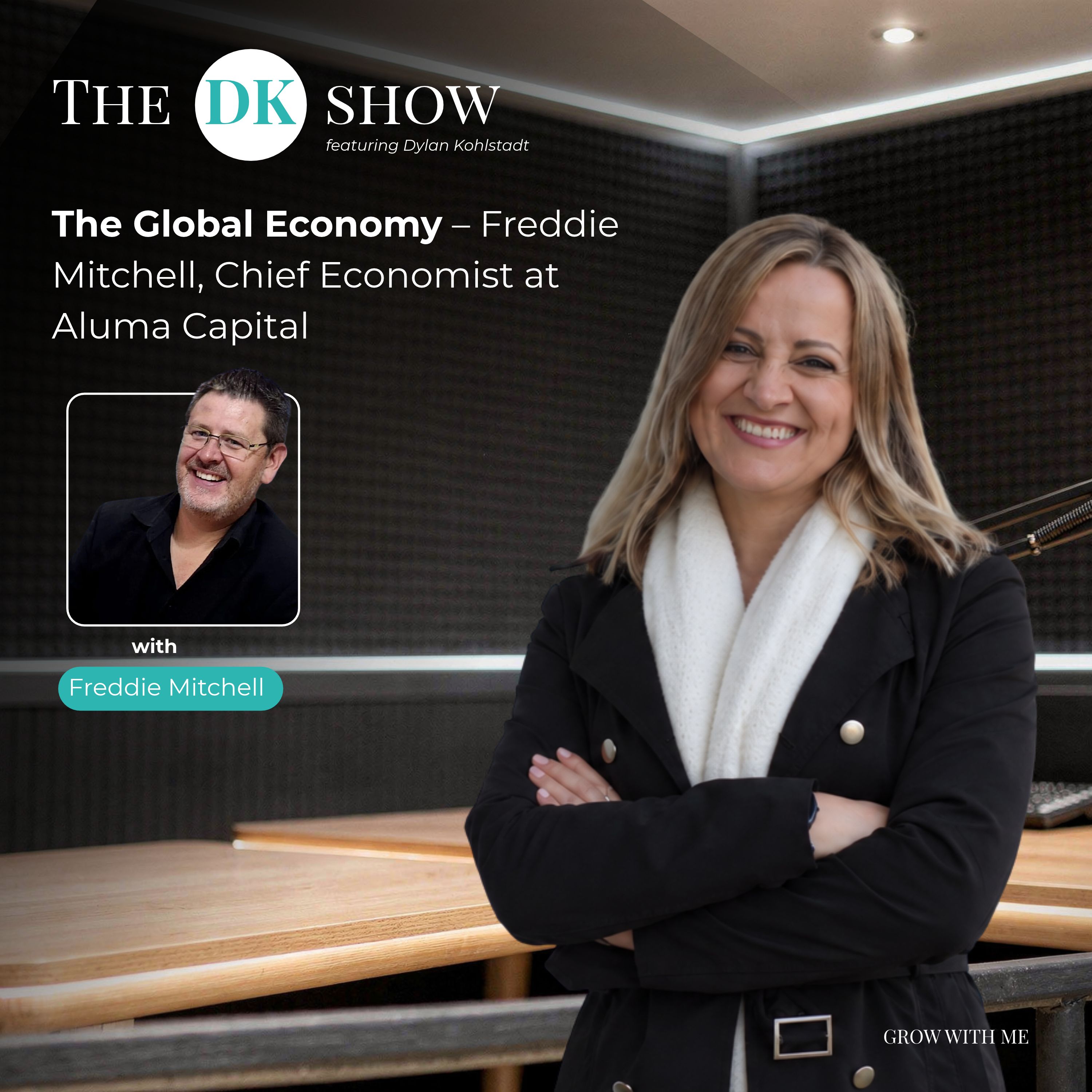
Freddie Mitchell, Chief Economist at Aluma Capital, joins me again to unpack the global economy, and this conversation could not be timelier. We cover the conflict in the Middle East and its knock-on effect on oil prices and the Strait of Hormuz, why the rand has gained ground despite South Africa's own economic challenges, and what rising energy costs are doing to earnings and margins for companies worldwide. Chapters: 0:00 – Welcome back: Freddie Mitchell, Chief Economist at Aluma Capital 1:04 – The global economy in three words: uncertainty, Hormuz, conflict 1:50 – Oil price swings and why the rand is gaining strength 2:52 – The knock-on effect on global business earnings and margins 3:45 – How fuel costs are hitting services and inflation 5:14 – Are we moving away from globalisation? 6:29 – What multinational and local businesses should watch for 8:32 – Tariffs, subsidisation and the social cost of cheap imports 10:28 – Which regions are best positioned for growth 12:36 – How businesses can prepare for a volatile global economy 16:13 – AI, data centres and the risk to jobs 19:00 – When should governments step in with regulation? 20:12 – How vulnerable is the global economy to the next shock? 25:01 – Where the next big opportunities lie: energy, rare earths and AI 27:27 – Closing thoughts and thank you LinkedIn: / freddie-mitchell-economist Aluma Capital: https://aluma.co.za
speaker-0: you you speaker-1: Hi, everybody. Thanks for joining us and welcome to another episode of the DK show. Today I'm joined again by Freddie Mitchell, the the big chief economist. Freddie Mitchell from Illuma Capital. Freddie, thank you for joining me again. Nice to see you. speaker-0: Very good to see you again. speaker-1: Yeah, thanks so much for your time, especially given that you only recently got your voice back. speaker-0: If it's cracking I'll take some water or caffeine. know caffeine is not the best but yeah well I like my coffee. speaker-1: Well, luckily it's back just in time for us to interview again. This time we're discussing the global economy. So last time we met we had some very, very interesting conversations on the the local economy in South Africa. But today I'm very interested to pick your brain on the global economy. So if you had to describe the global economy for me in three words right now, what would they be and why? speaker-0: uncertainty, or a moose, and conflict. speaker-1: Hm. Yeah, that sounds about right. speaker-0: What's going on in global politics if you've been following it. I'm not talking about all the stuff that's going on in Europe and the pseudo invasion of Spanish territory and stuff. I think that takes a back burner to what's actually going on in the Middle East. speaker-1: Hm. Yeah. So what's fueling those three words? So obviously what's happening in the Middle East is impacting fuel and and all of that. So those three words that you said uncertainty, conflict, and horumu's straight. speaker-0: Well, what fuels uncertainty is like, is this trade open or not? It's like, and I was like, no, it's closed. he said, yes, it's open. It's closed, it's it's closed, it's open. We find a deal, no, we don't have a deal. It's like, it's like uncertain about what's going on there. And if you look at the world prices this week, it went to 96, I see this morning, or now it's like at $86 again. So it's up and down uncertainty. That's because if there's uncertainty in the market, you will see prices fluctuate. You also see some dollar weakness. We've seen the RAND gain some value from a South African perspective. We're now at 1593. It's not like, in terms of, if you look at a local currency internationally, it's not like the RAND is, we are doing so much better in South Africa that the RAND is strengthening. It's more a thing of, I guess, bit of dollar weakness that's coming through as a result of uncertainty, oil price fluctuations, and the conflict in the Middle East. speaker-1: Okay. Amazing. So all of this conflict, geopolitical tensions, and obviously it's impacting on international trade, investments, business confidence, what have you seen is the knock on effect? speaker-0: Well, I guess I bring up some companies even internationally as they're pressures in terms of their earnings per share as well as their profit margins because of the cost escalation due to rising energy costs. So I guess that's a story across the board for most people. If you go from $60 odd a barrel, maybe a bit lower to close to $90, $100 plus $100, it's going to have an effect on your bottom line. And I guess that's a prevailing story internationally. for companies and countries. Few shortages as well as uncertainty in terms of the oil price and whether this trade is open is causing an effect on international trade as well as international pricing of stuff. speaker-1: So I can see all of this stuff impacting businesses that have a high dependency on fuel. But what about services businesses or you know, financial services and things like that? How how are interest rates and inflation, you know, impacting on that? speaker-0: I guess services is a bit more isolated but to render services you still need to get to a place to do this stuff. I'm not talking about telecommunication type of services that you can use in South Africa or wherever in your call centers in India or Vietnam or someplace. I'm not talking about that. I'm talking about when you do physical services like, and I'm speaking from a South African perspective, you still need to go out and get the services rendered and you still need to view. You still need to move around. Services can't be delivered in isolation. Some services, yes, but not all services and then your fuel costs do play a role, something they say indirectly in that regard to your overall inflation and even services inflation for that matter. It just shows a bit more up in prices of goods that's being imported and let's say transported over longer distances from port to where it's being consumed. It doesn't matter where, I mean internationally whether it's Europe or South Africa, but some goes to services. People need to travel. things need to happen and that's fuel cost is having an effect even on services prices of services being rendered. speaker-1: Mm, no, absolutely. So with all of this conflict and trade embargoes and tariffs, so are we seeing a shift away from globalization, do you think? speaker-0: That's a really tricky question to answer. It depends on where you sit on the French, whether you are for, let's say, more open borders or whether you're more for national identities. I guess that's the two camps internationally where we are now. We see a swing in European politics scene, most of them electing right-leaning governments away from open borders. We've seen the problems that emanated in Germany, specifically where you are in terms of the migrants coming in because of left-leaning policies as well in Sweden and the problems associated with that. So that gives rise to more nationalistic identities within countries and we see that turning up in the politics. Even in France where we see Marie Le Pen having a good run initially and because of electoral gerrymandering and how they do the French elections, that has been thwarted for some matter. But it's like the two comes, whether you go for more open economy or open borders. borders or a more nationalistic type of view of economies and countries. speaker-1: So I know a lot of our clients are very local. For example, our American clients, very locally loyal. You know, they want to work with local companies and uplift their local communities and and I think there's something to be said for that. but for companies that are very much operating on a global scale, what's something they should be watching out for at this point in time? speaker-0: Dylan, that's a quite tricky question because I guess your local businesses differ quite somewhat from those who operate on a multinational scene. If you look at multinationals, they tend to produce in countries where, or markets where labor is relatively cheap compared to the countries where they're exporting to or where they move their operations from. I know the US has been suffering from this a lot because of the companies could move their, let's say, manufacturing to Asian markets. They close down local markets or local industries within the US itself. We're just speaking now from a US perspective because that's most pertinent. And that comes to where the companies view it more profitable to offshore jobs in manufacturing countries to where it's cheaper to do physical labor and regulations is a bit more lenient towards employing people in less favorable conditions. about, I'm not going to go that, but there's reason for that from multinational for the locals. They still need to import some of the stuff that they sell to the local market from somewhere or get it from somewhere and it's good that you have local producers in certain markets and they prefer local but in the end it's going to have an effect when you look at how things are being done. speaker-1: Yeah. I see VW close to me and Bosch close to me all busy with layoffs and I guess it's difficult to compete against exactly like you're saying, companies that have very low cost of production versus much higher cost of production by keeping things locally. What is your view on subsidizations, just as a as a controversial topic? speaker-0: I guess I'm a bit pro subsidization and also I'm pro-talos. And the reason why, because if you look at the social effects of flooding market with cheap products from abroad, you're basically outsourcing your labor market to another market. you're employing other people instead of your own people. And that causes social problems over a longer period of time in your domestic market. So you'd rather have a bit of pain and have less social problems in than having cheap products and having super high margins for multinationals and then the local or domestic economy have to suck up or be left with the social problems associated with unemployment and lost opportunities. So I guess there's no such a thing as only good in terms of economics. guess it's a trade-off. You need to decide whether you're going to have cheap products and social problems or maybe a bit more expensive. products or you know and less social problems over time that you can deal with. speaker-1: Yeah, I mean, as a as a very shallow example, when I go back home every Christmas time and I wanna buy presents for family back home from Germany, I can't find anything in the shops that's not Timu that they can find at home or cheap local you know, there's no there's no locally made items that I can buy anymore to take back that's unique because the entire world is being flooded with cheap crap. Everyone's buying from Timu and you know, which is really impacting local companies' abilities and small mom and pop shops and also the uniqueness of of of each country is being lost. You know, everything's becoming so generic. okay, so which regions or countries do you believe are best positioned for economic growth over the next three to five years, do you think? Just of your opinion. speaker-0: It depends on what policies you want to follow because I am not a disciple of socialism. I detest socialism because I'm a market capitalist and I believe that... I know that people are going say, yeah, but multinational moves jobs across to cheaper markets. And yes, I understand that. But I prefer markets that's a bit more, let's say, capitalistic in nature and with the underpinning of we know we need to look out at the domestic population. I guess in that sense, I... I like what sub-Saharan Africa is doing in terms of how they are growing. think there's lots of opportunities within Africa, especially sub-Saharan Africa in certain regions or certain countries where they're doing the right economic policies and also some Eastern African countries, Kenya among others, which try to do things differently and getting the economy to grow. Rwanda was a good one, but... Europe, I'm very skeptical of Europe at this stage. They've been growing very slowly for the last, I don't know how long and... I like what the US is doing in terms of getting manufacturing and businesses back into the US even though it's painful at this stage. So I guess I'm pro to that. Yeah, so I would say US certain emerging markets you need to go look where the markets are growing in terms of what economies are growing and invest in that because if you look at let's say Europe they've been stagnant in terms of economic growth for a long time. I don't speak about 1.5 % growth. That's not growth. That's really really low. So I would look at which emerging markets markets are growing and where there are opportunities. And I think Africa's got some good opportunities and countries are trying to turn the ship around. So yeah. speaker-1: So how should businesses prepare for all of this uncertainty in the global economy? What what can a business do to stay flexible, nimble and on top of things and not go under? speaker-0: It depends on what business you're in. I guess if you're importing a lot of stuff, you talked about imported junk or Tmoo in China stuff. Let me be politically nice now, not correct nice. All those contracts and stuff being imported and shipped and stuff is about what is your exchange rating. So I would look at how fluctuating the exchange rate is and trying to tie that a bit down to absorb some of the costs in terms of your exchange rate to get that a bit more stable because in terms of the transportation cost you will not be able to do much about that because that's determined by international oil prices and what's going on with the conflict and what's the result there. So that's the unchangeable but the changeable that you can do like if possible tie down your exchange rates see how you can get stuff from where you're importing or trading to a bit more stable price given international uncertainties. and well-placed fluctuations. Like I said, it's industry specific. Every industry is going to have a different set of variables that will influence them. So it's a very random thing at this stage. It's difficult to say what I would do depending on what's going on. speaker-1: Should businesses hold on to their cash and prepare for a bumpy road and and make sure that they can that they've got a runway? speaker-0: Businesses where? Let's look at the question, businesses where? speaker-1: Well, let's start with businesses in South Africa because my business is based predominantly in South Africa. speaker-0: It's like, it's a nothing. I think there's a lot going on within the domestic market that's not favorable and we see that in the business conference that's not high. The economy has been stagnant in terms of growing 1%, 1.2 % per annum. That's really not growth at all. We've seen an unemployment crisis and that's all because of government policies. South Africa specifically we need better policy to come to the fore for the African, to unleash the growth potential of this African market which is possible but I don't think we always have the political will to do that because of various reasons. and going to that at another stage. But in South Africa, there's a lot that can be done in terms of you must go and look at where the government wants to invest and what policies are in place that's favorable to invest in. I transportation is, rail transportation is one where they've opened up the corridors to service the port system and rail infrastructure. There's green energy which is being pushed by the government. So there's opportunities in certain sectors where the government is really trying to make something work. But all in all, in South Africa, it's a very difficult situation and we see what's going on in terms of our money not being invested, businesses sitting on the piles of cash and not investing and there's reasons for that. But if you're international investors, I've been reading this morning that South Africa's bond premium is quite a nice attraction for international investors because our government bonds are rated. So we get a lot of portfolio financial plays in South Africa because of that. is good news so I guess depends on what your risk appetite and what your business in terms of where do you want to invest and what you want to do with your funds. speaker-1: So I think on our last episode we spoke about, you know, data centers and technology and and AI impacting on economies and productivity, employment, economic growth. So what are your thoughts around that and and the role that that plays in in driving economic growth, global growth? speaker-0: Do you speak specifically AI data centers? What are you specifically referring to? speaker-1: Well let's start with AI, but technology in general and some of the opportunities that are there. But let's start with AI. speaker-0: I think AI can increase productivity, but... If it goes unchecked, can get to a point where it can lead to job losses, which is not what we want. Because if your country like South Africa is sitting at 33.6 % unemployment rate, which is already high, youth unemployment is just close to 6%. So is that, AI can help with your productivity, but in some cases it might lead to further job losses that we barely can afford at this stage. I think AI and technology is a double-edged sword in some circumstances. speaker-1: Yeah, I completely agree with that. Especially data centers sucking all the water out of the out of already drying world. so in in terms of technology, you know, what should businesses be thinking about now in terms of technology adoption and the impact on growth? speaker-0: I guess technology adoption is... In general goes with increasing a company's efficiency in creating or delivering their products or services. So I guess there's always room for technological advances that businesses can use. But I guess the proviso is technological advances at this stage goes hand hand with AI adoption and how that's being implemented in businesses. Like I said, you can have technological advances and we're all for it and we need to use the efficiency. At some point you reach a tipping point where it's bound to lead to job losses and that needs to be carefully managed in terms of what's the use of it if you put your whole workforce out of work and you've got all these wonderful products that you can supply very efficiently but there's no one to buy the products. That's kind of the dilemma, the trade-offs that you need to look at as a business. speaker-1: Yeah, absolutely. And I and I think it comes down to regulation and and policy because businesses, you know, are in it for the profit and nobody's looking after the the people, right? So when is g when our government's gonna step in and start regulating the impact, constraining that. speaker-0: This is saying that if it moves taxes and if it stands regulated or something like that, it's like I'm not too fond of too much regulation because regulation, specifically in South Africa's case, we've got too much regulation. Red tape is burden of bureaucracy in terms of opening a business and getting parts of red tape and doing stuff. You must never get in the way. I believe money and funds are like water. It goes to the path of least resistance. And if there's too much resistance within the market, it will flow to someplace else. Business will go someplace else. So there's a fine line in terms of regulation and what you want to achieve with regulation in terms of the outcome that you want to see in businesses. speaker-1: Exactly. And that's why you're not seeing governments stepping forward and wanting to be the first ones to block that flow of water because all that flow of water is gonna go somewhere else and they're gonna be, you know, potentially hamper their country and their own growth, technological advancement and put their country behind the other one. So that's probably what's what the problem is there. So let's talk about how vulnerable the global economy is to an to another major shock. And where do you see some risks at the moment? speaker-0: If you speak about double shocks, they're talking about like a COVID case. speaker-1: It could be a covet, it could be a war, it could be more tariffs. speaker-0: There's a lot of rules going on. It's like there's always conflict. It's just I guess the superpowers, be they may, they who be, it's like they do proxy wars. If you go and look at where is the conflicts going, it's proxy wars. The Middle East is also a form of a proxy war at this stage. speaker-1: It's funded speaker-0: the US land forces and the Iran land forces, it's like the guidance that some of the Iranian missiles receive is where are they getting this pinpoint accuracy from? It's not themselves. that comes from somewhere else. I'm not going to go into that. You can make your own assumptions where that is. And the same goes in the Eastern European theater. So superpowers have always been at it and at each other's throat. But now it's like because of the threat of, let's say mutual destruction, they seem to fight proxy wars. That's how they fight it. It's like you don't want to escalate into a hot war between superpowers because that becomes really really not so beneficial for the entire globe at this stage because of the type of weapons that's available. So I guess that's always going to play a part, that's always going to be effective in markets, conflicts, uncertainties. It's part of of international politics and international trade and economics. speaker-1: Yeah, and I think if you look, you know, World War One, World War Two, pre that there was constant, constant strife, borders, Austria invading, you know, or Prussia invai being threatened by this, you know, there was always like so in the eighteen hundreds there was lots of border shuffling happening. Then we had World War One, World War Two, and besides a c you know, Vietnam and things like that and regional conflict, there's been qu qu a fairly long period of I wanna call it almost peace and stability and prosperity where people have been able to build and hand over their houses to the next generation and sort of build build long term sorry. speaker-0: It comes at the price. speaker-1: What's the price? speaker-0: It comes at my association is always, yes, it's good in the West. If I said the West, there's been relatively peace and stability and you get generational, I've been passed from one generation to the next, that was not the case for the entire globe. We had conflicts in the South American theater. We had conflicts in the Middle East. We had constant conflicts in Africa. So it's in a specific area that you had this this model. And the reason why in the European theatres you must go and look at what was decided when the European Union was formed. The problem with Europe is, if you go and read in the history and anyone can come and correct me on that, as soon as the European market starts, the country starts competing for resources, it boils down to a conflict at some point. So the European Union was, in my view, formed to, let's say, ease the pressure from competing for resources among the countries to lessen the conflict that you've seen. I mean, you know how brutal the 1700s, 1800s and parts of the 1900s were. And that's part of because they were competing for resources, for limited resources within that market or within that, let's say, continent. And as soon as the European Union was formed and competition was lessened, severe you had a decrease in conflict. The trade-off for that is you've got a very egalitarian type of society. in terms of let's say CEOs they earn more but it's not to the extent 30 times a normal worker's salary on the floor. It's very egalitarian. In the US you will see a CEO that receives way much more than a guy who's on the factory floor or a store clerk. Burid Mahdi and that is because it was done by design, specifically of the conflict areas that the European continent went through from the 17th, let's say from time immemorial, especially in the 1718 and part of 1900s. speaker-1: Interesting. So just to to wrap up, you know, there's a lot of uncertainty happening in the global markets. where do you see the next the biggest opportunities for the next three to five years and how can businesses position themselves to benefit? speaker-0: Sure, Dylan, that's a very interesting question. The question is, what makes the modern economy tick? There are a of things that companies and countries will look at when they look at where to from here. And the things that I think governments and countries will look at is energy security. And I'll talk about business opportunities in that, you'll understand where I'm going with that. You always need energy security in terms of energy. It's like oil. All products and all trades still need to go use shipping lines and ships use oil. They're not going to use batteries for anytime soon for big shipping companies. So your international trade is dependent on oil and the flow of oil and energy in that sense. The other thing is rare earths, semiconductors, because you need rare earths to do the semiconductors and semiconductors are necessary to power the new modern economy because all your smartphones, all your technology uses semiconductors. So that's the four things that power. And then the other thing is that the fifth part that comes with it is AI, the race towards AI supremacy. But you can't have AI supremacy if you don't have semiconductors and that goes with it and you can't have semiconductors without rare earths. It's like they need each other. And that's why if you look at AI stuff at this stage and it also becomes a question of energy and water. the more you have the more technological superior the country becomes, if I can put it this way, the more energy it consumes and the more Earth's it needs, the more semiconductors, that's the cycle we're in now. So that's why you see AI companies valuations skyrocketing because of this race. And I guess if you look at that, that's where the opportunities lie at this stage because we're not slowing down in terms of the technological AI race. It's only going to intensify in the next year to three years, four years, it's not going to slow down. And I guess that's where the opportunities are at this stage, if you're country and business looking at it realistically. speaker-1: Interesting. Very interesting. Thank you so much, Freddie. It's been very, very interesting speaking with you again. And for our listeners, we'll share your contact details in the description below. Thank you, Freddie, for joining us. It's it's always lovely to speak to you. speaker-0: This is all mine. speaker-1: And for our listeners and viewers, please like, comment, subscribe, do the usual 'cause we need your support. Have a wonderful day everybody. Go out there and be strong. Thanks. Thanks, Brady. Bye bye.