
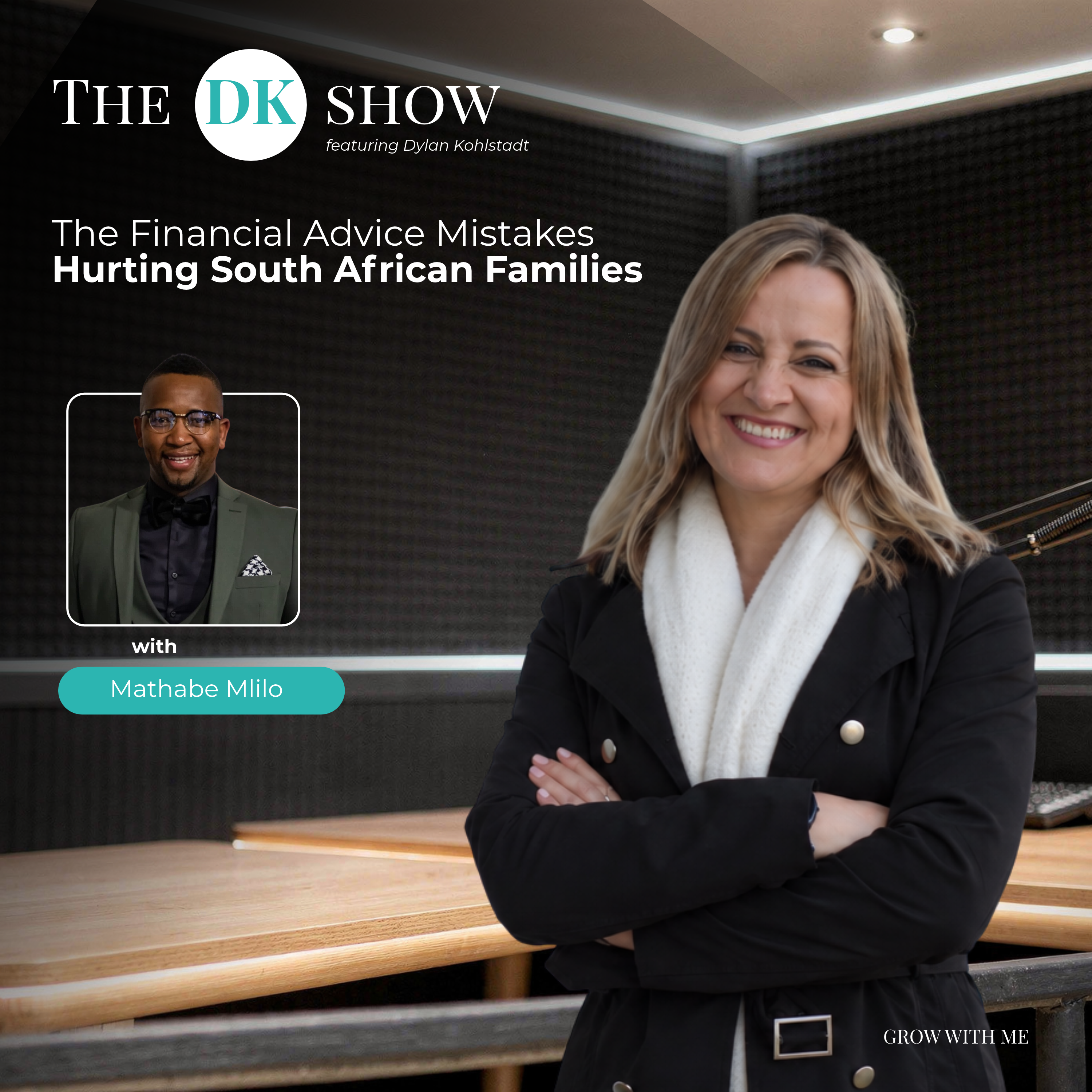
The Dylan Kohlstadt Show · Dylan Kohlstadt
If you run a business, lead a team or carry the financial weight of an extended family, this conversation will change how you look at every policy on your payslip. Mathabe Mlilo has spent more than a decade helping South African individuals, families and companies make practical financial decisions designed for long-term security. He has strong views on where the industry keeps getting it wrong. I sat down with Mathabe, co-founder and director of MapheQ Financial Solutions, to unpack his journey from Standard Bank, Liberty and Discovery to building his own firm with his wife. He shares how his mother’s payslip, five overlapping funeral policies and a childhood of school fee struggles shaped a practice grounded in education. We also get into why a home-town network can take years to trust you, and how solid systems made it possible to expand from Durban into the Eastern Cape, Johannesburg and Cape Town. He also explains why MapheQ grew on referrals and partnerships long before it touched LinkedIn. In this episode: Why Mathabe left corporate after years at Standard Bank, Liberty and Discovery What co-founding a financial firm with your wife looks like day to day The payslip lesson from his mother that still drives MapheQ today How emotional selling pushes families into duplicate funeral policies they don’t need Why an emergency fund can cover far more than a person-specific policy The hidden downside of building a business inside your home-town network How systems and a strong culture powered MapheQ’s growth across four provinces Where referrals and strategic partners fit into a founder-led growth model Three pillars for generational wealth: protect it, multiply it and plant seeds Connect with Mathabe Mlilo LinkedIn: https://www.linkedin.com/in/mathabe-matt-mlilo-15409763/ MapheQ Financial Solutions: https://www.mapheq.co.za/ Connect with Dylan Kohlstadt LinkedIn: linkedin.com/in/dylankohlstadt Website: dylankohlstadt.com YouTube: @DylanKohlstadt Shift ONE: shiftone.co.za #TheDKShow #FinancialPlanning #GenerationalWealth #SouthAfricanBusiness #Entrepreneurship
speaker-0: you you speaker-1: Hi everybody and welcome to the Dylan Colstadt Show. Today I'm really excited to be joined by Matabe Mlilo, the co-founder and director of MayPack Financial Solutions. Matabe, welcome. speaker-0: Thank you very much. Thanks for having me. speaker-1: We're excited to have you here because I love anything related to money and especially making money and especially making money while you sleep, which is this whole investment space. But before we do anything, the first thing I asked my guests to do is if I met you at a bra or a barbecue or in an elevator and I said, What do you do? What is your compelling elevator pitch? speaker-0: jeez. speaker-1: You've only got me for a couple of floors and I'm getting out. speaker-0: No, listen, I think I'm the co-founder of Maypak Financial Solutions and we help individuals, families and businesses make smarter financial decisions. We're providing advice that is practical, tailored, focused on long-term financial security. So I think in the main, my background is around insurances, banking and... Yeah, I think I see less of myself as a financial advisor and more of a trusted partner, you know, who kind of keeps people informed, you know, of decisions that they make every day or at different stages of their lives, particularly around, you know, where their financial journey is concerned. speaker-1: very, very good. Not bad at all. So mm I think I wanted to just touch on something because co founder, because your your business partner is actually your wife, and before the call you mentioned that she is royalty. Are we allowed to mention that she's royalty? Is that public knowledge? speaker-0: Yeah, yes it is. She is of the Macomba lineage, so from the Eastern Cape. yeah. speaker-1: Yeah. speaker-0: It cost me a few of those guanis, you know. speaker-1: That's a few's down I'm sure. But worth it I'm sure. So tell me a little bit of what it's like running a business with your wife. Because I don't think I could do it with my husband. speaker-0: I I mean, I think the idea of any partnership, in fact, is a bit like marriage, But without the honeymoon. So we were fortunate that when we started the business, we understood the bigger picture and the vision that we shared. And so the idea for us was really just to get things started and steer towards the direction we wanted. But we were quite, well fortunately for me, I would say, I think just a year or two after we started the business, we saw an opportunity in the Eastern Cape. I think before getting your own license within that space, I needed to have spent a bit of time with... under a brokerage, And those are the conditions of getting your license, et cetera. So we'd already built up something, you know, so it wasn't a case of when we got issued our license 2014, it was a clean, you know, start. I think by then we'd already built up quite a base of clients. So two years later, we saw the opportunity in the Eastern Cape and kind of needed to move to the Eastern Cape because I think this, and this is obviously from Durban, so we were based in Durban and I'm from the Eastern Cape and this is where I have most relationships. And so I thought... it only made sense for us to kind of just move our business this side. And then we kept KZN, which is still running as we speak. when we were making that move, she then got an opportunity to actually go back to corporate, which was great for us because it meant that, I've always seen myself as a... was a sales, more of a salesperson, a marketer, getting out there and getting the business that she's more of an admin, you know, the farmer, making sure that the bacon is cooked. And so I think by then we had really set up, you know, the right processes and systems, you know, for the business in order for her to actually move on and pursue, you know, her own career. So I didn't have... partnership for very long time. So we only really spent about two years in the business together when we were starting. And then she ventured off and she's now back. Cheers! speaker-1: Is she back? yeah. Cheers. Yeah. They say you need to be you need to be so sure of your business partner that you would marry them and I completely agree with that. You need to be able to almost marry your business partner and I yeah. But so so talk to me about the value of your network because you know as a person who started a business fifteen years ago and really didn't have a network and really struggled to to create drum up interests and clients and start really from the bottom, I don't recommend it at all. And it seems it seems you've definitely done it the smart way, which is being connected, having the contacts and moving up from there. But talk to me about the value of a network when it came comes to starting a a business. speaker-0: Yeah, think businesses are about people, you know, and I think when we recognized part of the reason why we felt moving to the Eastern Cape was the right decision. was based on people. We had, you know, the biggest relationships, as I said earlier, in the Eastern Cape. And so I've always understood that, you know, either your social capital or just the people that you know. make your business and they will build a business. Just understanding that the market that we serve, which is people, is key to what we do. yeah, I mean, we tap into the same network every single time. And fortunately for me, I think my character just allows for a better... say I I find it easy to actually build you know relationships so yeah speaker-1: Yeah, I was gonna say I'm glad you're business. Glad you mentioned character because that's the downfall of being in a small pond and being and knowing everyone and everyone knowing you because if you have a character f slip up, you're going to absolutely destroy your comp your network. But I think in your space you absolutely have to have integrity before you do anything, right? Absolutely. So talk speaker-0: It works for and against as well at times, as you said. I find you don't necessarily have to have any sort of character flaw. It's about building trust, I guess. People really... Have you heard the saying that a prophet is never accepted in their own town? And so true. The thinking that, I'm from the Eastern Cape and moving to the Eastern Cape thinking I've got better relationships here. speaker-1: Well Matabe, you stole my soccer ball back in the speaker-0: hahaha speaker-1: day. Yeah, you pretending to be fancy now, but I went out on the town with you. Yeah, exactly, exactly. But I think so Yeah. speaker-0: Yeah, sorry, I was gonna say like it's taken some people a long, know, very long time to kind of trust us and believe in what we're doing because of that reason. speaker-1: I didn't actually think about it that the network can, you know, depending on how far back it goes, can actually like not work in your favor. I think that makes a lot of sense. I mean, I've been seventeen people since I was born. Like yeah, you literally evolve and become different and change and learn and grow. You make huge mistakes. And even running a business, how many mistakes I've made. So yeah, if you ask people who worked for me five, ten years ago, it's a totally different experience to now. I hope. Hopefully it's gotten better and not worse. But now tell me, because you you come from the whole corporate you come from corporate life. So we were talking before the show started about being gunicow. Well this is a longhorn steer. And how like you know, when you're in corporate you're like a dairy cow and then when you become an entrepreneur, they lit it's like taking a dairy cow and throwing you in the Kruger Park and you have to get some skills and toughen up and become really, really wise because there's a you're just surrounded by predators. So you you made a jump, you were at Standard Bank, Liberty and Discovery, and then you you made decided to make the leap, you know, what was the big catalyst or what made you decide to go on your own? speaker-0: I think it was just about realizing that my passion wasn't just in delivering service, it was in creating something. I learned very quickly, I think being in the industry, you realize what product providers do. guess all of us are running a business, we tend to create products that are going to generate profits, But when you look at the type of clientele or the market that they're targeting, that became a major factor for me. I'll give you an example, funeral policies. I grew up and I tell the story every single time. Growing up my mother used to say if you ask for anything, know a pair of techies or whatever She'll say here's my payslip and you know, this is this is this is almost like a budget You know for the house and what we need to survive if you find any marginal change spoil yourself right and and what I learned speaker-1: But that's an amazing, amazing lesson. Wow. speaker-0: There were two things I picked up from that lesson or that moment. One, my mother was living in an insolvent position. And two, and for the longest time, I went to the former Model C schools and I can't tell you how many times I was kicked out of school because of outstanding school fees, et cetera. And that on its own was just a lesson for me that really prompted where we are today as a business. And the second part of that... Absolutely. And the second part was just seeing, you know, all the products that were in my mom's pastes. So there was Metropolitan, was Sandums, etc. 20 plus years later, when you zone into that picture, one still exists. And from a lot of civil servants, you'll find that the choice of products is completely wrong for where they are. So it does nothing to their needs. And we are to blame for that. And that is financial advisors or the financial advisory institution. So we go to people with a target on their forehead, how much we can make out of them versus solving for a need. It makes sense. And so 20 plus years later, zoning in, I realized what was happening in my mom's life at the time because I was now exposed to it. And I was seeing these pastels right in front of me. And I thought, Jesus, this is a picture that I recognize. So from growing up, this is what my mother used to. It was literally just the same sort of choices, et cetera. And so... And so part of what we then wanted to do was to rewrite these wrongs. Because I then realized that my mother had five funeral policies, and why would you need five? Instead of having one and consolidate everything under one funeral policy. The second thing that it teaches you is also the idea that we tend to, particularly in our culture, we tend to obviously... think about our extended family members, et cetera. And the person selling the product, you know, will really hit that sweet spot, right? Where they will remind you and just an emotional blackmail comes in every single time where they'll remind you that there is that aunt of yours or that uncle, you know, that might not make it, and then suddenly we make our decision based on, you know, those influences or certain biases, et cetera, right? And... And you find that, I mean, my philosophy has always been, if we're talking about my uncle, where are his kids? And I suppose, you know, the black culture or African cultures is raised differently to, you know, the Western culture. So some of the things, you know, might be, they're very different. And so what I experienced is we've always known the idea of a wound means that we take care of each other. and we look after our own, et cetera. But it actually does, it really just messes us up for where finances are concerned. Because we're hoarding all of these elements without the right knowledge on one, type of product I should be taking to actually take care of my uncle. Does it make sense? And insurance companies prey on that lack of understanding as well. So they will create then, you know, that minimum payout for this funeral policy would be 20,000 or 10,000 15,000. But who says I need to be paying 10,000 rands towards my uncle's funeral? We are his kids. Number one and two, why can't I build up an emergency fund that will then take care of all of these other unplanned... such as somebody dying in the family, I can draw it out of my investments as opposed to taking on a product that is specific to a person, if I'm making sense. So these were my early sort of discoveries that really prompted and motivated us to be where we are right now. And that's what I mean by swimming against the current. We wanted to ensure that education becomes a bedrock of what we do. speaker-1: I think that's amazing and I love yeah, I I I think that's the problem is you've got insurance companies that create products, or not just insurance, but financial companies that create products and they don't have deep understanding of cultural sensitivities or maybe they do and they're actually trying to take advantage of that and the lack of knowledge, which is a a new level of evil, but that's corporate greed and and I understand why you left because there's only so long you can that you can excuse it and and sort of like turn a blind eye before it starts to conflict with your integrity. So speaker-0: We can't, I mean on the same token, mean think corporate taught me a lot, know, it gave me a very strong professionalism, speaker-1: Yeah, yeah, absolutely. speaker-0: governance and just how large organizations sort of operate, you know what I mean? And so I've been able to actually tap into those, you know, those deposits or that investment, you know, into what we do now. So I really think that I have immense respect for corporate, but I just knew that we needed to do something different and I think that's what really prompted me into moving to where we are now. speaker-1: So so now you've you've started your own business, you've got three three offices, three different provinces. Am I right? speaker-0: Yes, so we've got an office in Durban, so that's where we started, here in the Eastern Cape, and as well as Joburg, and we've got one consultant in Cape Town, so we're hoping to kind of grow that market. speaker-1: That's great. That's great. So so how how how did you grow? So you've got your network and contacts and other did you do anything else that really helped you to get get customers in? What have you been doing to get customers in? How did you get to where you are besides leveraging your personal networks, which we've already discussed? speaker-0: think it's setting the right systems to be quite honest with you. think, that the biggest lesson that we learnt is that growth doesn't really happen because you have ambition. know? speaker-1: Yeah. speaker-0: It happens because you've built systems. so, you know, whether we're in Cape Town or Joerwijk, whatever the case may be, you know, if can sort of build a culture, right, it... that culture will take care of itself, you know what mean? And I think, yeah, that's where we are. yeah, think a strong culture really just keeps everyone moving in the same direction. and so the natures, yes, they are there, but it's just the growth comes in because you've got the right systems and then, you you've developed this culture where everybody understands what is expected of them and also who we are as a business and what we're trying to achieve. a full value proposition, et cetera. speaker-1: Yeah. And I think you you mentioned as well that so the systems that you have and that your wife put in because she's the ops and you the visionary sales. It's a g it's similar to what I have with my COO. She's the executor, I'm the visionary, handle sales, and but you ni we need to be partnered with that really strong operational person. And I think because otherwise you can't scale, right? So and that's what you were referring to earlier, is you couldn't have moved officers if you didn't have the the and you couldn't have grown and you couldn't have moved to the Eastern Cape if you didn't have the systems in place that you had already created for a sustainable business. So let's talk about 'cause I've got a lot of CEOs and CMOs that are that that listen to the podcast. so what would you say what is w some of the biggest mistakes that, you know, C suite people, leaders, mistake in mistakes that they make in terms of their financial planning. what's some of the are they glossing it over? Are they thinking I'm fine, I have a big salary, I don't have to worry about things. So what is your experience? What have you seen a common speaker-0: was great. I think it's just the importance of communication, especially in high pressure times. I think we talk a lot about advantages like shared responsibilities, complementary skills, different perspectives, et cetera. But if there's no communication... And it's crazy, we actually had a session yesterday, just one of these master classes. And I think the word that came coming out from my end was just employee engagement, employee engagement. It's the energy of employee engagement, energy of employee engagement. And I think what probably happens is I think when we're tested. we always equip ourselves for success and what to put in the right places, you for us to succeed. But when challenges sort of come, and I talked about this high pressure sort of situation, we are never equipped, you know, to kind of pivot, you know, and still find ourselves, right, whilst we're navigating through this difficulty, whatever the case may be, you know. Yeah, think I I'm not sure if I'm giving you the response. speaker-1: Yeah, I think I think yeah, being prepared for every eventuality is key. I do have one question though, Matabe, as as as your thought leadership consultant and as your brand and marketing consultant, your LinkedIn needs some TLC. I mean, obviously you rely solely on word of mouth because you have really not optimized your LinkedIn. So Are you using are you using LinkedIn at all? Are you doing any thought leadership? Are you giving talks? Are you writing your book? What's your plan there? Amplifying your voice? Because you've got a lot of wisdom, you've got a lot of insights and I think, your audiences are sitting there waiting for your wisdom and your pearls of wisdom. What's your plan in that regard? speaker-0: Look, we just wanted to get ahead in past 10 years, so now that we're on 12 years, we can start thinking about those. Absolutely, just speaker-1: You've been in survival mode. speaker-0: really trying to stabilise and make sure that, as I said, you've got the right systems and everything is operational, is running, you know. You'll know, mean the challenge with small medium enterprises is that, especially founder businesses, founder run businesses, it's that everything tends to focus on you and everyone looking for you. direction that you spend speaker-1: Okay. speaker-0: a lot of your time actually trying to normalize here and make sure that we can actually perform etc before going out. We are now starting to realize you know exactly what you're proposing. Nikki who found you is actually our PR you know officer or consultant who is based in Haas. And part of having her around is exactly that. Just to kind of point out some of the blind spots or pitfalls that I might not be seeing because I'm so consumed, you know what mean, in getting things right in a working order, et cetera. speaker-1: Well, I think you're doing it the right way because a lot of companies get their marketing and their branding and and their trumpeting right and they haven't even fixed the product yet. They don't even know that their service is right. And so I I would say it's best y you you need to have a good product before you start making a big noise about it, right? You need to have solid service and reputation and know what you're doing. so you're definitely going about it the right way. Matabe, any closing yeah? Sorry, go. speaker-0: Just on that point, I'll make it a quick one. For me, I started the business with the full understanding that 75 % of my business sits here. And the 25 % that we often go out for marketing, LinkedIn, cetera, one, we have trouble actually measuring. how much business we've received from all of those attempts. Not to say that they don't work, but you're quite right. I think for me, if you can get your team to understand that one, firstly, to buy into the vision, but two, to actually really get them to understand the idea of a ripple effect. Like speak to your friends, the fools, the three F's, friends, fools, and family. speaker-1: Yeah. speaker-0: And all of us then united in that, we can cause a ripple effect that then gives us the next 25 % of our business, which is referral, right? And then the other 25 % of our business comes from strategic partners. You know what mean? So our IT guy, why is he not giving us his business? You know, so this is the language I constantly speak, you know, within the team to say, actually don't need to going out there yet. So that's the last 25%, I think, in my opinion. That's probably why we then neglected, know, our LinkedIn pages, et cetera. we get... speaker-1: No, absolutely. Matabe, it's been an absolute pleasure speaking to you guys. We will share all of Matabe and Maypax's contact details in the description below. Please reach out if you need any financial consulting services and investment advice. Definitely Matabe and his team are standing by ready to help you. Matabe, thank you. Any closing words before we wrap? speaker-0: Yeah, think firstly thank you for the opportunity as I said earlier. think Maypec is, you know, we're onto something. I'm passionate about what we do. We love. idea of helping people build wealth. And I think the three pillars for me that I'd like anyone listening right now to maybe as a take home is protect your wealth, you know, grow. And that is obviously investments, et cetera. find ways to multiply your wealth. importantly, what we do, we believe that we're planting seeds, Hopefully, those trees will grow into fruits that can be enjoyed, not only just the fruit, but the shade by generations to come. I believe every single cloud you speak to, have a futuristic approach to it, which is not just helping them, but we help. generations to come. speaker-1: I love it. Very wise words and I love the the metaphor you use. Very, very, very apt, especially needed in our country. Thank you, Matabe. You've been an absolute pleasure. And thanks to all our listeners and viewers and readers. Please sign in for the next episode launching every Friday. Hot off the press and soon to be live. And don't forget to like, comment, subscribe, share, and do all the usual things. Thank you everybody and have an amazing day. Bye bye. speaker-0: Thank speaker-1: Thank you.