
The Collective Table · The Collective Table
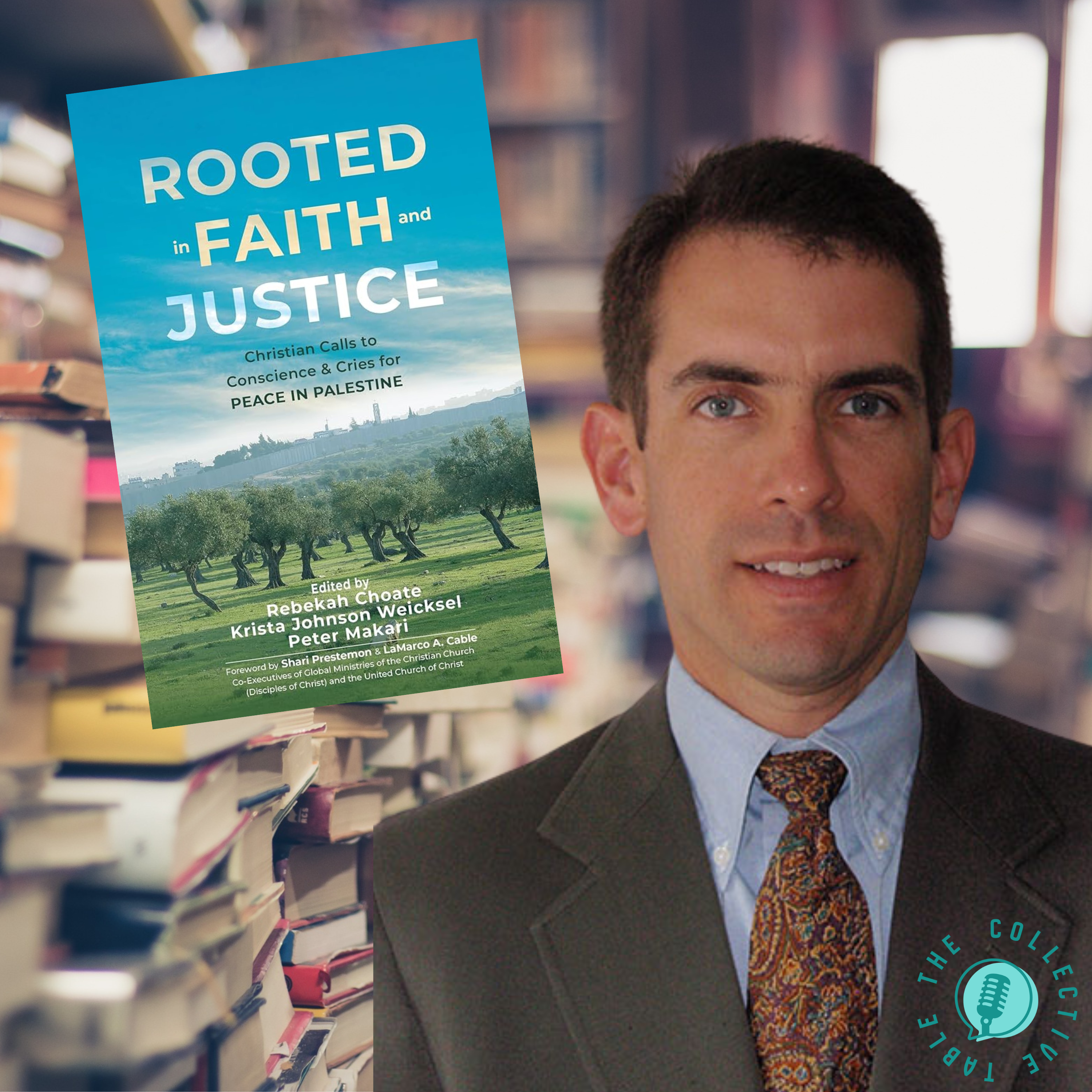
This special book club episode features a conversation with Peter Makari, co-editor of Rooted in Faith and Justice, about how Christian faith communities engage issues of Israel–Palestine, antisemitism, and human rights. Makari explains the long history of Christian denominations condemning antisemitism while still critiquing Israeli government policies, and he urges listeners to center the voices of Palestinian Christians in understanding the conflict. The discussion touches on misinformation in the West, the importance of decolonizing assumptions, and practical steps people of faith can take to support justice and peace. Guest Bio: Peter Makari is the Global Relations Minister for the Middle East and Europe with the Common Global Ministries Board of the United Church of Christ and the Christian Church (Disciples of Christ), a role he has held since 2000. He is deeply engaged in national interfaith and policy work, serving as co-convener of both the National Council of Churches’ Interreligious Convening Table and the Faith Forum for Middle East Policy, while also representing his denominations on the boards of Churches for Middle East Peace and the Shoulder to Shoulder Campaign. An Egyptian-American with extensive experience living and working in the Middle East, Peter previously served with the Coptic Evangelical Organization for Social Services in Cairo and the Middle East Council of Churches in Cyprus. He holds advanced degrees in Middle East studies and politics from the American University in Cairo and New York University. He is co-editor of Rooted in Faith and Justice and Restoring Dignity, and author of Conflict and Cooperation. He is a member of West Park United Church of Christ in Cleveland, Ohio. Learn More About Us: The Collective Table is a Ministry of The Oceanside Sanctuary Church in Oceanside, CA Follow us on Instagram
0:00Speaker AHey friends, Nico here. I'm so glad you're joining us for another edition of the Collective Table Podcast in our TCT Book Club series. If you've been following along, you know this is where we gather every month to read and discuss books that help us imagine a more inclusive, inspiring and grounded expression of Christian spirituality. Each conversation takes place live on Zoom with the author, and you're always invited to join in. If you'd like to be part of future book club sessions, connect with us on our online [email protected] There you can join the book club group, connect with other members, and hop into the live sessions right from our digital space. This month our host, Jason Coker, along with other book club members, sat down with Dr. Peter Makari, co author of Rooted in Faith and Christian Calls the Conscience and Cries for Peace in Palestine. They talk about how Christian faith communities can engage issues of Israel, Palestine, anti Semitism and human rights. Makari explains the long history of Christian denominations condemning anti Semitism while still critiquing Israeli government policies, and he urges listeners to center the voices of Palestinian Christians in understanding the conflict. The discussion touches on misinformation in the west, the importance of decolonizing assumptions, and practical steps people of faith can take to support justice and peace. So settle in and enjoy this thoughtful conversation between the TCT book club and Dr. Peter Makari right here on the Collective table.
1:27Speaker BSo welcome Peter Makari. He's asked that I not call him doctor so please don't think that I'm being disrespectful. But Peter Makari is the co author, as I believe you all know of, Rooted in Faith and Justice, Christian Calls to Conscience and Cries for Peace in Palestine. It's really co editor, along with Rebecca Coat. I'm not sure that I'm pronouncing that correctly. Choate thank you. Rebecca Choate and Krista Johnson Weaksal Weichsel Weitzel thank you. And so it's a collection of essays and some of you have noted that there are a lot of themes throughout these essays that are repeated, but on the whole gives a really broad introduction to issues of peace and justice in Palestine. And does it really, especially from a perspective that I think is is useful for us at the Oceanside Sanctuary as a congregation that's a part of the Disciples of Christ because the authors have overlap with the Disciples of Christ and the United Churches of Christ. And so Speaking of that, Dr. Peter Makari serves as Global Relations Minister for the Middle east and Europe with Global Ministries, a position he has held since 2000. He serves as a co convener of the National Council of Churches Inter Religious Convening Table and has participated in national Jewish Christian and Muslim Christian Dialogue initiatives. He represents the United Church of Christ and Disciples on the Faith Forum for Middle East Policy as a co convener and on the Board of Churches for Middle East Peace. An Egyptian American, Dr. Makari has lived in the Middle east, where he worked with the Coptic Evangelical Organization for Social Services in Cairo, Egypt, and the Middle East Council of Churches based in Cyprus. Welcome, Dr. Makari. We're excited to have you join us.
3:30Speaker CThank you so much. It's really good to be with you and I look forward to the conversation.
3:35Speaker BWe do too. I thought, if it's okay with you, that I would start with just a reading from the book itself. And actually I'd like to read something from your chapter which is on Anti Semitism comes from page 61. And I am at the age where I definitely need to put on my reading glasses, so this is the bit that really jumped out at me. It says this the declaration of the establishment of the State of Israel and Palestine in 1948 purported indeed in part to offer a place of refuge for European Jews fleeing persecution. There, European Jews joined small communities of Palestinian Jews who lived alongside the majority Palestinian Muslim and Christian community. Even so, Palestinians and others believe atonement for European antisemitism should not have come at the expense of Palestinians. Then you go on to add this, which I think is important. The practices and policies of the State of Israel vis a vis the Palestinian people have also drawn criticism from many corners of the globe and from many communities. Established in 1948 and adopting the Nation State Law in 2018, Israel defines itself as a Jewish state despite more than one fifth of its citizenry being non Jewish. Since the 1967 war, Israel has occupied and controlled a Palestinian population in East Jerusalem, the West bank and Gaza that does not have Israeli citizenship nor the associated rights, but lives under an Israeli military regime. Criticism of Israel's policies and practices is often characterized by Israeli officials and its defenders as anti Semitic because it is directed at the Jewish state and because they would say Israel is being held to a different standard than other countries in the world. I picked that bit from your chapter because it really, I think, rings true about one of the issues that comes up whenever I am discussing Israel Palestine with other clergy in particular. And so as a mainline Disciples of Christ's clergy person, I'm involved in relationships locally that are interfaith and ecumenical. And for a couple years, until recently, we organized the local clergy council here in North San Diego County. And in those relationships with my colleagues and friends who are rabbis in centers, the overwhelming sense that I get from them, even before, you know, the events of October 7th two years ago, even before that, the overwhelming sense I get from them is a general sense of sadness and real fear about rising antisemitism. And so I think your chapter was really important because it occurs to me that anti Semitism tends to be the wedge issue that divides people who might otherwise be very reasonable about the obviously destructive and unjust policies that Israel has towards Palestinians. But because of this fear of being anti Semitic or this fear of being perceived as anti Semitic, those conversations just tend to be non starters. Right. And so, and those complications I will share, they permeate interfaith and ecumenical clergy relationships to the point where it's hard to have these kinds of conversations even at that level. So I'm wondering if maybe just to start, and I know that this might be starting in the deep end a bit, but this just strikes me as like such an important issue at the heart of having any dialogue about this. I wonder if you might be willing to share a little bit of your own experiences about like maybe fruitful or productive ways of engaging in conversations across interfaith relationships and addressing this issue of antisemitism and being able to make a distinction between antisemitism and critique of Israeli policies. What has maybe given you some hope or what has worked? What have you observed that's been fruitful?
8:21Speaker CThank you so much. You're right. We are diving right into the deep end. I want to be clear first of all, in saying that the Christian Church, Disciples of Christ and many of the mainline Protestant churches in the US have been very clear in our denunciation of antisemitism in all its forms. And we are committed to, to inter religious dialogue, and that includes Jewish Christian dialogue. We participate in that at the national setting through the National Council of Churches and National Council of Synagogues. And we encourage the relationships that local churches have established over the years with neighboring synagogues to continue to nurture the those relationships and to have the hard conversations because it's really difficult to know that there is a big issue, an elephant in the room that you're kind of very careful about or avoiding in order not to disrupt a relationship in times like this. Like you said, global events do have impact on interreligious relations. And at times like this, it's especially sensitive when charges of antisemitism are introduced, there is a tendency to perhaps retreat a little bit and be a little more cautious about how we engage. And I think it's important to be sensitive in the ways that we engage. Absolutely. But we must be very open and clear in our denunciation of antisemitism, to speak out when we see it and to make sure that our Jewish friends are aware that we are friends. And we want to be present and accompany and walk in solidarity with them as they experience, you know, bigotry and hatred and, you know, rhetorical as well as physical violence, which certainly exists. And all of those things are realities. At the same time, we want to continue to assert that criticism of a government's policies are not the same as hatred of a people. And we can demonstrate that through our consistent critique of governmental policies. As churches, we are critical of US Policies and are engaged in advocacy with US Policies. Whether it's a Republican or a Democrat in the White House or whichever party is controlling Congress or. There are principles that we derive from our understanding of Scripture that uplift human dignity and the equality of all people. We work against poverty, we work against racism, we work for social justice in our own country and are critical of ways that our government does not advance those principles. Similarly, we're critical of governmental policies of countries around the world. When we see violations of rights and we see violations of human dignity that we become aware of oftentimes because of the partnerships that we have through the church through our missional relationships, those are ways that we have an access to perspectives on realities on the ground in different parts of the world that we may not be able to access through our traditional media. So those missional and church relationships are important for us. Through global ministries, the disciples have about 250 partners around the world in about 90 countries. So those are places that we have connections, we have ties to communities, and we have access to information and realities that may not be normally accessible through media. Part of that is our relationship with Middle Eastern Christians and including Palestinian Christians, who have been telling us for a long time that they are living under realities that are abhorrent and that our government has contributed to perpetuating. So when we're critical of Israeli policies and also critical of US Government policies that enable and perpetuate those policies in Israel toward the Palestinians, we are listening to our partners voices. And we also. We also are not engaging in acts or discourse of hatred toward a people. One thing we have noticed very clearly, especially in these last two years, is that there's a variety of opinion regarding Israel and its policies within the Jewish community. So when we look at encampments on college campuses, we see not only Palestinian Americans, Palestinian students in the US but we also see American Jews who are engaged in those demonstrations. That's just a visible illustration of the kinds of engagement and diversity of opinion within the Jewish community that exists. I am, I know from my own encounters with Jewish friends that there's a diversity of opinion on Israeli policies. So, you know, it's, I would say, also anti Semitic to generalize about Jewish opinion. And so in order to sort of respond to the charge of anti Semitism, I think it's just important for us to insist that criticism of a government's policy is not the same as hatred of a people. And we abhor any ideology or theology that excludes or, you know, results in hateful attitudes toward any particular person or community. So it's a tough question, but at the same time, I think we need to be very clear that in our criticisms of government policies, we're consistent in terms of our engagement with of US Policy as well as governments around the world. And also that we recognize that some criticism of Israel could be motivated by anti Semitism. But that isn't where we are coming from. So as a church, our engagement is for peace and justice for all the people there, including the Jews, Muslims and Christians. And we want to be able to accompany those who are engaged in nonviolent resistance to oppressive policies and also to lift up their voices, but also to engage in advocacy with our governments, with our government, U.S. government that has perpetuated, has allowed to perpetuate policies that are harmful to the community that we have a close relationship with on the ground there.
17:17Speaker DHello, Collective Table listeners. It's CJ again. A lot of people out there might not realize that this podcast is part of a real life faith community. The Collective Table podcast is a production of the Oceanside Sanctuary, a progressive Christian community whose mission is to foster collective expressions of inclusive, inspiring and impactful Christian spirituality wherever it is needed. And as a 501c3 nonprofit organization, that mission is only possible because of the generosity of people just like you. So if you believe in what we are doing, if you benefit from this mission, please Visit [email protected] Give to Become a Supporter today. Together, we can keep building communities of love and liberation.
18:15Speaker BSo we thank you for that response and also for emphasizing how institutions like the Disciples of Christ and the United Church of Christ have have been explicit in their denunciation of anti Semitism. I think that's very, very important to restate and to remember. Before we continue, I just want to invite those who are on here, Denise, Caroline, John, and Leanne. If you want to jump in with a question, please feel free to type in the comments. Just, you don't have to like type out a whole question, but just type in, hey, I have a question about this. And then I'll be watchful for that and I'll call on you as you pop into the chat. And in the meantime, I'll just continue to facilitate the conversation. And so while you're thinking about what questions you might have for Peter, I'll just jump into the next question, which in all fairness to Peter, I did not send him in advance. But it is just this we're wondering how did you get engaged in this kind of work to begin with? Like, how does your story intersect with these issues? What's, what's driving your passion for this?
19:28Speaker CSure. Thank you. Well, you know, you alluded to that in presenting my bio. I have roots in the region. My father is Egyptian. He's a Presbyterian minister, ordained in the Presbyterian Church of Egypt and came to the US after completing a seminary degree in Cairo and continued seminary studies here in the US and married my mother, who is who was an Indianan. So I have mixed heritage, Egyptian and Indianan.
20:09Speaker BOkay.
20:10Speaker CSo I'm connected to both places and so have roots in the Middle east, in the Christian community in the Middle East. So it's personal for me in a way. I also have done academic study. My master's was in Middle east studies and my doctoral degree was in Middle east politics, political science and Middle east studies. And also my own formation, growing up as a pastor's kid and experiencing discernment of call to work in the church. And a big part of that was living and working in the Middle east with the Christian communities there. And you also highlighted that in the introduction. So it's personal for me, but it's also academic and also professional. I mean, my career has been working with the churches of the region and also in in our churches here. So it's a multi faceted sense of calling. It's a passion and I see it as life work. So learning about the realities of Christians in the region and Christian churches and their presence and engagement in their societies, all of that has been incredibly informative and formative for me. And I hope that I can be a bridge between the places that I have roots in and interpret one to the other both ways, really, because I have the privilege of representing the disciples and the UCC in the region with our partners. So it's an opportunity for me to make connections and to interpret both places to the other.
22:18Speaker BWell, if you don't mind, perhaps we could put some of that academic study to good use here. In our conversation tonight. I just wanted to ask, how have you found it helpful for Christians to have a better historical and political understanding of the context of that region? And you know, perhaps for laymen and lay women here on the chat, like, how have you been able to help people understand the complexities of the context of the relationship between Palestinians and Israelis, the establishment of Israel? What have you found is helpful for people understanding what's really going on here?
23:01Speaker CCertainly in a church setting, it's been especially important to lift up the Middle Eastern Christian presence and voice and for our members in the disciples in UCC to have exposure to voices from the region. And you know, I think our media overgeneralizes, you know, in a pejorative way, the people of the region. There is studies, there are studies to show anti Islam bias and anti Arab bias, not just in news, but also in portrayal of Arabs in TV and movies, you know, sort of general cultural bias about Middle Easterners. So I think it's especially important for people in our churches to have access to voices that debunk those kinds of portrayals of Middle Easterners. The idea, for example, that Israel, Palestine is a millennia long conflict that never can be resolved because it's based in absolute religious terms that set up conflict between Jews and Muslims, you know, that's kind of a simplification of a portrayal of the region. But that framing is unfair for many reasons. But part of it is because it marginalizes and eliminates the Christian presence from the picture. So we don't necessarily even know about the presence of Christians in the Middle East. I remember when I was young hearing my dad speak in a local church once about the situation in the Middle east and sharing the question he would get as a Middle Eastern Christian, when did you convert to Christianity? And the tongue in cheek response is 2000 years ago. Christianity started there, don't forget it. And the Christian community has deep roots there and are proud of that rootedness. And that's part of the reason we chose the title of the book the Way We Did. But also the numerically small presence of Christians in the Middle east doesn't negate their historical presence as well as their current engagement in their societies. It's surprising, I think, for some to learn that Christian institutions in Palestine, schools, hospitals, community development organizations, social service organizations, those Are the things third largest employer of people in Palestine after the Palestinian Authority, the government, and then second, the United Nations. Third, are the Christian institutions. Even though Christians make up about a little less than 1% of the overall population, their institutions have that significant impact. So just to sort of understand the extent of the witness of Christians in the Middle east, in their societies, despite being a numerical minority, but also rejecting the idea of being categorized as a minority, they don't see themselves as less than anyone else and they see themselves as part and parcel of the fabric of Middle Eastern society. So how can we tap into those relationships that we have through the church to understand the realities on the ground differently? You know, the idea that this is a religious conflict rooted in absolute claims that cannot ever be resolved also is a framing that takes us away from an understanding of political and economic and social rights as well as human rights that are being violated, but issues that can be actually addressed through following international law, for example, and principles of human rights and human dignity. These are aspects of the reality on the ground that I think are shaded or covered up by a simplistic framing of the conflict as a religious one that is only about absolute claims. So maybe those are two aspects that are helpful for members in our churches to grapple with and to, you know, engage this issue perhaps differently than we've thought about it before.
28:54Speaker BI really appreciate you bringing up that issue of sort of religious framing and characterizing this conflict as a kind of inevitable conflict that's in God's hands. I think the thing that we often hear in certain kinds of churches, both evangelical and mainline, this is certainly not, you know, endemic to just one, you know, type of Christianity, but narratives like, oh, this conflict is just a perpetuation of like, the tension between Isaac and Ishmael. Right. Like it's sort of meant to be in some God ordained way, or the idea that, you know, this land is the land that was promised, you know, the promised land for the defend the descendants of Abraham and, you know, God's ordained this. And, and that's a narrative, of course, that, that even political parties in Israel make a lot of hay out of. And, and I'm wondering when Christians bring those, those very simplistic objections to you, what have you found are the best ways to diffuse that?
30:06Speaker CYeah, another good. Big question.
30:11Speaker BWe only have big questions here, Peter.