
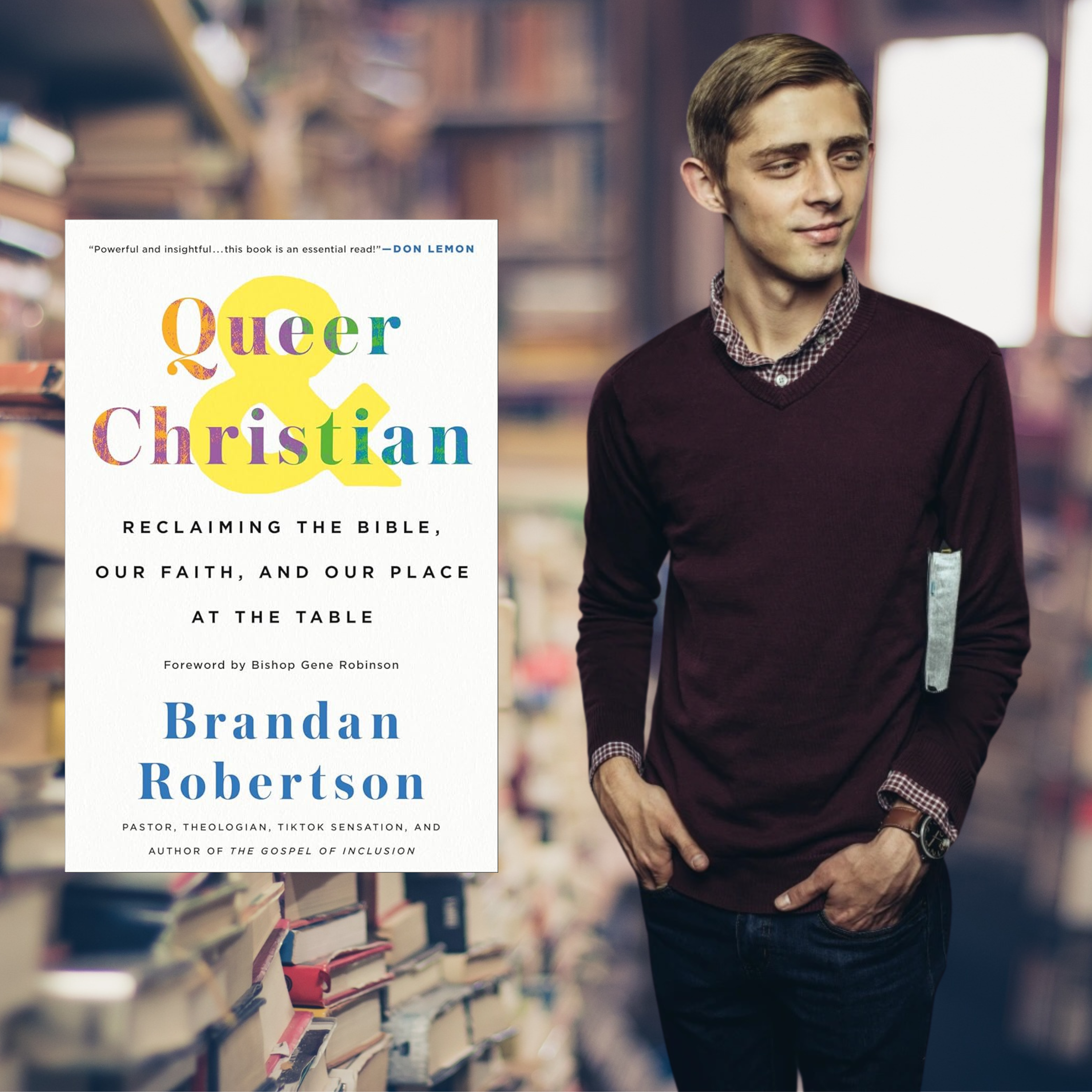
The Collective Table · The Collective Table
Join the TCT Book Club for a live, insightful conversation with Reverend Brandon Robertson—acclaimed author, activist, public theologian, and the "TikTok Pastor." In this episode, we dive deep into Brandon's book, Queer and Christian, exploring how to celebrate queer faith, reclaim the Bible as a dynamic conversation partner, and fully embrace Jesus's radical message of unconditional inclusion. Brandon shares his personal journey from a fundamentalist background at Moody Bible Institute to becoming a progressive champion for LGBTQ+ rights. The group discusses the inherently transgressive nature of Jesus's ministry, the importance of reading scripture through liberationist and queer lenses, and how to shift from fear-based religious boundaries to value-centered, harm-reducing ethics. The episode concludes with a live Q&A with our book club members, tackling tough questions about staying in conservative spaces, navigating relationships with non-affirming loved ones, and reimagining historical assumptions about Jesus. Links & Resources: Find and join our next book club session: oceansidesanctuary.org/calendar Support our mission: The Collective Table is a production of the Oceanside Sanctuary. To help us keep building communities of love and liberation, please consider becoming a supporter at oceansidesanctuary.org/give.
0:00Speaker AHey, friends. Nico here. I'm so glad you're joining us for another edition of the Collective Table podcast and our TCT Book Club series. If you've been following along, you know this is where we gather every month to read and discuss books that help us imagine a more inclusive, inspiring, and grounded expression of Christian spirituality. Each conversation takes place live on Zoom with the author, and you're always invited to join in. If you'd like to be part of future book club sessions, find the next session on our website [email protected] calendar to sign up this month, our host, Jason Coker, along with other book club members, sat down with Reverend Brandon Robertson, the acclaimed author, activist, public theologian, and author of Queer and Christian. They discuss how to celebrate queer faith, reclaim the Bible, and fully embrace Jesus's radical message of unconditional inclusion. So settle in and enjoy this thoughtful conversation between the TCT Book Club and Reverend Brandon Robertson right here on the Collective table.
1:03Speaker BForeign
1:06Speaker Cit's my pleasure to formally welcome Brandon Robertson to our book club Collective Table podcast. Here Reverend Brandon Robertson is. This is his. His formal bio, by the way, is an author, activist, and theologian known as the TikTok Pastor. He hosts the Faith for the Rest of Us podcast and has authored or contributed to 26 books, including the Indies Book of the Year finalist, True Inclusion. His work appears in Time, the Huffington Post, and the Washington Post. Named in Rolling Stone's 2021 hot list. He speaks at venues like the White House and Oxford University and is a champion for LGBTQ rights. He's pursuing a PhD in biblical studies at Drew University. You still working on that, Brandon?
1:55Speaker BStill working on it.
1:56Speaker COkay, fantastic. In addition to the formal bio, I'll just add that it doesn't say here on the bio that Bre and actually pastored here in San Diego county for a few years down at Mission Gathering Christian Church, and it was a pleasure to have him here in District 8 with the disciples of Christ. And I've had Brandon on other podcasts and Zoom calls before, so I always appreciate his willingness to jump in and have a conversation with us and really grateful for his work. Welcome, Brandon. We're really glad to have you.
2:31Speaker BYeah, thank you so much again. And I've loved and admired the work of your community for a long time. So it's always a joy to get to be back with you all.
2:38Speaker COh, my gosh, that's so nice of you to say. We can end the call right now. I feel great, obviously. Just kidding. So I'd love to read this Excerpt from Queer and Christian if I could. It feels to me, Brandon, a little bit like Queer and Christian is the culmination and maybe even like clarification of a lot of the work that you did before this, a lot of the writing that you did before. And so I really appreciate that. It really felt like you pulled together a lot of threads in a way that is just really powerfully stated. And so I love this passage. If I could read just for the rest of us. You write, to be queer is holy. It affirms that God doesn't make mistakes, that our unique expression reflects divine creativity, creativity. It refuses to blaspheme our Creator by trying to limit or suppress the image of God within us. In this broad sense, queerness is a calling every person should embrace. As Paul wrote, do not be conformed to this world, but be transformed by the renewing of your mind. Romans 12:2. To be queer is to see beyond the masks and roles that hide our light. Bell hooks defines queerness as, quote, being at odds with everything around it, and that feels right. We live in a world built by systems designed to benefit a few. What's accepted as normal has always been constructed and can be changed today. As awareness of diversity grows, more people recognize that demonizing difference harms us all. Movements of resistance have queered our societies for the common good by questioning and challenging these false normals. And I love, of course, that you took the opportunity to quote bell hooks. I think she is incredible, integral to this conversation. But I also love, like, how bold you are in saying we should all aspire to be queer, in a sense. And right after this, I don't read this. Didn't read this part today, but right after this, I think it's right after, maybe right before, you talked about how queer was originally a slur. And so I wonder if you could speak a little bit to that. Like, how did you go from, you know, being a closeted gay man at Moody Bible College, of all places, and then coming to terms with your own sexuality, your own queerness? And then how did that transition happen where you appropriated queer as a point of pride?
5:24Speaker BThank you so much. And, yeah, I mean, I think one of the things I've seen, not just with this book, but since I've been doing this work, is I think I say this in the book, but one of the first times I used queer publicly, I was speaking in rural England, and when I said the word queer out loud, there were audible gasps in the audience. And as I've done this work now for a while, I've recognized that there's a real generational divide, primarily about the word queer. Bishop Gene Robinson talks about it in the opening of the book as well, that for a particular generation, queer was a slur word, and it was primarily a word folks didn't want to be associated with. But at the same time, even back in the 50s, 60s, and 70s, there were folks using the word queer not primarily as a sexual description, sexuality description, but as a political ideology that kind of aligns with what I quote bell hooks as saying, this posture of resistance to norms. And so, you know, it took me a long time to want to come to terms with the word gay on my own journey. I certainly didn't use that word until a few years after I had left Moody Bible Institute. But really, those four years at Moody were formative for me because it allowed me to both have a space to go deeply into the Bible and wrestle with what the scholarship actually says. Because the truth is, even on the conservative side of this conversation, there's an admission that things are not as clear in Scripture as folks make it sound. So that started raising questions for me. And of course, I was also in downtown Chicago, which I always say, Moody has a really bad setup for a fundamentalist school, in the sense that if you put a fundamentalist school in the middle of one of the biggest cities in the country, as soon as students walk off the campus, they're confronted with things that challenge the theology they're being taught within the four walls of the institution. And so I kept finding God in Chicago in all the places my theology said God wasn't supposed to be. And so that started a whole another deconstruction process, apart from my own wrestling with sexuality. And I had a very similar journey to a lot of folks. When I initially came out, I used bisexuality, which I recognize now is not. I think it's a very easy way to kind of erase real bi people by queer people using bisexuality as a stepping stone towards coming out. But that was what happened on my journey. And then before I came to the word gay, I actually started really resonating with the word queer. And the reason is because queer feels like a better descriptor for me. It encapsulates my gay sexuality, but it also encapsulates my spiritual posture and my political posture, that of wanting to challenge and question norms. One of the subtexts of this book is a questioning of this idea of orthodoxy. For instance, even progressives tend to see orthodoxy as something that we don't want to touch too much we don't want to mess with it too much, but orthodoxy itself is a system set up by human beings who gathered in councils and debated and decided, sometimes by vote, what the doctrine of Christianity would be. And I think Jesus's posture in his own religious tradition was one of constantly questioning, constantly pushing against the norms and traditions. And to me, that's what queerness is. And so in this book, I hope, one, I empower a generation of people that do resonate with the word queer as a sexual or gender identity label to see that as compatible with Christianity. But as you said earlier, I also want to invite non LGBT people to see queering as a posture that is fundamental to the Christian faith and is fundamental to who Jesus was and how he did his ministry in the world.
9:32Speaker CYeah, I appreciate that perspective. It's important, I think, for us to remember that what the Holy Spirit is doing, for example, in the Book of Acts, is transgressive. And so coming to terms with how God is the one who is constantly pushing our boundaries, stretching our comfort zone, helps us, I think, to be a little bit more open, open to the possibilities what the Spirit of God is doing. And I think you appropriating or naming the appropriation of the term queer is really helpful to that. We have a. A group, all the people on the call here will know this, but we have a team, a ministry team here at the church that's made up of LGBTQ persons and allies. And several years ago, when that team first started, I want to say about seven years ago, I said, hey, you guys should come up with a mission statement and a name. You should call yourself something. And much to my surprise, they came up with the term Queer Committee. And I thought, okay, sounds good. We'll call it the Queer Committee. But what's interesting is over the years, a lot of people have come to that group and said, hey, I really love this. I want to be a part of this, but, boy, I'm a little older. And that term still feels uncomfortable. And, you know, to their credit, they, you know, have been gracious and open minded about it, but it's still something that we see even in our congregation, that you can see the woundedness that sometimes older LGBTQ people carry with them when they. When they hear that term. I also really appreciate it, Brandon, that you brought up the issue of biblical interpretation and how even conservative scholars, or at least conservative scholars who are intellectually honest, I would say, are willing to admit that the Bible and how it speaks to issues that are adjacent to or relevant to LGBTQ issues isn't as clear as perhaps they wish it was, or we have pretended that it is. And so I wanted to ask you a question about that. Just given how the Bible has been used so pervasively as a weapon against the queer community and has been used to incite bigotry and hatred and even violence against LGBTQ people, how do you think progressive churches or liberationist oriented churches like ours can sort of toe that line between confronting those harms and those interpretations on the one hand, but on the other hand, still upholding that Scripture is sacred to our tradition? That's a tension we. We really feel in a church like ours. You know, kind of like going back to that old restorationist movement slogan, no creed but Christ, no book but the Bible, no law but love. We have that no book but the Bible part in the middle, and that still feels uncomfortable at times because we're constantly critiquing that book. So I wonder, what's your insight into how a church like ours or other churches like ours could best lean into that tension?
12:41Speaker BTotally, yeah. I mean, this is one of the other subtexts that I weave throughout the book. When I was writing this, I was actually not thinking of queer Christians. I wasn't even thinking of Christians at all. I was thinking of the queer people that I meet here in New York City that have nothing to do with religion, but come from a Christian background and have a posture of why would we even care about what the Bible says? It's a 4,000 year old book from the Bronze Age. Let's leave it behind. And I get that impulse. And I see that in a lot of progressive Christians. There's stuff in the Bible that we can't reinterpret or explain away. It's just bad stuff. And yet the first reason I think it's so essential for us to not give up the Bible and in fact to deepen our engagement with it is political and social. The Bible is still the most powerful book in the world, and it will be for the rest of all of our lives and for generations to come. Billions of people around the world look at the Bible as a source of authority. Millions of lawmakers and public officials use the Bible, not just in the United States, but in countries all around the world as justification for laws. I think back to the Uganda anti Gay bill, that was a few years ago, quotes Leviticus in its legislation which calls for the death penalty for homosexuality. So the Bible is deeply influential, even if it moves from its central place of authority in our own spiritual lives. It still is influential. And it's important that we know how to engage with it in a robust, in a scholarly, in a progressive way that reclaims it. Because when we simply say, screw the Bible, we're conceding the most powerful book in the world to the hands of those who are using it to do a great deal of harm. The other thing is, I've also learned that we have this image of conservative or traditional Christians as being deeply biblical. But in the past 10 years, and especially in my PhD studies in biblical Studies, I've recognized how biblically illiterate I was as a conservative Christian and how much conservative Christian preaching is actually biblically illiterate. It's taking passages of the Bible and using them devotionally, but not from a rigorous scholarly or theological lens. They're not doing the work to know what the text actually meant to its original audiences. They're not studying the culture, context, and language of the Bible. And I think when you begin to do that, the Bible becomes an actually pretty fun book to engage with. I've been so influenced here in New York City. I go to a queer Jewish synagogue called Lab Shul. Oh, I love that.
15:30Speaker AYeah.
15:31Speaker BAnd it's been so incredible to watch how Jewish folks engage with Scripture. And pretty much across Jewish traditions, they've always had this dynamic relationship with the Bible where it is not the inerrant word of God, but something with which we argue it is the library of texts from our ancestors and forerunners in the faith that has great wisdom but also has a multitude of interpretations. And if you look at a book like the Talmud, which is like, second only to the Bible in Jewish Scripture, it's a book where rabbis debated every verse of the Bible, had 14 different interpretations of every little jot and tittle of Scripture, and. And never said one was right or one was wrong, but left the tension with the multitude of interpretations. If Christians were given permission to wrestle with the Bible not as the final authority, but as a conversation partner, where we respect it as wisdom from our forerunners in the faith, but also recognize that the Spirit of God is still speaking, that frees us to engage the Bible dynamically to reclaim the wisdom where it is helpful, but also to say this word was good for the time that it was given, what is the Spirit speaking to us today? And the last thing I'll say here is that this is actually what all Christians already do, even conservative Christians, although many of them are reverting to terribly racist theology. A vast majority of evangelicals were influenced by the abolitionist movement, which said yes, Paul says, slaves, obey your masters, but we don't think that that's ethical or moral. We don't think that's where the spirit of God is calling us. We think Jesus's example surpasses that command from Paul. And abolitionists evolved their theology, interpretation of scripture to move beyond the clear meaning of what Paul says, to embrace a more robust, I would say, progressive, liberating theology. We all do that. Christians have always done that. And progressives just need to get better at owning that we are biblical, we care about the Bible, but that the Bible is our conversation partner rather than the final word on all matters of faith and ethics, because it simply can't be as a 35 year, 3500 year old book.
18:01Speaker CYeah, I just so appreciate you unpacking all of that. And people who are part of our church, I'm sure, will recognize a lot of what you said and what I'm constantly saying here about having a discourse and a dialogue and even a debate with scripture and that it teaches us how to do that so that we can do that with our. With. With our own culture, with our own laws, with our own community of faith. And so I really appreciate that perspective. It. It occurs to me that, like you said, Christians already do this, and I think that's true. I think that what oftentimes fundamentalists or authoritarian Christians do is they outsource the emotional labor of that conflict to their pastor or their priest or, you know, the head of their denomination or whoever it might be, so that they're relieved of the. The, again, the emotional labor, the tension of having to decide, like the. The responsibility of freedom, having to decide, where do I stand? And now, like, how do I make a case for where I stand? Like, that sounds like a lot of work. And it's also potentially a lot of conflicts, right? Both with yourself and with others in your community or with our spiritual ancestors who we might disagree with. And I. And I think, like, my sense is that we just don't like that. Like, we don't. That tension. And that labor. And this, I think, is relevant to what you write about and also who you are, because I think LGBTQ Christians know that emotional labor really well, because as they read Scripture and as they encounter things that feel like condemnation to them or they encounter passages that were used, weaponized against them, they're doing that very real work, that very real labor of having to work through it. And the rest of us often don't have to do that. Right? Like, I don't have to do that. The the way that the Bible has been interpreted and the way, you know, Western Christianity has been constructed is literally for people like me. And so I'm off the hook in a lot of ways. And so I'm wondering. I'm working up to another question here. So I'm sorry it's taken so long, but I'm wondering how you have seen churches who embrace that, Embrace that discourse, that dialogue, that debate with scripture around these kinds of issues. How you've seen them, like, make that emotional labor a little bit safer, a little bit easier to enter into without it feeling like this incredibly dangerous or incredibly fraught enterprise. How have you seen churches equip people or maybe create spaces where it's safer to do that vulnerable work? Does that question make sense?
20:57Speaker BYeah, I mean, I think the answer to that question is what you're already doing in many ways. But I want to reflect on some of what you said in the lead up to that is I'm writing a book right now on how to heal from toxic high control religion. And it goes right to what you were saying, that I have a lot more empathy now on this side of my deconstruction for conservative Christians, because like you said, so many of us live such chaotic lives in such a chaotic world that it is really nice to go to a church where a guy in the front tells you this is the way it is. And you don't have to think, you don't have to, you just obey. And it's not even to belittle them. Like, I think many of us, if we came from conservative backgrounds, were there at some point in our lives. It's also why I think progressive churches, progressive megachurches, don't really exist. Because when we enter into this posture of Christianity, we're committing to discomfort, we're committing to not knowing, we're committing to having to wrestle and debate and be unsettled in our faith. And it's also very interesting that I see from some of the most liberal atheistic LGBT people, I'm always surprised when I get comments on my videos and things like that. And they say the same thing conservatives say to me, you're just misinterpreting the Bible. You're twisting it to fit your own desires. Like, that's not what the Bible says. Which goes back kind of to the last question in the sense that the conservatives have done a really good job of convincing everyone that their interpretation and way of engaging with the Bible is the way of engaging with the Bible. And, and anybody who's doing it differently is twisting it, reading into it, changing it. You even see this from folks like Richard Dawkins, who constantly critiques Christianity. But most of us would agree on this call the Christianity he's critiquing. We don't believe in either. But he doesn't want to acknowledge that there's a richer, deeper tradition, other ways of seeing Christianity. So all of that is to say, I think progressive communities need to have grace for the folks that come through our doors, that are leaving or escaping conservative religion, or have that in their background. Because a lot of folks are going to be triggered when they see us doing open interpretation or wrestling with the text, even if they don't believe that the Bible is the word of God, because of how they've been taught to view this text and engage with it. But at the same time, part of what I do in this book is something that 10 years ago would have made me roll my eyes so hard. I have that whole section of scripture where I, I look at or of this book where I look at the queer saints of Scripture. What that the purpose of that is to introduce queer biblical interpretation, which is in the same lineage of black liberation theology, feminist interpretation, womanist interpretation. All of that is how we've Christians have always, again, engaged the text. You begin with the lens that you have in your incarnate experience and have permission to read the Bible from your experience and see what uniquely pops out to you. Progressive church is my hope. I don't think we actually do this very well at saying to the diverse people in our communities, your lens is a source of authority, your experience is valid. And when you read scripture as a woman, or you read the scripture as a trans person, or you read the scripture as a person of color, the stories are going to have different meanings and different lessons. And when we empower people to have that authority and to know that their own life experience and lens is a valid authority, that's when the Bible becomes a living text in our communities and become enriched because you're challenged by what your black neighbor in the pew sees in the text and what your queer neighbor in the pew sees in the text that are fundamentally different, looking at the same stories, but both have a valid lesson for us. And so it's about making that space, giving people the authority back to engage the text from their own incarnated experience, while also having grace, knowing that even progressive people, even LGBT people, have assumptions about the Bible that are going to continually trip them up for a while until they get comfortable reinterpreting what the Bible Fundamentally, is.
25:32Speaker CYeah, well, and I really appreciate that you reference liberationist theologians, womanist theologians, feminist theologians, because that's where, you know, so much generative work has been done theologically to open up Scripture to those perspectives. And, of course, those. I think one of the things that's most powerful, especially about womanist writers, is that what they're doing is midrash, which, of course, we learn from the Jewish community and from the Jewish tradition. And when we're exposed to that. I know that in my case, like, when I was first exposed to Jewish midrash and then womanist midrash, like, I was shocked to discover just how incredibly creative and expansive readings of Scripture can be. However, like, the flip side of that is that also can play right into the accusations of fundamentalists, you know, who would say, no, you're not allowed to interpret Scripture that way. You're not allowed to read it that way. And so I wonder, like, for you, what is the. This is not a question I sent you in advance, so I apologize. But for you, in that sort of, like, tension between more rigid interpreters and more. I mean, I hate to use this word, but more liberal interpreters. Right. More of, you know, read between the lines. Midrash, expansive approach to Scripture versus a very constraining approach to Scripture. In that tension, what do you think validates or. Or confirms what are good interpretations and applications? Like, how. How do we. How do we validate what we believe it might say or speak to us, even from our lived experience?