
The Cogitating Ceviché Podcast · Conrad T Hannon
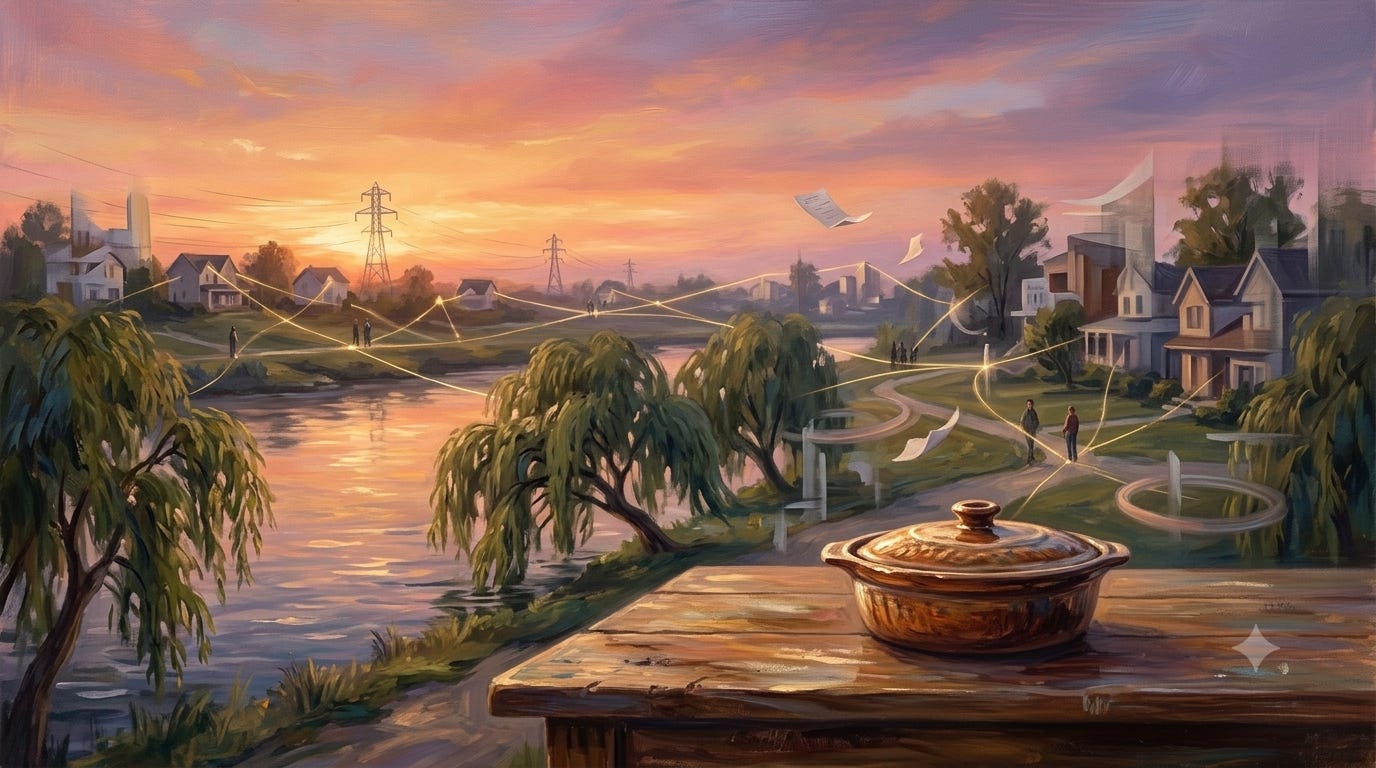
The Cogitating Ceviché Week in Review 26-29 Discussion via NotebookLM Editorial Summary This week considers the structures—visible and hidden—that govern how people care, work, decide, calculate, and endure. Calista F. Freiheit begins beneath an ordinary casserole dish, where a handwritten name becomes evidence of mercy made practical. Conrad T. Hannon looks upward and outward, first asking whether the electric grid might support national scientific computation and later watching an institution search everywhere except within itself for the courage to decide. Mauve Sanger examines the college degree as a form of employer protection, retained even after its official requirement disappears. Gio Marron turns to two classics in which danger takes very different forms: the alien presence moving through Algernon Blackwood’s willows and the disciplined strategy of Miyamoto Musashi. Across the week, the same question returns: What happens when a tool, credential, system, or habit stops serving its stated purpose—and what might restore it? Articles The Name on the Casserole Dish July 20, 2026 | Calista F. Freiheit A name written beneath a borrowed dish opens into a reflection on hospitality, stewardship, and the quiet networks that carry people through illness, grief, birth, exhaustion, and loss. Calista argues that mercy becomes useful through attention: the right meal, the manageable delivery, the respected boundary, and the organized community that notices those informal circles overlook. Could the Electric Grid Become a National Scientific Computer? July 21, 2026 | Conrad T. Hannon Conrad offers engineers, economists, regulators, and researchers a proposal meant to be tested rather than admired. Could the scale, reach, sensing capacity, and coordinated machinery of the electric grid support a new form of national scientific computation? The question invites technical criticism as seriously as construction. The Degree as an Insurance Policy July 22, 2026 | Mauve Sanger Employers increasingly announce that a college degree is no longer required, yet the credential often continues to shape who receives an interview or offer. Mauve examines the degree as a risk-management device: a familiar signal that allows institutions to claim openness while preserving old hiring habits. The Willows July 22, 2026 | Gio MarronBy Algernon Blackwood Two travelers enter a lonely stretch of the Danube where the natural world seems to possess an intelligence both immense and indifferent. Blackwood’s tale turns wind, water, sand, and willow into agents of unease, making the landscape itself more frightening than any visible monster. The Committee That Went Looking for a Spine July 24, 2026 | Conrad T. Hannon A decision enters an institution and emerges as a working group, a consultation process, a preliminary report, and perhaps a file bearing someone’s name. Conrad examines the language and procedures through which responsibility is distributed so widely that no one need...
0:00SPEAKER_00So imagine if like the electrical wire running
0:02SPEAKER_00into your house right now wasn't just bringing you power to keep your lights on.
0:05SPEAKER_01Okay.
0:05SPEAKER_00But what if it was secretly helping to cure disease or, you know, simulate climate change?
0:11SPEAKER_01Wow, that's quite a thought.
0:12SPEAKER_00Right.
0:13SPEAKER_00Or on a completely different scale,
0:15SPEAKER_00imagine if that faded permanent marker scribbled on the bottom of
0:18SPEAKER_00a borrowed Pyrex dish was actually like this piece
0:21SPEAKER_00of advanced social infrastructure.
0:23SPEAKER_01I mean, it really sounds like we are jumping between two entirely different universes today.
0:27SPEAKER_00We really are.
0:28SPEAKER_00But honestly, that is the magic of today's deep dive.
0:31SPEAKER_00Right.
0:32SPEAKER_00Right.