
The Clerisy · Loren Moss
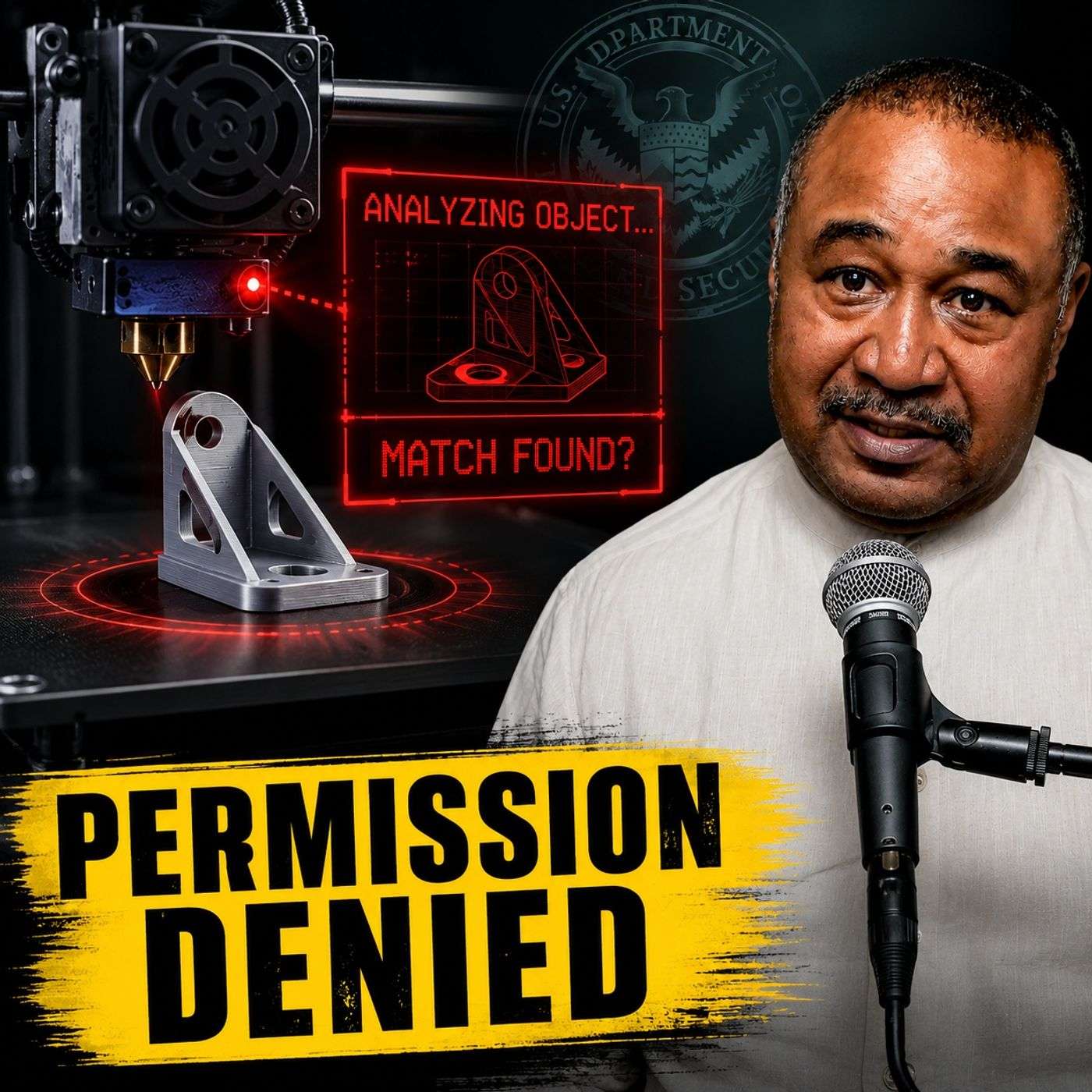
What happens when the government decides what you’re allowed to make in your own home? California’s AB 2047 would require 3D printers to screen designs before they can be printed. Supporters say it’s about guns. Critics say it could create something much bigger: a system that can inspect, block, and potentially monitor what you create. Follow me on social media Facebook: facebook.com/profile.php?id=61584036371719 LinkedIn: linkedin.com/company/epluribusunum/ Instagram: instagram.com/epluribusunum.vip/ SOURCES & CITATIONS AB 2047 — California Legislative Information: https://leginfo.legislature.ca.gov/faces/billNavClient.xhtml?bill_id=202520260AB2047 CalMatters Digital Democracy — AB 2047: https://calmatters.digitaldemocracy.org/bills/ca_202520260ab2047 NRA-ILA — California anti-Second Amendment bills: https://www.nraila.org/articles/20260814/california-anti-second-amendment-bills-advance-from-appropriations-committees California Senate Public Safety Committee — AB 2047 Analysis: https://spsf.senate.ca.gov/system/files/2026-06/ab-2047-analysis.pdf Skinner v. Railway Labor Executives’ Assn.: https://supreme.justia.com/cases/federal/us/489/602/ Governing — Hollywood Challenges California’s Ghost Gun Proposal: https://www.governing.com/policy/hollywood-challenges-californias-ghost-gun-proposal ATF — 3D-Printed “Glock Switches” and “Auto-Sears”: https://www.atf.gov/news/press-releases/trafficker-3d-printed-%E2%80%9Cglock-switches%E2%80%9D-and-%E2%80%9Cauto-sears%E2%80%9D-sentenced-over-seven-years-federal DOJ — Machinegun Conversion Devices Fact Sheet: https://www.justice.gov/usao-wdok/media/1366621/dl?inline= Everytown — New York Shuts Down the Plastic Pipeline: https://www.everytown.org/press/new-york-shuts-down-the-plastic-pipeline-governor-hochul-and-lawmakers-pass-nation-leading-measures-to-stop-the-spread-of-diy-machine-guns-and-3d-printed-firearms-in-fy27-budget/ Michael Weinberg — 3D Printers Cannot Effectively Screen for Gun Parts: https://michaelweinberg.org/blog/2026/02/04/3d-printer-gun-screen/ PBS NewsHour / Associated Press — New York 3D Printer Law: https://www.pbs.org/newshour/nation/first-of-its-kind-law-in-new-york-could-block-3d-printers-from-making-guns EFF — The Dangers of California’s Legislation to Censor 3D Printing: https://www.eff.org/deeplinks/2026/04/dangers-californias-legislation-censor-3d-printing EFF — We Can Still Stop California’s 3D Printer Surveillance Scheme: https://www.eff.org/deeplinks/2026/06/we-can-still-stop-californias-3d-printer-surveillance-scheme Louis Rossmann — False-Positive Gallery: https://www.youtube.com/watch?v=E1B2cWEaWDw Physna: https://www.physna.com/ Physna & Palantir Strategic Partnership: https://www.einpresswire.com/article/766612379/physna-and-palantir-announce-strategic-partnership-to-revolutionize-3d-data-analysis-for-defense-and-commercial-sectors Reclaim The Net — California’s 3D Printer Surveillance Proposal:...
Picture yourself in your own garage at 11 at night, printing a little mount to hold a flash on top of your camera. You've got a 3D printer. These are like really cool, nifty things. I don't have one, but I've seen them in action. And you can go and anybody can buy one off of Amazon or order one or go to the tech store and get one. But you're printing this little flash mount device that you've created or innovated and drawn up the plans for. To put on top of your camera. So it's a plastic bracket. With a slot and a screw hole. And you drew it up yourself. And your printer. Your 3D printer. Refuses to make it. Because an algorithm somewhere. Decides that your camera bracket. Looks like a machine gun conversion device. Which is the class. Or a part that the ATF. Alcohol, tobacco and firearms. The Bureau of Alcohol, Tobacco and Firearms. Is chasing hardest right now. On a rifle. It's called an auto sear. On a pistol, it's a little slide plate lever that on the street they call a Glock switch, even though Glock, the company, has nothing to do with it, and every Glock ever sold is a semi-automatic, not a fully automatic, not a machine gun. No civilian has been able to lawfully acquire a new one since 1986, and it carries a 10-year federal sentence if you're caught with it. But this scenario wasn't hypothetical, something that I invented to scare you. That's where things are going because California, always innovating with new nanny state laws, is about to vote on a bill requiring every consumer 3D printer sold inside of its borders to run exactly that kind of screening before it will build anything that you ask it to build. So as of when I'm recording this, they have less than two weeks to move this bill. And in December of 2029, they stopped letting you buy a printer that simply obeys you. So if they pass this law, then I guess there will be time for the inventory and the printers already manufactured to filter through. But any new printers and the technology is not even there yet. So I guess that's why they're going out three years because they're ordering the manufacturers. You've got to go and invent this stuff. Listen carefully. This is not about guns. Everybody knows or if you don't know, I'm here to tell you I'm a Second Amendment person. I have always been used firearms as a tool and also enjoyment by target shooting. But that's not really what this is about. The people pushing this are counting on you hearing the word firearm and switching your brain off. This is about a government deciding that it gets to inspect what you make in your own home with your own tools before you're permitted to make it. The California bill is Assembly Bill 2047, authored by Assemblymember Rebecca Bauer Cahan. It passed the Assembly 58-19, cleared two Senate committees in June, and came off the Senate Appropriations Suspense File on August 13th by a vote of 5-2. Now here's what the bill does. The California Department of Justice... would publish performance standards for what the bill calls a firearm blueprint detection algorithm. And every manufacturer selling a printer in California would have to file an attestation swearing its machines carry this algorithm. The department would then publish an approved list, and if your printer is not on that list, selling it becomes illegal in the largest economy in the United States. Disabling that blocking technology becomes a crime, not making a gun, but disabling the inspector. If a prosecutor decides that he can characterize why you did it, the state has to prove that eventually. You get to explain yourself from the defense table, but this is after they've charged you, maybe after you've been arrested, and after you have to go and hire a lawyer and pay for a you've got a permanent arrest record now. And you can measure how seriously this was drafted by looking at who got carved out of it. There are exemptions for licensed firearms manufacturers, for law enforcement, for aerospace and biomedical and automotive engineering firms. And my favorite here is for Hollywood prop and stagecraft studios. But the exemption only covers printers manufactured for and sold exclusively to those studios. The lab manager at Legacy Effects, which is one of the biggest effects houses in the business, told the Los Angeles Times that no such printer exists. So, you know, they buy the same machines that everybody else buys. It's not like, OK, we make these 3D printers, but these ones over here are only for biomedical engineers or these over here are only for Hollywood prop makers. They don't exist. So the legislature wrote a carve out for a product category called That does not exist. Hollywood read it, worked that out in about 10 minutes, and came out against the bill themselves. So when the people you wrote the favor for tell you that the favor is fake, you didn't write a law. You wrote a press release. New York already did its versions. Surprise. Governor Hochul signed it as part of the state budget back in May, and Every town for gun safety, this organization, put out a press release calling it shutting down the plastic pipeline. They're making this stuff up. Although New York's mandate is not running either because it is parked behind a state working group with the feasibility escape hatch. But the most important sentence, I was kind of not turned on to this. I already knew about this, but kind of remind it. of the urgency of this because I was watching Lewis Rossman on YouTube and he's done more to expose this than almost anyone else. He said in his most recent video that it passed and that he's out of ideas. And I understand the exhaustion because he was trying to fight that bill coming out of committee in California. But what passed is just, you know, the committee itself. California's bill is not law and it hasn't had a floor vote in the Senate, And because appropriations moved it out, amend it, then it has to go back to the assembly to concur in those amendments. And after all that, it still has to be signed. The last day for final passage in this session is August 31st. And I'm recording this today on August 15th. You'll probably see it later because it usually takes a few days to edit these things. But how does this technology work? Michael Weinberg runs the Engelberg Center for Innovation Law and Policy at New York University and And he wrote in February that accurately identifying gun parts is incredibly hard. And the hackable nature of desktop 3D printers makes it trivial to circumvent any requirements to try. Devoid of other context, he notes that a switch for a gun safety looks a lot like a switch for a door. And requiring every, and I know something about guns, and I know that this is true. A lot of the components that you use can be anything, okay? So requiring every desktop printer to carry enough computing power to run that analysis is, in his phrase, akin to requiring that all bikes include jet engines. Rossman put the comparison on screen on his podcast, his YouTube channel. And he shows a suppressor beside the tube of a flashlight, a pistol grip beside the grip. A suppressor is a silencer. And suppressor is actually the more technical word because it doesn't silence anything. If you know about guns, you know that if you fire around a suppressor, it's still plenty loud. He used a pistol grip beside the grip of a cordless drill and a Glock 17 beside a Honeywell barcode scanner. You know, like what you see to scan at your groceries or something like that, right? And listen to who else says it won't work. Bill Decker is the executive chairman of the Association of 3D Printing And his association actually supports this legislation. Decker told the Associated Press, it's not going to work and called it more of a political statement than anything else. So when your own supporters call your bill theater, you have a problem. Or maybe you don't, because maybe you just don't give a damn. Rory Meir at the Electronic Frontier Foundation, and they're a great organization fighting for our rights, like in the digital sphere, if you will, right in the, you know, online and with telecommunications technology and such. He put the consequence plainly, saying that these censorship algorithms do not work and wind up blocking a lot of lawful speech. Privately made firearms recovered in crimes and submitted to federal authorities rose from about 1,600 in 2017 to nearly 27,500 in 2022. 2023, I'm sorry. However, the Justice Department's own report did not specify how many of those recovered guns came from a 3D printer at all. So we would put an inspector inside every printer sold to 40 million people in order to make politicians look good and step-by-step lead to a surveillance dystopia. And another thing, this doesn't affect machine tools because if you're a machinist and you know what you're doing, the 3D printer makes it maybe convenient, but... If you're working with plastic, you can make an injection mold You can design that. You have a lathe and you have drills and maybe a computer operated lathe. It doesn't apply to those. It only applies to 3D printers, not all of these other like CNC machining tools or anything like that. It just applies to 3D printers. So again, They're not serious because if they were, why are they only restricting these hobby devices? They're also used obviously in business. And not these other tools because with these hobby devices, they work with plastic. But if you want to make a barrel or a serious machine gun or something like that, or even a serious powerful firearm, you need metalworking. But they're focusing on and bullying these plastics hobbyists. And I think that, you know, their movement to put an inspector inside of every printer sold to 40 million people in order to make politicians look good, not to do anything, not to solve any problem, but to make themselves look good and step by step lead to a surveillance dystopia. And this is where, like I said, this isn't a gun debate, but this is much worse. To screen your file, something has to look at your files. Paul Powers, whose company's technology could be used to do that, blocking, told the Los Angeles Times that his software only blocks, in his words, there's no communication with anyone. It doesn't go anywhere. So there are two possibilities here, and both of them are bad. Either it runs on your own machine, in which case you're trusting a closed binary permanently, where binary is a compiled computer program, with no audit right. So you don't know that it's never phoning home. Or it does not run on your machine and then your design is sitting on somebody else's server. Powers is asking you to pick door number one on faith from a company which announced a strategic partnership with Palantir, which is no friend of civil liberties, Palantir the company, in December of 2024, integrating a 3D data analysis into Palantir's platform for defense and commercial customers. And understanding what this screening actually is, because it's not a machine deciding whether your object is gun-like, it's a geometric search. It compares your object against a reference library, a library that you do not own, you are not allowed to see it, and you cannot audit it, but you have to invite it into your house. So nobody's going to ship that library out to every printer in the field and let you read it. And nobody can keep it current if they do, which is exactly why it ends up running on their server with your design on it, your intellectual property. And notice where this has to happen. Your printer never sees your design. It sees G-code, which is a list of coordinates telling a nozzle where to move. To check geometry, you have to look upstream and the slicer running on your own computer where your actual CAD file lives. So they're not putting a guard on the machine in your garage. They're putting one on your desktop. While we're at it, the firmware most of these machines run, Marlin, Clipper, RepRap is open source, licensed under the GPL, which is a way of structuring your software. If it's open source, you can say you're allowed to freely modify it. You can do this. You can't sell it, blah, blah, blah. But mandating a sealed tamper-proof inspection blob inside of GPL... licensed firmware is a licensing problem before it is even an engineering problem. And this is precisely why the Free Software Foundation is on the opposition list. And the mandate reaches sale, not possession. Millions of these machines are already out there, and the whole founding premise of the RepRap project is that a 3D printer can print the parts for another 3D printer. David Tobin, who has done more than almost anybody to fight this bill, framed it As a question nobody on the other side has answered. How do you prove that your print is legal without showing them your intellectual property? And this is some nuance here. I think that if you are an inventor or a designer or somebody who holds a patent or aspires to one day, then you understand this. But I think it's a little bit more nuanced here. For let's say the general public. That should also be concerned about this. Because it leads again step by step. To a surveillance dystopia. Now if you're an engineer in your garage. Inventing something. That design is the entire asset. And you're being asked to submit it for inspection. Before you may build the first prototype. Tobin also said. The thing that ought to end the argument. A pen on your desk does not have intent. No object has intent. We instill intent. This goes back to the arguments that guns don't jump up to kill people, but an evil person or maybe somebody who's saving the lives of others, like law enforcement or somebody defending his or her family. It's an inert tool. It's like a knife. I can use a knife in the kitchen and I can cut vegetables or I can be a crazy, mad, homicidal maniac with it. In either case, it's not the knife's fault. It is the person's. and the intent, okay? No object has intent. We instill intent. A 3D printer can be used to make life-saving medical devices. I know a company, a foundation called Humanos 3D Foundation, and it's in Colombia, and they make prosthetic devices for children and actually people of all ages that have maybe suffered a birth defect or some kind of injury or Like they've gotten maimed in the mine by a mine laid by one of these guerrilla groups or something. And so they use 3D printing to make custom 3D prosthetics for people. They're doing really good work with these 3D printers. And you might say, oh, well, like if you're some nanny state supporter. Well, in that case, they shouldn't have anything to worry about because they're not making devices on the naughty list. OK, but. No, it doesn't work that way. The government doesn't say we're going to take your rights away from you and then you have to earn them back. This doesn't work that way. OK, we have our rights. The government has to respect those rights. OK, and doesn't get to see what I'm building in my garage. If I haven't hurt anybody and I haven't violated any kind of other law, you don't get to see what I'm building. So anyway, the coalition that eventually sues over this is going to have to argue two things. And the state has an answer to each. They will argue prior restraint because a design foul is expression. The state will answer that building a physical thing is conduct and not speech. And that fight is a real one and it's not settled. But notice what the state has to say in order to win this, which is that the moment your expression is about to become an object, it stops being yours. And they will argue the Fourth Amendment. Now, somebody might already say that a private company software is not a government search. The Supreme Court answered that already in 1989 in a case called Skinner v. Railway Labor Executives Association when it held that private railroads doing drug testing became state action because federal regulation compelled it. When the state compels a private party to do the inspecting, the private party is the state's hand. This is a general warrant with a firmware update where the writ used to be. And I think they'll be right about this. And it's amazing to me that of all the people in American public life, the man who paid to build the organization behind this talk about conspiracy theory. But this we have documented. OK, the man is like people go crazy. What's that guy's name? George Soros is a bad guy. Now people are worried about Bill Gates. You're missing the ball. You're looking at the wrong people. Okay. Of all the people in American public life, the man who paid to build the organization behind this has already lost a suspicionless search argument in court. In 2011, at the peak of Michael Bloomberg's stop-and-frisk program, the New York Police Department made 685,724 stops, and 88% of the people stopped were innocent, meaning neither arrested nor issued a summons. In August of 2013, Judge Shira Shindlin ruled in Floyd v. City of New York that the program violated the Fourth and the Fourteenth Amendments. The appeals court did pull Judge Shindlin off the case for an appearance of partiality, and the city then dropped the appeal entirely so that ruling was never tested higher up. A lot of times you'll pull something because you're afraid if it goes to an appeal court or somewhere and then they make case law, then you can't go back and modify it. So you'd rather withdraw the case rather than try it and lose. But nobody ever defended those numbers on the merits either. And the status dystopian Michael Bloomberg is bankrolling much of this towards the same guy who wanted to tell you outlaw big gulps or big slurpees or whatever. He wanted to make it illegal if you want a 32-ounce soda or 24-ounce soda or whatever. He wanted to say what maximum cup size you can get. It's none of his damn business. What kind of cup, what kind of nanny state crap is that to tell you what size cup you could use? Like hell, most people with sane parents, their parents don't even do that to them. Okay, but Michael Bloomberg is actually the one putting up money behind this. towards his vision of creating an all-controlling nanny state that would make even the bureaucrats in Brussels and Beijing blush. And I'm not speculating about the money. The California Senate Public Safety Committee's own analysis of AB 2047 lists the source of the bill as the Everytown for Gun Safety Action Fund. And in Sacramento, source is the term of art for the sponsor. Who's sponsoring this? Bauer-Cahan did not even keep it quiet because she announced the legislation in a joint press release with Everytown on her own assembly website back in February. Bloomberg bankrolled Everytown into existence. He was his founding chair, and at the launch, he said he would spend at least $ 50 million on the cause in that first year alone. So you don't need a conspiracy theory. Here you have billionaire Bloomberg back in this BS, okay? It's like it's not even secret. Who funds it now? You're not allowed to know. So now it's gone into secrecy. OK, so now for those of you conspiracy theorists, now you have your meaty thing. So get out your tinfoil hats and let's go to work. Right. You're not allowed to know because it's a 501 C4 and the donor schedule is blacked out on the public copy. What you're allowed to see is that there's there are zero membership dues. They're not out there. It's not like a grassroots movement. of moms and their little minivans or SUVs or crossovers, whatever the hell they drive now. Conference income, $ 161, 000, $ 55 million from gifts and grants. That's Bloomberg's money right there. And that return was prepared by the firm founded by Bloomberg's own longtime accountant, which is also the organization's single highest paid contractor and more than $ 4. 5 million. Now, I'm showing you the dots and you can draw the lines yourself. Bloomberg's company bought Jeller's dedicated chief financial officer division outright in 2021. So these guys here, they are moving money around amongst themselves, getting paid millions off of a nonprofit. I mean, it's right there and it cracks me up. I remember when the objection to billionaires was that they buy elections, but this has skipped the middleman and went straight to buying the manufacturing supply chain. And another thing that really I find interesting little depressing is that we talk about the loss of manufacturing in the U.S. And when I was a kid, there were a lot of us who were hobbyists, who were amateur radio operators, and we would build electronic circuits, or we had chemistry sets, or erector sets, or we were just outside building stuff with sticks. I remember I kept trying to build a boat. I would try to make a raft, and I did a couple times, and I put my friends on it in a lake, and they sunk. I was probably about 13 or 14. But we talk about our loss of manufacturing. And here we have our legislators creating laws to make it more difficult to restrict, to install surveillance on the home hobbyist or whatever other kind of small business. Rossman also, Lewis Rossman also put up a, what he says is a LinkedIn message from that company, founder to 3D printer manufacturers, telling them that New York's law and California's AB 2047 put firearm foul detection on the roadmap, but his company's geometric search is ready now and asked to be routed to their firmware lead. So I couldn't find where any other outlet has independently reported that message, and I couldn't find any published account of anyone asking the company for a response. The company is FISNA, P-H-Y-S-N-A, out of Columbus. A vendor pitching his product into a brand new regulatory market is ordinary commercial behavior. But when the outfit claiming loudest that its technology is ready to go is also the outfit whose product the mandate would create a market for, you should at least ask who ends up holding the contract. So like, I'm going to get this law passed so you have to go and do this crazy thing. But hey, I sell what this crazy thing requires. Follow the money. And, you know, we've seen this before in history because the Soviet Union registered typewriters and it kept photocopiers behind locked doors, screened the documents that they created, counted the copies and kept the logs. By 1989, Moscow officials conceded that controlling the reproduction of information had simply outstripped government resources. So they would control who had a typewriter. It's like you had to have a license to have a typewriter. So if you type things that they didn't like, Like if you were a dissident, like Solzhenitsyn or somebody, then you couldn't have it. They'd take your typewriter from you. Or we'll prevent copies. We'll strictly regulate who has a copier so they can't print up pamphlets or tracts or anything against the regime. But the public won eventually, of course, because the people using these machines are more numerous and more motivated than the bureaucracy trying to inventory every copy. A 2018 Rand Corporation report, so it's eight years ago now, put the state's real anxiety in one line, writing that with additive manufacturing, that means 3D printing, point-of-sale consumption will no longer be an opportunity for governmental control of risky goods. Their leverage over you has always been the checkout counter, and a printer removes the checkout counter. So they're saying we can't trust people to have this power, to have this independence. We have to go through them, through Great Nanny in Sacramento or Albany or Washington. And before any red MAGA hat cult member gets all comfortable, Rossman is right that these bills cluster in blue states and equally right that his own red state, I think he lives in Texas, went after age verification in app stores. The surveillance impulse is not partisan. It is governmental, and the party rediscovers the Fourth Amendment about 11 minutes after it loses an election. So let's look at who actually is standing against this bill. The Electronic Frontier Foundation we mentioned, the ACLU, American Civil Liberties Union of California, iFixit, Repair.org, the Free Software Foundation, Prusa Research, Matterhackers, Make Magazine, and even the National Rifle Association. Now contemplate this. A law that cannot achieve its stated purpose that its own supporters call a political statement and that routes your private designs through somebody else's software before you're permitted to build anything in your own damn garage is not a gun law. It is a permission slip regime for making things. And this surveillance state, this dystopia that we're headed towards, if you don't wake up, we're going to be like Xi Jinping's China or 1984, that old movie, back in the 80s, called Brazil, and it had nothing to do with the country Brazil. But again, it was about a dystopia. The gun excuse is just the justification that gets it past you, so you don't look too closely. And Mr. Lewis Rossman, I'm a big fan of yours, All You Do With The Right To Repair, which is another issue that we should look at, and consumer rights broadly. But if you're watching this, don't give up. You said in your last video that you were out of ideas, and I understand the exhaustion, but you're wrong about the scoreboard. That bill has not passed. It cleared a committee, and it still needs a floor vote in the California Senate before August 31st. It needs a concurrence vote in the Assembly and a signature from a governor who has vetoed his own party's bills in the past. The work you've done is the reason that anybody outside the 3D printing world knows about the words A, B, or C. initials or whatever it is, uh, AB 2047 assembly bill at all. And we need your leadership on it. So go and subscribe to Lewis Rossman's channel at youtube.com slash at Rossman group. Uh, and there's the spelling there's tricky. So we'll put it in the notes and the description, go to 3d printing is not a crime.org. That's all run together. And if you live in California, call your state Senator this week, the people who print camera brackets and drone parts and prosthetic hands are can still kill this on the floor. And remember, if somebody tells you that if you don't like one party, you've got to embrace the other, they're a liar. This system is rigged to protect and enshrine only two parties that both really do the same thing, which is to borrow bullshit and steal, and now they take turns deciding which machines in your own damn home are allowed to obey you. This is a scam that's being run on us. And you ought to be tired of being fleeced and now inspected by both of these bands of nanny state brigands before it's too late. The Bolshevik Democrats and the MAGA Republicans have built a duopoly and have our country in a stranglehold. And we're going to keep crawling through the same crap if we don't break this duopoly and, as citizens, enforce political and intellectual plurality. They say that people get the government they deserve. So if we sit on our hands... or sit on our asses while a billionaire installs an inspector inside every home hobby bench in america mr michael bloomberg then we deserve exactly what's coming let me know where you're listening from please because i always am fascinated by that and it's a curiosity that i ask you to help me assuage And if you're listening via one of our podcast channels, give us a five-star review if you think we deserve it. And comment and engage with us on LinkedIn, Facebook, or Instagram. Or obviously YouTube comments if you're on YouTube. But if you're listening via podcast, then please take the time to log in and follow us there and share your comments and thoughts with us. I'm Loren Moss and this is The Clarity. Thank you for listening. Give us a like and subscribe. It does help. And what do you think? Am I right? Tell me in the comments. Am I wrong? Tell me why. I really want to hear from you, especially if you own a 3D printer, and you can tell me how you would prove to a bureaucrat that the thing you just designed is legal without handing over the design. First of all, you shouldn't have to. It's none of their damn business. Be skeptical, stay smart, and by all means, think for yourself. Lastly, remember that next to kindness, curiosity is the greatest virtue. Keep that in mind. See you soon.