
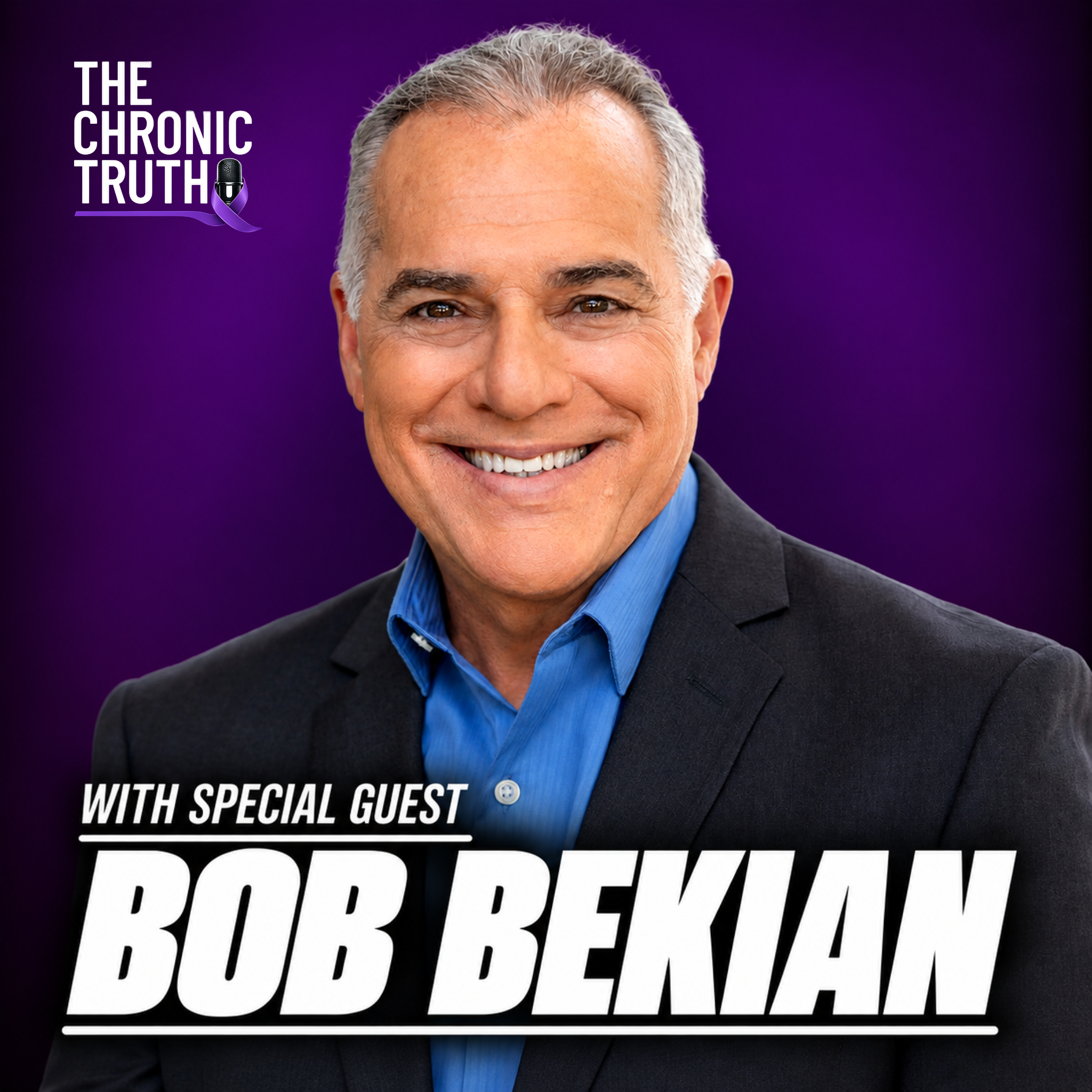
The Chronic Truth · Kim Nash
Bob Bekian is a Hollywood producer and director with 25 years of credits alongside Shirley MacLaine, Snoop Dogg, and dozens of sports and political figures. After a perfect storm of setbacks, COVID shutdowns, family loss, and two close friends who died from self-destructive choices, Bob built a research-backed system for getting back to yourself. His book, 10 Ways to Feel Better, is the result. Bob and Kim cover self-acceptance, forgiveness, gratitude, the nine-month personal commitment that changed Bob's relationships, and the Golden Triangle of nutrition, sleep, and exercise behind lasting mental and physical health. CHAPTERS / TIMESTAMPS 00:00 Introduction 01:37 Bob Bekian: 25 Years in Hollywood 02:05 A Perfect Storm of Setbacks 03:32 Happiness Is a Choice 05:26 Self-Acceptance & Forgiveness: Start Where You Are 09:08 Small Promises and Grow Forward 12:17 Developing an Attitude of Gratitude 16:17 Stop Taking Things Personally 20:39 The Golden Triangle: Nutrition, Sleep & Exercise 31:06 Connect with Bob / 10 Ways to Feel Better CONNECT & RESOURCES 🌐 Website: Bob Bekian 📚 10 Ways to Feel Better — bobbekian.com (signed copies) & Amazon ($0.99 download) The Chronic Truth Podcast: 🌐 Website: chronictruthpodcast.com 📱 Instagram: @ChronicTruthPodcast 📘 TikTok: @chronictruthpodcast 💬 Share Your Story: Testimonials 📋 Community Survey: Survey Production Partner: Podcast Mechanic
speaker-0: I'm gonna try this and I've done it now. It's September 22nd. So I've done it for nine and a half months. And that is, I am not gonna take anything personally this year. speaker-1: The Chronic Truth Podcast is for informational and educational purposes only. The views expressed by our guests are their personal opinions and do not constitute medical advice. While we share experiences and strategies related to health, neither the host nor the guest are acting as licensed medical professionals unless explicitly stated. Always consult your physician or qualified health care provider before making any changes to your treatment plan. Listeners assume all risks associated with implementing any information discussed on this show. speaker-2: Hello and welcome to the Chronic Tooth Podcast. I'm Kimberly Nash. Today I am joined by Bob Beckyan, Hollywood producer, entrepreneur, and author of 10 ways to feel better. After 20 years in the entertainment industry, Bob discovered that success doesn't always bring happiness. Through his own journey of personal transformation, he found a renewed purpose in helping others improve their lives through small daily habits, mindset shifts, and gratitude. Today he joins us to share his inspiring journey and how we all can take steps to feeling better. Hello Bob and welcome to the show. speaker-0: Hi Kim, thanks for having me. It's great to be here. speaker-2: I am excited about this when we talked a little bit before we started recording. I believe what we feed our mind, our bodies react. So I'm excited to learn some tools from you today for my own journey. So thank you so much. let's start off by sharing a little bit about your own journey with my listeners. speaker-0: Sure. Well, I have been a producer and director with the television studio in Burbank, California for 25 years. I worked with everybody on films, television, reality shows, music videos, everybody from Shirley McClain to Snoop Dogg. And I worked with lots of sports figures and political figures and so forth. And one of the things I noticed was that even though sometimes people have so much fame and notoriety, A lot of times they're not that happy and they also seem to be missing something, even though they have everybody admiring them and so forth. That's not the case with everybody, but I did notice it over the years. And then in my own case, about five years ago, I had a perfect storm of setbacks happen. And I had business changes. We had COVID and our studios shut down and all production shut down, and then I had some relationship and family issues come up which were pretty life changing for me. And I had my mother pass away. I had two of my best friends pass away from self-inflicted lifestyle decisions. And all of a sudden I just became unhappy and I didn't know why. I thought I had everything going on good and that I would I've overcome problems in the past many times. But at this point in my life I just kind of went off the rails and I started to go down the wrong path and my lifestyle decisions were not good. I was hanging around the wrong people. And all of a sudden I looked at myself in the mirror and I said, that's not the guy I want to be. That's not the guy I've ever been. I don't want to set myself on fire and throw my whole life away. So I came back to myself. How did I do that? Well I I just started researching this idea of happiness And I knew I wasn't happy, but I didn't know why. And I didn't want to drink or smoke weed to get happy because that's only a temporary thing. And that has other side effects to it. And I know all about both of those things. And so I started to really just study wellness and psychology and different things along the terms of how you can be happy reading books. And what I found out was that happiness is really a choice. But underneath that, choice, we have these things called feelings. And feelings are so powerful. They are you can't taste them or see them or grab onto them, but you can certainly feel them driving your life. And so then I started to study this idea of feelings and how can I feel better? Because I learned that in order to be happy and feel happy, I needed to feel better. And I started just working on myself and small little things. and I developed these ten ways that worked for me and they're not anything groundbreaking, but they're things that do work and I've been helping some other people too and I know they work for them too. So then I decided to write this book, Ten Ways to Feel Better and just help other people. speaker-2: beautiful and I believe there it's much needed out in this world, not just with the chronic health community for for that matter. I believe it's needed everywhere. speaker-0: Thank you. speaker-2: you you are doing exceptional work and for my listeners I highly encourage you to tune in to the end of this. We are gonna l learn so much today. If someone is feeling really bad or starting to feel bad about their circumstances, whether it's their health or their whole life in general, how do you or what could you say to help them turn things around? speaker-0: Well, I think that we have to never give up on a hope on ourselves. We have to come back to ourselves. And you know, a lot of us have had childhood trauma that is still with us. We've had people close to us pass away. We've had financial setbacks. We've had relationship issues. We've had substance issues. All of us have and all of us are caring a lot. That's just one thing I realized by talking to a lot of people. And I do a lot of talking to seniors. I I love going and speaking with seniors. And you know, you can't pull anything over on them because they've seen it all. So you gotta be pretty authentic. And what it came back to me as something that I've learned was that you've got to be authentic with yourself and just come back to yourself and say, Okay, I don't feel great right now. I don't exactly know why I don't want to go out and start drinking or taking medications or anything else to try and feel better because that's not really how I can feel better inside. We always have to come back to ourselves. If we take a couple shots of tequila or we smoke some weed, we might feel good for a minute. But then we have to come back to ourselves. And so I came back to myself and I recommend that try and come back to yourself and say, okay. The first chapter of my book is about self acceptance and forgiveness, including forgiving yourself. And one of the things that I realized was that a lot of times we get caught up in regret and we replay this movie in our mind, I wish this didn't happen, or I wish I didn't do this, or I wish this person didn't leave me, or whatever the case may be, I wish this person didn't die. and those are all real feelings. And I I want you to acknowledge those, but then come back to yourself and accept yourself where you are, meet yourself where you are today, realizing that, hey, you know what? These are feelings I have. I'm gonna try and figure out a way to deal with them. and then a lot of times people don't forgive themselves for things that they've done, mistakes that we've made, and we've all made huge mistakes. Our life is a series of short scenes of our movie of our life, which are, you know, mistakes and things that we did wrong and sometimes things that went right that make us happy. But our life is like up and down and it continues to be that way forever. It's never gonna be, you know, you're on the beach in a hammock and it's like this the Corona Beer commercial where everything is just calm and there's no problems in the world. Hey, we all want to go to Fort speaker-2: Yeah. speaker-0: See that commercial and we're like, I want to be there. but to get there, it's really moments in your life that'll be like that. And there will be. I encourage people to know that there will be more good moments in your life, but we've got to ex start where we are, accept ourselves where we are, and say, you know what, this isn't where I want to be. That's okay. where do I start? Okay, I want to start with myself. And I want to start by trying to not. live in the past and think about the regret and try not to have anxiety too much about the future because we can't go to the future and we can't go to the past. All we can deal with is today. And what can I do myself today to start? And something small. And one of the things is, you know what, I'm gonna forgive myself for the mistakes that I've made. And believe me, I've made a lot. And And start there. And then we go into some other ways in the book about how you can start doing small little things that are easy to do. They don't cost money, but they do cost you to create a mindset. And what I tell people is make a promise to yourself, make a series of promises to yourself, and then keep those promises. Nothing huge, because what happens is a lot of times on New Year's. We make these big resolutions. I'm gonna lose 30 pounds. I am not gonna drink anymore. I am going to, you know, not be a jerk or whatever it is. Right. And what happens is after 30 days, we go kind of go back to our comfortable way that we are. And that idea starts to fade off. And we might be doing it a little bit, but the 30 pounds might become two or three. And then we go back to the same type of things that we were doing before. And so It does require a change in order to get happy again, in order to feel better. But there's my I recommend and help people with small little changes that you can do, starting with keeping a promise to yourself that you know what, I am going to do this, and I know that the only way that I'm going to get to where I want to be is to keep the promise and just kind of move forward a little bit every day. And I've come up with this slogan now that I like called Grow. Forward. I love it. So instead of I did this and I did that and that happened to me and then this happened to me, we could all write that book. Right. and we can all say, I don't know what's going to happen in a month, a year, my health, my finances, my relationships, all of that is true. Those are concerns that we all have. But I encourage everybody to meet yourself where you are right now and accept yourself and say, okay. This is where I'm gonna start. And that's the it's a long answer to question. No, it's really it's you know, let's start with meet ourselves where we are and move on from there and go forward from there. speaker-2: And for me and most of my I don't want to say most of my people that I've interviewed to date, gratitude has become the forefront of our accepting of our diagnosis. Okay. Meaning, and I'm gonna rephrase that a little, we have to grieve the old us because our diagnosis is now precedent of the new being that you've become. So you know, learning who we are is key. And then not replaying the negative movie per se over and over and making that a a two hour series. Right. When you've got so much other beautiful things around you that if you start focusing on those, that story will become your two hour movie. That's right. that speaker-0: Well, speaker-2: is is key. So I like that. How do we develop an attitude of gratitude? speaker-0: Well, thank you. And that's the title of one of my chapters. So I don't know if you knew that by checking, but and it's a buzzword and a buzz sort of theme going around right now to be grateful and and gratitude and so forth. And I like to start with the small things. you know, when I talk to people like again, seniors that are 90 years old, and I'll ask them, what are you grateful for? And one of the things that Always comes to mind is people will say, Well, I'm really grateful that I'm able to be independent and make my own decisions. And it's such a simple thing that we forget about. But we're all here and we can decide what we're gonna do for the most part. We may have some limitations. We may have physical limitations, or our, you know, our mental state is not where we want it to be, and that's okay. but to appreciate the fact that here here I am, I'm alive. You know, I had a a couple of friends I I told you about earlier, and on on paper and what everybody saw, they had everything. They had beautiful families, they had houses that they had worked hard for, and they had a vibrant life, but inside they were feeling really bad and they self medicated and basically destroyed themselves. and kill themselves of just over indulging in things to try and feel better by consuming things speaker-2: And masking the pain. speaker-0: and masking the pain. And you know, start start with where you are and and and then start with the small things. Again, with the seniors, they're they're grateful that they're able to move around. And some of us might not be able to move around and we may have limitations, but To be able to get up and go somewhere and even to your kitchen and make yourself a cup of coffee, you know, that's a small little win. And it's a big win for a lot of people that are in a bed or in a wheelchair and they can't do that. And so start with where you are and just say, okay, I may not be as healthy as I want to be. I may not be where I want to be on my journey of whether it's addiction or just getting better. Getting more healthy or whatever. But I I intend to do that. And so that's the next step of it is to kind of set your intentions and say, you know what, I'm really grateful for these things I have. And now what I want to do is I want to feel a little bit better. And so then another thing that I notice a lot, like one time I went to a doctor and he was an Indian doctor, a wellness doctor. This was a few years ago. And I I was in the throes of producing and timelines and I had to get to the studio 50 miles away and I had a nine o'clock appointment and I get to the doctor's office at nine o'clock and the door was locked. And I started just, you know, my God, why isn't this place open? Why isn't he here on time? And I started working myself all up. And then finally they opened it about nine five and they let me in. What's the first thing they want to do? They wanna take my blood pressure. Which was way off the charts. speaker-2: Yep. And all of us patients can attest to that. speaker-0: Yeah. And so and so he I get in the room with him and he's like, Hey, you know what? Take it easy. okay, the door wasn't open. why don't you go and look at the trees and listen to the birds? And he was talking about nature. And I was like, What the heck are you talking about? I gotta get to a production fifty miles away and you're supposed to be here at nine o'clock. But my point is that what he was trying to say is, you know, how we frame situations, doesn't have to always be the way that I was before. And so now I'm more calm. And one of the things I did, which your listeners can certainly try, and it's worked for me. This was my New Year's resolution, I said on January 1st. And I don't know where I picked this up. I said, you know what, this is a good thing to try and do. I'm going to try this. And I've done it. Now it's September 22nd. So I've done it for nine and a half months. And that is I am not gonna take anything personally this year. speaker-2: Ooh, that's a big one. speaker-0: It's a big one. speaker-2: That's a big one. speaker-0: Because we get into a pattern of when somebody says something to us and our ego gets in the way or our pride. And it's it's normal. But especially someone like your husband or my wife, someone close to us says something that's we perceive as critical or that we didn't measure up and something that we did. and and the old Bob was getting You know, immediately down the path of upset and my ego was bruised. And how can you how can you be so petty as to call me out on something so insignificant when I did my best? speaker-2: Yep. Wonderful. speaker-0: Yeah. And and I thought I did a pretty good job. But anyways, so that changed my mindset and put me into more of a mindset of gratitude by by doing that exercise, by not going down that rabbit hole of victim, which is another one of my chapters, Be a Victor, not a victim, because in my life I've been guilty in the past of. assigning myself victimhood to things. And that takes us down the opposite way of gratitude also to think of ourselves as, well, this person did this to me. And so therefore I'm mad because of that and at her or whatever. And it's this the opposite mindset of, okay, he's mad about this or he did this. That's on him. I'm going to move through my life in a way that I'm not going to get drawn into that bad energy. Yeah. speaker-2: Yep. speaker-0: And so it's difficult at first, but it gets easier. And again, it's a promise I made to myself. It's a small little promise that I said, okay, I'm not gonna, you know, take anything personally this year. And it works. It's working because I spend no time being a victim of anything. And I just realized that, you know what, people are gonna get upset about things, people are not gonna be happy with things, things are gonna go sideways or wrong, but I'm gonna stay focused on my purpose and my intentions and that's what I've been doing. So it's been working. speaker-2: It's it's a good tool to learn and I like that, you know, what you are saying about about that from my own personal journey here. I tell my listeners I started a gratitude journal. I had a pity party when I was first diagnosed with end stage liver disease. I had my own little pity party for about three months. Wow. And long story short, I decided this is not how I wanna live, so I started a gratitude journal. The first morning and I still have this journal. I have what fifteen years worth now of journal. I go back to that first entry and the only thing I could think of, I had a a beautiful family. I had great kids, you know, I had my companies I ran that I started from scratch. I had a lot to be grateful for. And all I could think about in that first entry was this great cup of coffee. And it's kind of humbling to think about that now. But now it's like pages of stuff. And my whole mindset now determines what I look at for my my gratitude. It's it's not looking like you said at the pettiness of what someone said or the pettiness of someone cut me off in traffic. Yeah, do I get tested from time to time? I think we all do. But what is the golden triangle? speaker-0: the golden triangle. Well, that's my chapter number two. After you accept yourself and you forgive yourself and others. And that was a big one for me. Before I go to the golden triangle, you know, forgiveness is something that's huge. And I spoke with a a person the other day, she was 92, and she says, you seem like a pretty smart guy. I have a question for you. I haven't spoken to my son in ten years. What should I do about that? And I said, Well, what happened? And she said, Well, you know, it's his wife. His wife gets in the way of our relationship. And so therefore, you know, I have decided to pull back and so ten years, she's ninety-two. I don't know how many more years she has. And she said, What should I do? I said, Well, I think you should pick up the phone and call your son. And she said, Well, if I do that, then I have no self respect. And I said, Well, why don't you take your self respect and put it over here and call your son? Because you know what? You shouldn't wait for something to happen. You should make something happen. If you really are ready to forgive and go forward, make it happen and take action. And she did. And I came back a couple weeks later and she says, Bob, I got good news. I called my son and he came and visited me. And now we're now they're talking again. And so that whole idea of forgiveness is so important. And so with that said, now we're in the the golden triangle of nutrition, sleep, and exercise. So when I was more stressed out and I was doing other things that were interrupting my sleep patterns, my sleep was not very good. I went to bed at different times. I would stay up really late at night and work on hobbies and then be grouchy the next day and take caffeine to wake up and so forth and then get burned out. When the caffeine wore off and so forth and be grouchy. And I started to research this idea of sleep. And I realized that according to the, and by the way, every one of my chapters is backed by a scientific research study. So this is not just something that I made up, but statistically, 70% of Americans are sleep deprived. And that is a pretty big amount. Now that means less than seven hours of sleep. Most people need at least seven hours of sleep. Eight is better, but seven is ideal. And so I help people with thinking about sleep as a ritual that you try and program yourself to try and go to sleep the same time every night and wake up in the same time every morning around without an alarm clock. If your body will set a rhythm, and if you start doing that after a while, you will wake up at a Consistent time. And so you've got that now going on. so your sleep also is something that you have to figure out what makes you comfortable. my older son, he he likes a super cold room, and so he has this split air conditioner, and if we ever stay at his house, it's freezing. but that's how he sleeps. He can't sleep when it when it's warmer. I like to sleep with my socks on. I like to be warm with the and when it gets colder, I like a little hoodie and I put a black t-shirt over my eyes. But anyways, the point is that we all have our little rituals that we should try and figure out how when we lay down at night in bed, we're comfortable, there's no distractions, we haven't been scrolling right before, or multi-screening. And so sleep becomes something that's really important to us. And we have to figure out how we're comfortable going to sleep. And it's all di it's different for all of us. Some people like to watch a movie and fall asleep with the TV on. Studies show though that screens an hour before sleeping are not necessarily good for us. whether it's, you know, I'm I'm guilty of it. My wife and I will be laying in bed. We've got the TV on, we've got a laptop and our phone. Yeah. And, you know It's all important stuff. But you know, at some point you have to turn everything off and say, okay, now it's time for me to go to sleep. And and the other corner of the triangle, of course, is nutrition. And one of the things that we find is a lot of people are underhydrated. They're not drinking enough water. And they're also drinking sugary drinks, energy drinks, sodas and so forth, and none of that's good for us. The thing that we really need our body needs is water. And what the typical American breakfast is is to get up and have a cup of coffee and usually some type of a carbohydrate. You know, it could be a donut or a croissant or a piece of toast or something like that. And that's okay, but it doesn't really give our body what our body needs. What our body needs right away is hydration, and we need some protein usually to start off. And so I recommend that to start your day off, try and A little bit of a carb is great, but make sure you're adding protein. And also as we get a little bit older, even when you're younger, protein at every meal if possible. one of the things that's the problem with the American diet is we eat so many processed foods and nobody has time to make anything because they're so busy. And so we grab for the convenient things and we end up eating, you know, chips or snacks and things like that. And You know what? It's okay to eat chips sometimes and so forth, but the basics, the things that we are supposed to eat that you know are good for us, like fresh fruits and vegetables, protein, lean protein, and good carbs are things that take a moment or two to prepare, but are really good for us to have. So for example, an easy thing to do in the morning is I do what Tom Brady, our our goat football quarterback. Does and it's called a protein shake. And I put fresh fruit, berries, blueberries, bananas, protein powder, chia seeds, flax seeds, almond milk, walnuts, and let's see what else. I think that's about it. And I blend it in a neutral, and my wife and I drink that, and we get our protein. We get a lot of good vitamins, and those seeds and the nuts are good for us in other ways. And so there's a It takes a a couple of minutes to do, but it's a tasty good way to get a lot of things in when we're on the go because you can take that in the car with the straw and you can have it. and so the other thing that I try and encourage people to do is make sure you're eating good omega-3s, salmon, fatty fish, lean chicken, protein turkey, beef sometimes is good. and so Making sure that you're putting healthy, nutritious foods in your body and trying to simply I tell people, you know, eat the rainbow of colors. you know, red peppers, green cucumbers and kale and lettuce, different, you know, strawberries, blueberries, all the fresh foods. They're so delicious. and we tend to go for the convenience more than taking a minute to wash the fruit or eating a banana and so forth. And so that's the part about nutrition. And you we all know these things, but my main message here is that, you know, try and reduce the processed foods and eat healthy, fresh foods with lots of water. Now, the part about exercise is huge. And so I'm 64. every day I wake up, I do a hundred push-ups, and I do three hundred core exercises, which are leg lifts and and squ crunches and so forth. And then every other day I do weight training. And the reason why I do this is because we've got to keep our bodies strong. Women after menopause will be will sometimes lose up to 1% of their bone density every year. And so they've got to, women, especially in men, we have to keep our muscles strong to support our skeleton. But also I started using my phone. I walk my dog in the morning, I walk my dog in the afternoon at the evening. and it's about a mile and a half each one. And then I try and park my car a little bit further away at the market or whatever and get the steps in. And I try and get 10,000 steps in. Now I have a bad knee, so I can't run anymore, but I don't really need to run at 64. But I my point is I want you to move. I encourage people to move and be strong. Lift weights, do exercises. I don't have to go to the gym to do all that stuff. I have it right here in my house. I got some dumbbells. And I got a carpet on the floor. speaker-2: Pay for our membership. speaker-0: You can, and it's great. I do, I am a member of a golf club and they have a really nice gym there. And when I go there, I use all these great machines. But but again, I made a promise to myself that every day I'm going to do those exercises and that every other day I give my day I give myself a day in between to not lift weights so that my body can recover from the weights. But I feel better than ever. I have more energy. And then when I go to bed at night, I'm out. I go to sleep within like two minutes. So that's the triangle: nutrition, sleep, and exercise. There's small little things that you can do. It doesn't cost a lot of money. As a matter of fact, the study shows that fresh foods and water are much less expensive than processed foods and eating out all the time. So it just takes a little bit more time and it and it we have to sort of retrain ourselves instead of grabbing going and eating on the run, we sit down and we make something and we eat it and we enjoy it more too. speaker-2: And if you're on the road going to work or whatever, you know, chop up those berries or fruit chunks and have in your car so when you are driving, you have it and you don't have to pull off to the g nearest gas station and grab a snack. So speaker-0: Right. Pack it. Yeah. Good point. speaker-2: Very good. How can my listeners get in touch with you? speaker-0: Well, I have my website, bobbecking.com, and you can get my book there on my website or it's available on Amazon. I'm doing a promo right now where the the download is only ninety-nine cents because I'm trying to get it out to as many people as possible. So please reach out to me at bobbecking.com. I'd be happy to contact you back personally. And if you buy the book through my website, I'll sign it for you if if you'd like, or you can get it on Amazon and get it for ninety-nine cents on the download. speaker-2: I highly recommend this to my listeners. It's a good tool. We have so many so much negative going on in our life with our health. Let's feed our mind with books such as Bob's to help encourage us and help us become a better core person and and to be able to forgive ourselves and to move forward. Bob, it's been a pleasure having you on the show today and Thank you so much for sharing this uplifting information that my listeners definitely need and I need. So thank you so much. you're speaker-0: You're the most welcome and I wish you and all your listeners all the best. Thank you very much for having me. speaker-2: Thank you, and thank you for tuning in to today's episode. Please subscribe and share it with someone who you feel needs to hear it. Until next time, keep hope alive and remember you are never alone, not without a fight.