
The Chronic Truth · Kim Nash
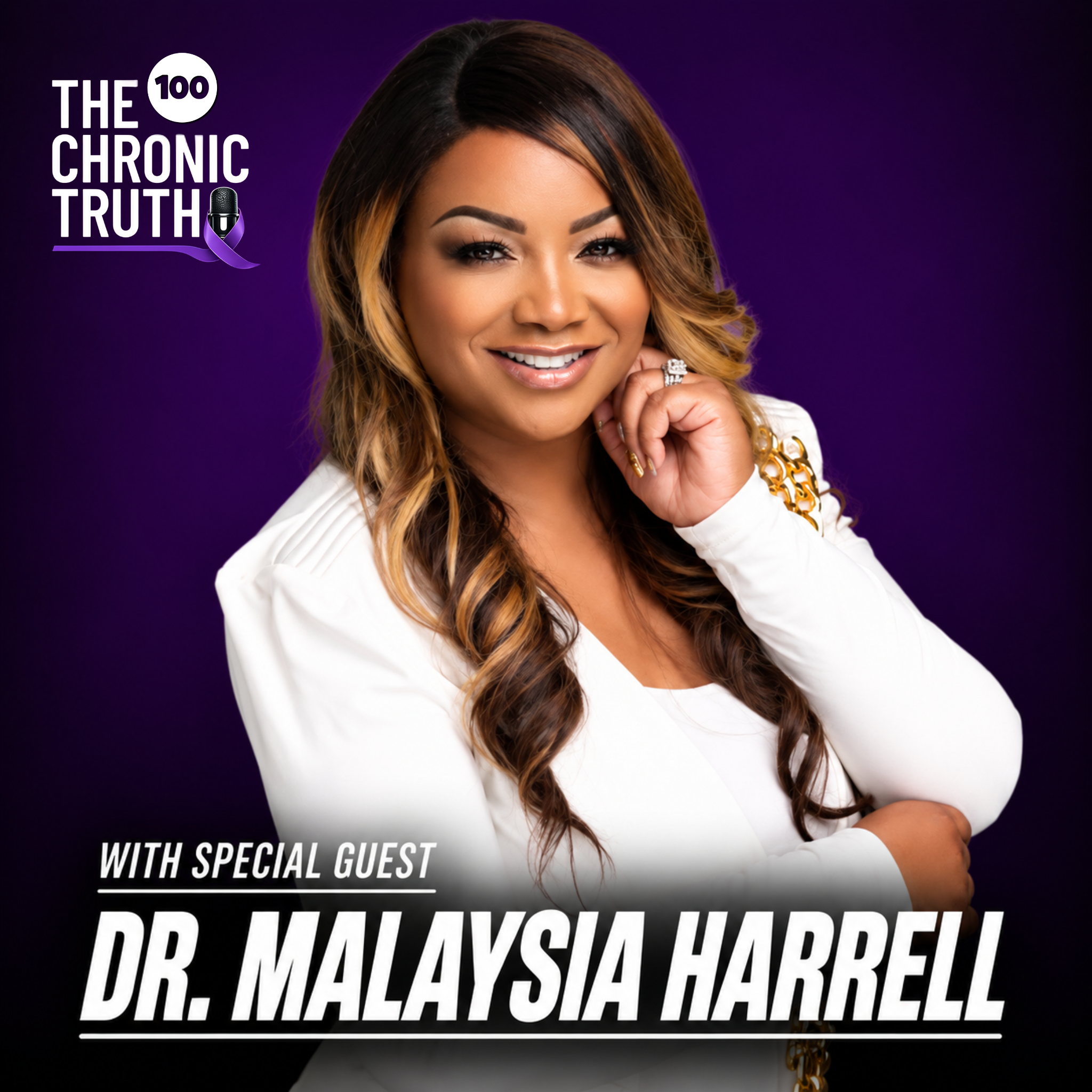
Dr. Malaysia Harrell built her life on achievement Air Force, U.S. Public Health Service, working with the Surgeon General until a 2020 near-death experience left her with sepsis, Bell's palsy, oral chemo, and no idea who she was without her career. On Episode 100 of The Chronic Truth, Dr. Harrell talks with Kim about why high-achieving women burn out behind a mask of success, how trauma collects in the body until the closet gets full, and what surrender actually looks like when you've spent a lifetime in control. Plus: Kim's most personal disclosure yet and the reframe that might change how you see your own story. Find Dr. Harrell at MalaysiaHarrell.com and Blissful Life Consulting at blissfullifeconsulting.com. CHAPTERS / TIMESTAMPS 00:00 The Burden of Trauma 01:45 Dr. Harrell's Journey to Healing 05:57 Rebuilding Identity After Crisis 09:43 The Impact of Social Media on Success 13:30 Understanding Trauma's Effects on the Body 17:47 Perfectionism and Its Consequences 21:29 Finding Purpose Beyond Perfection 25:33 Empowering the Patient's Voice 29:39 The Importance of Community and Support CONNECT & RESOURCES 📱 Instagram: @malaysiahharrell 💼 LinkedIn: Dr. Malaysia Harrell 📘 Facebook: Dr. Malaysia Harrell 🌐 Website: MalaysiaHarrell.com 🌐 Business: blissfullifeconsulting.com 🌻 Hidden Disabilities Sunflower: hdsunflower.com The Chronic Truth Podcast: 🌐 Website: chronictruthpodcast.com 📱 Instagram: @ChronicTruthPodcast 📘 TikTok: @chronictruthpodcast 💬 Share Your Story: Testimonials 📋 Community Survey: Survey Production Partner: Podcast Mechanic
Kim: Gonna put all my traumas really nicely in that closet. They're gonna be labeled. I got them stacked up real nice in that box, but guess what? It gets full. So eventually that door opens. And so you don't realize later on, wow, why am I reacting this way? Why am I angered by things that used to not even bother me? The Chronic Truth Podcast is for informational and educational purposes only. The views expressed by our guests are their personal opinions and do not constitute medical advice. While we share experiences and strategies related to health, neither the host nor the guest are acting as licensed medical professionals unless explicitly stated. Always consult your physician or qualified health care provider before making any changes to your treatment plan. Listeners assume all risks associated with implementing any information discussed on this show. Hello and welcome to the Chronic Truth Podcast, where we bring real stories, expert insights, and conversations to those living with chronic illness. I'm your host, Kimberly Nash. Today I am joined by Dr. Malaysia Harrell, a board certified psychotherapist, military veteran, and mind-body medicine expert whose own near-death medical crisis transformed her understanding of healing. Today she's helping others move beyond simply surviving to healing the mind, body, and spirit. Won't you please help me in welcoming Dr. Harrell to the show? Thank you, Kim, for having me. This is so amazing. I love your show and I love what you all are doing. It's so important. Let's start off by just sharing a little bit about you and your story. So thank you again for that warm, raving introduction. ⁓ again, my name is Dr. Harrell, and I, like many, especially high-achieving women who appear ⁓ high achieving on the outside to the world, built my life on a mask. And that mask was the mass of success, and that success was built on the absence of love and a lot of trauma in my childhood. And a lot of people can really relate to this. And so we start our lives, you know, with this, with this situation where it's like, hey, I have to get and I have to achieve and I have to appear so great on the outside. And so I've had such amazing opportunities in my life. ⁓ had many different careers. I started off in corrections and then after nine-eleven, I, you know, got commissioned in the Air Force. became a clinical social worker in the Air Force and did very well. Ended up transferring ⁓ to the United States Public Health Service, worked for the Surgeon General of the United States, had the h highest, you know, positions and things like that, working with Congress. And so I thought, well, I'm probably gonna be a senator, you know, I wanna make change. I'm one of those change makers. You know, people who've had a ⁓ life of trauma, like they want to have a great impact. And so I did all those things, and it wasn't until 2020 when I had my own medical crisis and near death experience that sh catapulted my life into a whole different direction, which has been very good by the way. But ⁓ it it that's how it started out as the situation was like, okay, I'm gonna prove to s all these people that I'm really great because you never saw that I was great, right? And so you're just chasing your own tail all these years. I can I can resignate. So yes. After your near-death medical crisis and ⁓ chronic illness, how did you begin rebuilding your life and that identity? Well, I'll tell you, ⁓ it was very challenging. And so I think this answer can be very complex. And I just want to dive into what it meant for me to go through that first. And so that was my identity. So with with being able to control your finances and control your life and your appearance and all the things, when you no longer have that, it's almost like you don't have life. You don't have breath anymore. And so to even think about rebuilding wasn't on the top of my mind at all. I was like, ⁓ I had a great life already. I'm not, I'm not going back. You know you do. Right. Yeah. And so I was it was like, wait a minute now, who am I? So I think that was the first question that really came up was, who am I? I'd never knew who I was outside of success. But when you are forced to be in a position where you can't even take care of yourself, like people are literally, your husband's taking care of you, my family. My friends, one of my friends from junior high school came to take care of me. That's when it's like, okay. So to rebuild myself, I had to first kind of even ask the question. It's not like, ⁓ I had to learn who I was. That doesn't happen right away. That takes a little bit of time. So I had to explore who am I now? Because I was still trying to hold on to that version of myself that I had before the near death experience. And when you have that situation, you can never go back to that person. You you may trans you know, transcend and do even greater things, but the meaning and the impact is gonna be completely different and your intentions will be different. So I had to start there. And then the second part of that is I had to surrender. Because again, before I'm controlling everything, right? ⁓ I got this job, I got this promotion, time to get the next one. I got this honor, time to get the next one, I got this degree, time to get the next one. When you sur when you don't have that anymore, the only thing that you can do is surrender. And once you start to surrender and say, okay, you know what? I'm already kind of at rock bottom for me. Let me figure out what there is that. might I that I could explore, right? And so it becomes this situation where it's like, ⁓ it could be Christmas today. Let me, let me try this new life. And I'll tell you, Kim, I was 254 pounds. I had Bell's palsy on oral chemo. So imagine being active duty, right? During COVID, coming home from deployment. And then you you're you're not you're not recognizable, right? And so again, that was where it started. And so once I decided to surrender. I had to get a little tattoo put on my arm because again, I have to remind myself practice. This isn't, ⁓ I made it. I got it. I'm this spiritual guru on the mountain. No, it doesn't work like that. We are still human. Yes, and I can resignate with that. and I think many with a chronic condition, the life that they know prior is totally different than the life they live now. That's right. I know I you know, sunk into a s a severe depression ⁓ right after diagnosed ⁓ with mine. And it took probably a good three months for me to to come around and like you said, surrender. I love that word. for me it was just accepting the new reality. Yes. Yeah, acceptance is key, but it's it's a grief, right? So I hear You know, people who have chronic illnesses or even who are going through changes of life, right? You your body's not the same. You know, you used to be able to do five thousand things in one day. Now it's like, what do I have to do? I have to keep referencing my list because I can't remember everything. And so I think surrender was really, really key. And also for people who are experiencing this, one of the movies that I started out watching was called Heal. And I think it's either on Amazon Prime or Netflix, but that is a good movie to start off with because when you just talked about your reality and accepting it, just know that that is your current reality, but your imagination allows you to imagine anything you want. And so again, I didn't think I'd be doing what I'm doing now and traveling the world and doing TED X's and meeting, you know, other successful billionaires and people who you know, just pour into me now. ⁓ I think I have even more of an impact now than I did when I was active duty because you couldn't say anything, right? You have to stay within these bounds. Now I'm talking to you. This podcast is gonna reach people all over the world. And so I think if we could just save one life and let one per let people know, you know what, it may look bleak today. But you could have the life of your dreams and give up what you know, the mask and all that, you know, f the fallacies of everything that we thought life was, and you realize what's really important. If you don't have your health, it doesn't matter how much money you have. I just think about Steve Jobs, you know, one of the richest men. He created like we got how many phones we got. Exactly. Exactly. Why do you believe so many high achieving women struggle with burnout while appearing to be successful on the outside? Well, this quest this is a very good question. And ⁓ I think we continue to struggle with it because there's so many reasons why, let's just say that. But the world tells us that we have to. When you look at the social media world. in this world of technology, right? You you see you you see things that are not real. So it's like you'll see this little thirty, thirty second, city sixty second clip of someone who went here, they picked up their children, they they made the dinner, they went to their job, they went with their girlfriends to is that really real? Very true. Was that their whole day? The whole day like they that was a clip over five different weeks, I'm sure. It was not one day. And so the world has shaped this real this this current reality that these are that all the world the world in the way you want it to be, this is how it is. And if you talk to those people offline and you see them, I'll bet you. They're not doing that or they have help. So I follow people who have these most beautiful homes and you know they're showing themselves clean in their homes, but they've admitted that they have like a cleaner. You know what I mean? Like they're not sitting there doing these videos all day. They have a whole video team that's doing they're doing it for the gram. Yeah. So knowing that number one, that's not real. And for some of us, that's who who are who have established themselves through trauma, right? And in their world, they're saying, you know, they're living in fear, fight or flight. I don't want to go back to that for whatever that is. I have to have money. And so you think I have to do it all because if not, who's gonna do it? But it's not until something happens and you realize, ⁓ my goodness, I'm still able to do this. During COVID, the world stopped. But kept going. Wait a minute now. Let's think about that. The world stopped, but it kept going. So I think that was a big awakening. We had already started having an awakening, but I feel like that was a huge awakening for us because we realized you don't have to drive three hours to work back and forth every day, right? A hour and a half one way and an hour and a half back. Same pay. And then they started getting into telework. ⁓ we could we could work from home. We could be on Zoom. Yep. And you get more work done because you start on the at that time and you leave at that time and you you're and you don't have to drive, so you don't have to rush out. Wow. That's just so much on your mental driving anyway. So that saves a lot there. It is. How can chronic stress and trauma affect the body and your overall nervous system? ⁓ this is it. Trauma impacts so many things. And we don't realize that our body holds on to that. So there's this book, right, called The Body Keeps a Score. And I even went to the training on that as well, ⁓ with Dr. van Kolk. And ⁓ Our bodies soak in. We are human beings. We have five senses and we and including spirituality too, right? And so we have things that happen to us and not only things that have happened to us, but my TED talk that I did in the Netherlands in April, I really talked about how trauma stir ⁓ transcends not only across what we've experienced, but with your Ancestors has experienced, what the world is experiencing. You imagine turning on the news and you see something and you you immediately start feeling different, right? ⁓ things that have happened to other people that are close to us. If you're in the helping profession, you're you're having potentially vicarious trauma where you're soaking in the traumas of other people, of our families, of our children. And so that Is a collective and it just our bodies, our mind, and our spirits collect that. And so we think, well, I'm just gonna exercise, I'm gonna eat healthy, I'm gonna do everything that that help book told me to do, that self-help book. And it's not till years later that you realize, ⁓ my goodness, I have high blood pressure. ⁓ my goodness, I'm starting to have anxiety. I didn't have anxiety when I was younger. I'm 50 years old and I'm having anxiety now. What's going on? So your body start mind and spirit starts to have this threshold. So it's like, okay, I'm gonna put all my traumas really nicely in that closet. They're gonna be labeled. I got ⁓ stacked up real nice in that box, but guess what? It gets full. So eventually that door opens, right? And so you don't realize later on, wow, why am I reacting this way? Why am I angered by things that used to not even bother me, right? And so honestly, all of that starts to collect in our spirit and in our vagus nerve, right? That is what calms us. That is what regulates our system. And so it starts to not operate appropriately because of what you asked before. We're used to doing it. I should be able to do this. I should be able to push more because I've always done it before. What's going on now? And so we don't even know what our baseline is for being at rest. Right? You think about it at night, you're on your phone, you're thinking about everything that you have to do tomorrow. When do you ever cut your mind off? When do you ever are not thinking about that next thing that I have to do? Right. And so your body. We're just we just are so used to it that we allow it to continue to progress until, right? The until. And when the until comes, you're no longer able to decide, you know, like, ⁓ I'll I'll just do meditation now. No, it's usually something happens that is like a medical crisis or something that happens that changes the trajectory of your life to when you realize, ⁓ there is trauma. But then sometimes we may not even be aware of the trauma. Again, if it's transcended down, you have something in your DNA, you have a predisition predisposition for certain things in your family. So you'll notice there's some families where people will be like, ⁓ all of them are hypochondriacs. Yep. You know, that whole family, but not realizing that that's due to trauma and generational trauma. That just keeps going down the line. It does. This resonates with me. I grew up ⁓ my mother was the first kidney transplant patient to give birth to me in the US and fifth in the world. And so ⁓ we were in magazines and we got a lot of publicity and I just remember as a little girl always having that ⁓ you have to be perfect. You have to And I know they didn't mean it in a harmful way, but I think they felt the the stress of it as well. ⁓ where you have to be perfect and you have to look a certain way and act a certain way. And when you grow up like that, you know, I'm a go getter. Like like you said, you know, a achiever just constantly my mind just doesn't shut off. Like, what can I do to help someone? And you get this mindset going and This totally just opened my eyes to everything. So I'm like, ⁓ that totally makes sense. So thank you for that. Yes, it really does. It's but and that's the beauty in it. That's the beauty in the pain. That's the beauty in the experience, is that you're not that same person. You're more enlightened, way more than you are now. And you sharing your story of you and your mom and your family, that is what's helping people. Do you have to run around at the food pantry every day to do that? No. You you can give back in a way that makes sense for you. But I think a lot of people can identify with that perfectionism, you know, and in the world thinking, you know, having to hide things from the world. You know, we used to have these family sayings, what goes on in this house stays in this house. You know, you didn't talk about things. And again, you could be Something could happen to you in the house and then you come outside and you just you you put on that Yeah, the smile. That cloak. Mm-hmm. The smile, the outfit, the the smell goods. And you get out there and people are like, ⁓ how are you doing it? How are you doing so well? Not knowing that you're struggling on the inside. Yes. Yes. And that was my probably my hard reality when I did get sick for myself, ⁓ is accepting that I'm not perfect. Because I I built this life of I have to be perfect. Yeah. And so I think I hit crash rock bottom fast. ⁓ just severely depressed because I had to relearn who is Kim? Who what does she have and and what can she give to to be a better hum human person, you know, in humanity and and give back? What is my purpose? And that's what I learned. I love that. And when you said I'm not perfect, right? I I had something that I had to think about too in that situation. Cause again, you couldn't tell me nothing. I thought I was it, right? But when I and and that made me feel uncomfortable to say that and to realize that. But then when I turned to, you know, my resource, God, right. I I realize, ⁓ I'm made in the likeness and image of God. So if that's the case, I'm pretty I'm I'm pretty good no matter what. Right? If I if I believe that, then I'm perfect just as I am now. Long I mean, I'm not going out beating people up and you know, but I feel like what is perfection? You know what I mean? Is what what e what even does that mean? And so doing a like a cognitive reframe on that and saying I am great just like I am now, because I was made this way. I had these experiences this way, so that I can do the work that I'm called to do. If I didn't go through that, I wouldn't be here talking to you right now. Right. I I would be at work still in my uniform and I wouldn't have I wouldn't look this cute. You know, I'm a little cute, but a different outfit. You're beautiful. No, thank you. But yeah, I love that because and the reason why I just talked about that is because when you do go through that shift, it feels dark. If the only thing you knew was perfectionism, that's a very dark road to go down and it's very lonely. Yes. Because there are not many people who can identify with what you're going through. And even if people love you and even if they try to support you, they're not gonna have the language or the words to understand what you are going through. So I would say I'm I'm very connected to God. And so in that way, I want to use my life to do God's work, if that makes sense. And so doing that, I don't have to run around and you know, hand things out at every race or, you know, what all the extracurricular things that I used to do to say that I'm giving back, right? Everything at the church, everything at all these other places for, you know, being off duty and or the with the military was doing extra things. Like, I'm I'm I am great and I am perfect in God's image. And I I came to that realization too. I mean, it was a process. You know, I don't want my listeners thinking that I went in my room and shut myself in, you know, and I came out a new kim. It's a process of accepting that. I failed out of medical school. I wanted to be a doctor so bad. And I am still in the medical field. I am just not the doctor. I'm the patient. And Patient's voice and doing this podcast is is bringing light to so many. There's so many more patients than there are doctors in this world. And I I am thankful that God has has given me this platform and to be able to interview people like yourself. ⁓ it's teaching me a whole different ⁓ reality of respecting my new Kim. Yes. I love that. And Kim, I would just ask you No, please, this is it. This is part of it. This is us being real, being The chronic truth. It's the truth. Yeah. And that's what I told my listeners. ⁓ I would ask you. I would ask you, did you fail or were you delivered from medical school? That you don't have to answer that question. That's and we could get into a whole conversation about that because, you know, for those of you who are not aware of my story, when I was hospitalized and I had my near-death experience, ⁓ they tried to send me home with sepsis. They sent in a psychiatrist to evaluate me. And so under the, you know, constraints, and again, I had to advocate for myself, I would have been dead in days, actually. ⁓ but under the constraints in Western, we won't get into all of that, Western medicine, you know, I think that you have an opportunity here to allow people to be empowered on their medical journey, whereas being a doctor, you're not always able to do that. That's what I'll say about that. Thank you for that. That I mean, yeah. And I I see being on the patient side of it, doctors don't have the time to put the compassion that I had on my heart to give people. I wouldn't have had the time. So this allows me to do what is my passion. And that's helping us. Yes. I I did I did pre med too. I did pre med, but I didn't Yeah, but when I realized 'cause I wanted to be a psychiatrist, but when I realized they don't really do the therapeutic part of it, like you were saying, they do more of I mean they taught they do the counseling too, but they do more medication management. If you're going to a psychiatrist, it's for medicine, right? And so I wanted to do more therapy. And so I I switched that. Yeah. And that that was what God led you to do. You know, because you have that compassionate heart to help others too. How can my listeners get in touch with you? So I am on ⁓ most social media platforms. ⁓ on Instagram is Malaysia H H Hurel. ⁓ and I'm on LinkedIn, I'm on, you know, Facebook. ⁓ but my website is MalaysiaHorel dot com. ⁓ my I have a mental health and wellness business, Blissful Life Consulting. So blissfullife consulting.com. And yeah, I just love for people to ⁓ to connect with people who have watched the show, who've been inspired. You know, I learn, I'm still learning. Like, like you said, this is a journey. It's not like, ⁓ we're gonna put a a a pen in this, you know, and a dot and be like, period. That it's not like that. This is a journey. And I think we learn from each other and us getting the word out there, having a sense of community. ⁓ one other thing that I would love to mention to your guests is that ⁓ I am an ambassador for the Sunflower ⁓ organization for hidden disabilities because a l there are millions of people walking around with hidden disabilities. And so if People don't see you in a wheelchair or they don't see you with a walker or cane, you know, and I think it's important too because a lot of the perfectionists or people who've experienced trauma do develop a lot of medical illnesses, chronic illnesses. ⁓ and so our goal is to allow people a voice and to say that it's okay. A lot of people have PTSD for many different reasons and other mental illness as well that you know, are not you know, there's no ⁓ there's there aren't a lot of accommodations that are available. And so, ⁓ we have these lanyards that people can wear and they have sunflowers on them. You can go ⁓ online and Google the sunflower hidden disabilities and get one of those lanyards. But when you wear them, especially during travel, because traveling was very difficult for me after having ⁓ two hip replacements with TSA, I'll tell you it was it was a challenge. And so ⁓ wear those out. ⁓ is started in Europe. And so, you know, they over there when you wear it and you're on the planes, like everybody knows. ⁓ but pe the we're getting the word out there. And so there if there are people with chronic illnesses, fibromyalgia, any of that, make sure you get one of the lanyards and wear it around and you can tell people about the organization. That is is wonderful news because I didn't even know anything about that. So putting that voice out there for this is is beautiful. Beautiful. I have really enjoyed this conversation so much. I feel like we just, you know, hit a just a little tip of the iceberg here, so to speak. ⁓ there's so much more ⁓ out there that, you know, mental mental what am I trying to say? out there with your mental, you know, struggles and, you know, fighting a chronic illness mentally, physically, and all of that. So thank you so much, Doctor Harrell, for coming on and sharing your incredible journey and for touching my life. I am a believer that God brings people in our lives for a purpose and I am so honored to meet to meet you and share your story. Thank you. And thank you for again for this opportunity and sharing space with me today. It was such a pleasure talking with you, meeting with you, and being inspired by you as well. Thank you. And thank you to those listening to today's episode. Please subscribe and share this with someone you feel needs to hear it. Until next time, keep your hope alive and remember you are not alone, not without a fight.