
The Christy-Faith Show · Christy-Faith
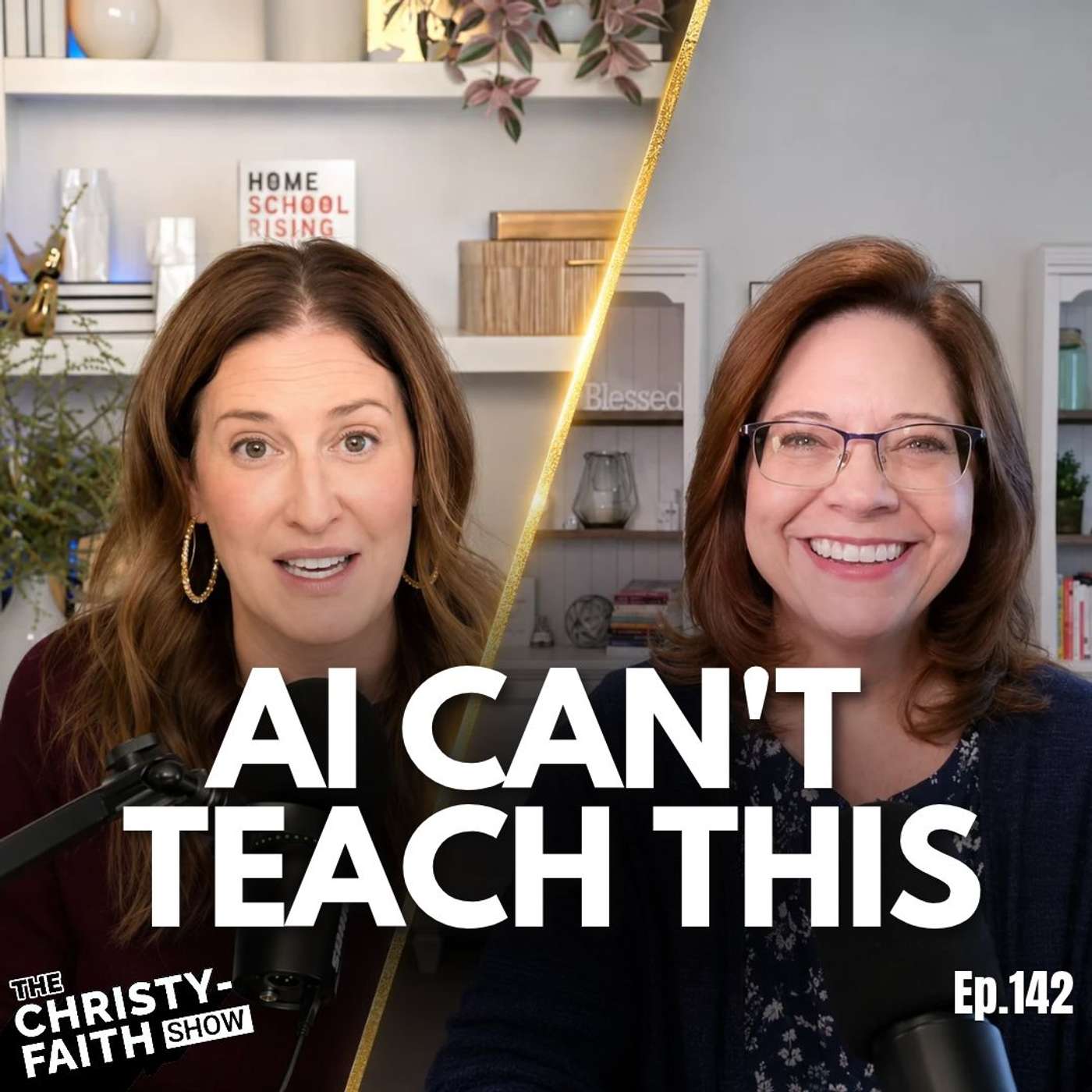
Should your kids be using AI like ChatGPT for school — and how do you keep it from doing their thinking for them? Homeschool expert Christy-Faith sits down with Nancy Manos, host of the AI and Your Homeschool Podcast and a homeschool leader for more than 20 years, to talk about AI and homeschooling with wisdom instead of fear. 🎁 Free Resource: My Curriculum Recommendations I spill the tea! No paid sponsorship placements! Grab the list, by subject, of the most reputable homeschool programs on the market (in my opinion). 👉 Free Download In this episode, you'll learn: What AI tools like ChatGPT actually are — and a Christian perspective on why they can't replace human relationships or spiritual guidance How to raise kids wisely with AI without reacting in fear or blind enthusiasm Why AI can sound confident and still be completely wrong — including a research study it made up Privacy and flattery: what to watch for every time you type into an AI tool The critical thinking skills kids need for jobs that don't even have names yet Why the struggle of learning builds a "muscle" AI can't build for your kids The question to ask when your child says, "Can I just use AI for this?" Practical ways homeschool moms can use AI — from multi-age lesson ideas to field trip planning Sponsors: BJU Press Homeschool ✔ Flexible curriculum to fit your family's needs ✔ Biblical worldview and critical thinking built in ✔ Hands-on learning for every grade level 👉 View Samples CTC Math ✔ Get 50% off my favorite online math program ✔ Adaptive lessons so kids build confidence at their own pace ✔ Teaching, grading, and testing — all done for you! 👉 Free Trial 👉 Get 50% Off Summit Healthshare ✔ Save 40–60% vs. traditional health insurance ✔ See any doctor — no networks, no permission slips ✔ Free labs, office visits, prescriptions on select plans 👉 View Health Plans & Savings Resources mentioned: AI and Your Homeschool Podcast — Nancy Manos's podcast for parents navigating AI and technology Free Family Discussion Guide — Nancy's free guide with questions for parents, teens, and the whole family The Trojan Horse of the Digital Age: Why Christians Must Discern AI — book by Misty Phillip The Christy-Faith List — Find homeschool-friendly providers Thrive Homeschool Community About our guest: Nancy Manos homeschooled her two daughters from preschool through high school and has served in homeschool leadership for more than 20 years. She is passionate about encouraging and equipping parents in the homeschool adventure. Nancy hosts the AI and Your Homeschool Podcast, where she helps parents raise children wisely and with discernment in a world of rapidly changing technology. 👉 nancymanos.com Connect with Christy-Faith: Instagram: @christy_faith_ TikTok: @christy_faith Website: christy-faith.com Book: Homeschool Rising 🎧 Love the show? Follow, subscribe, and leave a review wherever you listen — it helps more homeschool families find us! (00:00) - Introduction (02:33) - Raising Kids...
Nancy Manos: AI, think of it as a computer tool. Right? It can create images and all sorts of amazing things. But what it can't replace, what it can't do is it can't have a human relationship, and it can't give you spiritual guidance. It will it will try. It will say, have you ever heard this? I've talked to so many people that have been using it to plan something that they're working on and it will say, I'm praying for you. Okay, What? Email Yes. Christy-Faith: Wait, woah, woah, woah, no. Welcome to the show, everybody. This is a topic that I know is buzzing about. You've heard all sorts of things on social media and podcast episodes on AI and what do we do with it. I wanted to do a podcast myself because I think as Christians, we need to have a perspective of wisdom in light of scriptures on how we are to view AI and this technology that is just rushing at us faster than we feel ready for. And how do we manage it? How do we harness it? How do we utilize it to make our everyday lives easier? And to what extent do we allow this into our homeschools? I asked the perfect person to come on to answer all of these questions that we are all asking to give us nuggets of wisdom and framing for how to think about these things. And her name is Nancy Manos. She's actually a friend of mine. She has been in the homeschool space for over twenty years in national leadership. She is the host of AI and Your Homeschool podcast, where she helps parents navigate raising children in a world of rapidly changing technology. Thanks for coming on the show today, Nancy. Nancy Manos: Thanks for having me. I am so excited about this conversation. Christy-Faith: Yes. And we have talked about this, you and I, on several occasions. I'm so excited about the launch of your new podcast. How's that going by the way? Nancy Manos: It's going great. I am really excited. I'm learning all things video editing, and I've had some amazing conversations with people that have led to unexpected learning adventures even for me. So it's been really fun. Christy-Faith: Oh, man. Yeah. So make sure to tune in everybody because your whole podcast is on this issue of AI, isn't Nancy Manos: it? Yeah. Christy-Faith: Okay. And then the guests that you have on, they have different areas of expertise. Right? So they can speak into particular areas. That is just so fascinating and valuable and much needed right now. So I wanna ask you the first question today, which is how do we raise children? This is a bit... That's a doozy, Nancy. How do we raise children wisely in a world where AI is becoming increasingly powerful and pervasive without being scared. Like, how are you approaching I know you use AI. I use AI with some of my stuff. I have failed with AI. Half the time I say Claude and I are in a divorce because he fails me so often. But, you know, we also don't wanna have blind enthusiasm. Right. So how have you been thinking about this lately? Nancy Manos: Well, I think it helps to to realize that neither extreme serves us well or serves our children well. Like, being fearful is not helpful. And also adopting new technology without thought, embracing it blindly is not also helpful. And so I think it's just really helpful to think about, we don't have to panic, we don't need to be in fear, but we might not also want to embrace technology just because it's new and shiny and exciting and everybody that we know is using it. So using some discernment is really helpful, but you know, our role as parents hasn't changed, right? We're still discipling our children, we're raising them to become future adults, we're forming their character, we're helping them to grow and learn. And so the landscape may have changed and technology is changing fast, but our job as parents has not changed. And so it might be a little harder and we're gonna talk a little bit about this because I think it can be scary. I think there are some scary elements to technology, but we just need to stay engaged. I think there is this thing where parents are like, I don't want anything to do with that. And we can't afford to bury our head in the sand because it's not going anywhere, which I know we're gonna talk a little bit more about that. Christy-Faith: Before we move on, I just wanna say thank you for being here truly. Subscribe, hit that like button, and leave me a comment. And real talk, I recently looked at our YouTube stats, and over 90% of our watch time is coming from people who are not subscribed. So if you are one of those wonderful folks who keeps showing up but hasn't actually hit the subscribe yet, well, this is your official nudge. Why am I even asking? Well, subscribing tells those little robots behind the screen that this show is worth putting in front of more moms, and it helps us keep making these episodes for free to you. And if you really don't wanna miss the next one, tap that bell too because only a tiny sliver of you have notifications on. I see you. Maybe do three things for me today just because you Subscribe, like the episode, and leave a comment telling me what part of this hit home. We read all of the comments, and we love watching you show up for other homeschool moms in there. It really does make a bigger difference than you know. Thank you in advance, friends. Love you. Yeah. And that's the thing. Last year in my co op, I taught, I think it was a four part... I can't remember if I taught a four series class or a five series class, but it was on digital literacy. And what was really interesting is... And these were all high schoolers, and so we were kind of able to talk about what their interests were for post graduation. Like, whether it's college plans or or getting other other certifications or degrees in the trades or or technologies or whatever. But one of my homework assignments was research how... You know, not that you need to decide your future right this second, but Right. Think of one or two that you're interested in and look at how AI is being adapted into it, is going to change it. Because if you wanna have the edge in that particular field and to be employable or desired as as an employee, for example, you really need to embrace this and know it to an extent. And that's really hard. I think that in the Christian homeschool space in particular, I do... I don't... It's not many of my personal friends, but I have experienced a fear of kind of all technology even Sure. From social media to to passwords on phones. And I I think that I think you're right. That's not serving us either. Plus, I think that maybe there's some misunderstanding about if you simply own a phone, you really have no privacy anymore. Like, don't don't delude yourself into thinking that you have privacy that you really don't. If you have any app, any email, Gmail. Right? But I think that a great place to begin the talk today, which was your suggestion, I think it was a fabulous suggestion, very classical, is let's define terms. So what is AI, and what can it do and can't it do? And I know this is gonna sound basic to the listener, but I do think it really does need to be defined before we start talking about benefits and drawbacks and how to use it and embrace it. I think we need to start with what it is. So what is Well, Nancy Manos: of course, AI is a super broad category. But I think when we're talking about, we're talking about tools like ChatGPT and Claude and Gemini and Grok, those kinds of large language models is typically what we're talking about when we are talking about AI. So they are systems that are trained on huge amounts of data and they're trained to recognize patterns and generate responses. So it's basically a sophisticated predictive text machine. But what makes it unique is that it can sound human. It doesn't mean that it is human, and it certainly doesn't have things that are human in nature, like wisdom and beliefs and judgment and values. The fact that it sounds human can be a problem, I think, especially for teenagers, but even for us as adults, because it can sound like you're talking to a person and you're not. And so I think that's one thing that we need to be aware of that it is not human. It can also be confidently wrong. And so it will give you an answer that it sounds like this is absolute fact, and it could be totally fabricated. We need to have knowledge and discernment and judgment when using these tools, because we have to be able to determine, is this real? And what questions do we need to ask to get a little bit farther? So it can do some really great things. You know, computers going back, I mean, I'm old enough to remember the advent of the internet. We were young maids when we got the internet, but computers are useful. It's a useful tool that can do things like organizing information and it can help you brainstorm or helping you plan or summarize. And so AI, think of it as a computer tool, right? And so it can do some things really well. It can do coding. It can do, I mean, it can create images and all sorts of amazing things. But what it can't replace, what it can't do is it can't have a human relationship and it can't give you spiritual guidance. It will try. It will say, have you ever heard this? I've talked to so many people that have been using it to plan something that they're working on and it will say, I'm praying for you. Okay, algorithm. Yes. Christy-Faith: Woah. Woah. Woah. No. Yes. That's my... You know what my son would call that? My son would say... Because he he uses Gemini, and he calls it glazing. Like, Claude, mom, don't let Claude glaze you. Meaning, just give you what you wanna hear, you know? Yes. That is frightening that it has said that to Yes. Nancy Manos: But it cannot actually pray for you. That's where I think we need to be wise. So one of my favorite episodes of the podcast was with Misty Phillip, and she's the author of The Trojan Horse of the Why Christians Must Discern AI. And she talked about how we have to put AI in its proper place. So we have to let computers do computer things, and humans should do human things. Christy-Faith: I think that's a beautiful way to phrase it. And I I would say my perspective overall is in general enthusiasm. Part of it is because I'm a trained historian, and so I can trace back to major technological ages and massive changes in technology with the Gutenberg press. And you can trace the the industrial revolution, and you realize that technology changes, it can make life... I'm I'm almost hesitant to say easier because the human life, the human mind is very complicated and very emotional. But it can make... You know, you... You'd had to do dishes before. Now you have a dishwasher. Okay. So what are you doing though? You're just adding more things to your day. If that's your human nature to fill your days with stuff to do, it doesn't really help you. You're still... If you are a busy type person, you're still gonna be a busy type person. So that happened to me because I had a... An assistant that had to go on medical leave. And I thought to myself, oh, Claude's this brand new thing all over the Internet was Claude agents. Make an agent. And I was like, I'm gonna give myself a half of a week and try to build an assistant that can do all these things for me and connect here and this and that and the other. And it worked for a while, and then it just added... It just made more for me to accomplish. It did not simplify my life, and then it just made all my deadlines speedier. Like, it just made me more rushed. And that is what I realized looking back is that's a me problem. Like, humans are gonna bring their me problems to any new technology that there is. Right? So Yeah. I think that's so important to realize that... And still be in touch with our own humanity and our own struggles and our own spiritual walk when we are coming in contact with all these technologies of all kinds. Yeah. It can't replace human touch. There was someone I was talking to asking, well, what jobs is it not gonna replace? And and I think we'll talk about that later. Or maybe I can just ask you now, like, as homeschooling parents, we wanna prepare our kids for a bright future. All of us do. And that means a lot of things. That means giving them the skills. We don't want any doors closed on them. We want them emotionally healthy. We want them spiritually healthy. What do you see as the skills considering when we're looking ten years from now, we can't even name the jobs our kids will have. No. We don't even know what they are going to be called. So how do we homeschool now? Homeschooling for kids means I'm juggling roughly 24 different subjects at any given time. And a few years back during a particularly busy season, I hit a wall. I needed some serious help with the heavy lifting of teaching everything myself and managing schedules for four kids. That's when I found BJU Press Homeschool, and we've loved their courses so much that we keep going back. Some families use them for everything and love it. I use them for certain subjects. Either way, total mental load relief. Here's what my mornings look like now. Let us take science for example. My three girls do that one together. They fire up the lesson taught by a real teacher, well produced, actual teaching, not just click through busy work. And I sit there with my coffee, watch them, or make breakfast, and we discuss the big ideas. Every BJU Press homeschool course prioritizes critical thinking, a biblical worldview, and hands on learning. I just guide the conversation and pick which activity or pages or projects we want to do, and everything's already planned out. They have an online platform included for you called the homeschool hub, and it keeps everyone on track, both me and my kids, without micromanaging or nagging. And when I have questions, I call my Homeworks consultant. These people don't just help you get set up. They're available for you whenever you need them. It's like having a homeschool expert on speed dial. Go to bjupresshomeschool.com or click the link in the show notes to find out more. I wanna talk about homeschool math for a minute, specifically CTC math, who I'm so glad is sponsoring this episode because you need to know about them. I'm picky about curriculum, and there are a few subjects I won't compromise on, and math is on the top of that list. CTC math is what I use with all four of my kids, and it's an excellent k to 12 math program. Rigorous, thorough, comprehensive, everything I want my kids to have education. But without all the stress, the tears, and me having to learn long division all over again. Here's what happens at our house now. My kids log in. A real math teacher walks them through the lesson four to nine minutes clear, step by step. They do their lesson and finish up with practice problems. The program grades them, and I don't have to remember how to do fractions with unlike denominators or where exactly they left off last week, which means I get to be the mom in the room. I can sit nearby, listen in, encourage, fold the laundry, and watch math get done beautifully. Easier on mom? No sacrifice on academics? Yes, please. Join me and tens of thousands of homeschool families using CTC Math for their go to math curriculum. Links in the show notes. Grab your free trial today and you'll see why we love it for our kids. Nancy Manos: You know, they need a good solid base of knowledge because when you get an output from a tool, you need to be able to assess, is it true? How do I know it's true? Where do I go to verify that it's true? So they need research skills, you know, critical thinking, the ability to look at information and ask those questions, relationships. I think one of the things that they also need is to develop some perseverance. And technology can remove friction, which can be a good thing, but it can also remove friction that we actually need to learn things. Like we have to think of learning like a muscle, right? We have to exercise it. We have to grow the muscle of thinking and learning. And if you remove the struggle, then the muscle doesn't get built. And so I think it's a balance, right? So we're teaching our kids, they need to know scripture, they need to know history, they need to know science, they need to know how to build something with their hands. You know, you can have Chatuchipiti write an essay for you, but if it writes the essay, you've learned nothing. Even if you read it five times over, you really aren't retaining the information that it gives you, if it's accurate. And then there's something to reading whole books, to writing awkward paragraphs, to learning how to be a good communicator that only comes from actually doing the work. And so I think those actually non technology skills are the skills that are gonna set our kids apart, that when they engage with technology, they'll actually have greater success. Christy-Faith: Yes. And while you were saying that, what I was reminded of is all of us in this current generation as adults right now, we are coming into this age of AI with those skills intact, hopefully. I mean, even if you got a a... What you would consider a poor education, you probably were taught how to write a five paragraph essay. Or Right. And so if I have any fear, it's in that. Whereas, do we really understand? Because we're... It's making our lives easier. It's helping us, you know, outline this or or whatever. But do we really understand what we're bringing to the table already that Yeah. That our kids won't have? And I think that's so important with, like, learning how to write and also the skill because so much of writing is thinking. And so not building that muscle, I think that's maybe a framework to when a kid's saying, can I just use AI for this, mom? Which my son asked me that all the time. Right? Can I just use AI for this? And I ask him, okay. Well, what is it? Right? For example, last year, he had a end of year presentation, and it was in cultural geography. And what he did is he put all the facts together himself that he wanted, but then he asked me, can I use this cool new AI that I found? Because it will build a song. Oh, yeah. It will build an AI song out of the material. And to me, I thought this was an excellent use of building his technology skills. Like, he... I knew he had done the work. It was the end of the year. I had been there the whole year. He knew the material. And and so would other people side eye me for that? Like, oh, Lincoln didn't do a real presentation. He played a song, but he he picked the pictures pictures for the song. So, anyway, so that was... I I asked myself, okay. Well, where's the benefit here for him? And Yeah. For us at the time, it was... He had done a lot of public speaking that year already. Yeah. Let's learn how to use this new thing. I've also done things where I want you to learn graphic design. Right? And so I've also had him do stuff like that, like go on Canva. Like, hey. I want you to make... You know, rather than an essay for this, I want you to go and make a Canva poster. You gotta learn Canva. Right? So... But... Yeah. So let's talk about those ethical concerns for a minute here. And maybe I'll just let you speak to this because there is misinformation. Because I've actually tested AI, and I've gotten kind of scared, like, on... I've, like, deliberately pushed it Nancy Manos: Yeah. Christy-Faith: To see what would respond. Have you done that? Nancy Manos: I have not pushed it that far, but I have a... An example to share. Christy-Faith: Yeah. And it was a political thing. It was politics. Yeah. Like, is, you know, is is Claude a democrat or republic? Like, I, you know, I wanted to, like, see what would... I put in something very controversial. And so... But what about this? And by the way, I was scared at the answer. Sure. Let's talk about misinformation, cheating, ethical concerns, privacy, safety. I'm always scared when I use AI. Like, this is here forever. Like Yeah. People can pull up chats from... Have there been court cases yet where they've used? Nancy Manos: I don't know, but there will be. And I've also just, I read an article where, if you put anything regarding a case, like maybe you're being sued or you're in a lawsuit, if you put anything into an AI tool, it's now not covered by, you know, attorney client privilege. Like, there's so many different ways that this is, expanding and becoming a scarier entity. It's a wild ride. Christy-Faith: But let's talk about that. Let's talk about Yeah. What concerns you do have. So you mentioned one about the... If you're in a lawsuit, that's pretty frightening. Be careful what you put in. Yes. What else? Nancy Manos: Well, I think we have to treat AI tools just like we would the Internet or social media or email or text, anything you put in writing. Just imagine that it can be viewed on a large screen in a stadium full of a million people. Like we just have to be wise in what we're putting in. So the example that I was thinking of when you were talking about that, when you pushed it is, unless you set up a tool like ChatGPT or Claude with some more specific direction, it is by nature sycophantic. It will tell you what you wanna hear. It will make it sound like you are the most brilliant person and you ask the smartest questions and you have the best insights. And then if you push back even a little bit, and I use it daily, I am an avid AI user and I am pro technology, but I, you know, I see the problem. So I'll, I'll push back and I'll be like, well, I don't really like this when you said that, or this is not true. And it'll be like, you're absolutely right, Nancy. And I think Christy-Faith: shouldn't a have said that earlier. It's like, you're not helping. Nancy Manos: No. Well, and it's... It will tell you what you wanna hear. It's like the most... I don't know what the word... What the the personality trait is that will tell you whatever you want to hear, but Christy-Faith: Flattery. Right? Flattery? Nancy Manos: It really is. And so there are ways to add settings that will, you you can tell it to be more direct and don't flatter you and things like that. So I was interviewing Sean Dickers and he was talking about, he was looking for homeschool research. And I can't remember what tool he said he used, maybe ChatGPT, but he had asked for how homeschoolers are doing, standardized testing or something. And it came back with the name of a study, the link to the study, the statistics sounded very in line with all the research we've seen for forty years from Doctor. Brian Ray with Neri and other places. And then when he went to find the study, it didn't exist. It completely manufactured the whole thing. And so we just need to know, it isn't that it's dishing up facts and truth. It's dishing up a reasonable response. You know, what is the next thing it should say based on what it's been trained to say? And it's been trained on tons of data. Some of it accurate, some of it not. And so I think that misinformation... Because it sounds very confident when it gives you its answer. This is the fact, and it might be a house of cards. Christy-Faith: Did you did you happen to ask him if he was using a free version or a paid? I'm curious about that. Nancy Manos: I didn't. Christy-Faith: Okay. Yeah. Because... And and also because I use AI for research because a lot of my podcast is I need to pull up studies, and then I say, fact check it. Give me the links. Right? And then I actually click on the links and go and check. And at least my paid version, I have not found that. And I do a lot of research, but that's one of the reasons why I went to a paid version that was... Is not cheap. Because, you know, being a writer, you have to fact check everything. And I'm not gonna say anything that I don't know is true for sure. But I'm just curious about that if that's a problem with the free models or not. I don't know. But is very interesting Nancy Manos: to learn more about. I don't know, you know, the difference. I know you get a little bit more functionality when you do have a paid account. I have two, Claude and ChatGPT. I pay the $20 a month and it gives me what I need. That's a really good question and observation, you know, maybe it is with the free version. Now I haven't used it myself. I would like to, is a research tool that a lot of people talk about is perplexity. Have you used that at Christy-Faith: Yes. I've been meaning to try it out. Nancy Manos: Yeah, me too. I just, you know, there's so many tools out there. That's the other thing that I would tell parents is a lot of this, it can feel very overwhelming. Like you need to be an expert in order to teach your children. And one, that's not true. And two, it's impossible. Christy-Faith: Right, right. Nancy Manos: Because not only are there 10,000,000 tools, but the tools themselves change. And so by the time you learn how to use it, now it's a different thing. Like it used to be NotebookLM, where you could create these notebooks and it would only use the information you put in them. It still exists, but now it's called GoogleLM. And so... Yeah. No. Google Notebook. Is that right? Google Notebook. Christy-Faith: Yeah. Nancy Manos: Is that right? Now I'm now I'm not positive on on the name Christy-Faith: of Because my son was studying for a test because he's doing dual degree, and he had a study guide. And he used NotebookLM or whatever the new name is, and it turned his notes into podcast episode he could listen And to while he was working I was like, dude, that's awesome. Nancy Manos: It is awesome. Yeah. There are some amazing tools, but just, I think the thing, take the pressure off yourself. Don't need to master any of these tools. You're learning alongside your kids. And I would say, don't rush to having your kids using AI tools. It really is about preparing them for life to be solid thinkers and researchers, and then knowing that technology is out there. So that deviated from the topic, I think. Christy-Faith: No. No. And I think, you know what we're gonna have? We're gonna have AI radar very quickly here. Kids already have it better than us. I can scroll through social media, and Lincoln can say that's AI. That's real. That's... They can see it even better than I can. But have you been doing this lately where there's just this slew of all these new websites? Even in the homeschool space, I'm like, unsubscribe, unsubscribe. Don't unsubscribe for me and Nancy. Okay? Listener. But unsubscribe from the AI slop, please. I'm just like, can you stop? And then I go to a website, and it is so clearly an AI slop website. And I'm just waiting for all this to blow over for just, like, all these people to realize this this isn't gonna... We we can see it. We know this isn't a person who actually cares behind the screen here. And I'm curious, do you think all that's gonna blow over, or do you just think we're gonna be more fooled? Nancy Manos: Well, I think both. I think I think our kids are smart and they have a good, strong intuition. And I think they prefer actually human things. And I think we're gonna see, like this is my prediction. I think we're gonna see a return to more in person events because people are tired of being fooled and you can't always tell, is it AI, is it real? And I think we're gonna crave more humanity as technology becomes bigger and bigger and more part of life. And so I don't know, I don't worry so much about our kids if we equip them well. But I think we are seeing more and more, like you'll see the trends, like all of a sudden there's a new graphic style and everybody's social media post has this new graphic style. I'm like, I know where that came from. Christy-Faith: You know? Yeah. Yep. Absolutely. Something that I love that you said is that that struggle and that friction that is learning. I've often talked to my girls when they're struggling with something. I often say the definition of learning is actually frustration. You have to... You go from not knowing something to knowing something, and this place in between is discomfort. It and and that means... Now I wanna match it really well, but it's okay to be there. And I think you're so right in in asking ourselves in our day to day... So, like, getting practical for a second. In our day to day homeschooling, how would a mom use AI? Like, I've used AI when I didn't wanna learn a new math lesson. And I went to AI and said, using teaching, you know, print out a lesson for a fifth grader with this, your decimal. I even forget what it was. And then I hit, you know, with the practice problems and a teacher answer key and this voice or whatever. And I hit print, and my daughter disappeared. And she came back thirty minutes later completely understanding the concept. And I was like, did I just cheat? Like, I... You know? But, you know, at the same time, we didn't work through it together. She didn't see me learn it again. It wasn't time together. There was a cost. Nancy Manos: Yes. Well, I think any tool that we use that makes things easier also has the potential to create a deficit. So if we're not doing the work ourselves, there's a deficit created there. And I think that's what you were talking about with our kids. Like we grew up in an era where we had to do the work. You had to write the essay, you had to do the research project, you had to, do these things. And it was, it's not that cheating is even new when you're talking about challenges with tools like this, the tendency to want to cheat is still human nature, right? Whether it's, you have access to the teacher's manual or have access to an AI tool that will give you the answer. But I think there are so many ways that we, as homeschool moms can use AI that will help. Like maybe you're studying something, I don't, you know, pick a topic. Maybe there, you want to do some research. Is there a field trip in your area that would enhance what you're learning? Is there a concept that your child is struggling with and the curriculum can't help them figure it out and you haven't been able to, so is there a different way to learn it? Maybe you're like me, and now I only had two kids, but if I had had 10, I would have had the same education approach where we wanted to do as much of our learning together as we could, because it's relational. Like I didn't wanna create also different history lessons and science lessons. I wanted to do things together. But say you have four or five children and they're different ages, and you're studying ancient Egypt. Well, you can ask AI to give you activities and assignment ideas for the different age groups so that you're all learning together, but it's age appropriate for each child. Or maybe you have older kids that you're homeschooling and you've got some little ones and you need some ideas to keep them busy because they will burn your house down if you're not watching carefully. You know, so things like that. I love, like I love field trip planning or maybe it's, you're going to see a play and you want some... Without it feeling like an assignment, you want some discussion questions you can ask on the drive there or the drive home. You know, just so that you have some thoughtful takeaways instead of what did you think of the play, you know? Christy-Faith: Yeah. And all of those are so great. And I do those too. We just had... Oh, I was just in Orlando with you, and we stayed extra days, and we did two day pass. I can't believe I did two days in a row at an amusement park. I've never done that before. That was a lot. But we had my husband... Because we know you have to have some strategy to the parks. Yes. Right? There's certain times of day to hit certain rides so that... Right? And so we used AI to plan the park time. Awesome. What restaurants to go to that were near here for that, this and the other. And it was... It made some mistakes, but it was pretty good. But, yeah, I just love it for that. I'm teaching US history this year, and me and my co teacher, we use AI to brainstorm. Oh, okay. It's on the Magna Carta. Go search the Internet and tell... Come with, you know, three really engaging projects that aren't expensive. Right? We're a self pay co op that we could do with the class of 13 kids. And we did the Dead Sea Scrolls, and we did a scavenger hunt. The kids loved it. And it was, you know, we... It... I think it's so fun to use technology for that kind of a stuff. But... Okay. I have a question for you. This is this is a curveball. Nancy Manos: Okay. Christy-Faith: But I I... I've been thinking about this. So we are very concerned, rightfully so, with the lost skills then AI is... So, oh my goodness. Our kids aren't gonna learn how to write. Yeah. Okay. Yes. Our kids need to know how to write. Yes. Other skills. I'm wondering, though, are there some skills that really aren't going to be needed anymore, like, all? Like, think of tools from the industrial revolution, some random farm tool that is you literally don't need the skill to use that tool anymore. So do you... Are... What do you think? So I... What's coming to mind is my kids had to do a research paper, and I was tempted to just go on the inner... Go on AI, and have it print out and make a cute encyclopedia entry page. Rather than having my kids have to go on Wikipedia, and this, and that, and the other. And I... That's what came to mind, like, that particular skill, for example. Do we need to go to live? This is this is like crazy. I'm probably... People are gonna be like, Christy, be quiet. But going to the library, looking stuff up, like, isn't everything gonna be digital at some point? Can you think of any that's like, no, we can we can let that one go? Nancy Manos: You know, I can't offhand, but I think there is something to still learning those skills even if you don't need them because then you have a foundation of knowledge. There is something to opening an actual book versus a book on a Kindle or on a PDF online or whatever. And so I would hate to have people rush past something that they think isn't needed anymore because you can easily find it online when there's something really rich about holding an actual book in your hands. Not that things can't be done online and you can't watch a video and you know, that kind of thing. So I would love to hear if anybody has ideas. Christy-Faith: Yeah. Put in the comments, you guys. And it's so funny because a friend of mine made a comment about me the other day is like, oh, of course, Christy's gonna go paperless. It was kind of a... Because everything I'm like, no. Don't give me paper. Right? And also, like, with that, with the Kindle, I agree. I love holding a book. I love smelling a book. And often I need a break from screens, and so that could be a reason alone. But I also think that's our generation because that's that's very comforting for us to have a book and smell a book. Because I've noticed my kids don't have that. Even though they like books and they like holding books, they don't have that attachment, like a sentimentality to books that I have. So it's just gonna be different. It doesn't mean to not have physical books because man... So even this morning, I'm interested in this new bible study that I wanna do, and I had the option of doing it on my phone. And I ordered the book. Yeah. It's like when I wake up in the morning, do I really wanna pull up my... I'm on my screen all day long. And the screen stuff is a concern. Ask any occupational therapist. You know, ask anybody. That is a major concern. We've gotten off on a tangent, but this is so fun. Nancy Manos: Good tangent. Christy-Faith: Alright. Next question that is a little bit more abstract, but I think important, and that is, let's talk about the type of adults that we are trying to raise. What should our children be able to do without technology? I think that's a question we're all asking every day is, okay. Is my kid gonna need this? Is my kid not gonna need this? And what parts of childhood are are worth protecting even when technology can make something so much faster? This is... That's loaded. But I wanna hear what you have to say Nancy Manos: about it. Question. It's important. Yeah. Well, I think, you know, we're not just trying to reach kid... Teach children who ultimately become efficient with technology. Right? I think just naturally, they're going to learn what they need to learn. And technology comes natural to them. Our children are growing up in the digital age, right? They're digital natives. My children were not. Social media didn't come in until their teen years. But even so, my husband is a technologist, so we always had computers in the house and they've always had those skills. But today's children, my grandchildren are growing up where, you know, it used to be the joke that our kids could run the VCR and we couldn't. Well, now it's, they can, you know, run the world on an iPad. But I think, just think about, what's your purpose even in homeschooling? Like, don't you wanna raise kids who know and love the Lord, who care for others, who have skills, you know, because each one of us is born with some kind of gift and talent and, you know, propensity towards something. And so our job as parents hasn't changed because of technology. We're still unfolding the gifts that are inside of them. We're nurturing those gifts. We're giving them opportunities to grow and develop. They still need to write well. They need to read vast amounts of things, different types of books. They need to be good communicators because that's a human connection, right? I think they need to know how to do research and make decisions and things like that. But they also need to learn how to work through problems. They need to not just be rescued the second something is hard. So we want them to build resilience and building resilience is that uncomfortable space, right? It's when things get hard and there's a struggle. So I think, you know, things that are worth doing well because of the people we get to impact. I think there's something to doing something, creating something with your hands, doing something that makes someone else's life better. That's still a goal we have for our kids. Now, over time, they can use technology and they may be required to. And so I think that's something, I think if we raise them to have wisdom, and discernment, and have integrity, that when they're in a job that requires them to use AI, and be proficient with it, they're gonna be able to use it wisely. And so it's all of those human things. I don't, it doesn't like the question doesn't really change the answer, does it? We still are trying to raise human beings who are kind and compassionate and thoughtful and have good character. Christy-Faith: Yes. And what I always keep coming back to is... And this is gonna lead into my next question, the advantage of homeschooling in this new era that's so unknown is skills. Right? So Yeah. One question I try to ask myself when my kids are saying, can I just use AI for this? I ask myself, well, is this going to replace their thinking? And if it is, then I'm hesitant or cautious or I say no. And I think that's gonna give homeschooling, homeschooled kids, homeschooled graduates the edge because we will have a generation of people who can't think. So the same with numeracy. People don't realize, you know, when you've... Every kid has said when they're when they're throwing the pencil across the room with long division, I'm never gonna use this. And actually, they're right. They're probably never going to use long division. People don't realize that. But you know what they will use in the long division is the working memory, the multistep problem solving, the neuroplasticity, the connections that are made in the brain, and how that connects connected to logical reasoning. So Right. It's a difference between viewing education as content, like get those questions right, finish that page, or education as skills. I don't care if you get every question wrong. We'll just retry it, and we'll work at it till you till you get it because it's important for you to think in this way, which is what homeschooling can do. I think it's just so important. But how else Yeah. This will be the last question, and I'm gonna frame it in a way that's personal for you. You already raised your kids in a different age. So put yourself in my position now. I have a fifth grader, two seventh graders, and a sophomore in high school. Do you have any specific things that you would do differently or omit or add to your current homeschooling if you were me right now. You chose to opt out of the conventional school system because you looked at it and how it measured kids and said, nope. Not for my family. Did you know that a lot of us can and have done the same thing with traditional health insurance? I wanna tell you about a different way to take care of your family's health care needs. And it's a way that's been around for over a hundred years, and it's saving families like mine a ton of money per month. For my family alone, it's a thousand dollars a month we're saving. So huge thank you to podcast sponsor and my husband's company, Summit HealthShare. So if you're not familiar with health sharing, here's the short version. It's not insurance, but it can replace it. What it is is it's a community of people sharing medical costs. With Summit HealthShare, families on average save 40 to 60% on what they were paying for traditional health insurance, and they have a 98 customer satisfaction. You can see any doctor you want, even crunchy ones. Love that. Love me some crunchy doctors. And there are different plan options. Maybe you just need major medical. They have it. If you want something a little bit more like me in perimenopause and I need a lot of labs, I'm on a plan that gives me free labs, free prescriptions, and no co pays. Sorry to get personal, but it matters. And I know it sounds too good to be true, but it's not. It's actually how health insurance should work. So if you are on traditional health insurance, just do this one thing for me. Go to summithealthshare.com and do the savings calculator. It takes you, like, two minutes because it will tell you what you should be paying for what you need. And when the result pops up and you spit out your water, you're gonna be spraining your ankle running to the phone to find out more. And when you call, they will walk you through everything. Tell them you listen to the show because I've told them that you need to get the VIP treatment. Go to summithealthshare.com. A link is in the show notes. How would you like to know which businesses, doctors, and organizations in your area share your same homeschool values? What started out of necessity for my family, finding safe service providers and doctors has turned into something really beautiful. A whole community of colleges, businesses, doctor's offices, reading specialists, you name it, all in one directory. It's The Christy-Faith list. A place where homeschool families can find and give business to the people who share their values. And it is free for homeschooling families to search. And if you're a business owner listening today and you love working with homeschooling families and wanna reach more of us, sign yourself up. We wanna know who you are. The Christy-Faith list. Support the people who support you. I'll put a link in the show notes so you can search the list right this second. Nancy Manos: I think we did some things really well, and some of the things that I would encourage parents to do today is to continue have dinner together and have conversation. No screens at the table, talk to each other, have meaningful conversations, review what you've learned, like those kinds of things. Play board games. Like there's something about laughing together, but also you're learning strategy and things like that. There's so much that I feel like was beneficial to our homeschool experience. And at the same time, especially with my husband, he taught the girls how to code. And they say now with AI, you won't need to know how to code, but somebody needs to know how to code to find out if the machines are coding correctly, right? That's right, yeah. What if they can't do it well? Somebody has to be able to untangle the mess that has been created. And so I think there is this balance of like real things and technology skills. The thing, the advantage that we have as homeschoolers is time. We have time with our kids. We're discipling them. We're walking alongside them, whether that is how to work through a math problem, how to fold laundry, how to chop vegetables to prepare dinner, you know, how to create a nutritious meal versus, you know, just fast food takeout. Nothing wrong with that, but we need some nutrition too, you know? So there's all these skills that we get to do alongside our kids, and AI can be one of those skills that we get to teach them. And I think that one of the great advantages to time is if something starts affecting them negatively, you know, if they're online, whether it's social media or something like a chat GPT, you can tell things are going south. You can pivot faster than you can with a classroom full of children, right? And then you're not making decisions for a classroom full of children. You're making decisions for your unique individual children. What are, what is the purpose of the assignment? If the purpose is to learn this skill, then don't use technology to bypass the skill. Right. You know, so there's, I mean, I don't know, Christy, there's so many different things, but I think we have the opportunity to really be in the learning with our kids. And you know what, if it's a rough day, if everybody's cranky, if you have hormonal teenagers, whatever, like go outside, go for a walk, go for a bike ride, you know, whatever. Like, we have this incredible flexibility because we're not in a system and we aren't managing a large class. Even if you have 12 children, can, you know, flex on the fly. Christy-Faith: Yes. And also, when you were talking, I was coming back to what we're always telling moms who are new to Thrive Homeschool Community. There's... We have them take this class. It's a video class that when you're in Thrive Homeschool Community, we have them take this class within the first week of being in our community, and it's the finding your why workshop. Nancy Manos: So good. Christy-Faith: Because I can... We can advise moms only if they know what they want. Yeah. Because that's our job is to help her figure out what she wants for her kids, how her kids learn, and all... And that whole formula, and then we can help and advise. But you said something that I think is even more granular than that. We should be asking the why of every day, I think, with assignments that... Is this busy work? Is this not? You know, why are we doing this? My daughter was writing an essay, and she was getting... Actually, she was writing a fable, which is so cute because it had a little moral of the story at the end. It was adorable. And she was getting frustrated with her spelling. And I said, girl, I feel it. I know it. But do you know what they tell professional authors to do? They say, get it out. Get out a really bad first draft and have it out there, and then you edit later. And that that was the friction. She wouldn't have had that friction if she... And that skill and also frustration tolerance. And so I do think that there are really good nuggets that you've shared because you've thought you spent so much time thinking about this. Some great nuggets, like, is it missing a skill, really knowing your purpose, and so many other things. I am so thankful that you took the time with me today to talk about these really important topics. We're gonna put everything in the show notes on how to... How people can listen to your podcast. Any links that you think would be helpful for moms, we wanna put in the show notes. So those will be there for those of you listening. But is there anything in particular that you want us to be aware of that you can say out loud so that people may not have to hunt in the show notes? Nancy Manos: Well, I have created a family discussion guide that I think can be really helpful around these ideas. So it's got questions for parents. It's got questions for teens. It's got questions for the family. And just to help you kind of think through, how is your family? Because your family's unique. Every family's gonna have to decide for themselves, how is technology gonna be part of our children's education, to what extent, you know, and that kind of thing. And so hopefully these discussion questions will just help you figure out your boundaries and your, you know, how you're gonna approach it all with your kids. Christy-Faith: Great. And so is that free and we can put a link to that link to that in the show notes? Okay. Yeah. Perfect. I'm so excited about that. And don't forget to listen to Nancy's show. We'll put a link to that in the podcast show notes as well. This was a great discussion. This is complicated, but I think you're right. I think out of every mode of education, it's the homeschoolers that have the advantage with this particular topic. And I think that's exciting, and I think we need to keep having these conversations. And I'm really thankful for the work that you're doing in our space for this, Nancy. Thanks for coming on. Nancy Manos: Thanks for having me.