
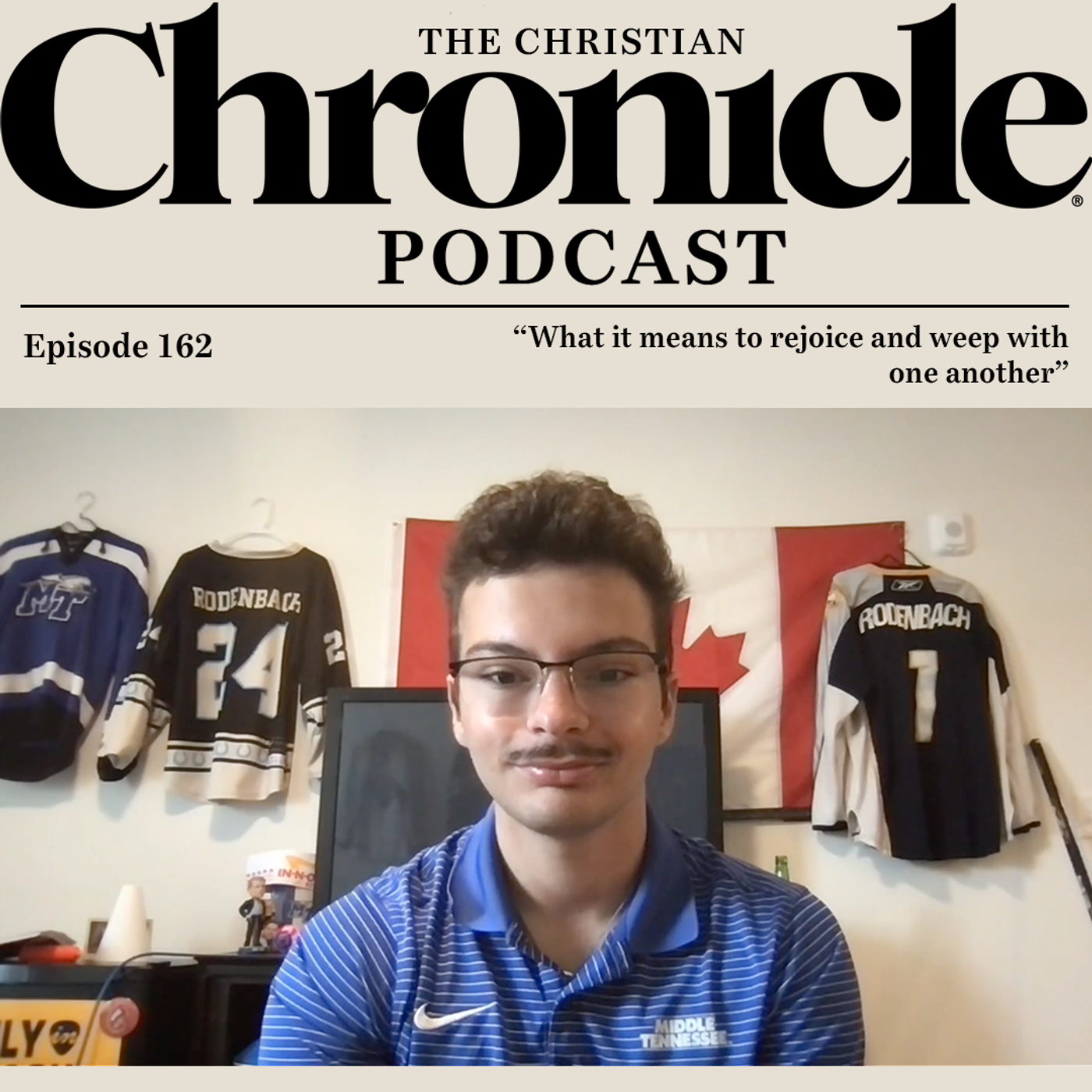
The Christian Chronicle Podcast · The Christian Chronicle Podcast
Christians should rejoice and weep with one another, according to Romans 12:15. That support is shown in a lot of different ways, and it can even turn into ministries to help others going through similar struggles. The Christian Chronicle has reported on a lot of stories of rejoicing and grieving in Church of Christ congregations around the world. Staff members witness some of these ministries firsthand, including the summer interns. Ephraim Rodenbach, a junior sports journalism major at Middle Tennessee State University, was one of this year’s interns. He got to interview many Christians in Tennessee experiencing what it means to rejoice and weep with one another. Listen to some of his stories from his internship in this episode of The Christian Chronicle Podcast. Heritage21 offers guidance for churches to plan for the future, whether that be to renew, repurpose or replant. Learn more at heritage21.org/chronicle Please consider donating to this nonprofit ministry at christianchronicle.org/donate. If you have additional comments, ideas or suggestions, email us at [email protected].
Marcus Stenson: Hey, everybody, welcome to the show today. Excited to get into it. I'm here with Wes McAdams, as always. Today we're looking forward to chatting about weeping with those who weep, morning with those who mourn, and rejoicing with those who rejoice. But before we get into that, I want to introduce our other compatriot today, none other than the Bobby Ross Jr., the editor of our Christian Chronicle is our guest today. Bobby, how you doing today? Wes McAdams: For two months each summer, one or two students have the opportunity to intern at the Christian Chronicle and report on events in churches of Christ around the world, something that the Chronicle staff has been doing for over 83 years. Ephraim Rodenbach, a journalism major at Middle Tennessee State University, was one student who got that experience ⁓ summer of 2026. He recently finished his internship with the Chronicle, after reporting on congregations and Christians across Tennessee, Marcus Stenson: Churches in the United States face many challenges. Where can they turn? Heritage 21 serves churches of Christ as they navigate important decisions about their future. This nonprofit aims to encourage faithful kingdom stewardship by offering general consultation, legal review, and facility and real estate support for churches of all sizes. Whether a congregation decides to renew, repurpose, or replant, the Heritage 21 team provides experienced guidance for every stage of church life. To learn more about how Heritage 21 serves within God's kingdom, Bobby Ross Jr.: it's I guess my first time with you guys since you started doing this and you're doing such a remarkable job. So it's great to be here with you. Wes McAdams: Those of you listening may have read Ephraim's words online and the in the paper for the past few months. And today you get the opportunity to meet him. Ephraim, thank you so much for joining us, brother. Marcus Stenson: Well, we've been looking forward having the man himself in the room with us, so to speak, digitally anyway. So ⁓ we're gonna have a good one today. Ephraim Rodenbach: Thank you, Wes. I'm excited to be here. Marcus Stenson: Visit Heritage twenty one dot org slash chronicle. That's heritage twenty one dot org slash chronicle. Bobby Ross Jr.: Great. Wes McAdams: I'm excited to have this conversation. you know, let's talk about ⁓ your internship. You you got to report on congregations in Tennessee, you got to travel to Idaho with the editor in chief Bobby Ross Jr. for a story. ⁓ What some of the interviews that you did that have been the most memorable for you? Excited to get into the news items. But before we do, the disclaimer that we always like to give is that the opinions that Marcus and I express are those ⁓ alone and not necessarily those of the Christian Chronicle. But Bobby, we are interested to hear about what are some of the things going on in churches of Christ right now. Welcome to the Christian Chronicle Podcast, where we explore what's happening in Churches of Christ. I'm Wes McAdams and I'm here with Marcus Stenson to bring you the latest news and honest commentary. you want to hear stories about Churches of Christ, where we've been, where we're headed, and how God is working, this is podcast. Bobby Ross Jr.: We've had a couple of stories that I was actually blessed to be a part of published in the last week that that we've gotten some good response on already and I I think people would enjoy seeing. One was Ephraim Rodenbach, who was our this summer, and he was based in Middle Tennessee. And and those of ⁓ most of us here at The Chronicle, we're here in Oklahoma City, so he was Ephraim ⁓ was Ephraim Rodenbach: I'm sure talk about it here in a little bit, but I was given the quote unquote health beat. So it seemed like any time there was something about someone going through some health challenges, that was kind of my thing. They were like, hey, go for this part in Tennessee or go here and go here. And that was honestly the coolest part for me was kind of meeting people where they are. Because I think a lot of time in journalism, especially some of the stuff I did on campus, it was very much, well, I'm talking to you about this, but you know, you're going to people's congregations, you're going to people's homes, you're like, hey, let's talk about this. Let's talk about your story. And it's a very different kind of story than the sports journals. Wes McAdams: If you'd like to hear more from me and Marcus, tune in to the Radically Christian podcast. It's available on YouTube or wherever you find your podcast. Bobby Ross Jr.: Remote, so I had not ever met him in person. He even though he's done such a great job and been probably the most prolific intern we've ever had. But he he anyway, he met me in Idaho this little rural town in North Idaho, about forty miles south of the Canadian border where these Ephraim Rodenbach: that I do at MTSU. It's very much you're talking to people very personally about their story that's not as structured. getting to meet people kind of there is awesome. But I think probably the most memorable story I did was either my scout story, or the multitude of stories I did on the health beat. I know one really memorable one was with Chris McCurley, ⁓ Cancer Can Be a Ministry. That was an awesome story. I text Bobby was like, hey Bobby Ross Jr.: Two ladies who had connected maybe 20 years ago. They became close friends when both were members of a Church of Christ in Great Falls, Montana. You how people in the church you just connect and you kind of become like lifelong soulmates, ⁓ and then maybe you don't live near each for 20 years or see each other. There there was a little bit of that. Ephraim Rodenbach: You want to do this story? And I'm yeah, okay. So I texted him, come to his office, and we sat down and talked for probably two hours. And we just talked and he gave me some awesome quotes. You know, there was something along the lines of, you know, if I beat Cancer, you know, this isn't a Chris McCurley story, this is a God story. And that quote's always gonna stick in my head. It's one of those things you're sitting there, you know, you may be drinking your coffee in the morning, reading your Bible, and it's like, that's kind of what that means. Because you make those connections and it's like, that's why this person thinks that way. And I thought that was pretty neat. And you talked a little bit about Bobby, and I love Bobby the death. Bobby Ross Jr.: involved with them and and way back when they had said, you know, what you know, what if we started a school to just kind of help kids who are in need and kids who need Jesus and kind of maybe have some other things going on in their life. And so, you know, they had that conversation two decades ago and life goes on and that doesn't happen. And now, you know, you can read about this in the Christian Chronicle, but long story short, they there's a thriving Christian school and and what these Ephraim Rodenbach: But we went to Spokane, Washington, the seafood capital of the Northwest, and we get red robin and olive garden. So personally not my not my favorite thing, but it was just kind of like, hey, can we go try this? He's like, no, no, there's a red robin right across the road. Bobby Ross Jr.: what these Christian women see as a mission field here domestically, that there's just some exciting things happening and, you know, it was inspiring to me. And then I made a quick trip to Wes McAdams: Man, I'm with him though. I I like seafood, but red robin is hard to beat, especially those endless fries. I don't know if they still do that, but man, the the fries are pretty top-notch. Ephraim Rodenbach: I think they still do the ⁓ L S Fs. I think they still do those. But I I'm very much ⁓ I wanna find the most like hole in the wall like when I travel. Like when I went to West Virginia it was very much what's the like most local restaurant I could possibly find? And that's that's just how I travel. Wes McAdams: That's awesome. Well, Chris McCurly is a good friend of mine, and and I love what what you said about him and and ⁓ just about him, like you said, what God is doing in in his life and through him and even through this this challenge, this health difficulty that he's had. Let's talk about churches of Christ in general, Bobby Ross Jr.: The bluegrass region of Kentucky flew into Louisville and then drove to the Cane Ridge Meeting House on Saturday, which if you people who are familiar with restoration movement history much at all will know there was a big week-long gospel meeting there where people who were Baptist and Methodist and Presbyterians all came together and basically decided with Barton Stone and some other ministers through the preaching that Wes McAdams: Has there been any of the interviews that you've done or the work that you've done through this inter internship that has changed your perspective or your thoughts on Churches of Christ in in any significant way? Bobby Ross Jr.: You know, we've got these creeds, we've got these these confessions, we're doing all this denominational kind of things, and we've really gotten away from the true meaning of Christian unity and just preaching Jesus. So that was quite a formative event in in forming what became known as the Restoration Movement and then w even the main branches of what we would call the Stone Campbell movement today, including Ephraim Rodenbach: So I think a lot of it for me was scale. ⁓ I come from Baghdad Church of Christ, which maybe has, you know, fifty people. On a good day in its middle, small town Tennessee, you know, there's probably not a Walmart for 45 minutes. You have to drive down the interstate and go get there. But a lot of it is scale, because I've been everywhere from Owen Chapel Church of Christ in Nashville. That has probably, I would say, about a hundred people. Then you go to where Chris McCurley's from, Walnut Street Church of Christ, where there's many more people, there's hundreds of people. And I was of my experiences with churches of Christ have always been very small churches. They've been very, you know, Bobby Ross Jr.: those of us in a cappella churches of Christ would fit into that. And then thus some of us was have differing opinions about whether to acknowledge the restoration movement at all. Some of us like, you know, all I need is Acts 238 and go back to the first century and we don't need to worry about all that history. And then I think there are others who would say that yes, the first century church is important. Yes, we want to do biblical things in biblical ways, but Ephraim Rodenbach: I've known you for 50 years, or you know, I've been here my entire life. And it's been really interesting to see the scale and kind of what churches are doing. Like I a most recent story I did over senior ministry was we're over here giving resources to everybody in Nashville. The Harper Fields Church of Christ has a resource center for aging. This has everything from grief share to the Sunny Day Club, which treats ⁓ Alzheimer's giving caregivers some time off. And it's like all of that ministry is coming out of one church. Bobby Ross Jr.: if we just try to go straight from D thirty three, as the sign says on some of our buildings, to twenty twenty six, then we may miss a lot of a lot of understanding of our history and also some lessons that would be helpful even today. We just went to press the day before we're recording this with the print version of the chronicle for September, in which that Cainridge story will be on the front page. Ephraim Rodenbach: where I'm from, we don't really get to do as much of that 'cause we just don't have the resources. being able to talk with people in Nashville or, you know, when we went to Spokane and talked about the foundation school, there's all these people in the churches of Christ that are doing things that are much bigger than kinda I realize their work. 'Cause you hear about if you you know, in Baptists and others where they have, you know, the the children's shoeboxes and other things like that that are kind of more national efforts. And it's amazing to see how churches of Christ are doing their individual ministry, but also working together with other congregations to kind of put those on. And interviews like that with these people putting something like that together is so cool because they're doing it on their own. They're just they have God pulling on their hearts Wes McAdams: Thank you so much for listening. Please take a moment to like, subscribe, or review today's episode. If you have additional comments, ideas, or suggestions, email us at podcast at Christian Chronicle.org. The Christian Chronicle Podcast is a production of the Christian Chronicle Incorporated. Please consider donating to this nonprofit ministry at Christian Chronicle.org/slash donate and supporting our mission of informing, inspiring, and connecting churches of Christ around the world. I think one of the most amazing parts of that story that you did about Kane Ridge was the age of Barton W. Stone when that happened. I I had no idea that he was 28 years old when that happened. It just kind of blew my mind. And I was thinking back to when I was 28 and kind of feeling humbled, like, man, I wasn't doing anything like that, like starting a movement that that helped to change the fabric, not just of of Bobby Ross Jr.: Yeah. Wes McAdams: that's exactly why why I appreciate the Christian Chronicle so much because it's so exciting to hear about what's happening in our fellowship around the world. like you, Ephraim, I I grew in in small congregations. I thought anything over congregations within the restoration movement, but even in many ways the fabric of this country, like the what they were doing and the way that they thought about scripture, the way they thought about following Jesus has really ⁓ affected more than people might realize, I think. Bobby Ross Jr.: Yeah, no, I think you're right. And it is amazing that he was twenty eight. And I don't know if it's just the way photography looked back then or if the pictures we have of of Stone and Campbell, if we've just got like the old man versions of them, but but you're right. When you think, man, he's twenty eight. I you know, I'm sitting here thinking, I've got I've got kids older than that. So that I mean, that is that is crazy. It is that's an excellent observation Wes McAdams: 60 or 70 or 100 people was was big, and and now preaching for a large congregation, it still is kind of overwhelming to think about all the things that are happening just at this one congregation, but to think about all of the congregations throughout the country and throughout the world and and the things that we're doing, like you said, individually, but also that we can do collectively and we can cooperate with each other and work on these different projects and different ministries and missions. around the world. So it's so exciting to to watch that and hear stories about that. So thank you for the way that you have reported on and helped to celebrate the good things that churches have been doing. Marcus Stenson: Yeah, had a I had a full-blown existential crisis when I turned 30 because I realized, man, ⁓ Jesus starting his ministry right now, and I still have no idea what I'm doing with my life. At 33, I was like, man, Jesus accomplished everything that he was sent to accomplish. And I still have no idea what I'm doing with my life. ⁓ But I found that to be such an interesting facet of a lot of the folks that we we stand on the shoulders of. Ephraim Rodenbach: Hey, I just did the easy part. I just typed the words down. All these people doing all the work and putting all their effort and faith into it. If you're willing to meet me, you know, in a church parking lot at seven a.m. in the morning or call me and do you think that's the hardest part. I can wake up whenever, but it's amazing that people are so busy and they're just willing to like I want to make sure that this story gets out. 'cause they're so willing to just tell those stories and kind of connect the church Marcus Stenson: Stone and those guys in the restoration movement included, a lot of the founding fathers of this country, we envisioned them because they were wigged out with the style of the day. But those guys were in their 20s in many cases as well. And it's just sometimes ⁓ interesting to think about how much ⁓ things have changed culturally. when we start to make big moves in our lives. But I'm really glad that that story was was something that we shined a light on. I found that Ephraim Rodenbach: You don't see that in every part of journalism nowadays where everyone's trying to come together and tell a story. It's very, you know, people against people. conflict, is always out there. But in the church, in the Christian chronicle, which I've had the blessing of doing, this is the most impactful work that I've ever felt I've done. Marcus Stenson: There are a lot of segments and swaths of our brotherhood that are unaware that Cane Ridge was even a thing. That might be the first time that they even read about it. And whether we want to start the clock at the, you know, 80 33 stone engraving on our building or not, I I I feel like many of those would not exist ⁓ what happened at Cane Ridge didn't happen at Cane Ridge. So the attitudes and posture and disposition as you were talking about, Wes of those men and Ephraim Rodenbach: 'Cause you know, you're telling people, you're telling their stories, and it's going to other people. It's doing other things. I mean, with that, I did a story over free minutes to save a life, ⁓ I got a after that story published from my mom. And of course she comments on everything. She's like, ⁓ you're doing such a great job. You're doing great. But she was like, people in our church are gonna get, you know, extra safety precaution equipment. They're gonna look into a plan like that. And that's so cool as a journalist, because you know, you do these sports stories or you do something at school where it's like, okay, great. But people are actually ⁓ using this for the betterment of their own congregations and, you know, for things like that. That's such an awesome thing for me. Marcus Stenson: And what they kicked off in this country around that time is something that we owe a lot to. Wes McAdams: to add to that, Marcus, I think sometimes we forget the lenses that inherit from those who come before us. ⁓ I know sometimes we don't like to admit that we're reading scripture through a lens. We like to believe that we are just coming at it any bias, without any preconceived ideas. But it it's really helpful to say, where did this Marcus Stenson: Yeah. Wes McAdams: framework, where did this this lens through which I'm reading my hermeneutic to use a big fancy word, but where did that come from? And and then when we acknowledge it, when we when we see it, then we can begin to analyze, is that the best framework? Is that the best hermeneutic? Where it is good and where it is healthy and where it leads to Christ following and being spirit filled. like you said, there's so much that other people and other congregations ⁓ can learn from other people are doing or how God is operating in one place and lessons that they can take away from that. So sharing these stories is so significant and important. Because we get to brag on what God is doing, but we also get to learn from each other. Let's talk a little bit about the the medical side of things, the the health beat as you called it. Let's talk about that and and what you took away from specifically reporting on the way that Christians have ⁓ used their health situation or their diagnosis for the of God and to serve and to minister to others, Ephraim Rodenbach: a lot of it for me was going back to that Chris McCarthy quote. It's a God story. It's not it's not very much I have this and this is why I'm telling you this thing. You know, it's not They're rather taking that experience and being like, this is what God's doing for me. It's never, you know, this is happening because of God. No. God is doing this through me, through this, so I can preach to you. in the couple couple stories that did, it's always God, God is doing this through me. You know, God is guiding me through this. I have complete trust in God. And you know, all those things, whether it's people, you know, does church coming together or supporting them or it's you know them getting a good you know CT scan or whatever it could be it's always about God and every single story that I did that was the main component of course you know this illness isn't great you know it's not the best for me physically but you know there's no fear in that like I know I did a story over Mitchell Bowles in Celina Tennessee and he is a 17 year old goes to Clay County High School, and he was like, I have no fear, you know, and with his cancer, he's like, I know God has written my name in the Lamb's Book of Life, and I have nothing to be afraid of. What an amazing message that is. Someone who's, you know, my age, a little bit younger than me, sitting across a table and just saying that to me, it's like, wow. You know, his faith is so strong. Wes McAdams: What other stories do do you have for us, Bobby? Bobby Ross Jr.: The other one I think that would be good to mention is Calvin Cockerell, who's our managing editor, he has a story about a church fire. ⁓ the the Troy Church of Christ in Michigan, which seems a lot of people have had connections with that based on what I've seen on social media. Had the minister well, the minister wasn't awakened. He was he has six children and his youngest was having Ephraim Rodenbach: And you know, as a Christian who I've I've been very blessed with great health and you know, besides me being like a two pound premature baby back in the day, I've been really great. And it's like it's amazing to see that faith from someone my age and how inspiring is that. You know, you're going through something like that, you're battling all these challenges, but yet you're still putting God center and you're like, you know that God has got you. Bobby Ross Jr.: some kind of issue like three in the morning. So they got a call from police saying, Hey, you your church is on fire and he got over there and, you know, the church is ablaze. And, you know, sadly given the number of churches of Christ we have in the US, that probably happens several times a year. We hear about that happening. But in this case, it it you know, it was a massive bad fire. The good news is nobody was there, nobody was hurt, but you you know, ⁓ obviously Ephraim Rodenbach: And I think that's something as Christians we could do a better job of because we always, ⁓ you know, I'm doing this at work or I'm doing this. Well, in those situations, they're much more, I trust God. We can't always trust God, you know, when we're in our worst points, when we're struggling or doing this. Why not do it at your highest too? Bobby Ross Jr.: You know, the church is not a building, but when you lose your building it's emotional. There's there's fine you know, you have to deal with, you know, this we baptisms here, weddings here, that kind of thing. And you gotta deal with what's the insurance situation, where are we gonna worship? you know, just a lot that goes into that. So Calvin's got a great story kind of just Wes McAdams: it's such a reminder that that life is filled with these ups and downs. And that even when we come together, you so much of church life happens on Sundays and Wednesdays when we we gather together. I think sometimes we encourage people to leave all the stuff they're going through at the door ⁓ and to bring that in. And you say, We we don't want to be distracted by all of the things that we're going through in life. I ⁓ I nonsense. I I think that Bobby Ross Jr.: catching everybody up on on on what happened there and and how the how the congregation is doing. Wes McAdams: that's devastating. ⁓ It a reminder of exactly what we're talking about in this episode that I like to think of our church building as our shared house. And just like when a person's a family's house burns down, it is emotional because there is so much tied up into it. And you can say, well, it's just a house. It's not really your home. Home is where your heart is or where whatever. But ⁓ but we we get tied up in places and and in buildings and all the things that happen there. When we come together, we bring our whole self, we bring all the stuff that we're going through. We celebrate the the wonderful blessings and the the wonderful highs, but we also lament the lows and we we pray with each other and encourage each other. And our church building is where we share our life, like you said, Bobby, so when we lose a church building, it's more than just brick and mortar. It is our shared heritage, our s our shared story and the house that we share together. Marcus Stenson: Yeah, it makes it makes it really tragic because for as much as we know that, you know, we aren't the building, ⁓ those are memories. There's sentimentality there, there's something about being human, and I think God put this in us where we want a place where we can belong that has permanence. And that's, ⁓ you know, ⁓ part of what we get to look forward to in that day when kingdom comes full. Ephraim Rodenbach: And I think one really impactful thing for me was when I was at the Scout Jamboree there was somebody who said, Among the among the words of I don't want to quote him for sure, he said, you know, everyone brings their burdens in the camp. You know, it's very much a look, there's chaplains there to greet you, absolutely, but we know you may be coming into something. You know, I've I've done scouts for a very long time and you have people going for things and that may be their one chance, that Sunday morning. Marcus Stenson: ⁓ it seems like in in in life, the places that we attach ourselves to for whatever reason as time goes on eventually get stripped away. And sometimes you just find yourself feeling something, ⁓ if you're driving by an old field that is now ⁓ a strip mall or something like that. You're like, Man, that's just doesn't feel right. So hearts go out to that congregation up in Michigan that has lost their building. ⁓ incredibly difficult, I'm sure. ⁓ Really thankful nobody was there. And ⁓ Ephraim Rodenbach: to kind of talk about people and talk about God and talk about faith. And, you know, we all have things going on and I think exactly what you said, sometimes it's, you know, leave that at the door, you know, come in here with, you know, the open mind and, you know, but we've all got things that we can tell about even if we don't really realize what's going on. And we can talk about what God is doing in our lives, even if things aren't necessarily going the way we want them to. that's the whole point of the community of the church, is to kind of bring each other up in the faith. Marcus Stenson: We look forward to seeing the entire body rally around them in this time. And that's that's kind of what we want to talk about a little bit today. And I think that's a good springboard for that conversation, maybe. Wes McAdams: Yeah, yeah, absolutely. In fact, before we we transition just a little bit, I want to remind people that if you want to follow this story and others, you can visit Christian Chronicle.org or keep up with the Chronicle on Facebook, Instagram, or TikTok. Before we get into what we call the potluck segment, I want to read our scripture. Romans chapter twelve and verse 15, where Paul says, Rejoice with those who rejoice and weep with those who weep. It's a reminder that when we Absolutely. Amen. You mentioned scouting. Let's talk about that for just a second. Like tell us your history with scouting and and you you recently got to go to the Jamboree and report on that. So what was that like with the with this history you have personally with scouting, but also ⁓ as a as a reporter now? Ephraim Rodenbach: thirteen of my nineteen years of life has been devoted to scouting. I started when my mom ⁓ Wes McAdams: Gather, we don't just gather to worship, we do gather to worship, but we also gather to share our lives with each other, So that's the theme of our potluck today. And our potluck segment is where we each bring something ⁓ to share ⁓ because it's been blessing to us and we it'll be an encouragement to you. ⁓ And even before we get into our potluck, a reminder that if you, the if you have any potluck items you would like for us to share on the show. Ephraim Rodenbach: forced me to go when I was six years old because I didn't really know much better. And then I did that for a while. I was in the Cub Scouts for a couple years, and my mom, our den leader, stepped into that role. Okay, now my mom was in it, and I was in it. And then my dad stepped into it. So now all three of us were in ⁓ scouts. So that was kind of the the hook. We were stuck. Wes McAdams: please send those to us and we would love to to get into those and share those with everyone. In fact, I've got some some potluck items that have been shared with me that I want to share with all of you later on. Marcus, what did you bring for potluck today? Ephraim Rodenbach: Because then we move through Cub Scouts, so you go through, you know, all the different ranks, you go through Tigers, Wolf's Bears, Weeblos, and then Arrow of Light. Then you graduate and then you go into the Boy Scouts, or I guess Scouting America, as it's called now. And you go through all the different ranks, and then you get all the way up to Eagle. Marcus Stenson: I'm kinda like you. I've I've multiple items because I I I really wanted to sort of canvas some of the relationships that I have and and kind of feel what was out there. There's so many anecdotes and and and personal experiences that I have that I could point to the church ⁓ at its absolute best, especially in times of trouble. and it's really is life-changing. It'll change your perspective on all of life and and and what real relationships are meant to be. ⁓ quite recently, a couple of years ago, tragically, my very first week when I got to Leander down in Texas, on the Wednesday of that week, seven-week-old ⁓ baby girl was found to have a liver situation that they couldn't get a handle on. And Saturday she was gone. And it was one of the most devastating moments. But I tell what. Ephraim Rodenbach: I had a really awesome time in in the scouts. I mean leadership and you talk about the merit badges, you can talk about the knots. I don't remember every single knot that I've ever done, but I probably know a lot more than most, and it's actually helped me out a lot more than you would think. A lot of those I've shot football games before with my camera and I've had to tie things to posts and it's just little things I know. I'd say, huh, okay, so that does come in handy. But ⁓ I've done so much scouts and after I got my Eagle ⁓ in 2021, I was 14 at the time. Marcus Stenson: I have never seen a group of people rally around a family that was just obviously devastated but confused the way that I saw ⁓ our family rally around this family there and walk with them, not just for ⁓ and weeks, but months. And grieving ⁓ is linear. we do not all grieve the same, ⁓ we do not all heal the same. Ephraim Rodenbach: lot of people tend to drop off after that. They tend to go do other things, whether it's sports or you know, ⁓ or whatever it may be. And I decided to stick around. I was kind of a pseudo-adult leader. I around a bunch of younger scouts. And I also joined this really neat thing called the Order of the Arrow, which is the National Honor Society of Scouting. Marcus Stenson: but we all bleed the same and and there were there were just so many instances of of going above and beyond. I had so many folks bring something to the potluck for me as well. a good friend of mine shared an instance where ⁓ his brother-in-law battling cancer and ⁓ multiple around Charlotte area showed up to be with the family there in the waiting room at the hospital. There were over ⁓ a hundred and people there on one occasion, so much so that the fire marshal came and told them that they were a hazard That's the level of support without a doubt, when people are hurting, ⁓ we certainly know how to mourn with those who mourn and grieve with those who grieve. And it's extremely powerful. my friend who shared that story with me ⁓ said that it was a big part of restoring his wife's faith, who was really at the time with why God could let something like this happen, I imagine. ⁓ And so So that's what I wanted to bring today. ⁓ just example after example. I'm sure if listening, you can think of instances like this as well. Wes McAdams: Thank you for sharing those marcus. You brought up something that I think would be helpful for us to talk about for just a second. And it's the other side of that coin of the yes, we need to weep with those who weep. need to grieve with those who grieve, but also Paul says to rejoice with those who rejoice. And you made an observation about that that maybe we don't do that as well, ironically. Marcus Stenson: Yeah, it feels like sometimes joy or rejoicing is the most scarcely found fruit of the spirit ⁓ in our fellowship. And I had several people actually mention this to me And I think part of it comes from the fact that we don't like to make things about ourselves. So there are lots of things that could be celebrated and should be celebrated and rejoiced over that maybe ⁓ we just don't know about because folks don't want the attention, right? And so Ephraim Rodenbach: the National Jamboree every three to four years, it's pretty expensive and I never got to go. And me and Bobby were kind of going through one of the papers, we're like, hey, there's this members of Church for Christ for Scouting at Isn't the national jamboree coming up? I'm like, well, yeah, I mean, that'd be pretty neat. And he was like, ⁓ yeah, let me call this guy and let me see if we can get something going. And I ended up getting in contact with Steve Letty, who was the past national chairman of MCCS. And he was like, ⁓ yeah, we'll take you to Jamboree. And I was kinda sitting there like, What? I'm going to I'm going to Jamboree. Like j like just like that. Marcus Stenson: We sometimes make it hard on our family to actually celebrate with us because we don't want to make it appear like, you know, it's it's hubris that's going on. I I think pretty much every congregation I've ever been associated with in any capacity ⁓ is constantly celebrating baby showers or wedding showers, or we find those ⁓ moments to really celebrate. But I think Paul is getting at something even more than that too. The the the day to day, the the small life wins, the stuff that happens behind the curtain, so to speak. I think we oughta be rejoicing in those ways too. Ephraim Rodenbach: it's kind of one of those things like you you walk in there and it's like, ⁓ wait, I'm here. Like I'm actually here. Cause you know you've got fourteen thousand acres of just quote unquote scouting paradise. Wes McAdams: it made me think that I think sometimes, in addition to what you you pointed out about the arrogance or the pride or the hubris, I think sometimes we avoid the celebration because we don't want to offend those who are weeping. We don't want to offend those who are hurting. ⁓ And so if somebody is expecting baby, they are hesitant to share that because understandably ⁓ and and commendably. Ephraim Rodenbach: I'm not wearing a scout uniform. I'm not wearing what I'm tick typically gonna bring to a scout event. It's you know, I have a camera, I have a polo on, and it that was kind of a surreal moment. You know, you're there reporting on something that you've been wanting to do your entire life. But not only am I reporting on it, I'm kind of bringing you know the gospel and presenting the Lord in that moment. You know, it's I'm filled with grace for God just being able to be there. And it's I would have never been able to do that if it wasn't for this opportunity. Wes McAdams: They are wanting to protect the feelings of those who lost a baby or those who had a miscarriage or those who can't have children. I struggle with this when when it comes to Mother's Day every year, and I preach a sermon on Mother's Day, and I I don't typically focus on that throughout the sermon, but I will start by by acknowledging that hey, today's a day of celebration, and I know many of you are are celebrating, but it's also a day of grief and it's hard for many people. And I think that there's a tension there that sometimes we resolve. Ephraim Rodenbach: the Chronicle and being able to kind of work with people throughout the Churches of Christ and that's an awesome feeling and being able to meet all these different people and talk about religion and scouting in a way I've never done before. Wes McAdams: In favor of those who are hurting. And I think sometimes we neglect to rejoice. And we we don't allow ourselves the freedom to say, hey, I may be hurting, and these people may be hurting, but these people are also celebrating. And for the church to really be a family, we need to be able to bring all of that to the table, both our sorrows and our joys. Marcus Stenson: I'm thankful that there there seems to be a little of momentum behind speaking with some discretion and some tact to make sure that the folks that are hurting in instances like that are acknowledged. Wes McAdams: Well, thank you for sharing that, Ephraim. it makes me think about the fact that sometimes we expect every organization, every group that we're a part of to be the church. And this is a good reminder that that scouting is not the church, but it gives you a great opportunity to be the church, to be a Christian in those spaces. ⁓ And how important it is that if we going to at any age or any stage of our life, Yeah, yeah, absolutely. Bobby, what what did you bring for our potluck today? Bobby Ross Jr.: I'm going to keep it real and I'm one of the people who showed up at the potluck and forgot it was potluck day. You know, I've Wes McAdams: If we're going to be an influence on the world around us, we have to be participating in all kinds of things. And that really is where evangelism happens. That's where we get to represent the Lord, is when we build relationships with people that are based on all kinds of things. Bobby Ross Jr.: In twenty one years at the Chronicle, you know, we get a lot of death and disaster and been to a lot of wildfires and tornadoes and hurricanes and all of that. And and it's always sad, it's always trygic, it's there's always even ⁓ in those circumstances, it's it's amazing to me how much hope you can find. And even, you know, I'm thinking of being in Southern California last January. Wes McAdams: I think it's a great reminder that ⁓ find the things that you're interested in or that your kids are interested in, build relationships with people in the world, and then bring your faith to that so that we can be and light in the world. We can't just isolate ourselves all the time and only participate in things or associate with people that that share our faith. We have to go out there and be in the world. And the way that we do that isn't just, you know, having a bullhorn or or or just knocking on people's doors, randomly cold calling on people. We can build relationships with people around other shared interests. And I think this is a great example of that. Bobby Ross Jr.: with Christians who've just had in in Altadena and Pasadena and that part of the Los Angeles area fed a had had huge chunks of their city wiped out and was interviewing one woman after service ⁓ Sunday morning whose whose own church building had been burned and she just she just had so much hope in Jesus e despite all had happened. And then you know, I think about Matt and Macy Collins in Ephraim Rodenbach: And one thing that I've always come back to is, you know, everyone hears the news about scouting. Everyone kinda knows, you know, all the controversy that's been going on around it and all the things that have been going on, whether you like it or not, there's a million people in the program. That's a million more we can minister to. And you may not exactly agree with every single part of the program. Bobby Ross Jr.: in Cookville, Tennessee, Matt was Matt was a youth minister when a when a major tornado tornado struck Middle Tennessee in twenty twenty. I think right around right before the COVID pandemic started, but he their their daughter, four years old, w was killed in this tornado. And and obviously, I mean you can't imagine as a parent or Ephraim Rodenbach: But if we agree to every single thing about everything, you know, the church is imperfect. We can't agree with absolutely everything that's going on. But yet we still put time and effort into that because we knew that God tells us to do that. God tells us to go into these mission fields and find things and talk to people and evangelize. Why can't we do that in organizations like Scouting? They're not perfect. Nothing is. Bobby Ross Jr.: their grandparents or any you can't imagine anything so tragic yet Matt and Macy have emerged from that to to start a ministry where they kind of use their personal experience to help other parents who who lose children, be it through natural disasters or through illness or other means. They've kind of they've kind of even through their own heartbreak found a way to share hope. Ephraim Rodenbach: But we can do our best effort. Bobby Ross Jr.: And and one of the things they mentioned, you know, as I was thinking of as Marcus was talking about celebration, one of the things that Madden and Macy point out is that, you know, when you do go through something tragic like that, you're not gonna remind me when you mention my daughter that my daughter died because we don't ever forget that. That's always in the back of our mind. But you know, her birthday, we're gonna be thinking about it, help us celebrate even then or Ephraim Rodenbach: At MTSU during my time there, you see a lot of evangelism happen in sports. You know, you see the little pieces, you know, the John 316s on the name tags Bobby Ross Jr.: you know, the anniversary of the tornado or, you know, just milestones. There are ways, you know, as far as grieving with people who grieve that I'm sure that for the rest of their lives they're gonna be thinking about those certain dates. Ephraim Rodenbach: little things that they're doing that promote the faith. And how amazing is that that it's not just organizations that are church sponsored, it's things outside of that that are much bigger than that. Wes McAdams: Well, speaking of of sports, speaking of college, you I know that before you came to the Chronicle, you were the managing editor for the student newspaper. So tell us about what's next for you, E from what now that the summer's winding down, what's next? Bobby Ross Jr.: So in some ways that that one way you can grieve with people who grieve is is to remember even after the rest of the world has moved on, if th if that makes any sense. Marcus Stenson: Yeah, man, that that's so good. And I love what you're saying. That story of Matt and Macy, was it? ⁓ in Cookville. Yeah. Just such a great example of how what we go through will equip us to be able to actually mourn with those who mourn in a way that can connect with them that nobody else can. And how how beautiful that is just ⁓ an instance in which you can know that if God allows you to go through it, he intends to use it. Bobby Ross Jr.: Matt and Mason Collins, right? Ephraim Rodenbach: coming into this fall semester, I'm going to start being a junior. So I'm a second semester junior, so I'll have about a year and a half to graduate. And then I so ⁓ I was working at the SU newspaper from when I came to now. and then I I'm starting a job as an MTSU athletic communications assistant. So essentially that'll do everything from taking photos to writing articles. So kind of doing a little bit of everything, And then after that, we'll just kind of see. I'm still involved with student government. I'm stepping into a parliamentary role there, Marcus Stenson: What a cool story. Thanks for sharing that, Bobby. That's awesome. Wes McAdams: Yeah, that's rich. For somebody who didn't bring anything for the potlock, you you shared a lot. Ephraim Rodenbach: still plan to go to my home church at Baghdad Church Christ. I love those guys. me and my mom love going there all the time and we try to spend as much time there. So that's about an hour and a half drive for me from Murfreesboro. But it's worth it. You come home fulfilled on the way home and it's like there's nothing there's nothing better than that. Wes McAdams: it me of last night the the the brother who brought our lesson at our summer series, he talked about how God protected him in a horrible car accident that that would have taken the life of ⁓ anybody else. Like the the people who saw the the wrecked car were just shocked that he was able to walk away it. And as I listened to his story, I I couldn't help but think. Ephraim Rodenbach: it's gonna be a fun semester and hopefully get a job in sports media and whatever that may be. And I'm blessed to, you know, keep going with the chronicle. Wes McAdams: Well, what about those who did lose loved ones in accidents like that? And, you know, how how are they hearing this? And I was feeling sensitive for them to think, well, how come God protected you, but He didn't protect my loved one? He didn't protect the people that I love in a situation similar to this. And it really is an act of faith, I think, to be able to say. Ephraim Rodenbach: it's been an awesome experience and I'm so blessed to be able to get it. You I'm not from Harding. I'm not from a Church of Christ school. So when I first got the call to come on, I was like, ⁓ really? You're gonna you're gonna let me come on. And that would ⁓ it's been such a blessing. It's been awesome. Wes McAdams: I am happy, I am rejoicing that God is working in these ways and doing these things for people, even if it's not me personally. And I long for the day when Jesus makes all things right, when God does for all of us what He has done for for a few. It's it it goes back to even to the ministry of Jesus. Like Jesus didn't heal every single sick person who was on the earth at that time, but he healed some. That's awesome. That's awesome. Well, thank you for this conversation, but more importantly, thank you for the work that you've done this summer. I appreciate all the reporting that you've done and and thank you for your work in the kingdom and that you will continue to do, Ephraim. Ephraim Rodenbach: Absolutely, Wes. it's been awesome. Wes McAdams: Thanks, brother. As a sign that someday God is going to do for all of his people what he's doing for a few now. Marcus Stenson: I actually with this this past year. I was I was looking at the instance where Jesus heals the woman with the issue of blood. And for the first time, I recognize that this happens in midst of another per individual chasing Jesus down because their child is on their deathbed. And he's trying to get Jesus to to get there to save his child. And Jesus stops to help this woman and As Jesus is interacting with this woman, the guy gets word that his kid has died. And I just put myself in his position for the first time and thought, if I was him, I probably would be thinking, you have time to stop and help her, but you couldn't get back to help my kid. Now, of course, the story ends with Jesus actually healing the child who survives. And that's just a picture, I think, that no matter how it looks for us right now, in the end. The healing of God is always on time. And things will always will be put right when it's all said and done. And it is an act of faith, as you're saying, to trust that and hold to that, even when we are in seasons of mourning and seasons of grieving. And beautiful is it, and how thankful am I that we have a family that mourns with us and grieves with us and rejoices with us and allows those really difficult things to turn into beautiful blessings and redeemed parts of brokenness that we get to see ⁓ walk through each and every day. Wes McAdams: with that in mind, I just want to read some of the the responses that I got. I got so many on the radically Christian Facebook page when I asked them for. Jeff Luplace from the North Mission Church of Christ in the Rio Grande Valley of Texas. He said every Sunday ⁓ we end with a challenge to spend time in prayer with one another. If you see someone who needs prayer, go ask them if you can pray. If you in need of prayer, ask someone to pray for you. We've been doing this for a few years now. It has become a part of our church environment. Now most people Don't rush out the door after an assembly. Instead, people stay praying for one another, sharing burdens, building fellowship and relationship, rejoicing with those who rejoice and weeping with those who weep. And those who regularly take part have been blessed by the experience. I loved this ⁓ account because it's reminder that it's not just the preachers and elders. Who can pray with you? We don't believe in a select priesthood of clergy. We believe in the priesthood of all believers. And to see a community like this where they're not just responding to an invitation. I love the invitation. I love elders getting to pray over people. That's a biblical thing to do. But so is every member praying with and for each other. So I love this picture that this painted ⁓ of a church community where don't rush out the door, but instead they stay and pray with and for each other. It was beautiful. I also got a voicemail from a brother named Winston Smith. He's the youth minister at the Beach Hill Church of Christ. I won't read the entire voicemail, but he said he grew in this congregation at Beach Hill ⁓ and he he came back later after after he, you know, went got education different things, ⁓ and he came back and now he serves as their youth minister. ⁓ and his wife had a son. ⁓ their son's name was Theo, but unfortunately Even in during pregnancy, they they knew that Theo was gonna have a lot of health issues, and he passed away at seven months. And the church was there for them through every stage of the complications and every stage of hospice care and even in the passing of their son. And then they found out that they couldn't have any other children, which was another devastating blow for them, and the church was there with them. But then they started the process of adoption and they adopted a ⁓ young boy and his biological twin sisters. he was celebrating that. And here's what he said at the end: He said, Our situation made me aware of how united the body is in times of grief, sorrow, loss, and celebration. We are one. When I needed a shoulder, one was there. A prayer, one was uttered, encouragement, some was given. And I really appreciate Winston for sharing both the the heartache of losing a child and the heartache of not being able to have. other biological children, but the celebration of being able to adopt children and bring them into their family and their home and what a tremendous blessing it was to have a church family who was there with them and for them through all of that. I want to remind everybody that we would love to share your stories, your questions, your comments in the next ⁓ potluck segment. So if you have comments, questions, or a story you'd like for us to share, you can email us at podcast at Christian Chronicle dot org. ⁓ And coming up, you're going to hear from the intern we were talking about earlier, Ephraim, and what it's like to be part of the Christian Chronicle staff. Bobby, I'm afraid he's going to share some behind-the-scenes stories about what it's like to take a road trip with you, but ⁓ I don't think you'll be too embarrassed about that. ⁓ I'm not sure. I'm not sure. But he's gonna reflect on his summer internship with the Christian Chronicle and what a blessing it was to get to see and hear some of the stories of Churches of Christ. Bobby Ross Jr.: ⁓ Are there gonna be Ranger games involved? Wes McAdams: around the country and the world.