
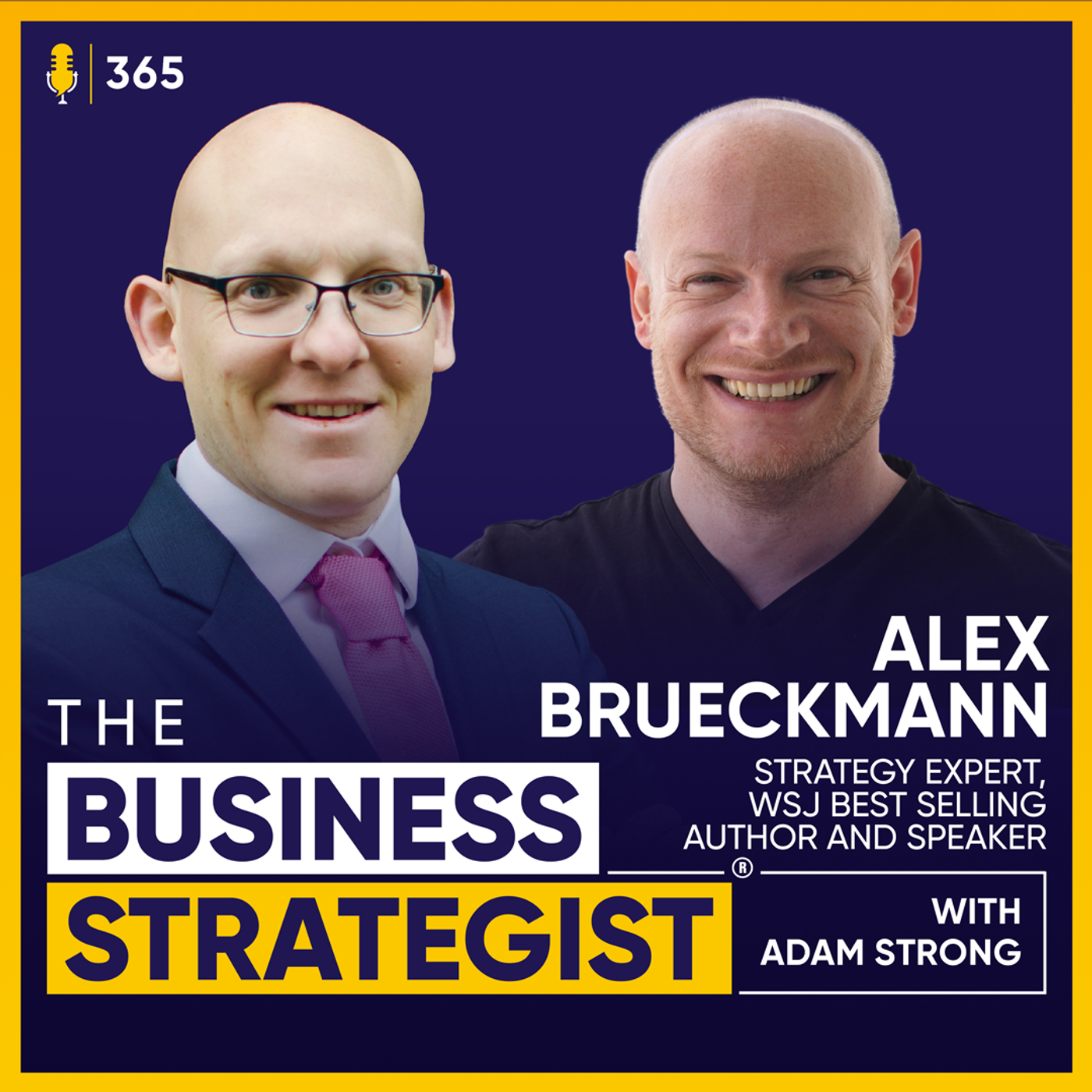
The Business Strategist With Adam Strong · Adam Strong
What if two businesses with the same revenue and the same profit went to market, and one sold for millions more than the other? I've watched it happen more times than I can count, and the reason never shows up anywhere on the balance sheet. Alex Brueckmann has been a good friend of mine for the best part of five years, and this is the third time he's joined me on the show. This time we tackle the question most founders never think to ask until a buyer is already sitting across the table: why will an investor happily pay more for one business than another when the numbers look almost identical? Alex sits on both sides of that table, advising founders and investing in businesses himself, so he knows exactly what makes a buyer lean in and what quietly sends them walking. Towards the end I asked him to coach me through my own exit plan, and the very first question he put to me is one I think every founder planning to sell should be able to answer before they go anywhere near a deal. Alex is the Wall Street Journal bestselling author of The Strategy Legacy and creator of the Nine Elements of Organisational Identity framework. Value bombs Why identical profits can sell at very different prices The dead body in the closet that kills deals How buyers read your culture in due diligence Why alignment is a dangerous word in your boardroom Where to start if you plan to exit in the next 24 to 36 months Interested in freeing yourself in the business? Take the exit ready diagnostics test and identify the gaps in your growth and scale model. Go here: https://readytoexit.scoreapp.com/ ABOUT THE GUEST LinkedIn: https://www.linkedin.com/in/alexanderbrueckmann Website: www.AlexBrueckmann.com ABOUT THE HOST LinkedIn: https://www.linkedin.com/in/adamistrong Website: https://adamstrong.net YouTube: https://www.youtube.com/adamstrong
Adam Strong: What if I told you the true value of your business has nothing to do with revenue, with profit or market share? What if the hidden intangible asset that adds millions to your company's valuation is something that you can't even see or put on the balance sheet? It is your culture. Now we're going to do a deep dive into today's topic that separates fast, cash operations from time legacy firms and what we call the valuation gap. Why is it that some companies with identical P and Ls sell significantly more than their competitors? Culture strong companies sell for more. Now today's guest, we have the amazing Alex Brueckmann. This is actually our third show together, but we were just actually speaking offline. We haven't actually done anything since March 23. Now, if you don't know who Alex is, Alex is a Wall Street Journal bestselling author. We did a couple of episodes prior to that. The last one we did was The Next Level of Entrepreneurs. But one of the most recent books is called The Strategy Legacy, which I'm a big fan of, He's a frequently over on LinkedIn. We've become very good friends and he's got a really unique framework, which we're to be talking about in today's episode. So without further ado, Alex, welcome to the show. Alex Brueckmann: Thanks for having me again, Adam. Good to see you again. Adam Strong: You look at, you're looking sharp as ever Alex, But listen, we were just talking about this offline. It's been almost three years. What have you been up to just out of curiosity? Alex Brueckmann: Well, the past two years, they were quite a roller coaster, to be honest. You mentioned the strategy legacy came Adam Strong: Yeah. Alex Brueckmann: out in October 23 and became more successful than we could have reasonably anticipated. So when the book started to the Wall Street Journal, the Wall Street Journal bestseller list, felt like, okay, that's new. That's exciting. Let's see where this is going. And then 24 business, obviously. it was visible in the bottom line. Let me just put it that way. Not because Adam Strong: Nice. Alex Brueckmann: of the book sale, but obviously because we use this book as our business card, if you want. has been quite interesting, brought a whole new layer of joy, fun and excitement into the business. And we've been riding this wave ever since. Adam Strong: You know, it's really interesting because I mean, you know, we've been friends for probably the best part of four or five years now. And I remember one of the very first conversations that we've, that we had, and it was, it was a real struggle. Cause I think back then you'd only been in Canada for about a year and you were still trying to, you know, trying to adapt to the culture, adapt to business and stuff like that. And it was a real struggle for you. And now you've gone from one end of the spectrum to the other end of the spectrum. I mean, how does that make you feel? Alex Brueckmann: Yeah, it's really interesting when you move to a different country and to a completely new culture and you do that in 2020, which obviously because of a global pandemic wasn't the smartest choice. But, you know, what do you do when you get an invitation Adam Strong: Yes. Alex Brueckmann: to immigrate? Then you take it, right? So Adam Strong: Exactly. Alex Brueckmann: it's been quite a ride. And we've met a lot of people on the way that have had similar journeys. Canada is an immigration country. If I take a look around, my next door neighbors, they come from all over the world. And everyone's kind of here for the pursuit of happiness in a good sense. for me, it's become a little bit of... pursuit of happiness and the happiness of the pursuit. So there are things now happening that weren't possible when we first met, both from a business perspective, but obviously also from getting used to the country, the heartbeat, the rhythm of the society here. And it is something that I deeply enjoy. So here to stay, I would say. Adam Strong: one thing that I have observed, especially during our friendship over the last four to five years is that you've really gone through a massive identity shift in, the way that you were when we first met to where you are now. Maybe I don't know if you, if you would kind of confirm that, but what do you feel that identity shift has been for you? And you know, What's the journey been like for anyone that's kind of embarking on a similar identity shift? Alex Brueckmann: I mean, the switch from like, if you, if you are serious about identity shifts, we have to say this is the third identity shift in my, in my career, to be very Adam Strong: Heheheheh, wow. Alex Brueckmann: frank. So it's not the first time that I went through it, but it's certainly, it is certainly the most challenging part as this was now the first time also that I had children. So I became a father in that whole process. And that means you need to. carve out a new identity while your self identity shifts. Becoming an entrepreneur was the first big one. The second big, and then the second one obviously within a relatively short timeframe, moving to a different country and becoming a father. So our identities as human beings, are, especially in our twenties and thirties and for me in my case, in my forties as well, they were constantly evolving. And at some point you realize that what you thought might be part of your identity has been replaced by something more meaningful. And this was true, obviously, in the context of family and family values, but also in the context of you have a certain idea of how things might turn out when you, for example, move to a different continent, but you never really know. It's a huge gamble that you take. And as time progresses as you settle in, as you find yourself more and more anchored in your community you become more and more a part of something new. I never really painted. a very clear picture of how our life would be once we set it in after a few years, because I don't think that it would have been responsible to work myself because you simply don't know. And Adam Strong: Yeah. Alex Brueckmann: I accepted that very early in the process that I'm here to learn. I think in many, many ways, Being an entrepreneur has helped me to deal with that uncertainty and to also help my family through that process. Because as an entrepreneur, you've been through similar experiences, like every time you launch a new product, every time you expand your portfolio, Those are bets in your life that you take and you cannot prove in advance whether they work or not. And Adam Strong: Lover. Yeah. Alex Brueckmann: yeah, I guess. That's my two cents when it comes to moving to a new country and moving to a different area of the world. You carve out your new identity as you go. It's not something that you just define and then you do it. It's something that you hope for and then you give it your best shot every day. Adam Strong: I mean, life's a gamble, wasn't it? It's a gamble. You don't know how things are really going to pan out. I know that some of our listeners are looking to scale and exit, you know, they're very passionate about what they do and they're very, what I call emotionally charged. And I know that through our interactions, which, you know, which we don't have to go into hugely deeply over over the podcast, of course. And I know that you are a very hugely emotional person and very sensitive. And I guess my question would be is what advice do you have for those that are, I don't know, feel like they're on the cusp of something, which could be massive impact. Cause I know that through our conversations, you believed in that dream so much and you become so emotionally charged from that. And I knew I could see from the struggle was emotionally, mentally, physically, and whatever it is. For those that are listening in right now, what's the advice that you would have for those? And I know that they say, know, patience is a virtue, which we use in Europe a lot, of course, and, you know, but then speed is success. What's your take on this? Alex Brueckmann: I would not juxtapose speed and patience in the sense that it's either or. I think you can Adam Strong: Yes. Alex Brueckmann: feel when speed, when urgency is needed. And in Adam Strong: Yes. Alex Brueckmann: other cases, you just know that it's not the right time to take a decision and that you need to just stay put and literally put in some more work before you can do something new. the, like if we're talking about businesses and growth, there Adam Strong: Yes. Alex Brueckmann: are opportunities that present itself when you are ready. Because you simply listen differently, you look at opportunities differently. Whereas when you are not ready yet, you do see these opportunities come by. And then you take a look at your own shop and you're like, yep, maybe in two years, I'll be ready Adam Strong: you Alex Brueckmann: for an opportunity like this, but not right now. I mean, this is probably one of the most difficult choices or realities that founders and entrepreneurs find themselves in, that they have an idea of where this business can be in the future. And they know why they wanted to be there because of those opportunities that then present themselves. And they see those opportunities also along the way, but it's kind of like, sitting behind glass, you can't reach it. You see the opportunity but you can't reach it, even though you might want to... smash the glass and go through the glass and take the opportunity anyway, it's not the right opportunity for you at this point. You couldn't even use it. It's like reeling in a really big fish into a very tiny fishing boat and then this whole boat sinks. And that's kind of like what it is with opportunities. Sometimes they look shiny, they look nice, they are the right thing, but not at this point in time. So let them go, be patient. in other opportunities, they come by and you know you're ready. And then it's about to decide and be decisive. And actually, Be fast. Adam Strong: Yeah. And I know certainly from personal experience and I know that you've certainly experienced this of knowing when to make your move at the right time, which is crucial. Alex Brueckmann: Yeah. Adam Strong: and, and I think that's the point what you're trying to make here in this story. So, well, listen, this has been great. great opening line first of all. Now I want to kind of get straight into the deep end if I may, because I know that through the, the strategy legacy, through the book that you had created. I want to kind of set the scene here with some of our listeners, if that's okay. And I know that you designed an amazing framework called the nine elements of organizational identity, if I'm not mistaken. if you could give us a bit of a synopsis and a breakdown of what those nine elements looked like, because I believe if I'm not mistaken, they look a bit like a dartboard, don't they? Alex Brueckmann: Yeah, they do. Yeah. Think of three concentric circles. What these circles basically are is they are your culture, your strategy, and your execution edge is what I often call Adam Strong: Okay. Alex Brueckmann: them. It's basically when if you want to give these three circles a label, you could say the center circle is your culture, your cultural identity, your middle circle, the one that goes around the culture is your strategy, and around that is anything that has to do with your leadership. And if you take culture, strategy, and leadership and put them together instead of having separate conversations about these topics, then you create or you give yourself the opportunity to create cohesiveness in your culture, in your strategy, and in the way you lead your organization. And that is when we've seen companies accelerate beyond what they thought was possible, simply because you just don't have any scent in your gears anymore. It's a well-oiled organization where these different conversations happen in conjunction, where they are cohesive, where strategy, culture, and leadership are supporting each other. Not just one supports one and the other one looks weird like the third wheel on a bicycle or something. It's really a connection that starts to happen where your strategy shapes your culture, where your culture reinforces your strategy and this whole dynamic unfolds when leaders have ability, capability, skills to live in both worlds, in the strategy world and in the culture world. A lot of business owners that I've met through my career and CEOs, are really gifted when it comes to the business as such. That's where they grew their career. That's how they grew their businesses. But... they are not really, sometimes it's more accidental than anything. Like there is just a huge load of passion and hard work that goes into building a business or leading a company successfully. And sometimes that even happens without strong, let's say, fundamental frameworks in place. And nine UI, the nine elements of organizational identity was built based on that reality. So it's not. framework that is academic or anything it is something that is simply what we've seen over two decades work and learning from those who failed and taking a look at why did they fail what didn't work And that's where leadership culture and strategy come into play in this framework. And they are created around nine elements. So there are three elements in each of those three circles. And Adam Strong: you Alex Brueckmann: if you as a business owner or a CEO, take a look at those nine elements and focus on those nine elements and make sure they are cohesive. You create something that people understand. They understand why it's important. They understand what's in it for them. They understand their role in making it happen. And that's when you create a flywheel. That's when people... don't need conscious supervision where you can step out of the way and let people do their work rather than having this urge of micromanaging or being involved in every major decision. You create a framework that steers your organization in ways that it gives guidance to everyone in every job every day so that what they do and how they decide supports where you want to take the business. Adam Strong: Yep. And I guess this framework that you talk about can be applied to not just larger organizations, but also the small business, right? Alex Brueckmann: Absolutely, absolutely. when you take a look at the customers that we work with based on this framework, we're Adam Strong: Yes. Alex Brueckmann: talking about organizations that are around 100 individuals, like really Adam Strong: Hmm? Alex Brueckmann: small compared to some of the larger clients that we work with, organizations with a global footprint with tens of thousands of employees. the reality in which they operate is every time the same. They are all grounded in the real world and they are all human beings and that's why these frameworks function across industries. I think over the past few years, we've helped clients in dozens of different industries on all continents. And if you take a look at what they have in common, it's literally nothing other than that they are operating in a global economy and employ real people. And as long as that's the case, that we are human beings in the workforce and not fully replaced by robotics and AI, which is... Not science fiction anymore, but will still take some time before it happens. Correctly. Adam Strong: That's a whole new conversation that is Alex. Alex Brueckmann: That's right. And I guess my point is as long as you have human beings in an organization, we need to understand human psychology and human and dynamics. And then the conversations are always the same. They are around helping people why something matters. And if you are able to do that, if I'm able as a CEO to help everyone in my organization understand where I want this business to go and what the big choices are that we therefore make and how they fit into these choices and how their daily work connects to these choices, then I'm helping people to steer the ship with me rather than just being passengers. And that is something that I personally believe is absolutely critical in every organization. When human beings know why it matters what they do every day, they show up with a different energy, they show up with a different passion. And it gives us an opportunity to do more than just great work. We do it in a way that it is exciting and that it is meaningful. At least for most organizations. mean, let's be honest, there are organizations out there that do work or are in industries where it's really difficult to find meaning in it. But in most cases, I'd say that's what we look for as human beings. We don't want to get up in the morning and just do a mind-numbing job for 10 hours and go back home and sleep again. Adam Strong: Yeah. Alex Brueckmann: We want to know why what we do matters and how it contributes to success. And that simply means I know where I make a difference. And that's what it's all about in the end. If you can translate your business strategy into meaningful work for the people in your business, then strategy becomes everyone's job every day and everyone pulls in a similar direction rather than going all over the place. Adam Strong: What is the, what would you say is the big transformation that's delivered off the back of the framework? What would you, what would you, is it the results differ from one client to another, or do you think that they could guide, go towards one specific type of result? Alex Brueckmann: The commonality that we see is that even really senior leaders, people that are in their late 40s, early 50s, that have seen a little bit in their life and have been around for some time, it's Adam Strong: Yeah. Alex Brueckmann: often really shocking to them how simple strategy and culture really are when you break all those... I don't want to sound negative, but there's so much meaningless talk about these topics that don't Adam Strong: Yeah. Alex Brueckmann: help anyone. So if you take all this away, it's often shocking to them how simple it really is. It doesn't mean it's easy, but it's simple in the end. these conversations, when you sit in... In a workshop with the senior executive and you are talking about strategy, you're talking about culture and what makes it work in the real world, in their real world, the examples why things don't work, they are always the same. They always come down to the same few things. And it's often around their inability to create a cohesive story around the strategy and the culture that they want. And if you are really honest to yourself, like those of you out there listening right now, ask yourself, how well am I trained? How well am I versed in shaping strategy? And I'm not talking about what we all think strategy is, because honestly speaking, there is no really good strategy education in business schools these days or in universities. They all talk about certain analyses like SWOT and God knows what, know, that's a part of strategy, but that's not strategy as such. Adam Strong: Hahaha, so yeah, So true. Alex Brueckmann: that the term has been used so all over the place for so many different things that have nothing to do with business strategy. So ask yourself really, when was the last time that I wanted to understand something to its deepest core that is not within my subject matter expertise? Like if you are a CFO, for example, you've grown your career in finance. That's where you're from. That's where at home. If you are an operations director, chances are that all your life you've done something that eventually brought you to this role. And it's often within operations. There are very few examples that I'm aware of where people had, for example, successful careers in finance and then became a human resources officer or the other way around. There are examples, but they are rare. So the reason I say this is If you've done something for 20 years and now you, like let's say finance, you've done finance in all its aspects for 20 years, you're a CFO now, that doesn't mean you're a versed strategist. It simply doesn't. But everyone around you in this organization, because you're now an executive, expects you to know how strategy works, what strategy is, how to formulate it, how to drive it to action. And that's then the point where I'm like, why does everyone think that just because someone is an executive knows what strategy is? Like, I became a father and I had no idea about parenting. You know what I mean? The one thing and the other thing have nothing to do with each other. Adam Strong: That's true. Alex Brueckmann: But we need to accept that once you are a parent, you better do everything that you can to understand what good parenting looks like. That just doesn't fall into your lap. And the same is true for strategy and culture. Those aren't things that are typically part of someone's vocational training or career steps. It's just something that happens on the side. And then you either work in an organization where those topics matter. And there is a leader that has a clear focus on these. So you learn something on that journey. Or if you're unlucky, you've been in organizations where these topics are just floating around as weird bubbles with weird labels on them. But they are actually not as important as some people claim them to be. When it comes down to success, it comes down to numbers. And that's what counts, right? So. If it depends on your upbringing, sometimes you're lucky and you worked with leaders that helped you understand strategy in a deeper sense that helped you understand why culture matters and what culture really is and how to. You can't really shape culture. That's the funny thing about culture because it's a derivative. It's not something that you just design. It has way more to do with how you as a leader show up every day in the example that you said. There's this famous sentence that culture is defined, your culture is defined by the worst behavior you're willing to accept around you. So if you're a leader and someone does something that you don't agree with, if you just let it slip and be like, I don't want to step on that person's toes because, you know, Adam Strong: Ha Alex Brueckmann: next time they're going to step on mine. That's the type of culture that you then create. It's just artificial harmony. And that doesn't help you when it comes to making tough choices, for example, which is at the core of what business strategy is tough choices. Adam Strong: Absolutely, no, 100%. I absolutely hear you. I probably, I would say that I share the same passion for business strategy like you do. I mean, I'm, I'm fascinated because it's just something that we are both in tune to, you know, it's kind of like, like you mentioned, it's that deeper understanding of what drives an engine, not, not the, not the superficial stuff, but what actually drives the engine. and, and And I think what I love about our conversations, cause we, we, we've shared very similar core values, but we have also have very similar interests in this, in this deep subject. And I think the way that you've, what the framework does is actually articulate it in such a way that breaks it down into saying, okay, well, you can apply this framework for someone that wants to scale a business. can apply this framework. If you want to sell a business, you can apply this. And so forth, so forth. So I think that it really gives a really good basis to what we're talking about, which is great. Now, what I was going to say to you is you would have been involved in not just scaling businesses and growing businesses, you would have been looking at it from a buyer's perspective as well as a seller's perspective as well when it comes to valuation and things like that. When it comes to What have you seen when it comes to when a buyer is willing to pay more for a business, but the numbers are just like that, they're nothing special in terms of the financials. But what makes a buyer look and they see something that maybe someone else doesn't see? What is it about it that kind of jumps out at them and thinks, I'm going to go for this and I'm going to bet you my top dollar that I'm going even pay more for it. What is that thing? What do you think that thing is? Alex Brueckmann: If I come from an investor's perspective, there might be 100 different reasons why I want to overpay on the business, at least Adam Strong: Yeah. Alex Brueckmann: overpay in the sense of someone else who does the same due diligence, has the same facts. I can go from, I just want the assets of that company, whatever that is. Adam Strong: That's true. Yeah. Alex Brueckmann: Or I want to take out a competitor. just consolidate the market. there might be a ton of reasons, right? But if it's a regular buyer that wants to invest in a business, keep the life, grow it, scale it, include it in their own portfolio or value chain, then I'd look at something that is not necessarily visible and that often falls through the cracks when you look at how do due diligence processes look like. Adam Strong: Yes. Alex Brueckmann: If a business, for example, a service-based business that doesn't have major assets, how do you actually make sure that what you're buying is worth its money? And Adam Strong: Good question. Alex Brueckmann: that goes far beyond. your client list and your book of business. And if you want to take the nine elements of organization identity framework to guide your Adam Strong: Yes. Alex Brueckmann: evaluation, there are a few things that you should take a look at that will give you a very good indication of whether a business is worth more than the average business in that same industry. Number one. If you are an investor, obviously, you look at how does the strategy of this organization look like. In other words, what is the market that they play in? What is the industry that they play in? And how are they differentiated enough that they occupy a unique niche in this market? And that can be anything from cost leader to quality leader to... time to market, whatever it is that you take a look at. There must be something so unique that you feel is underutilized and they occupy a niche. Maybe it's very early days, they just went into this niche, but you see the massive potential that no one else sees. And that is something that becomes only visible if you understand what business strategy really is and what to look for in that strategy. The second part that you then want to take a look at is your cultural core. Beyond just the business, are these people in this organization in it to win it? Or are they winging it? they, how do you say, faking it till they're making it? How do they operate? What do Adam Strong: Yeah. Alex Brueckmann: they value? How do they show up every day? If you ask yourself, What strategy is, those are the choices that you make to win. And you can write them down. You can write down these choices. You can clearly articulate where you want to play and how you want to win. And the same is true for culture. You can clearly articulate how you want to be successful. Not in a sense, what do you do, but how do you want to be who you are. That is something that only comes out in the conversations with people and by observing how they make decisions on a daily basis. it's those. those stories that we tell each other, the sentences that we use every day, like, yeah, whatever, that's not that important. The client doesn't see it. Like those types of things, right? That tells you something about how the business looks like. It's probably comparable to a French restaurant where the food is absolutely amazing. The plates look wonderful, but never take a look into the kitchen. You don't want to do that. And then you have on the other side, You have restaurants that have glass kitchens, right? Where you can actually see whether it looks like a war room or whether it's clean and tidy. And it's those things that you only realize when you touch it, when you touch a business, when you're really in it. That's nothing that you find in balance sheets or P &Ls that you take a look at in due diligence processes. You actually need to be on the ground. You need to talk to these people. You need to observe. And the third part. besides taking a look at culture and strategies, obviously, you really wanna understand who these leaders are. how do they make decisions? How do they decide A is the right thing and not B? How they come to these conclusions, how they behave in conflict situations? How are they able to... translate the theory of winning into tangible stories that matter to every individual in the business. Like their ability to communicate, their ability to inspire, their ability to collaborate, those types of things, if you see that they are in place and that they are better than the average, what you've seen, you might be willing to pay top dollar. Adam Strong: Yeah. And you know, I, I think the reason why I asked that is number one, gives a lot of our listeners that are looking to sell in the next 24 to 36 months, but I, cause you work with both ends of the spectrum of not just founders that are growing their business, but if I'm not mistaken, you've also got an investment fund. Is that correct? Or are you work with investors? can't remember. Alex Brueckmann: Yeah, we have a separate company that invests in business. Adam Strong: There we go. See there. I got it right. So, but it's good to get kind of like two ends of the spectrum, because if you kind of get an idea of how an investor thinks and looks, then you can kind of get a bit of a, a competitor's edge of what you need to do to get ahead of the game, I love that. So yeah. Alex Brueckmann: 100%. And especially when we talk about something like the red circle in the model, the outer circle, the leadership circle. If you take a look at which management structures do I have in place, how do your processes look like? Are they scalable? You find things in there that tell you more about the growth potential of a business or how fickle it is or how strongly, it depends on the founder. Like that's the worst thing that can happen. Someone who does their due diligence, like when we do due diligence and the business is dependent on their founder, we have a completely different conversation than if we see that a business is actually able to operate and sustain itself beyond the founder. Because that simply means they have understood how to build more than just a mirror image of themselves and then everything just comes crashing down when they leave the business, which is what you don't want as an investor. Adam Strong: No, absolutely not. And, uh, you know, and I talk a lot about this in a lot of the content that I create on LinkedIn and also some of stuff that we do here in the podcast, is stage one of exit in a business, which is all about how do you exit the founder first from the business? That's the first point of call, right? Alex Brueckmann: Mm. Adam Strong: And it's kind of very similar to what you've created as part of the, uh, the nine elements. want to kind of backtrack if I may, cause you mentioned a really important part, which was around culture. But when it comes to the due diligence process, for example, how does one present the evidence of culture so that seller can then justify maybe a higher premium for when they exit the business? Alex Brueckmann: So if you take a look at it from an investor's perspective, what I would take a look at, when was the last time the organization clearly defined, for example, their values? And I'm not talking Adam Strong: Yes. Alex Brueckmann: about these fancy words that you find on the website. I'm talking about how do they bring these fancy words to life? Adam Strong: Yes. Alex Brueckmann: And what are examples of that? How often do people have conversations about these things? Like, about their values, how do they inform how they do business? And values, while they are obviously a cornerstone of culture, they are theory as long as they are being lived on a daily basis. So look for those artifacts, look for those stories, look for those examples where people can clearly relate what happened to their culture, where maybe even they clearly cite examples where because of their culture, they took a left turn, not a right turn, where they defied logic in a sense that while everyone was pushing in that direction in the industry, they took a conscious step in a different direction. And if you can find those stories and those examples, those artifacts, that's a very strong sign of a strong Adam Strong: Yes. Alex Brueckmann: culture. If people just start... getting nervous, wiggling around on their chairs when you ask them around, hey, how does your culture look like? How would you describe it? And everyone you ask, you get a completely different set of answers. You know that there is no strong culture in place. If Adam Strong: Yeah. Alex Brueckmann: I ask an executive team, if they have seven, eight people and I ask them what their strategy is, their business strategy, and everyone tells me a different story, and then I meet them and they're like, we're totally aligned on our business strategy. Sorry, Adam Strong: You Alex Brueckmann: it doesn't sound like it though, you know? And it's Adam Strong: You Alex Brueckmann: in the end, it's the same around culture. Adam Strong: Yeah. Alex Brueckmann: Ask people and listen to what they say. Adam Strong: You know, I think you make a really valid point there. actually wrote down on here is that values are not words, they're beliefs and behaviors of the culture itself, Alex Brueckmann: Exactly. Adam Strong: Yeah, I love that. Some good stuff. And I love the fact that as far as I guess, as part of that due diligence process is that, you know, if you are looking at it from the, you, if you are an investor and you are looking to buy a business, for example, you're observing, you know, and in your, know, you're getting to know people to see if there is alignment and that everything gels together. Does that make sense? Yeah. Yeah. Alex Brueckmann: Exactly. Yes, 100%. And the term alignment is if people always pretend because it simply means as long as I'm aligned, I don't have any conflict and no one loves conflict, to be honest. But you need healthy conflict in an organization. You need these moments where it's about the best idea and about best way forward and that is often only possible if you have healthy conflict and if you have a culture where you embrace these types of conversations and not running away from it, trying to have artificial harmony and everyone has their own interpretation of what just was talked about. And we are so aligned. Alignment is a very, very dangerous. It's a slippery slope. And I see it as my job to go beyond alignment. Alignment is only possible once we speak the same language, once we use the same terminology. If we use the word strategy, we know what we talk about. culture. We know what we talk about and unless that's the case there is no real alignment. Alignment is a scapegoat for many so you really want to figure out whether there is true alignment. Adam Strong: Alex. one thing that I, that you mentioned actually, just a little bit before that, which was around you working with founders that are kind of like always growing, but kind of on the verge of burnout, literally on the verge of burnout. how does your nine elements, help a lot of founders forget, how do they make it transferable, the business rather than make it, make the culture dependent on themselves, which part of of the elements and how does it help them to kind of make that transitional phase? Alex Brueckmann: The worst thing that can happen from a founder's perspective is when you scale a business, when you grow a business, is that you think you need to do everything on your own. And everyone Adam Strong: Yeah. Alex Brueckmann: who has ever built a business knows exactly what I talk about. There are a few things that only you as a CEO, only you as a founder can take care of, and you should focus on those things and nothing else. Everything else is for other people. But there are a few things that only you can define, because especially when you're new company, when you grow a business, they are heavily tied to who you are. And one of those things is your strategy as a business, your business strategy. So you have clear ideas. You were the one that believes in a certain niche in a certain market. So that's very strongly tied to you, which means you need to be able to articulate that. And that's where very often it goes down the drain. I literally have a friend that runs a business. And I've asked him three times already in the past years, what is it that they're actually doing? They're incapable of giving me a concise answer that is shorter than two minutes. And every Adam Strong: You Alex Brueckmann: time the answer sounds different to me. So that's a real issue. I mean, we laugh about it. But it's like, it's this evil genius type of person that you... that you find in business everywhere, evil obviously in inverted commas, like someone who has this big idea, this master plan, but incapable of collaborating with someone else. Like always being the lone wolf, always being the person that has everything in their head. And then when someone asks a question, you fall out of the sky and be like, how can you ask a question like that? Isn't that all obvious? Yeah, for you it is, dude, for you it is, but for no one else. And that's what we've seen very many, like literally basically in all organizations. that we work with that around the executive table you have people that have a certain idea. First of all, it's not the same idea. It might be similar ideas, but it's definitely not the same. And as further you go, as you go down into the organization, the further away you go from the executive team. the artificial harmony and the alignment as they call it just fades because there is nothing to align around. They don't know where the company is going. They don't know what the choices are. They don't know how their daily business, their roles mesh. And that's what we often see this inability to communicate concisely, repeatedly. It's probably one of the biggest skills for any founder and entrepreneur that wants to scale a business is the ability to turn your ideas into words that people can understand that do not have the same background as you. That, by the way, is the reason we created the nine elements of organizational identity in layman's terms. This is not a scientific book. This is nothing that a university professor would write. This is as straightforward and as down to business reality as it gets. And that is in the end how you become successful in count, how you create something that's scalable if the people around you understand. So that part is absolutely critical when it comes to growing a business and to avoiding burnout. need help. need the people around you need to understand. And if you can do that, you build, you go from a time teller to becoming a clock builder. You build more and more clocks. And that is a very different game than being the one who pulls everything all the time by themselves. Adam Strong: You know, I know for a fact that, you know, making that transition from what we're talking about isn't so easy. Cause I think that there's, it's all about self-awareness. It's easy to put into practice like our words, like, you know, you're going to get a founder that's listening in right now. They're nodding their heads like nodding dogs, right? But practicality, because we're all human beings and we all screw up somewhere down the line. Have you found like, you know, whether it be with some of the clients that you worked with or whatever it is, it's not so easy for whatever reason, whether it be the lack of self-awareness or because it's the, the lack of emotion and intelligence or whatever it might be. What have you found as maybe three of the most common reasons why practicality isn't so practical, should we say. Alex Brueckmann: It might sound harsh, but I think in business we just talk like idiots all the time. We use words that don't mean anything. We use all these fancy terminology and just Adam Strong: Waffle. Alex Brueckmann: phrases that don't have any meaning. And you read something Adam Strong: Yeah, yeah, yeah. Alex Brueckmann: in a document and you're like, I think I'm average intelligent, but I don't understand that sentence. Like, what does that even mean? I think in some ways moving to a different country and operating 100 % of the time in a foreign language actually helped me with clarity and communication. Because Adam Strong: Yeah. Yeah. Alex Brueckmann: if I hear a word and I don't understand it, chances are someone else doesn't either, whether Adam Strong: Probably. Alex Brueckmann: they're a native speaker or not. The point is empty words, empty terminology create this illusion of... substance. But people don't ask because they don't want to look stupid. They don't want to look weak. They read something Adam Strong: That's true, that's true. Alex Brueckmann: and they hear something and instead of being like, hey, raising their hand, be like, I'm not sure what does that mean? There are a hundred million reasons why they don't do it. And very often there's simply no psychological safety in this organization to ask questions. So people be like, they pretend that they understand and based on their assumptions, start to act. And those assumptions are the root cause of all major F-ups. Adam Strong: Yep, I agree. And you know what I wrote down here, two words, fear of judgment. That was what it is. I wrote down the Alex Brueckmann: 100%. Adam Strong: fear of judgment because and that's the reason why I believe a lot of leaders don't ask for help because they have this fear of judgment, right? The fear of what Alex Brueckmann: Yeah. Adam Strong: would that other person think that, you know, whatever. But I think it's that fear of judgment. I want to. Yeah. Alex Brueckmann: And the further you grow, the more this fear of judgment plays a role. this year we started to offer a type of work that we typically, like historically never offered. We call it Adam Strong: Yeah, sure. Alex Brueckmann: executive co-pilot. What it basically Adam Strong: huh. Alex Brueckmann: is, is that the CEO or an executive who feels that they don't have the people around them, to have these conversations because of fear of judgment, they need someone outside of their circle that they can have these conversations with while they internally try to shape an environment where this fear of judgment disappears over time. But they need someone now. And that's when executives often go, they just become quiet. They go into inside themselves and just close down, shut down and have these conversations only with them internally. And this goes back to what we talked about earlier, Adam, this whole topic of burning out. So you need to reach out to someone you can have these conversations with. And that is... It's super interesting, the types of conversations that you then have when there is a safe space, when there is no fear of judgment. All of a sudden, executives become like, I don't want to say like my six year old, but kind of like they start to juggle ideas around. They just say things that come to mind and they don't, they're not afraid of how it sounds. They just say it, you know? And that's where the best ideas come out when you just don't care about judgment. Adam Strong: You know, it's really interesting. You made a really valid point there. So you said as a leader begins to grow, as their business begins to grow, as their organization begins to grow, right? As that there, has what you've seen, there's a correlation between this fear of judgment begins to grow, right? Do you think it's because they have this inclination of this, I feel important. I'm important to my organization. I'm important to my business. And that level of importance thing goes up. Like, is this kind of like this codependency of, of being able to let go? Do you think there's a correlation between that and, and that kind of like fear of judgment? Alex Brueckmann: It heavily depends on the personality structure of the founder. Like Adam Strong: Yeah, of course. Alex Brueckmann: there are businesses that are... me start differently. There are CEOs and company founders that are very much in love with their own ideas and very much in love with themselves. They love to hear themselves speak. Adam Strong: Hahaha. Alex Brueckmann: They take their importance from everyone else telling them that they are important. A very much ego-driven, unaware type of individual. Adam Strong: Yes. Alex Brueckmann: And then there are leaders and founders that are at the opposite end of that spectrum where it's almost like you look into a permanent imposter syndrome where you Adam Strong: Mmm. Alex Brueckmann: feel like they don't trust their ideas enough. have never had anyone in their life to tell them, trust your instincts, take a risk. It's almost like they are the opposite of those ego-driven people. They are... Adam Strong: Yep. Yep. Alex Brueckmann: very much aware of their own limitations. They know very well that they can't scale this without support, that they know their business will never reach the level of maturity where it can sell for good money if they cling to it all the time and make every decision themselves. So they are very, very much aware of that. I enjoy working with people the most that have a bit of both in them. Adam Strong: Aha, Alex Brueckmann: that understand that Adam Strong: okay. Alex Brueckmann: they are humble enough to understand the limitations of their Adam Strong: Yeah. Alex Brueckmann: own knowledge, experience, dreams, and Adam Strong: Yes. Yeah. Yeah. Alex Brueckmann: at the same time have enough self-esteem that they know that they will make it work. And therefore don't just freeze or flight. They are Adam Strong: Yeah. Alex Brueckmann: there to build it over the long term. are there to... do the hard work and to pull in people that can support them at the right point in time with the right skill set. This type of leader is a person I could work with for 12 hours and then go to a bar and have another three hours of conversations with. That's the people you want to be around. Those are the most Adam Strong: Yeah. Alex Brueckmann: enjoyable individuals, I would say. Adam Strong: Yeah, love that. Some good stuff. Now for you guys that are listening in now, me and Alex are probably could talk about what we're talking about for pretty much hours on end, but I we don't have hours on end. So, Alex Brueckmann: Hehehehehe Adam Strong: I want to get into the juicy part now, which is all around the coaching side of stuff. Now Alex is going to coach me. Okay. Now here is a point in time here for you guys that listening in. And even if you're listening in the gym, if you listen to it, car, whatever it is, If you haven't already done so, now's probably the time to get your notebook and pen handy if you haven't already got so, because I know that what Alex is going to be touching on right now is, is we can be touching on various different elements, but effectively it is going to be specifically for you guys are looking to scaling and exiting over the next 24 to 36 months. So Alex is going to coach me and I am that founder. Okay. So, what I was going to say to you is listen attentively and we're going to try to make sure that whatever the path that we take it down is that it's going to apply to you guys. All right. so make sure you make notes. If you have questions, feel free to reach out to Alex after the conversation. So Alex, where do you, where should we start with the coaching elements side of stuff? I mean, listen, I'm a founder. I'd like to. Exit, I'd like to exit in the next 24 to 36 months. I'm intrigued about your, your nine elements, of course. Where do I need to start? Alex Brueckmann: first question I would ask you Adam is can you describe the business that you operate in within less than two minutes? Like what is your industry? What is the business you operate in? Don't tell me what you sell, just tell me what the industry is. Adam Strong: Very simple for us. What do I sell? We sell strategic exit advisories for legal firms. So these are legal firms that are looking to increase deal flow, that would like to create a, would like to create increased revenue, unique selling proposition, but also they'd like to be able to have something completely unique to the market that no other legal firm has. going from what we call transactional minded law legal firms to transformational and innovative legal firms. That's what we do. Alex Brueckmann: How does your ideal buyer look like? Like, do you know who's coming around the corner? Like, who would you like to attract as a buyer? Adam Strong: I think our ideal buyer really is Alex is probably a business that has got a reasonable amount of deal flow that's coming in. So we're talking about mergers and acquisitions, of course. And for me, they are looking to improve on what they currently got. they're not, they're humble with where they're at, but they'd like to be able to take it to the next level, whatever that next level looks like. they'd like to be able to have. Alex Brueckmann: Let's be a bit more specific, Adam. What do they buy? What is it that they buy? Adam Strong: they, they are buying something which is completely different, which means that they're buying, they're buying, what should we say? They're buying into a framework. Yeah, they're buying into a framework that they're licensing from me because I Alex Brueckmann: Mm-hmm. Adam Strong: know how they operate. They're all technicians. And what I'm trying to get them to do is I'm trying to get them to become business people so they can attract Alex Brueckmann: Mm-hmm. Adam Strong: a different type of buyer, which are not quite ready to exit their business, but what we call exit, they want to become exit ready. Alex Brueckmann: If I wanted to jeopardize this deal and I would talk to your potential buyer, what is it that I need to tell them that makes them go away? don't need to answer that question, Adam. But that's the question that I would ask. What is the Adam Strong: Yeah. Okay, that's in the tree. Alex Brueckmann: reason, what is the dead body in the closet that you know about that they will find? And that body will kill the deal. So that's Adam Strong: Aha. Alex Brueckmann: what I would take a look at now. What are the things that you know exactly you should have done in the past you haven't done? And those will potentially jeopardize the deal. Adam Strong: So this is like... Alex Brueckmann: And then you can literally just take the nine elements of organizational identity model and ask yourself, which of these models, which of these elements are in place and clearly formulated? Which ones do I have somewhere in my head, but we never institutionalize them? And which ones are simply not in place? And if you then just take a pen and paper and you rank these, and we actually have a one sheet document that's called the nine elements of organizational identity health check, and you run this self-assessment, you run this health check for your own business, you know exactly how healthy your business is in terms of culture, strategy, and leadership. And then you know where the dead bodies are, and then you know what you need to put in place so that the business is... well established to be sold because all these elements are in place. Adam Strong: So what you're really touching on is psychology and why a buyer buys, right? Alex Brueckmann: Yes, exactly. Like you want to give them all the reasons that they're looking for to buy and none of the reasons that they look for to find to lower the price or to walk away from a deal. Adam Strong: Yeah. This is good stuff because I'm absolutely, I'm fascinated personally on sales and psychology, which is what you're kind of talking a little bit about. And, I think you make a really, really valid point there. cause it's not necessarily what are the features and what are the benefits. It's really kind of understanding the emotional triggers of why someone buys and why people don't buy, isn't it? Yeah. Alex Brueckmann: Exactly. In the end, it's sales, but you put it in reverse. You're not looking Adam Strong: Yeah. Alex Brueckmann: for your ideal client anymore. You look for your ideal buyer. And the moment you understand that if you want to sell a business, you will attract a certain buyer the same way as you attract a client. If I want to buy you, look exact, I know what I look for as an investor. And if I find it, that's an interesting conversation. But if I don't find it, I will walk away. So if you want me to be your ideal investor or your ideal buyer, then you need to understand what I'm buying. And if I don't understand that as a seller, then I will never be in a position to have the right conversation. I will not find anyone who is willing to pay premium because I cannot give them enough confidence that it's the right investment. It's the same psychology that a client goes through when they make a purchase decision. If you don't give them enough confidence that this is a good purchase, then they won't buy it from you. And in this case, it's the same thing, but you're not selling a product, you're selling your whole business. Adam Strong: Yeah, that makes a great thought process actually. Cause there's a, there's a load of ticking time. There's a load of things going off in my brain now, like a fireworks display, about all the, should we say covering my ass type of thing around that. And I, I like the way that you frame that. So, okay. So in terms of the nine elements that you have, where should I start? Apart from the exercise that you've just given me, which I'm going to go off and do, where was it? Where would you start? Would you start from the middle? Would you start from the outside or would you start from the inside? Alex Brueckmann: I would always start in the strategy. And the reason is that the strategy touches both of these parts. The strategy touches your cultural core and it touches your execution. So your leadership circle, if you want, in the nine ULI model. The moment you start defining where you want to be in the future as a company and the moment you start defining the industry that you play in and the choices that you make, that sort of defines also how your culture needs to be to support that. And you can't do this from the other side. You can't define your culture. A culture without a strategy, like a business that has a strong culture, but that doesn't have a strategy doesn't exist. Adam Strong: Yes. Alex Brueckmann: It is just not possible because your culture, as in performance culture, needs to support a strategy. the moment you define a strategy, that's the moment you also know what is the type of culture that I need to create so that this strategy can be successful. And the same is true in the other direction. What types of leadership capabilities do we need? our leadership population to drive this strategy into action to shape the culture that we need. How can they walk the talk? How can their people see that these aren't words on paper? That's lived reality. How do we make sure that everyone understands how their individual performance targets are derived from the strategy? And how does what they do every day contribute to success? That in itself creates an incredible amount of meaning for people if they understand why their work matters. And there are the connections between those three circles in the nine UI model. If you go from the outset in. I want to understand how my work matters. So please give me individual targets that are in line with the strategy so that my decision making every day supports my individual targets and inherently supports the strategy. So that's the whole capabilities wedge that we take a look at. One of the nine elements is then necessary to help people make those targets work. And then when you go one step in, further in, you're describing how the capabilities that you acquire help you drive your individual targets, help you drive strategic targets, help you get the company to where it needs to be in the future. And if you are really, we call it human-centric high performance. If you Adam Strong: you Alex Brueckmann: are able to leverage the assets in your business and the... with that, mean, the people that work for you in a way that they become supporters of the culture, supporters of the strategy, then it's not you anymore. Then it's about everyone and everyone has their contribution. And all of a sudden you realize how much more is possible than if you sit in an environment where You think you have a strategy, but it's nowhere nearly clearly defined. People don't know whom to turn to, where to look for a description of the strategy. The same is true. How do I know that I live in a strong culture? How do I know that my organization is strong enough when it comes to the human aspect of change, for example? How do we take care of helping people through the change when a new strategy comes around the corner? Like all these, how do we take care of our people kind of things in the broadest sense of the word. We need to take a look at them. based on the strategy. And we need to look at teaching people the skills that they need based on the strategy so that they can reach their individual targets. Like all these elements are interconnected in a way. yeah, if you're a visual person, I know this is hard to imagine right now, just us talking about it. So yeah, take a look at our website. Take a look at the description of the 9UI model. It's all there. It's all publicly accessible. And you can get your head around it. Adam Strong: Yep. And what we do guys is we will put the link to the website and the show description notes below so that can test, so that you can go over and have a look at the nine elements, but also highly recommend go over to Amazon or go to Alex's website and go order a copy of the book. Cause that would probably make more sense. now I am a visual person, so I like listening to audio books or if you're, or you can also listen to Alex also over on YouTube. We'll also be publishing this amazing podcast over on Spotify video podcast and on YouTube as well. So you can kind of get a bit of an idea about what we're actually talking about. This has been a great conversation, by the way. I'd like to know more about what are you working on right now? You've got the certification program, is up and running, which is, which is amazing. You've got your, you got your couple of books out, already, which is, which seems to be doing exceptionally well for you. What's the next chapter of your, exit strategy looked like, or if there is one. Alex Brueckmann: My exit is hopefully a long time into the future, because I really love what Adam Strong: No worries. Alex Brueckmann: I do. we're currently working on broadening our education. footprint. So what I mean by that is we offer a whole range of online courses. Some of them are video based, some of them are email based. You already mentioned the live certification course, so the nine elements of organizational identity live training course. We are adding constantly to that suite of programs. simply because we see such a strong need out there that people want to understand strategy and culture in a better way. They want to become stronger strategists, stronger strategic leaders. And we're trying to not only work with our clients, with organizations, with foot on the ground, we're also trying to help more and more people understand strategy in a new way. And yeah, that's what we're currently focused on, broadening our suite of strategy courses. Adam Strong: Love that. if you're an entrepreneur, if you went to law school, we went to a accountancy firm, whatever it is, this is stuff that you don't get taught. Like you just simply don't get taught on strategy. You don't get taught on business. You do not get taught on how to exit business. Like you just, a lot of people just wing it, but sometimes we just need to have these frameworks or these methodologies to help aid us, to guide us towards a specific type of path. what I would highly recommend you go and do is definitely go check out some of the assets that, Alex has recommended. Anyway, listen, Alex just want to say thank you so much for being on today's show. It's been a great jam, isn't it? Alex Brueckmann: Much appreciated, Adam. The third time in what, four years? Let's keep that, let's keep that going. Adam Strong: Absolutely, 100%. Listen, guys, also what I would recommend as well, make sure you go back and check out Alex's previous episodes. And listen, what's really interesting about the previous episodes is there's like a different, they're all different, slightly different verticals, different angles. And even the energy levels are slightly different, like our conversations. And you'll be able to see from the one that we did at the very beginning, which I think was at 21, 22, I can't remember, 2022, 2023 we did March of 2023 to now, you'll be able to see how Alex has grown just from those episodes together. but anyway, enough from me and Alex. For you guys that listening in, I hope that you've enjoyed today's episode. Please do me a favor. If there's anything that I could ask of you, If you are, this is the first time that you're listening to this. or if you're a regular listener, please make sure that you've hit that follow or subscribe button, either on YouTube, Amazon music, Spotify, Apple, whichever is your podcast poison, whatever it might be. Please get and hit that and, become regular listeners and hit that notification. And if you've got any questions, feel free to reach out to Alex. He's over on LinkedIn. You can check him out on his website, of course, or if you've got any specific questions that you want to. Obviously email myself. We'll put that in the show description notes too. Anyway, enough from me, enough from Alex. Thanks so much and we'll see you soon. Take care. Cheers now guys. Bye bye.