
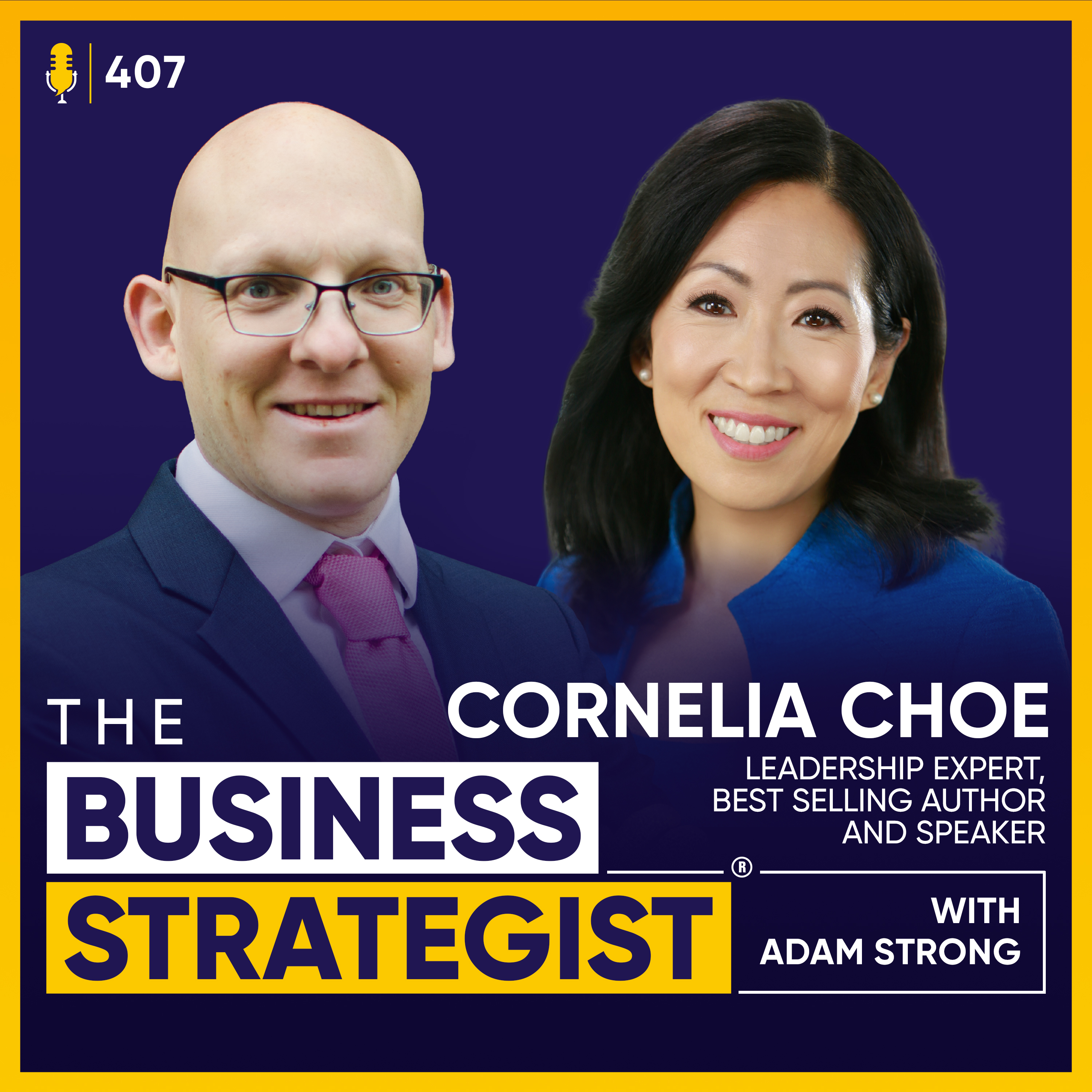
The Business Strategist With Adam Strong · Adam Strong
What if the one area where you feel most sure of yourself is exactly where you cannot see straight? I have always backed my gut in business, so this conversation properly challenged me. In this episode I sat down with someone who has spent her career in rooms most of us never get near, from the UN stage to Fortune 500 boardrooms. We got into why brilliant leaders get blindsided, why your gut might be quietly steering you wrong, and a simple audit that could sharpen your very next big decision. I will leave the rest for you to hear. Cornelia Choe is an international leadership expert, global keynote speaker and Thinkers50 Radar honoree. She has advised hundreds of CEOs across five continents and wrote The Panoramic Leader with Marshall Goldsmith. Interested in freeing yourself in the business? Take the exit ready diagnostics test and identify the gaps in your growth and scale model. Go here: https://readytoexit.scoreapp.com/ What you will learn Why your biggest blind spot hides exactly where you feel most certain The perspective audit that sharpens any decision in 15 minutes How to keep your instinct without letting it trap you What really happens to your identity when you step away from your business Why the truth gets more filtered the higher you climb ABOUT THE GUEST LinkedIn: https://www.linkedin.com/in/cornelia-choe/ Instagram: corneliachoe_author ABOUT THE HOST LinkedIn: https://www.linkedin.com/in/adamistrong Website: https://adamstrong.net YouTube: https://www.youtube.com/adamstrong
Adam Strong: Here's a strange truth about business. The person most likely to get blindsided isn't generally someone in middle management. It's generally the expert, the person that is running the ship. The more you've seen, the more certain you become as a leader. And that's that certainty is where blind spots tend to hide. Now, my guest today has advised hundreds of CEOs across five different continents. And she says that great leaders. They fail because they make huge decisions based on the world that only they can see on their from their perspective. So here's the question that I really kind of want you to think about today is where are you most confident? Because that might be exactly where you are also blind. Now my guest today is someone who I've been following for a little while And we sit in the same circles. Her name is Cornelia Choe. Now Cornelia is a international leadership expert, a global keynote speaker, and also on the Thinkers 50 radar, She's a co-author of the book, which we're going to be talking about with the amazing Marshall Goldsmith, which I always rave on about, called the Panoramic Leader, How Great Leaders See Things Differently. Now her TEDx talk has also been watched by over two million people. she's advised leaders in places like the UN, the White House, Morgan Stanley, and and from startups right through to Fortune 500 companies. Now she's lived in seven different countries in her entire lifetime. and at 17, she was connecting CEOs all over the world. And at 19, she was on stage. At the United Nation. what's really interesting is that your decisions are only only as good as the world that you see it. So, so without further ado, Cornelia, welcome to the show. Cornelia Choe: Thank you so much, Adam. I'm d absolutely delighted to be here with you and to share this exploration and conversation. Adam Strong: Absolutely. it's really interesting because Mar me and Marshall we t comment on each other's LinkedIn posts and when yours came up, he was like, Yes, hundred percent. You should definitely get Cornelia on the show. And I'm like, Okay, I will we'll definitely do that one hundred percent. So I'm excited about today and and and you know, just offline as well, it's been It's been really interesting just to hear your story and where you've come from and and your experiences and insights and things like that, which is which is great 'cause it I mean you've really and and I love the book by the way that you have written with Marshall, 'cause I think it's definitely my cup of tea, as they would say in England. Cornelia Choe: Thank you. I mean, it's such a pleasure to write the book together with Marshall because we our ideas coincide so much. He has Adam Strong: Mm. Cornelia Choe: his stakeholder-centered coaching where he encourages leaders to reach out to people within the company of at all levels, peers, managers, and people who report to you to understand more about what's actually happening around you and what and your effect on them. And then When he heard about panoramic leadership, he instantly loved the idea because it's really about the same concept, but widening it to outside of the company so that you're able to get perspectives from all all different kinds of stakeholders. Adam Strong: Love that. And you know, the word perspective, by the way, is probably one of my favorite words because it really kind of challenges a unique belief system that is personal to ourselves. but also it also ties back to your own experiences in in in in the how what in the world that you see it as. So for you guys that are listening in, by the way, I know for a fact that. Just having conversations with Cornelia offline, she's gonna be dropping a lot of value bombs. So, whatever you're doing right now, whether it be listening to this in the gym, in the car, whatever it might be, I would endorse you to make sure you got a notebook and pen handy. And if you don't have one in handy, listen to the episode and do yourself a favor, rewind and re-listen to this particular episode because there is gonna we're gonna be covering a lot of unique. different angles on today's episode. So and apart from talking about Cornelia's book of course, but I think is really gonna help you really kind of help you move forwards as a as as a leader and things like that. So let's let's start because I I'm excited and you know we talked I I mentioned in the introduction about the fact that you got into the world of leadership at such a young age. I mean seventeen years old and then And then you from what from what I understand, you were also on the UN stage at just 19 years old. And now most people at the age of 19 are trying to figure out who they are as individuals. give us a little bit more perspective? where did number one, where did the fascination come from? And where did that unique opportunity come from at such a young age? Because that's That's very young to be very curious about a s a a topic or a subject where maybe when we think of the world of leadership, we think of someone that runs a business or someone that has been the CEO of a Fortune 500 company, as we alluded, and things like that. Where did the catalyst or where did that interest come from? I'd love to get more perspective on that. Cornelia Choe: Yeah, Adam. There's so I heard two different questions about where the interest came from and where the opportunity came from. And I'm Adam Strong: Yes. Cornelia Choe: gonna give two different stories because the roots run deep. And the first is about a rather happy childhood living in Minnesota, raised there until I was about 10 years old. And Adam Strong: Mm-hmm. Cornelia Choe: thought I was blonde because everyone else around me was blonde and when I was small. y you didn't question it, you know. I just thought I was whatever I saw and didn't give two other thoughts about it. Then I moved to Korea when I was ten, and there the first question I asked my mother in the airport was why everyone had black hair and how did they get them all in the same room? Because I'd never seen that before, and just the entire color of the room was different. And so I was wholly unprepared to move there. And and I had a really hard time at school. The first day at school, couldn't even talk to anyone, people turned their backs on me and found myself alone. And then I was promised a whole world of loving relatives. And instead I got the comment, you know, you look Korean, but you're not acting Korean. And that was a it was a it was a rejection, but I couldn't figure out after that how I was supposed to act. And so that started in me a very deep curiosity and understanding how do people see me? and how Can I connect with people and people who are very different from me? And that was like an underlying question for me throughout all my travels. Now I've lived in 11 different places around the world. And as you mentioned, Adam, in seven continents. And each time I have total immersion and the world completely changes. And people have told me that's kind of how they're feeling right now. So I I saw my experiences a bit, you know, early, but very reflective of. What people need to know right now. And so that's how I start to specialize more and more into this question of how do you connect with people and how do you understand a completely different world around you, which people are seeing. As far as how I got onto the stage, it starts also from Korea. When I was living in Korea, some of my relatives who are women had a hard time getting a job because at the time you would call a company and get an interview and Adam Strong: Mm-hmm. Mm-hmm. Cornelia Choe: a lot of times the phone would hang up on them if they heard a female voice, because somewhere along the way it didn't make commercial sense to hire women in their eyes, because as soon as you've trained them for a few years, they would leave to get married and to take care of children. So, is that a problem with childcare services or the structure of society? Whatever it was, it was really hard for the women who did want to have a career to be able to pursue that. So that's what motivated me in my first week at university to help start a program where we matched up CEOs who are female in the United States with interns from around the world. So that if they Adam Strong: Mm-hmm. Cornelia Choe: couldn't get a job, they could start their own company and follow that entrepreneurial track and make it happen on their own. And through that experience, I was asked to give a talk at a global landmark United Nations conference. And that's that's where after having lived in a world where in a childhood where I was told to be quiet and you know the Whole philosophy of children being seen but not heard, knowing that my voice could have an impact and that everybody's perspective could contribute something in some way absolutely blew my mind. And I was invited to speak with and advise really heads of state and ministers and participate in a lot of really high-level meetings. And so it it was fantastic in teaching me more about this quest that I had. to learn about connection and learn about understanding the landscape on a whole different level hierarchically instead of geographically this time but also in knowing that you know the sky's the limit and you know to to to dedicate your life to what you're passionate about. Adam Strong: I love that. It's really interesting and it it it and it's great to have an opportunity like that 'cause I mean that's like kind of a once in a lifetime opportunity, isn't it? what did the room of the leaders that you met at that particular conference do what did it teach you about what about about seeing what others had missed from a leadership perspective? Is there anything that kind of crops to mind when you look back at your experience? Cornelia Choe: Yeah, Adam, I was asked to help countries with sustainable development Adam Strong: Got it. Cornelia Choe: and improving their economy in a way that wouldn't be short term. And through my experiences of living in several different countries and some countries where there was a heavy emphasis on education and others where there weren't. And also within some of the countries I've lived in, having friends in some of the highest rungs of society, for example, in Barcelona where I was, and also some of the lowest. as I started a theater group for abandoned children in Barcelona. Adam Strong: Mm-hmm. Cornelia Choe: And Being able to see the differences between countries and differences between socioeconomic levels at that age at such at such an intimate level, I was able to really understand what the levers that contribute to long-term growth. And so I spoke about education and the differences that I saw between countries firsthand and the mobility that I had to understand different layers. And what I saw was that. the ministers and heads of state, they were nodding their heads and understanding what I was saying and that they couldn't have had that experience. Only I could have at my age and in my position and that I had that perspective to contribute and that that was valuable. And that's when I started to understand that putting together different perspectives and understanding different perspectives was was so crucial to leadership because leadership Means that you're not always hearing what people are actually seeing. You're hearing what they think you want to hear as a Adam Strong: Mm. Cornelia Choe: leader. but creating these relationships and getting access to these perspectives is the really the infrastructure that we need for getting access to panoramic leadership and to panoramic views. And that's when I realized A, that It's important to create these relationships and maintain them with all different kinds of perspectives. And B, that it's important that we do contribute our perspectives, but not blindly, in a way where people can understand what you're seeing. So you need to kind of tailor what you understand to someone else's perspective so that they can incorporate that information very easily. And in the book, we call that microtranslation. Adam Strong: Yeah, love that. Well, that's a a that's a new word that's a new word that I have never heard of, but I love that. Some very cool. We'll talk about that actually further on into the into the episode. But tell me, I wanna kind of talk about something which you just mentioned, which is the whole idea of blind spots, because in the world of entrepreneurship especially is that I feel like a lot of people treat blind spots as like weaknesses more specifically. but you link them back more around confidence. So what does prospective blindness actually look like from say the inside of how an individual may look at it? Cornelia Choe: Yeah, that's a really good point that you made about blind spots being seen as a weakness. Whatever they were seen as in the past, today we have so much change around us: socioeconomic change, political change, supply chain problems around the world, wars, technology changing the way we live and work. We're constantly going to structurally have blind spots. This is something that we need to get used to accepting because. the increase of change and complexity in the world today has is grown so much that no one person can see everything that's happening around them Adam Strong: Mm-hmm. Cornelia Choe: as we potentially could have before. There's no more possibility of having the leader on the hill standing on one leg and looking out on the landscape. there's so much change in this the the information that we need to understand what's actually happening is now distributed in the minds of so many different people around us, whether it's our C-suite team or the people on our team or stakeholders or you may maybe an influencer halfway around Adam Strong: Mm. Cornelia Choe: the world who's actually bringing people to our products or not. or one partner that we have for our business. And so today, blind spots are structural. And because of this complexity and change, our maps are outdated constantly, even if we're able to see everything at one point, the next moment things have changed, but we don't always know how. So that's really the genesis of all of these blind spots and So panoramic leadership that we talk about in the book is really about being able to broaden your field of view through the people who see different parts of reality differently so that you can complement the map that you're using, your internal GPS that you're using to lead your life and your organization, and to be able to integrate those perspectives into your own. Adam Strong: Mm. I love that. Cornelia Choe: And this yeah, this this will happen before decision making. Adam Strong: Yeah. So, have you ever been in like a board meeting or in a situation where, say we take a typical white collar worker who's got senior position and they have this attitude, and I call it an attitude because generally most people do have attitude, is that they feel like they just they they they're the perfect leader. They know everything about leadership. They don't Cornelia Choe: Yeah. Adam Strong: have blind spots. And if you accuse them of having blind spots, they're in complete denial of themselves. how do you deal with someone that has that belief system ingrained to their subconscious that it's kind of like when they do finally realize that they do have blind spots and they're not perfect, that they have this kind of not victim mentality, but they have this denial, this feeling of denial of my goodness, like this shock. How Cornelia Choe: Hm, yes. Adam Strong: how do you deal with people that are in a state of denial with regards to blind spots? Cornelia Choe: There's two different challenges here. First, if they're in this state of denial, they're probably going on autopilot in a lot of ways. And autopilot is important. It's important to go fast and to keep your foot on the gas and to keep on moving forward. The problem is if it makes no sense to go quickly if you're going quickly in the wrong direction. And so Adam Strong: Mm-hmm. Cornelia Choe: at some point, and we talk about this in the book. But as we're going on autopilot, we think that if we make a mistake, we're we're going to move from unconsciously succeeding to then, you know, having to think about it and consciously succeeding. But Adam Strong: Mm. Cornelia Choe: the the gap is that if we're unconsciously succeeding, then we're gonna be unconsciously failing as well. And what happens if, you know, the landscape's changing around us and we have a certain map in our minds, you know, forget the GPS that's changing real time. It's really a a paper map that we're dealing with, if we're going on autopilot, because we're not looking to update that. Then if the world actually switches, flips around, or we're looking at the map upside down now. We're going in the completely wrong direction at breathtaking speed. And so that's the problem that we face. And ultimately, when the world changes around you, it will catch up to you. And arguably having more autopilot where the world is incredibly stable is a good thing because it could save you energy. But in today's world, where we do have so much. Not just change, but unpredictable change, then the blind spots become even more dangerous to us. So so one of the best ways to think about this is to move from being the resident expert in our organizations as the leader, the one with all the answers, to the chief investigator. And the chief investigator has a very Adam Strong: Mm-hmm. Cornelia Choe: important role. And this comes down to the stories that we tell ourselves about what makes us valuable and keeps us valuable in our organizations. We're not going to try to be an expert in a world of uncertainty. The best thing we can do is to ask the best questions. That's what the leader of the future is going to do. And so to keep our expertise as someone very knowledgeable about. The company is really important, but to use our expertise as the beginning of our investigation and not at the end of it, that can be really helpful. Adam Strong: Yeah, a couple of thoughts there. when I think of when we when we think of sub unconscious just going Cornelia Choe: Mm-hmm. Adam Strong: in terms of what success is, I use the same analogy of if I'm putting in a flight plan, I'm going from destination A to destination B, and then I put it on autopilot, but then there are other it potentially internal or external factors that could affect my flight plan, which would then probably end up tur if my destination is Brazil, but then ended up turning in Chile. Like so so that so you've got these what I call mitigating factors which we don't take into consideration that could take us to a destination which is what you're saying, right? Yeah. So that's Cornelia Choe: Absolutely, yeah. Yeah, that's it's a good way of looking at it. And instead of landing on the plains or the pampas, you could end up in the ocean or in the mountains. Yeah. Adam Strong: That's very true. And so the other thought process that I had in my mind was when when you're dealing with people that have what what might deem them as a as a bit of an attitude problem, generally what I have found, and maybe it's the same for you, is that it is generally stemmed because of fear, whether it be the Cornelia Choe: Mm-hmm. Adam Strong: fear of losing control, compla complacency. ego but have you found that to be the case too? Cornelia Choe: Absolutely, because I see two different dangers, and they're at each is at one end. The first is going on autopilot and you know being unconscious about your success. And the other is the fear of the unknown. So you could be overconfident, but you could not have enough confidence and then resort to fight, flight, or freeze when it's not necessary and or to really succumb to this fear. And it's easy to feel overwhelmed when you have this much uncertainty. It's exhausting. You don't know what is uncertain, but you know that the world is changing, you just don't know how. And so it's a tough place to be in. Adam Strong: Yeah, I I would agree. I think in particular is especially in the world that we live in today, there is a constant struggle of you know, of what's happening in the world. yes, most of it we can't control Another another thought here, just based on the book, of course. let's talk about a practical exercise here because I I'd love I love to get juicy in in our conversation. So if someone wants to really kind of widen their perspective, widen their lens, say generally this week or you know, while they're listening to us. Cornelia Choe: Yeah. Adam Strong: What is one particular exercise that you'd put maybe in front of someone if a group of leaders walked in your door right now and said, Hey, we need to learn more about how to diversify how we look at these different lenses? What would you get them to do? What could we get some of our listeners to do? Cornelia Choe: So I'll answer that in two ways. One to address a mindset that is helpful. And secondly, to address really concrete actions. And the first is a concept that we have in the book called optimistic fear, and that I use with a lot of leaders around the world. And this concept is there to help you recognize that yes, there is danger there. There is a reason for fear. Using that fear to propel us forward to get to know more about the situation can be extremely helpful. It raises our confidence, not necessarily that you know automatically we're going to succeed, but that, but that by getting up close, we're going to understand a lot more, see more options, and options usually lead to more success and solutions. And so Recognizing that fear, being able to hold it, yet getting up close to people, to situations, to problems and to different perspectives can be extremely productive, especially at the entrepreneurial level, in but at at all levels in getting to know the customer who was thinking about walking away, but can offer a need that you can fulfill easily in getting them to be one of your, you know, your your biggest supporters or to speak with an employee who is thinking about leaving, but realizing then that there's something really simple that you can fulfill or or you know, a different way to structure a partnership that's better for both of you. The more you get up close, unless you're at in physical danger or something like that. Adam Strong: Mm. Cornelia Choe: But the more you get up close, the more options you'll see. And so that's a really positive way to get the productivity that you need instead of getting stuck in the fear of the unknown. Now, some really practical things we can do that are really quick is first, the very first step is to take a perspective audit and look at who's at my table, who's at my decision-making table, who, whose perspective do I understand, who influences me. And to say, okay, look, now I'm gonna ask myself three things. Who's closest to the decision? Who thinks materially differently from me? And whose perspective is important but can materially change my decision? Having the courage to understand and get up close to those perspectives is really important. So after doing your audit, if you can. Call these people and schedule meetings throughout the week, or if you can read about them or talk to an intermediary who knows them. That can be extremely helpful in getting to know the parts of our map we might be missing and to get a more complete perspective. Adam Strong: So y in order to gather that information, what you're saying is have conversations with those people that you have on your list and Cornelia Choe: Mm-hmm. Adam Strong: then you can then start ask all answering the questions that you had just mentioned. Is that right? Cornelia Choe: Exactly, to first make up that list and then ask Adam Strong: Mm-hmm. Cornelia Choe: yourself these three questions and say, do they fulfill these three tri criteria? And if not, widen that list and get the new people on your schedule, meetings with them, coffees, or to to read about them, or even if it's hard, just to familiarize yourself with the perspective that they have. That can be extremely helpful. And then of course then to move to a decision. And to Adam Strong: Yeah. Cornelia Choe: make a decision about that, which is really important. Sometimes all it takes is 15 minutes to ask yourself, who sees this differently? What do they see? And what assumptions of mine would change if I adapted their perspective? And to Adam Strong: Mm. Cornelia Choe: even if you don't change your mind, you don't have to. Maybe you're 100% correct. But having done that exercise and having looked at the full map can really solidify your decision. And can be done in as little as, you know, five, ten, fifteen minutes, depending on how deep you want to go. Adam Strong: Love that. The prospective audit, ladies and gentlemen. you'll remember that one, I'm sure. which is a good one. I I have a challenge for you actually. So Cornelia Choe: Yeah. Adam Strong: so a lot of our listeners are founders, business operators, business owners, and basically the founders that I tend to work with are ones which are ones that they have basically built a business. Where they have been using their instinct, should we say, to get through what is it is that they're trying to achieve, which is building a successful business. So in terms of like their gut instinct, now I'm really big in intuition and gut instinct and you know, going with that flow. Are you from your perspective, are you asking for people to distrust the instincts that maybe helps them get them to where they are right now and change it for something else. What is your take on the whole ideology of going with gut instinct and how that affects people's decisions? Cornelia Choe: Yeah, I think instinct overlaps a lot with experience. A lot Adam Strong: Mm-hmm. Cornelia Choe: of times an instinct that we have can be based on experience that we've either read about or lived through ourselves. And this is this can be extremely helpful and is a good guideline. So keep your experience, keep your instincts, don't throw them out. What we can do with them in a world that could change our map completely is to be able to question that instinct. And it takes more effort, it takes a bit more time, but even a small pause can be extremely important. And to use our experience and instinct as a starting point, not as an ending point to to so we can use it to generate our first hypothesis. But than to do the exploration we need to say, is this still valid in today's world? It's you know, the the people who say, I know exactly what I'm doing and I've known what I've been doing for the last ten years, so I'm extremely confident. Those are the the perspectives that worry me the most. Adam Strong: It's a really valid point, by the way, especially if you have been running a business for a decade or two or three. because again, I do think that all of us, regardless of who's listening in right now, we've all got blind spots. We're all not perfect. But that's again my personal opinion. but I'm sure Cornelia Choe: Yeah. Adam Strong: that we'll have others which will probably disagree with that, but we all get that's fine. Cornelia Choe: Well, the way I see it is that we are driving on the motorway and we know we're going at top speeds, foot on the gas, and things are relatively stable. But in order to maintain that speed, everything has to be at an ideal situation. If you have Adam Strong: Mm. Cornelia Choe: a car swerving in front of you, if you have road works or something like that, automatically the speed decreases. And today, with weather patterns, with governments changing their policies, our lane markers are changing. So we're no longer driving on the motorway. We're on open road. And we have to adjust accordingly to be able to pivot and to be able to adapt. And really what we're trying to do is to see around corners, to be able to understand what the next change is going to be and how that's affecting the the circumstances, the nature of our business, our sales of customers, our employees, and to be able to adapt f earlier. Because the earlier we're able to adapt, the more options we have, the more opportunity we have to talk to different stakeholders, to employees, customers, and to circumvent anything that might happen to our detriment. Adam Strong: Mm. Yep. a good perspective, ladies and gents. good stuff. So here's an interesting one. So a lot of the again, a lot of the audience that we have here, they're in what we call a a transitional phase in their careers, okay? And so they're basically running from an operator and they're Cornelia Choe: Mm-hmm. Adam Strong: transitioning into leadership, okay. Cornelia Choe: Okay. Adam Strong: and eventually they will want to exit their business, however Cornelia Choe: Mm-hmm. Adam Strong: many years that could be or months down the down the line. Cornelia Choe: Okay. Adam Strong: now to do that they have to stop being the person that they are or h have been in the past because their identity is generally wielded to being one that has all the answers in the organization. Yeah. They're the ones that their employees see as the guiding light. What happens to a leader during that transitional phase, where does it all start to break down and and fragment in places that they might not be expecting to? Cornelia Choe: Yeah, I was working with a CEO who had stepped into a company after the departure of a founder. Adam Strong: Hm. Cornelia Choe: And the founder was either intentionally or inadvertently still pulling some of the strings in the background. whether that was through relationship or something stronger. The CEO who had stepped and was obviously extremely frustrated and they were thinking about leaving. And when I put this CEO in touch with another founder who just left their company after a decade, the CEO was finally able to understand the sensitivities of just how difficult it is to let go of a company because our Adam Strong: Yeah. Cornelia Choe: identity and a lot of our self our value that we put in ourselves is tied in that company. And when we lose that part of our work, it's very easy to lose the value that we see in ourselves and to want to get that back because it's it's so deep that it you know it it almost affects the the primal question of why are we here? What are we doing here? And so It's it's important to understand that sensitivity. But for this particular CEO, they were able to then go back to the founder of the who had just left the company that they Adam Strong: Yeah. Cornelia Choe: were leading and to to have that conversation first recognizing I know how hard it is, which is a really difficult question because seen in a different light, it could put your own job at jeopardy. They they weren't saying you're right to do what you're doing. It's very Adam Strong: Yeah. Cornelia Choe: fine nuance, but to say I understand what what why you feel the way you feel. But is it possible? Can you trust me? Is it possible to create some boundaries that we can both agree on and to to to work towards helping each other? And and eventually the relationship got a lot better over time, but without having met that. the other founder, the CEO would have had a hard time understanding the the depth of how difficult it is. And so on leaving a company, it is it's important to both recognize that our value is not solely available through the existence of our work with that company. And Adam Strong: Mm-hmm. Cornelia Choe: as we were discussing before, it's it really comes down to knowing where do I see my value coming from. And it's really comes down to the stories that we tell ourselves about what makes us valuable on this earth. What why do people appreciate us? And are we still going to have a standing and a community if we don't provide the same value that we've been providing before? So first realizing that it's our our value is not solely tied up in that role is important. And Secondly, to find something else to fill the void is very important. Whether we have the answer or not, even going through an exploration can be something that will fill us up and allow that discovery and those good feelings and more expansion of our map to happen. So Adam Strong: Mm. Cornelia Choe: we need to kind of rewrite our map in that case. And explor exploration is a really good way to do it. Adam Strong: Yeah, I love the the idea of openness, should we say, of the of the story that you described because it is, it's about kind of approaching it from a a mindset of openness. It's like, can we do this? So it's an open-ended question and it's like I'm asking permission without kind of jeopardizing the relationship. And I think that's important because it is It can come acros it's like this kind of gulp moment, like w you're kind of worried about the outcome of what that conversation could look like. but if but again it's asking the right questions that doesn't come from a place of alienation, from a place of threatening behavior, or defense. you're exploring certain questions that if you've got a right hand man or right hand woman that's taking on that role, the and you're gonna see, you know, those behaviors which may irritate you, 'cause they are irritating, Cornelia Choe: Yes, absolutely. Adam Strong: and they may piss you off a little bit. it's completely normal, but I I do love that whole idea of making sure that you understand the perspective of the founder. So I just wanted to acknowledge that. That was that was really good. Cornelia Choe: Yeah. It it's also a sense of loss to to to recognize Adam Strong: Yes, it is. Cornelia Choe: that whenever you transition, and I see this with people who are changing homes to a bigger home that they've always Adam Strong: Mm. Cornelia Choe: dreamed of, they would never go back yet. They still have carry the sadness of a sense of loss because transition is hard and we do Adam Strong: Yeah. Cornelia Choe: lose something. And so to first recognize that and normalize that and and and validate. that it's okay to feel sad about that, but Adam Strong: Mm-hmm. Cornelia Choe: the end game is so much bigger than a role at one company. And to be able to see the rest of the map of everything else that could be out there, putting that into perspective can be really helpful and to help recognize and appreciate that loss and to to make amends with it, so Adam Strong: Hmm. Cornelia Choe: to say. Adam Strong: I think one of the things that I often think about is possibility. So if you're Cornelia Choe: Mm-hmm. Adam Strong: kind of making that transitional phase, which ultimately is the probably one of the most most life changing events that you could ever go through. And yeah, there are other life changing events, of course, but this is probably one of the most important, especially Cornelia Choe: Yes. Adam Strong: if you've been building a business for a long time, is this, you know. this question of possibility of well is it possible to do this or is it possible to achieve this or what's the impact that I could have if I actually concert and direct my efforts to this particular passion project or whatever it might be. and again it's kind of it's it's the intersection between curiosity as well as possibility. And and again, I for you guys that are listening in, if you are in that transitional phase, And trying to think about what that line identity shift tends to happen, I would endorse you to really think about what is the possibilities that you could achieve once you have made that shift. So anything to add there, Cornelia? Cornelia Choe: Yeah, with possibilities, accepting and you know, deciding that we're going to take a courageous stance and Adam Strong: Mm. Cornelia Choe: something we call courageous curiosity is important. And curiosity necessitates the courage to follow through because what we learn by being curious could cause us to sh to to shift or pivot. And this is hard because we have to then take on more uncertainty and rechart our map. But this is what we do all the time. This is what we agree to do. This is how we've chosen to live our life according to this mindset. And if we accept that up front, then It can be easier to have that courage to explore and to do this on an ongoing basis. And we don't need to throw out our map, as you know, Adam. We don't need to rewrite everything. We're always making modifications and tweaks. And so when you ask, do we want to throw out our intuition? Absolutely not. Keep your intuition, keep your experience, keep the pride that you have in it. But also know that we're constantly rewriting our map and that's okay, especially in today's world. If you ever need an excuse for having blind spots and for rewriting your map, today the the change and the complexity that we have in today's world will give it to you and it will only increase going forward. Adam Strong: I agree, a hundred percent. you've got a lot of experience in working with startup companies, rights of Fortune 500 companies, they've all got their own challenges and problems. n now a general truth, we're gonna call call it a brutal truth if you wanna around senior seniority. So the the belief generally is, especially if you're in the Western world is that the higher you climb the corporate ladder, the fewer people then tend to tell the truth because they don't want to hurt your feelings, right? So Cornelia Choe: Yeah. Yeah. Adam Strong: the only people watching you closely are the ones who work for you, as in like they directly respond and and and kind of work very closely aligns you. And they've got every reason to hand you this kind of like rosy picture. Everything is perfect, you know, everything is tickety boo. So by the time someone is ready to sell the business, right, at generally at the what I call the highest stakes of the moment of their career, they Cornelia Choe: Yeah. Adam Strong: may be even more eluded or more blind than they ever have been. How do Cornelia Choe: Mm-hmm. Adam Strong: you how do you protect against that moment? Cornelia Choe: Yeah, so people have a lot of different filters. And the more important you are, the more careful they are about the information they give you, and the more they filter it. And some of the filters that people use are hierarchy. How important is this person? How much do I need to please them? but also geography, culture, your your position in the company, the function that you're in. And your your own interests. And people will never stop using filters, but we can make these filters stronger or weaker according to the behavior that we've displayed. Adam Strong: Mm-hmm. Cornelia Choe: And it it really comes down to our reactions that we've had in the past. And whether it's intentional or inadvertent, if someone feels that they're not safe sharing certain information or they received a bad reaction or one that could potentially harm them in the past, well of course they're going to use a bigger filter. It's all about survival and being able to get the best situation possible. So the more we can't get rid of filters, but we can help influence how much filtering is happening around us. And if we're able to display that we can take more of an unvarnished truth from people, then we will get more of that unvarnished truth. That's really helpful. But we we really recommend three steps for executing panoramic leadership and getting that going. And the first is to get up close, just to get up close to a lot of different people who think differently, whether that's in person or by reading about them. And then the second step is called establish meaningful bonds. And the keyword here is established because these bonds of trust that will give you access to more of the unvarnished truth don't come automatically. We have to earn it. And so we have to create a relationship of trust over time and to demonstrate that we can handle this truth and that we're able to relate to different people. And then the third is answers the question, what do we do with the perspectives and the information that we gather? It's to add it to our to decide whether we're going to add it to our map or not. And the third step is map your evolving perspective. And it's constantly evolving. And it's about mapping, not incorporating, because we could come across a lot of information that is interesting, but you don't have to incorporate everything that you learn. Just you know, what you decide is helpful in making a good judgment and making better decisions. Adam Strong: Great stuff. So three step perspective. and by the way, I'm not gonna repeat them. I'd like you if you if you if you are interested to re listen, do me a favor, pause it, rewind what you just and and write it down because again, these different frameworks, these different processes, these different perspectives will hopefully widen your horizon and, you know, again, challenge a certain belief system that you may have ingrained to your subconscious. So So this is really juicy stuff. now I'm conscious of time and I wanna make sure that we can kind of get our last sort of last conversations in. Now, if a a leader wants to change something that they see, the perspective, what could give them their biggest return on investment? Because everyone is taught everyone all the leaders like to try to use some sort of metric, a return on investment. Cornelia Choe: Mm-hmm. Adam Strong: or of one way or another. Is there any particular exercise that we could use so that we can kind of help us to kind of move forwards where wherever we are in our leadership journey? Cornelia Choe: if we look at the question we're trying to answer, it's am I able to get on top of this change and this complexity that is now surrounding me against my will? And the metric that we use is how often am I being surprised? And That's a tricky question because a leader who is in their own little cave, who's controlled everyone around them to give them certain answers, could say, Yeah, I'm flying high. and going on autopilot. but Reality will catch up with us sooner or later. AI can also trick us and give us a lot of information. Adam Strong: Yeah. Cornelia Choe: I mean, it's really commoditized information. And what we're really looking for is judgment and being able to see a wider, bigger, more real, a bigger picture of reality before we make judgments. So it's really simple. The key question I ask is. Are you finding yourself being surprised by what's happening in the world more often or less often? And there is one other question. And is it because the world itself is changing faster and becoming more complex? and I'm doing a good job, or am I missing things because I'm stuck in my own map? And that's that's a good question to ask on an ongoing basis because. The world will keep on changing, and it's predicted to change faster than it has even in the past. So being being conscientious of that and staying on on that is really important because we don't have to have a perfect map. The most important thing is to keep on looking and to keep on Adam Strong: Loved. Cornelia Choe: exploring around us. Adam Strong: And that's a that's a great way to to to round up our conversation. Because I mean we've gone through a lot of great stuff today. so first and foremost, I want to say thank you to a great conversation. I think it was a lot of fun, right? Cornelia Choe: absolutely, always Adam. Thank you. Really enjoyed it. Adam Strong: Fantastic. Excellent. Me too. And for you guys that are listening in, by the way, if you if you are interested, of course, to widen your lenses, gain a different perspective, what I would highly endorse you to do is to make sure that you check out Cornelia and Marshall's book called The Panoramic Leader, which you can obviously find in all good bookstores or online, wherever you are in the world, of course. feel free to also connect with Cornelia over on places like LinkedIn, which she obviously is very active on, and and make sure that you are able to follow her on all good media channels. if you do reach out to her with your questions, of course, please make sure that you mention the podcast as well. And I'm sure that she will come back or her team will come back in due time. So from me and Cornelius, thank you so much. for being on the show and hopefully we'll see you again on the next show. Take care and we'll speak soon. Cheers now.