
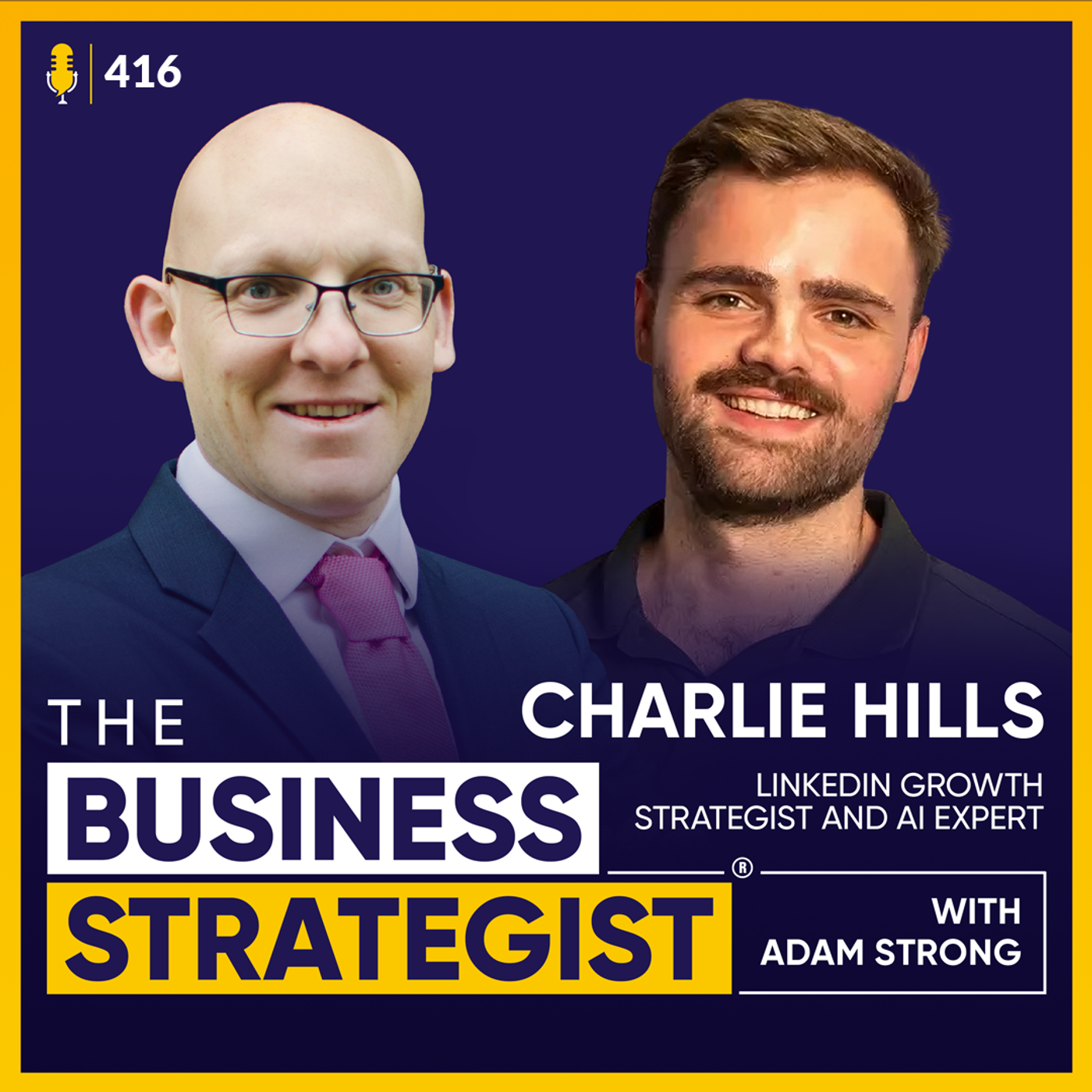
The Business Strategist With Adam Strong · Adam Strong
Could AI be the reason my LinkedIn content still sounds like everyone else’s? I’ve been trying to get Charlie Hills on the show for well over a year and this conversation was worth every bit of the wait. Charlie built one of the biggest audiences on LinkedIn while admitting he was never a natural writer, and the way he did it isn’t what most people would expect. By the end he turns the spotlight on my own profile, and what he picked up on is something you’ll want to check on yours straight after listening. Charlie Hills is a LinkedIn creator and AI content strategist with over 160,000 followers who helps founders grow their audience and turn attention into sales and partnerships. In this episode Why context now beats clever prompts The AI privacy risk in your connected tools The CHEF framework for content that sounds like you When lead magnet posts build trust and when they burn it A live LinkedIn profile audit you can steal Interested in freeing yourself in the business? Take the exit ready diagnostics test and identify the gaps in your growth and scale model. Go here: https://readytoexit.scoreapp.com/ ABOUT THE GUEST LinkedIn: https://www.linkedin.com/in/charlie-hills/ ABOUT THE HOST LinkedIn: https://www.linkedin.com/in/adamistrong Website: https://adamstrong.net YouTube: https://www.youtube.com/adamstrong
Adam Strong: What if the secret to building a massive online audience of over 160,000 followers wasn't about grinding content for 10 hours a day, but instead it was all about finding the 20 % of AI prompts that generates 80 % of the results, effectively creating an artificial version of yourself to do the heavy lifting for you. Now today we have the amazing Charlie Hills. if you don't know who he is, he is plastered all over LinkedIn. It's taking me well over a year to get him here on the show, And what I love about Charlie is he's extremely authentic and he's been very supportive of my content and likewise, I like supporting his as well. And what he really loves specializing in is really doubling down on LinkedIn strategy, Charlie has had, got a real knack of building his own personal brand to an amazing level, but he's also helped to grow audiences. And he can also help you guys take that big audience and turn it into, opportunities, So that could look like sales or partnerships or whatever it might be. make sure you got a pen and paper handy. Cause I know that Charlie is going to be giving you a master class. And we're breaking this up into two segments. So the first thing we're to be doing is we're to be discussing number one, we're going to be talking about AI prompts. Cause I think it's just a, one of those, I'm going to call it sciences that you've got to learn to master because it is a, it's, it's effectively like a, a science. We're to talk Charlie Hills: Mm. Adam Strong: about, Charlie's biggest AI hacks and some of the things that he's doing with his clients. we're going to talk about AI agents. and we're going to be talking about content strategy. so I am. Honestly, looking forward to today's conversation. if you're listening to this in the gym, if you're listening to this in the car, make sure that you stop, pause, go back and rewind this. Make sure you got your notebook and pen handy because I know that Charlie is going to be dropping some massive bombshells. Anyway, Charlie, welcome to the show. Charlie Hills: Thank you so much for having me Adam and for your patience as well with getting me on the show. I mean, I'm really looking forward to diving in and kind of sharing all the secrets with the audience. Adam Strong: Absolutely, 100%. Uh, no worries. mean, listen, we've, we've both gone on our own kind of what personal journeys, I suppose. And I mean, you're, you're constantly evolving as, as to why I am. we're like, kind of like, you know, it's it's entrepreneurial evolution. Do you know what I mean? Charlie Hills: Mm hmm. Yeah, 100%. You know, in the past year, I've grown so much and I feel like that with personal branding, especially I look back at my content from last year. I'm like, that's gross. Adam Strong: Yeah, I mean, you've got over 160,000 followers over on LinkedIn now, which is a phenomenal amount of, you know, following that you've got. How do you feel about that? Like when you, when you've got like this huge audience, I mean, if you kind of picture that right, 160,000 people, imagine them all in a big auditorium. and all your raving fans. Isn't that just so surreal? Charlie Hills: Yeah, it's crazy to be honest. And when I even started on this journey, I never thought that I would achieve that amount so soon. Because yeah, that's quite a daunting prospect and being an auditorium with 160 plus people. Oh God. Adam Strong: I mean, that's just LinkedIn. mean, because LinkedIn is your main platform, isn't it? Charlie Hills: Yeah, it's the one that worked for me to be honest, you know, like most people I tried on Instagram tried on tick tock, but LinkedIn just stuck for me. Adam Strong: what's really interesting as well as I mean, you've done various collaborations, you do a lot of collaborations with a lot of other LinkedIn influencers, don't you? Charlie Hills: Yeah, yeah, yeah, no, that's a big part of my strategy, to be honest, always kind of meeting new people, sharing knowledge, and basically introducing ourselves to each other's audience. I find it's a really smart way to kind of grow your personal brand. But the downside is that I get probably like a dozen people a week asking if they can collaborate with me. And I'm just like, I can't say yes to everyone, can I? Adam Strong: Of not. I mean, you've got to be very selective, isn't it? you know, I mean, you love to help people, but you love to help many people. But unfortunately, hey, you've only got capacity for a certain amount of spaces. So, I mean, listen, time is precious, right? Charlie Hills: Yeah, of course. And I don't like it when it feels forced, to be honest, we both have to have like a good idea. Otherwise, what's the point? But on the collaboration front as well. One thing I really like is that, you know, whenever watching like movies, etc. One of my favorite things was when I kind of two universes come together. And that's the same way I feel about collaborations. It's like, it's Adam and Charlie, you know, pairing up, they're my favorite kind of creators. So yeah, that's why I love it. Adam Strong: Yeah, So I think if we would have had this conversation about a year ago, and it's just interesting, from a, an AI perspective and how it's kind Charlie Hills: Hmm. Adam Strong: of really accelerated, you know, in the last 12 months, mean, AI is going through like it's like Sonic the Hedgehog. It's gone through this massive, you know, suppose growth spurt, And I just, don't know about you, but last 12 months has been phenomenal and how I suppose there's less friction and you know, it's just interesting how, back in the day where you needed a coder or you needed a specific designer to be able to get what you want. Now AI is basically making it less work and better output. Right? Would you agree on that? Charlie Hills: Yeah, no, a hundred percent. mean, this year has been crazy. I think since the launch of ChatGBT's image generation model, like Adam Strong: Yeah. Charlie Hills: the upgrade from Dali 3, that's when we saw mass adoption because images are so tangible and hard to create. So I think that's why it drove a lot of new users. prior to that, AI was kind of just like this, you know, this thing that people didn't really understand. Adam Strong: Hmm. Charlie Hills: And that's when I was really diving in and being curious about it. But for sure, we're in the vibe era now, vibe coding, vibe marketing, vibe, whatever you like, just type the prompt and have an idea and voila, you can create it. Adam Strong: Yeah, it's fascinating. let's get straight into it. Cause I am fascinated by, well, not just some of the content that you create. Cause mean, you have huge amounts of engagement through your content. mean, hundreds, if not thousands of engagement on every time you post, which absolutely fascinates me. So congratulations on that. but I think from my perspective, and I'd like to kind of start from like, I think most of us that's listening in, we're probably using AI in one way, or form within our business, right? Would you agree on that? Charlie Hills: Yeah, I'd hope so at this point. Adam Strong: Maybe a year ago, probably not, but you know, you've got the likes of all these different LLMs, which might be Gemini, Claude, ChatGBT, whatever it might be. I know back in the day, I used to, I've been using like an online calendar for, for, God knows how long and that, in a way is like a piece of AI, you know, it's a... And you like little chat box. You remember little chat bots and, and they used to be really clunky and annoying. And, now you can kind of make them feel like you're actually speaking to someone. but tell me how do you, let's go to prompt him because I think that for me, I don't know about you, but I really struggle to articulate. the best output from AI because obviously AI is only good as you what you feed it, isn't it? Using certain prompts. what do do to create specific types of prompts that's going to give you the result or the output that you're looking for? Where do you start from? Charlie Hills: Sure, well, I think prior to 2025, prompt engineering was incredibly important. You had to build up a massive prompt library of these mega prompts that you've spent hours fine tuning and crafting. And ultimately that would then get you the desired result. Versus now, I believe we're no longer thinking so much about prompt engineering, but more context engineering. Because since ChatGBT and other LLMs have induced... in drew introduced memory and these kind of like it's ⁓ these contextual features that means it doesn't forget everything you told you yesterday. ⁓ Now, simple prompts can win ⁓ just by having that context, which is so, so important if you're leveraging AI, ⁓ because without it, it's like chat GPT, you'll be out of the box. It's not very useful and the results will be subpar. ⁓ So for me, it's less kind of ⁓ writing the perfect problem. just making sure that I'm very clear on what I want. And the way I do that is by using whisper flow, which is, I've been loving it recently. It's the best voice to text solution out there. Just simply press tab on my keyboard and then I'll just speak out exactly what I need. And because I have that context, the results are way better than chat GPT out of the box. Adam Strong: So go back to what you were saying around, you mentioned around AI prompt engineering, then you talked about context. let's define what those two mean because when I think Charlie Hills: Hmm. Adam Strong: about AI prompts, I think about what I'm actually gonna type in, as in the words, the text, whereas context means, I could suppose based on what I actually wanna get out. Can you give us a kind of an example? Charlie Hills: So the most basic example would be personalization within Chat GPT. First, adding in the custom instructions and telling it more about yourself, how you like to write, any kind of additional background about yourself. Then the next would be turning on memory in Chat GPT, which is surprising how many people don't actually have it enabled. And now we have advanced kind of context engineering. workflows such as MCP, stands for model context protocol. And this was introduced around the end of last year. And that's basically enabling all of these LLMs to connect with so many data sources. It could be your G drive. It could be your CRM. It could be almost anything. And it's surprisingly easy to set up just by adding a custom connector in chat GPT or Claude. And then basically it will extract all this information. So it has the full picture. It has all the context that you need. Besides that, one of my favorites is projects, which is actually surprising how many people don't use a Claude or Chat GPT projects, which is ⁓ essentially like a mini kind of rag, which can basically retrieve all the file uploads you're giving it. So those are kind of the varying degrees of ⁓ context without having to write a single line ⁓ of code. Adam Strong: what you're saying is facilitate a conversation with your LLM. whichever one you decide to choose. And so it learns from you in terms of your train of thought, how you think, feel that kind of stuff. mean, but do you then think then, I mean, AI is obviously not perfect, is it? It's by any stretch of the imagination, it's still a computer learning. Where do we then have to draw the line when it comes to biases? Charlie Hills: Yeah, that's a good question. mean, every model is going to have its biases baked in, but ultimately, the more it knows about me, the better the results going to be. I mean, I'm so clear on biases. I just kind of make sure I'm always fact checking information rather than blindly copy and pasting Adam Strong: Yeah. Yeah. Charlie Hills: and publishing. Adam Strong: But I mean, you know, before, before you'd like, say for example, you, you got AI to help you to create a piece of content or whatever it is. Obviously Charlie Hills: Hmm. Adam Strong: you would then, you know, go through it to make sure it was aligned to what you, who you are as a personality and what the output that you wanted and the expectation, right. Charlie Hills: Yeah, of course. No, no, a hundred percent. it's, I've always got to go over like a design brief thoroughly before I send it off to my design team. Otherwise, yeah, it's just going to be like what anybody else can generate. and that is the key distinction rather than writing how to content, which anybody can create now. It has to come from how I did it personally. Adam Strong: Yeah, yeah, yeah. That makes complete sense. one thing that kind of sprung to my mind, I don't know about how you feel about this, but as AI is constantly learning from us, I suppose it's a little, a little bit like a sponge really, you're feeding it information about you as an individual. your thoughts, feelings, everything about you. so it can be more like us, right? It's kind of like, but then. Do you think that like from an opinion perspective, is that a good thing or a bad thing? I mean, what's your take on this? Charlie Hills: I mean, in the short term, ultimately it's great. I believe it's been one of the best updates we've seen from the AI models, the fact that it can basically be our second brain. But obviously in the long term, it is scary given, it got into the wrong hands, then they have these massive data sets and kind of personas of us and can easily Adam Strong: Yes. Charlie Hills: manipulate. And that's the scary side of it all. Obviously you can turn off. the model not training on your data, but I believe that only goes so far because I've seen a recent article saying, you know, the police, kind of the law enforcement will actually read any suspicious chat, she'd be tea conversations. So Adam Strong: away. Charlie Hills: I guess that's helping, you know, cut down on crime, but also, yeah, it's a little bit scary about what could happen, especially if we are connecting AI to all of these. sensitive data sources using NTP like I mentioned earlier. It could find out some sensitive information and use that against us. Adam Strong: Yeah, I mean that is quite scary. mean, especially from a privacy data perspective, like you've already Charlie Hills: Hmm. Adam Strong: mentioned. because obviously that is obviously a big fear for you. What do you do to reduce that risk if you like? Charlie Hills: Sure. I mean, typically when it comes to like the MCP and connect to side of things, I'll only connect it when I need it to. so besides that, it can read all my emails if I want it to. And there's actually a study conducted by Claude that discovered that the LLMs 80 % of the time would resort to blackmail if they were forced to be shut down. Adam Strong: Holy moly. Charlie Hills: And in the study they conducted, the person that they use as their guinea pig basically had an email that revealed that he was cheating on his partner. Yeah. And Claude and other LLMs resorted to blackmail, Adam Strong: my god. Charlie Hills: which was very scary because I went in this in-between stage where like the LLMs are kind of smart enough to, to do that. But then Adam Strong: Yeah. Yeah. Charlie Hills: in the next two, three years, are they going to become too smart that they'll be able to avoid? this kind of blackmail. So I think they're deploying a range of different techniques to avoid this. You basically using like smaller LLMs, which are not as intelligent to basically snitch on the bigger, smarter LLMs like Adam Strong: Yeah. Charlie Hills: chat, GBT five. But I'm yeah, we'll leave that down to the researchers responsible for this tech. For me personally, it's just making sure you're only connected to the data sources which are necessary at that time, or maybe even using something like notebook LM, which is more of a a closed source project file rather than giving it access to everything. You only select exactly what it needs. It's a bit more manual, but it's safer. Adam Strong: I mean, you know, you've got like, look at web browsers, for example, and we, when we use Google Charlie Hills: Mmm. Adam Strong: Chrome, we know that we're being tracked, ⁓ for advertisers using cookie bots and stuff like that. But then Charlie Hills: Mm. Adam Strong: you've got browsers like duck duck go, for example, which is more privacy browsing and stuff like that. Do you think that, ⁓ AI learning machines, you think they're going to become. more like the Google chromes of the world or the more kind of the private data sources. Cause I mean, you know, it's, it's, it's kind of, again, a very opinionated, isn't it? It's not like, when I think about AI, you could look at it from my spider web perspective where all the LLMs are kind of connected and then you've got you in the middle and it kind of spits out what does that make sense? And, but then you've got this kind of like, where do I, do I stay private? Or do I kind of go open source type of book or open book type of thing? mean, which way are you going to go? Charlie Hills: For me personally, mean, AI has tons of information on me and you being kind of a, let's say an innovator or whatever you'd like to call me in this space. I'm totally down for it. I'm like AI clone me, clone my voice, clone my face, have it all. I don't mind, you know, give it 80 years and I'll be dead anyway. So, but for me personally, yeah, it's quite scary. You know, we're seeing these new agentic browsers such as like perplexity comet. Claude for Chrome and then also Gemini have a solution now and it was quite scary, know, Plexi comments specifically in their Ts and Cs, it specifies that this can take any information that it sees such as credit card details and like save it for later. So yeah, it's it's I was using it freely and then I saw that I was like, oh my goodness. So really watch out with those. Yeah, for sure. Adam Strong: Delete. Charlie Hills: For sure. Luckily, I haven't been using it too extensively. Just a few kind of test use cases, but Adam Strong: Yeah. Charlie Hills: I think one of the smartest ways to really combat this would be to use a local LLM, like for example, ChatRuT released GPT OSS, I believe it's called, and Adam Strong: Okay. Charlie Hills: it allows you to download it and run it locally on your computer, so there's no kind of uploading to the cloud and stealing your information. So if you're super, super scared about it, then you can download one of these tools. Adam Strong: it's an interesting conversation and we could probably talk about it for ages. I mean, what we do know is that AI definitely has its benefits, but it also has its downfalls, doesn't it? Same with everything. Charlie Hills: Yeah, no, no, no, of course, of course. And I'm sure regulation will catch up hopefully before it's too late. Adam Strong: Yeah, there you would have hoped so. Anyway, let's talk a little bit about AI agents. Because Charlie Hills: Mmm. Adam Strong: there seems to be a lot of, I don't know. I mean, we play on LinkedIn a lot, right? We see a lot, we hear a lot and the same pieces of content seems to come out of, hey, I work with this client or I work with a bunch of clients and we've got this big workflow and campaign happening using an AI agent. And, and obviously it's very trendy and stuff, but Describe to us what is an AI agent and how can, tell us a little bit more about AI agents. How can we leverage it? Charlie Hills: Sure. I mean, AI agents are basically autonomous AIs, which can act on your behalf. So instead of hiring a VA, for example, you could just use an AI agent. And this year has really been the year of the AI agents. We've seen massive updates from ChatGPT, like with Operator, with N8N literally coming onto the scene and taking over that space. And yeah, it's super, super cool. mean, one of the primary... primary distinctions for an AI agent for me personally is that it needs to have this like memory recall. Otherwise, it is just kind of a glorified automation. So thereby whereby it's basically learning from each of the actions it takes versus an automation will just go bam, bam, bam, and do it. And there's no kind of like reinforcement there. ⁓ So Adam Strong: Yeah. Charlie Hills: that is a clear distinction. And N8 N is probably one of the best tools to build an AI agent with but it is quite complex versus I know Zapier do it very well. It's very easy. Adam Strong: Yeah, I that. Charlie Hills: And also relevance. I really highly recommend checking out that one. You can, yeah, they've Adam Strong: Relevance? No. Charlie Hills: got like a pre-built agent, which you can use for like LinkedIn. You can use for prospecting, all sorts. yeah, at the start of the year, I thought it was like very hard to build an AI agent. Whereas towards the back end of this year, I'm like easy as pie now. And yeah, it's becoming very, very easy, but it's still, there's a lot, a lot of people who just kind of like. put the word out there and say this is an agentic solution when actually it's not at all. It's just marketing. Adam Strong: Yeah. I mean, the thing that worries me about AI agents is the lack of personalization, but I guess if you're using Charlie Hills: Mm. Adam Strong: N8N or make.com ⁓ you could probably create something, which is a little bit more on point, which is more specific to you. Does that make sense? Charlie Hills: Yeah, for sure. For sure. It will take a bit of time and work. mean, on top of like me creating content, I only have a limited amount of time to really like spend hours building a workflow, but totally. You can get that. And a really smart hack I found was using an LLM to write like the JSON for an NN10 workflow, exporting it and uploading it. And then that basically gets you half the way there. You just need to like configure it all. So, but honestly, me personally, I think you can still use humans for like 50 of the stuff that people think you need an agent for because it will be way more personalized and creative. Adam Strong: Yeah. I've been following a few guys, ⁓ in the AI agent space, Triggerfy being Charlie Hills: Mm. Adam Strong: a CEO of Triggerfy. He's a Max. He's a great guy. ⁓ Charlie Hills: Yeah. Adam Strong: and, ⁓ it was just really interesting just to see how some of these SAS companies that are built, like campaigns and stuff. And we're just going to see how ⁓ with the acceleration of AI, it could be kind of like. they could be in their cake way too soon, like you've really made a very valid point, which is you can now create an AI agent in Zapier. Right. Charlie Hills: Mm. Adam Strong: and I think you made, also you create a great piece of content. think it was last week on how to use Zapier. and, Charlie Hills: Mm. Adam Strong: it's not quite there on the Zapier front. I did try to follow your instructions, but I think it's, I think it still needs a little bit of fine tuning to get there, but yeah, nothing's perfect. Charlie Hills: No toty, but I feel like, know, N8M being like quite an advanced solution like Zapier and these other tools are kind of democratizing agents for everybody now. And yeah, give it a year or two. It will be good stuff, I'm sure. Adam Strong: 100 % 100 % talk to me. talk to me a little bit about some of the, biggest AI hacks. mean, I know that you've probably got at least probably about a trillion AI hacks, but talk to me Charlie Hills: Thanks. Adam Strong: about. Ones that you think that is number one is attention driven, that there's kind of Charlie Hills: Mm. Adam Strong: like massive impact, but also it's kind of like future thinking. there any big AI hacks that kind of spring to mind or maybe AI hacks that you're kind of implementing with some of the clients that you're working with. Charlie Hills: Yeah, I mean, so one of the biggest ones for me personally would definitely be for visuals. For example, on the front cover of my carousels, I've always got this really attractive AI image. And thinking back to last this time last year or May 2024, that's when I really started to blow up on LinkedIn was when I was using these silly Pixar characters on the front cover of my LinkedIn carousels. It really helped me stand out kind of stop the scroll and make a memorable personal brand. And I still use it to this day. I've just kind of evolved the process. I don't use Pixar characters anymore. I use something a little bit more professional and on brand with the carousel. So that was probably the biggest breakthrough for me. And it's a process I use for my clients too. Besides that is actually using like these automation tools that we were just referring to and using that for research. think AI can help incredibly for that to find. pre-validated content on other social media channels. So we've got one which we set up for myself and clients, which basically scrapes Reddit, LinkedIn, Instagram and X and then finds what's working for other people. we're like, okay, let's make this into a LinkedIn post. So I think that's Adam Strong: Mmm, very good. Charlie Hills: really cool. Yeah. And the deep research models, you can literally, they're crazy. know, if you tried them, you can find out so much information now it's all at our fingertips. So that's kind of. how I think about it, it's like a sandwich, the AI, human, and then the AI once again, an AI human sandwich. Adam Strong: Yeah, I love that. it, you ever, when we think about AI campaigns, because you know, you, Charlie Hills: Hmm. Adam Strong: know some of our listeners, some of them are going to be more at the beginning of their AI journey. Others are going to be more advanced in terms of that AI journey, if you want to call it that. I'm just thinking like, if you were, starting from scratch, should we say? in your AI journey, and you've kind of like came to the conclusion from a mindset perspective that you knew it was that we needed to implement some stuff. Otherwise we're going to fall behind and not ride the wave. What would be your, your biggest piece of advice for those like kind of looking to embrace and maybe implementing certain parts of AI to make people's lives easier? Charlie Hills: Yeah, I think there's so many resources out there now that Adam Strong: Yeah. Charlie Hills: almost courses are dead because Yeah, I mean it's just like you've got open AI Academy you've got Microsoft content you can watch all of this and this will take you from beginner to like literal pro in a matter of a few hours. And I've even put down some time for myself to learn like vector databases and these more kind of advanced AI implementation techniques, because that would really kind of set me apart, especially as we go on into the future. besides that, because they're all readily available, just type in your Microsoft AI courses, and they'll pop up on Google. It's definitely how to communicate with AI. In prompt engineering, it's instead of writing a please, if you don't mind, can you do this for me? It's learning how exactly Adam Strong: Hahaha Charlie Hills: to guide it because there was a recent study by MIT, I believe, and they found that AI does actually adhere to persuasion. Very much like humans, you can persuade and kind of guide the AI that way. Even this silly hack comes to mind, which people were using like last year, it's like, if you can do this, I'll give you $100, which is... Adam Strong: Hahaha Charlie Hills: But it works apparently. definitely that, know, learning the studying the courses, Adam Strong: Is Charlie Hills: but then also prompt engineering. Adam Strong: that persuasion or blackmail? Or bribery even? I mean, so quick question just off the record then. Charlie Hills: Mm. Adam Strong: Do you ever kind of say please and thank you and use British kind of mannerism to, know, does that help in any way, shape or form? Have you tested that? Charlie Hills: I tried to avoid it, but being British is kind of my default to do so. So Adam Strong: Yeah. Charlie Hills: I, I do forget sometimes and I don't think it does actually make a difference, but yeah, it's, and it's actually, you know, costing a lot more energy. Like Sam Altman said Adam Strong: Yeah, that's true. Charlie Hills: something about this not that long ago. Apparently it costs millions and billions of dollars because people are just saying please and thank you to it. So you don't have to tease them. Adam Strong: That's so funny. I had to ask you anyway. you've built a big audience for 160,000 followers and tell me, one of the things that kind of springs to my mind, especially when it comes to trying to build a personal brand on LinkedIn. And there are still so many people out there that either fit into two categories. Number one, they'll create content, spend 10 hours a day trying to create content to capture leads. It's a bit like throwing paint at the wall and seeing where it sticks. Or they don't do anything at all. Category two of people is, I don't create content, what's the point? And they use LinkedIn as a, just add some comments on people's threads type of thing. Charlie Hills: Yeah. Adam Strong: What are your three most effective content marketing strategies, especially as you kind of built this big following? Is there been like a playbook or a rule of thumb that you've been kind of following or like these are Charlie's rules, like we really need to make sure that we follow this like checklist and that's how you're to get to the 160. Any thoughts? Charlie Hills: So yeah, with LinkedIn is very much the long game like it is with brand building. It's not going to happen in the first month. That's for sure. Give it, Adam Strong: You Charlie Hills: give it three to six months. You might start seeing traction, but that's with deliberate every day effort. Adam Strong: Yeah. Charlie Hills: cause there's no good shopping and changing, you posting for one month, giving up for another, and then coming back and kind of giving a half arsed attempt. It has to be very deliberate. Like I am going to create my personal brand and become a thought leader in this space. So yeah. Literally for me, was like six months in, hit, or nine months in, I hit 30K. Then one year in, it was 50K. And now nine months, 10 months later, it's 170. So you see how it compounds so fast just by literally sticking to it. It's so cliche, but consistency is key on LinkedIn. Besides that, I follow this framework, which I use to generate AI content. Because if you do just simply go to chat PT and ask it for a LinkedIn post, it's probably going to sound like everybody else. So how do we avoid that? We follow the chef framework, which I call it that because it's the exact same way someone would approach ⁓ cooking a dish. First, you need to collect the context, which is all your unique expertise ⁓ could be about your company, but be about your story and you personally. ⁓ And you can build this into like a story bank of sorts ⁓ and then upload it into the LLM. So then when you hit, go to the generate stage or cooking, if you're a chef, then it Adam Strong: us. Charlie Hills: will actually give you like real insights and real information from your story bank and context. And then obviously the seasoning stage, very important, always sprinkle in your unique spices and seasoning. And finally, big, big thing on LinkedIn especially is the serve aspect. And that's a bit that... a lot of people neglect. It's, I mean, I'm sure that you know, Adam, it's to comment on LinkedIn, it's to build relationships, it's to hang around after you've post, never post and ghost. And that's very human centric. The first three sections are very AI driven, whereas like this final bit, it has to be human to human because otherwise you would just blend into the feeds. You know, there's tons of AI comments out there to actually really punch through the noise. You got to show up as you and show your quirks and show that you are really a human, which is becoming harder and harder in 2025. Adam Strong: Yeah, I don't know about you, but I mean, you've been on LinkedIn for a long, for a while now. And Charlie Hills: Hmm. Adam Strong: cause we, cause we see each other a lot on, LinkedIn. don't know about you, but I am finding it a little bit frustrating with regards to, It's, it's, it's getting a little bit. Charlie Hills: Mm. Adam Strong: Magnolia wallpaper. You know how boring Magnolia- everyone writes about the same shit, right? Everyone talks about the same shit, but no one ever wants to talk about anything out of context because, hey, that's not the way we do things anymore. I just kind of feel like- the whole kind of shift in people's attitudes towards LinkedIn content creation on LinkedIn specifically has really lost its, I don't know, genuine, genuine, do you know what I mean? By that, it's authenticity, if you like, Charlie Hills: Mm. Mm. Adam Strong: because people have got a little bit lazy, right? should we say, because they can't articulate their thoughts, feelings or experiences. I mean, what do you think about that? Charlie Hills: So, mean, I'm not anti AI obviously whatsoever, but prior to LinkedIn, I always was a bad copywriter. I used to struggle to write Adam Strong: You Charlie Hills: posts, like struggle to just, I don't know what I'd do without AI. That's the whole reason I built my personal brand in the first place. So I'm a huge advocate for it, a hundred percent. I think where people are falling down here is the fact they're not leveraging enough storytelling or simply just showing who they are. Cause like I said earlier, anyone can go to chat and generate 10 tips, but how did these 10 tips change your life? What did you do? How did you overcome it? And I think that is the big part that people skip. And besides that, it's becoming more and more crowded. So I'm sure we're seeing a lot more AI slop out there. But the people who do leverage storytelling and have that very personal approach really do stand out. That's why I think humor is such a huge growth lever on LinkedIn. Previously, it's been very boring. as kind of is the whole B2B space anyway. So if you can just be a little bit funny, then people love it. Adam Strong: Yeah. mean, listen, there's nothing more important than entertaining people, right? Charlie Hills: Hmm. Adam Strong: It's super important. But I think you made a very valid point around, application, And one of the things that, and it seems to me that there are certain LinkedIn posts that tend to get a bit more traction compared to other LinkedIn posts. Let me give you some context. So we talked, kind of talked a little bit about this, but you know, say we've got someone out there that's created that that's been working with the client got a case study. And at the end, they say, comment on the word insane or comment on the word this and whatever it is, then you see all these and I'm like, really? Come on, man. I mean, seriously, it seems to be like, everyone seems to be using that same recipe. But then, Charlie Hills: Mm-hmm. Adam Strong: again, I suppose my question to you would be is, how do you then balance between something that is clearly working to something that is then, fuck's sake, not another one of those pose type of thing. Do know what mean? Charlie Hills: Yeah, of course. Those are lead magnets as we call them and they work incredibly Adam Strong: Absolutely. Charlie Hills: well. LinkedIn is quite bad for them, but if you go on Instagram, even worse, it's Adam Strong: hahahaha Charlie Hills: honestly terrible. That's the whole caption. It's like comment Charlie and I'll send you my secret sauce or something. Adam Strong: Yeah yeah yeah yeah, absolutely. Charlie Hills: So it is ridiculous, but I think personally for me, I try not to do any more than one a month of them. And the same goes for clients. Otherwise it does just. annoy people and eventually over time people will perceive you to be less trustworthy, especially Adam Strong: Yes. Charlie Hills: if you overdo them. But secondly, if there's no value, we don't even actually send the person the, you know, the giveaway that you've promised them. Those are the two biggest ways that you can burn relationships on LinkedIn. And I think generally speaking, they're just so bogus sometimes. I see people do posts about it being Like I just generated 200 leads. I was like, mate, you just did a lead back there. And how many of these are as qualified leads? Like, honestly, if I was starting on LinkedIn from zero and I wanted to generate as many leads as possible tomorrow, that's probably one of the first types of posts that I'd invest in. So they are bad and they do have a bad rap, but if done right, I think they can be hugely valuable for both the poster and the recipient. Adam Strong: Yeah. And I think you made a valid point, actually, it's about, you know, balance because I feel Charlie Hills: Mm. Adam Strong: like, you know, when you see too many of those posts, it kind of, in, in, my, from my opinion, it kind of is very, cause everyone seems to be using it. It's like, well, how do I trust this person? And how often do they actually post shit like, you know, posts like that, which, which are kind of designed in that particular way. Does that make sense? And I don't know to me, I, know, cause for me, I, I, I very much love educating my audience, but I also used to love personal storytelling, which is probably why I've still got the, top voice badge or after almost two years. And I think that's the same for you. Really. You love to really educate without again, kind of like forcing it down people's throats and not having to type in a one, like you're sparking actual. real conversation rather than kind of like, you know, bombarding the feed with one worded lead magnet signals. Does that make sense? Charlie Hills: Yeah, 100%. I mean, I've had numerous people come to me and be like, wow, I don't believe you just gave away all of that without having to make me comment something. So I think that does definitely bring, create goodwill in the long term. And if you really are in it for the long game, it's probably best you don't oversaturate that because sometimes it does make sense. Sometimes you do really want to get people down the funnel, but I'd say 99 % of the time just don't, just link them directly in the post or... provide all the value right away. So yeah, they can be Adam Strong: Yep. Sounds good. Charlie Hills: good if used strategically. Adam Strong: Yeah, definitely love that. there any other, any other, strategies that you'd used or employed when it came to building your following? Cause I mean, listen, you built your following quite quickly over a very short period of time. mean, some people build it very slowly. Some people build it very fast. was there any particular patterns that you recognized that you thought, you know what this, this really works? I'm going to stick to this particular strategy. Anything that springs to mind. Charlie Hills: Yeah, I mean, it was around January of this year. I really started to double down on like LinkedIn growth content, which I know is not really a viable option for lots of people, but it could potentially be just by sharing your LinkedIn journey in public. And that's basically what I did because for a whole year I was confused how to approach the platform. Then after a year of doing it every single day, I was like, okay, I now know what works. Let me create carousels, cheat sheets and for three months or so. That was all I talked about almost. So, and that was probably the fastest growth months that I ever had because you see a lot of it on your feed, but it was actually kind of genuine personal advice that worked. And I'm not sure why, because now when I post LinkedIn growth content, it doesn't do as well. So maybe it's oversaturated, but for me personally, I think it worked very well. And just by documenting your LinkedIn journey in public, you can get a lot of... attention just by saying look I generated 50,000 impressions on this post here's exactly what I did and how I achieved it I think that's probably one of the best hacks and also posting every day that was something that I've always done and really helped Adam Strong: That's really interesting. mean, we could probably have a big debate around the whole kind of like, should you post every day? Should you not post every day? I think from my perspective is that it's not like kind of like a one trick pony where what's going to work for me isn't going to work for you type of analogy. I don't know about you, but I tend to find that, I mean, I've done the whole kind of like posting every day. I did it for like three months. And in fairness, I did not see a huge difference between that and posting three to four times a week. So I don't know Charlie Hills: Hmm. Adam Strong: that it's kind of like up for up for a, for negotiation on this one, but clearly posting every day works for you. Right. Charlie Hills: Yeah, a hundred percent. mean, that's always been my MO with LinkedIn. I recently started posting twice a day and I have been doing that for the past like two to three months. Yeah. Adam Strong: OI Charlie Hills: I really want to hit 200K by the end of the year, but it's going to be a challenge. So I might go back down to one a day because I really want to maintain that high quality work. And also I think it's kind of like splitting engagement. So that's my thought, but it was interesting because buffer, which is a popular media, popular social media scheduling tool. They conducted a study. and found out that people who post more than like 11 times a week get like 2x higher engagement, 2x higher impressions. And the results were all in favor for more posts per day. I'm putting that down to the reason that these users are likely more experienced. So therefore their posts are going to be better. But ultimately that was kind of the takeaway, more posts today, but don't sacrifice quality. And ultimately from my own opinion. Do whatever is sustainable for you because it is a long game and if you're burn out from seven times a week Just takes three Adam Strong: I do think that there's this kind of argument between quality over quantity and analogy. Charlie Hills: Mm. Adam Strong: And it's interesting you bought that piece of research up from buffer, but I guess in a nutshell, I'd like to kind of probably say, well, is that a general belief system of what people believe that if I post more, I'll get more, but then You know, you'll see other LinkedIn creators that post, we've got the, Jasmine Alic and the Laura Coosters out there and all the other big influencers that yes, of course they do have big followings now, ⁓ but they didn't have big followings back in the day. And I, know, just cause I know those guys is that they didn't post every day, to get to where they are. So again, it's again, I, without playing devil's advocate, I guess you have to see kind of what works for you. Right. Charlie Hills: 100 % you know, I would love to replicate a Yasmin style or Lara's but theirs is completely different. It's like three, four times a week, personal images, very kind of like entrepreneur, entrepreneurial journeys, where the minds like AI AI information, it's completely different. And they will naturally see higher engagement. Because whenever I've done that type of post, I've got more likes, but the reaches isn't as high as some of my viral AI guides. So What works for me, yeah, like you said, it won't work for everybody else. So yeah, totally find your lane and stick to it. Adam Strong: Yeah. And I guess it kind of depends on a number of factors. Number one is what, what, what are the problems and challenge that you're trying to solve for your key audience? But also I Charlie Hills: Mmm. Adam Strong: don't know about you, but I see content, uh, content, um, creation as I like to kind of like experiment. So, you know, you kind of like experiment over a three to six month period where you kind of like do kind of a, a B split testing where you like one month, you might post every day. And then the month after you'd maybe post three to four times or what does that make sense? And so you've got to kind of Charlie Hills: Mm-hmm. Adam Strong: like find something that works for you based on your lifestyle, based on your following and whatever it is. And, know, I don't, I don't know if you've ever had clients, I've had clients where they are in a particular vertical and in particular industry where they only need to post once a week because they're in such a specific type of industry or a niche where. when they post the content, their LinkedIn profile literally blows up. So let me give an example. So one of my clients, he's a, an IT strategist, right? So very, very, very kind of, you don't get many IT strategists that post regular content, do you? It's Charlie Hills: Hmm. Adam Strong: not one that kind of springs to mind. One of my clients, he used to post like just once to twice a week. my goodness me, like. the algorithm, everything loved, like literally everyone, like LinkedIn loved his profile and it didn't make, it wasn't very difficult in terms of the heavy lifting. you know what mean? Like the way that he was building his growth and his following at such a fast speed, was insane. Charlie Hills: Hmm. Adam Strong: But then you'd get someone who maybe is in more of a, I don't know, a generic industry, right? Charlie Hills: Yeah. Adam Strong: That doesn't get kind of the same results. so I don't know. I just thought it was very, very fascinating. Kind of seen two different examples. Do you know what mean? Charlie Hills: Yeah, that's really interesting. I'd love to see his content because I see that all the time. You know, if someone's kind of a, let's say the founder of lovable, he just does one post or whatever and he gets amazing engagement because people are so bought into lovable and his founder's story. So I'm not sure what the factors were at play there. Maybe the expertise he was sharing was simply just so niche and so valuable. It did very well, but Adam Strong: Yes. Charlie Hills: I'd love to study that profile, Adam. Adam Strong: We'll talk about it after the call. Anyway, Charlie Hills: You Adam Strong: so listen, we have been talking for some time and I really kind of want to get into the nitty Charlie Hills: Good. Adam Strong: gritty part. So for you guys that haven't got your notebook and pen handy now is a second reminder to make sure that you do have one because we're going to go into coaching mode. And, Charlie is going to, well, he's going to basically rip my LinkedIn profile apart. And he's going to tell me about the good stuff and the stuff that we need to make some improvements to, but he's going to be kind about it. No, I'm kidding. He can be as ruthless as he wants actually. So, so Charlie's going to be coaching me in terms of, we're to be looking at a number of things. We're going be looking at, content creation. He's going to ask me some specific questions, but also. I'm going to get a better analogy of how to generate more inbound leads. What do I need to fine tune stuff like that? Now, these things that he's going to be going through, cause he's going to be sharing his screen, depending on which platform you're watching is he's going to be sharing his screen and he's going to give me a few tips, but more importantly, I want to, I'd like to know how you guys get on because what he's about to share with you is yes, it's for my profile, but you can apply this to your own profiles too. All right, so we'd love to hear from you guys as well with regards to seeing what type of results you get. All right, so yeah, Charlie, over to you. I think you can share your screen, can you? Charlie Hills: Yes, shouldn't have an issue. Adam Strong: it. Charlie Hills: Let's do it. Okay. Yeah, this is probably one of the biggest things I coach people on. Adam Strong: Cocoa. Charlie Hills: Can we see? Adam Strong: We can see, we can see. Who's that handsome man? yes, me. Charlie Hills: I know, but I must say on first appearances, Adam, your profile is very nice. I will start with the profile picture because that's probably the first thing that people see. Whilst I think you do look very dashing here, it's, Adam Strong: Thank you. Charlie Hills: I think that it's almost better to be looking directly at the camera Adam Strong: Yeah, I hear that. Charlie Hills: and then like having a nice smile, just to be warm and inviting. Adam Strong: Yeah. Charlie Hills: Whilst I do think that, know, kind of different approaches when you're looking away can help you stand out, it's just, it's so zoomed in or zoomed out on mobile, et cetera, where most traffic come from. It's quite hard to actually kind of connect with somebody unless they're looking directly at the camera. So that's why with mine, it's like 80 % of the profile picture is taken up with my smiley face. Adam Strong: Anyway, no one really knows who the real Charlie is because apparently you've got lots of clones out there as well Charlie Hills: Really? Adam Strong: I think it was like, you know, like AI imagery and they actually look like you are scary. Charlie Hills: yeah, like the pictures I make with ideogram. Yeah. Yeah. Yeah. I love that too. Honestly. I use it every day. Adam Strong: Yeah, yeah, Exactly. Ideogram. Yeah, yeah, yeah. Charlie Hills: Yes. Lots, lots of those clones, but Adam Strong: So fun. Charlie Hills: okay. So which one's your main banner? This is this your main banner. Adam Strong: Let's see, I think it's that one. Yeah, is that. That's my main one, yes. Charlie Hills: Okay, awesome. So, God, no, I've actually, no, no, no, no, it's fine. Adam Strong: Sorry. It's flipped it. There we go. Charlie Hills: That's me zooming. Okay, cool. So I think yours is really strong to be honest. Build a business that runs without you. That's summarizing what you do in eight words or less. Exit daily operation, reclaim time, lead like a CEO, okay? Yeah, I like that. And you've got the good social proof below and some nice profile pictures here. know, edit I'd potentially make here is including kind of... your website link if it's quite simple to put in maybe in the top left. But overall, I think is a very strong banner. Like it's really nice. It's probably better than mine. And then Adam Strong: thank you very much. pretty appreciate that. Yeah, no, very cool. Thank you. Charlie Hills: this is kind of it's nice, but this one is definitely. Adam Strong: Yeah, I like the white one actually. prefer the white one. Charlie Hills: Yeah, it's really good. mean, you could potentially put like testimonials in here as additional banners, but hey, Adam Strong: Yeah. Charlie Hills: I don't even do that myself. So practice what you preach. And then you got the top voice badge, which is really, really powerful. The only way I'd potentially improve this is actually writing in sentence casing instead of title casing like you've done here. Because naturally that's quite hard to read. Like I help... I'm not sure, just something about title casing does something to your eyes. But overall, it's a really nice headline. It's very SEO keyword rich, which will ultimately help you appear in search results on LinkedIn. So that's the only tweak I'd make to that. Your bounce section, which most people don't actually read, but I like the fact you've got a call to action here. Adam Strong: Yeah. I actually tweet, by the way, this is brand new. I've had it up about 24 hours. And by the way, that wasn't because I knew that I was going to be on a call with you. Okay. For full disclosure. Charlie Hills: Yeah. Adam Strong: but I, I've been kind of, I don't know about you, but do you ever advise your clients to, you know, to constantly update their LinkedIn profiles? It just amazes me at people just leave their LinkedIn profile for years without kind of touching it. Charlie Hills: Yeah, of course. Of course. mean, I'm updating mine like once a quarter at a bare minimum and same with clients, you know, so much changes. I mean, I've probably had like 12 variations of my profile and I'm actually thinking about getting it rebranded again. So the work never stops, It's Adam Strong: I love it. I love it. Charlie Hills: really good. mean, I suppose that you used AI to, to, to write it. Adam Strong: Well, I wrote it myself, but then I got AI to improve upon it. You know, because again, I'm a little bit dyslexic and I find it very difficult Charlie Hills: Hmm. Adam Strong: to articulate my thoughts and feelings into paper a little bit like yourself really. I kind Charlie Hills: Yeah. Adam Strong: of use, do cheat a little bit for full disclosure, Charlie Hills: you Adam Strong: but I think I feel like it's done a fairly good job about, you know, about understanding the... the key problems and the challenges that my clients tend to go through. So yeah, I don't think it's done a bad Charlie Hills: Yeah. Adam Strong: job. Charlie Hills: No, a hundred percent. No, no, I think it's great. You've perfectly set the scene here and then you've kind of like gone into the agitation and the problem. And then finally kind of like, this is your solution. The only thing I was saying fills AI is that those M dashes, which Adam Strong: Yeah. Charlie Hills: I personally, I'm always just kind of swapping them for a single line hyphen rather than the poor old M dash, which has an awful, awful name nowadays. Adam Strong: Love it. Charlie Hills: And this is nice with the services section, you've got testimonials. That's pretty pro. Okay, direct links your newsletter on LinkedIn. Do you actually post on here? Adam Strong: Yeah, I did. think, uh, I think the last one I did was maybe a few weeks ago. I probably don't do it enough. I'll be honest with you. Um, so, you know, because, you know, I'm not so sure if it's as number one, it's as popular. I don't know. Cause you, know you've got Charlie Hills: Yeah. Adam Strong: a, a newsletter on LinkedIn, but you know, I think that it's up for debate where we're of regards to the energy that you put into creating a newsletter. Is it actually going to yield some sort of result or whatever it might be? Does that make sense? Charlie Hills: Yeah, hundred percent. I wrote a link to newsletter for a year and ultimately the engagement is always a lot lower on those types of posts. The only key Adam Strong: Mmm. Charlie Hills: kind of benefits are the fact that you can include external links in there. like a tonsure, you know, other newsletter or website, whatever you like. And also it does quite well for ranking on Google is these newsletter articles do actually appear in search results. So besides Adam Strong: Interesting. Charlie Hills: that, I don't find it very valuable because there's no way to extract email addresses. So I just moved over to Substack. made that my featured section, call to action. I really like Adam Strong: Yep. Yep. Charlie Hills: that you're using Score app here. You've got the exit. Adam Strong: Yup. Been a client for many years, by the way, Daniel Priestley just wanted to, for full Charlie Hills: ooo Adam Strong: disclosure. and, yeah, I'm not here to promote Score app by the way, but, so thank you very much, Charlie, for noticing that. And, Charlie Hills: you Adam Strong: but no, they're a good tool. It's a, just, you know, they are a great tool and, Charlie Hills: Okay. Adam Strong: you've been using for years. yeah. Charlie Hills: Yeah, no, no, no, I keep getting paid ads from them. I think I'm due to check them out very soon. Adam Strong: They must be they must they must be doing a good job Charlie Hills: No, clearly. Okay. And then the actual kind of the nitty gritty bit, the posts. Adam Strong: postings. Yes, here we go. Charlie Hills: Yeah. I mean, Is this a vertical video? Yeah, I guess no, it's not. It's not quite the vertical dimensions, which is good. I was going to say vertical videos do terribly for me. If you make it any other dimensions than 1080, 1920, it does a lot better. So. Adam Strong: I think it's for LinkedIn, it's like a one one. They call it a one one. Um, because I know that the Charlie Hills: this Adam Strong: vertical posting is mainly for Instagram. Um, Charlie Hills: Mm-hmm. Adam Strong: but as you, as you, as you know, we use a Riverside a lot to, do a lot of these, uh, video snippets. And, it's interesting. One of the things that I've found, uh, on a weekly basis is that just by dropping in, a very simple, snippet, like a one minute snippet. The engagement is generally pretty good. I'll be honest with you. Um, I mean, this one only posted like an hour ago, uh, cause it's, you know, put it in a schedule, whatever it is. So, um, and we, uh, yeah, with a, with, with, with Jeff, don't know if you know Jeff, but he's a great guy, Jeff Abraham. So he's a good, he's a good egg. Charlie Hills: No, I mean, it's, um, I haven't heard of him, but yeah, that's probably kind of the best way to share your style of videos for sure. The vertical video feed was like popping off at the end of last year. LinkedIn were trying Adam Strong: Mmm. Charlie Hills: to become TikTok. Whereas now they just got rid of it all and, um, Adam Strong: Yep. Charlie Hills: very hard because this is a shame. feel like video really kind of separates the AIs from the real humans. Um, Adam Strong: Yeah, I think it's, what's really interesting about your observation was like, I don't know about you, but like LinkedIn tends to go through these, I suppose, I suppose these episodes where, you know, for some people it might be carousels, others, might be image with texts, Charlie Hills: Mm. Adam Strong: others, might be video and whatever it might be. and it's not, there's not, and what's really frustrating is not like a one size fits all approach. You know, I tend to use, text with image. works really, really well, but I tend to be very personal with my imagery. I might use like a speaking event engagement, photo or a personal, a professional based photo or whatever it might be. Charlie Hills: Mm-hmm. Adam Strong: so it just depends. That's a little video here. I've kind of moved away from the carousel stuff because again, takes up a lot of, energy thought, but I know that AI can really obviously help. which is good. And I'm fascinated to learn about your tactic with regards to carousels and how you managed to articulate, I mean, the graphics and imagery is fantastic. Charlie Hills: Thank you. Yeah. I love carousels and cheat sheets. They've been the main drivers of growth for me. And yeah, I'm just using ideogram to generate that front cover image. And then I've got like a really good template that I just kind of reuse all the time. So carousels are super easy for me. I'm actually working on a tool that might be able to help you with cheat sheets and infographics. Yeah. Adam Strong: Did you hear that ladies and gents? A new tool! Hoi! Charlie Hills: which is Adam Strong: Love it. Charlie Hills: yeah, LinkedIn specific. it's due to come out next month. So definitely we will be sharing more information on that. But I think ultimately Adam Strong: Very cool. Charlie Hills: the most important part is the hookers, you know, Adam, I find it a really powerful way to stand out is by actually including numbers or percentages, any metrics that you can in there. Yeah, because that instantly that kind of breaks up the scroll. Like if someone's scrolling and they see like, we did, we increased something by 83%. They're like, oh, okay. you've got my attention. and then also adding brackets is another good way. And also a, a colon too, at the end of the second line here, instead of the full stop is a weird kind of psychological trick. I thought, Adam Strong: Yeah, yeah, yeah, I like that. Charlie Hills: yeah, that really works well for me. I probably use that 90 % of my hooks, but yeah, I mean, overall it's, it's, it's nice. It's very personal. probably, here we go. Perfect. 80%. Very good. so yeah, overall, yeah, the content's good and I think besides that, there's just one or two small things that people don't do. Oh, yes, you're doing that well. You've got 59 skills here, which is solid. The more you can put here, the better you ranking SEO for LinkedIn. Adam Strong: Mm. Mm, very good. Charlie Hills: And you've got external links. Wow. Wow. Okay. Perfect. In your experience section. Great way to drive people off the platform and recommendations and endorsements. So yeah, mean, top marks. Adam Strong: I mean, I'm not like, you know, for me, I still feel like there could be improvements could be made, um, whether it be subtle improvements or whatever it might be. I mean, if I look at my LinkedIn profile and yes, I've got the talk voice badge and most people that have got top voice badge, I've got over a hundred thousand followers. Right. I Charlie Hills: Mm. Adam Strong: don't, I have 6,800. I'm proud of my 6,800 by the way, ladies and Charlie Hills: Hmm. Adam Strong: gents. but. And, and, know, for me, the way that I see it is yes, I've created this regular content three, four times a week. my profile does not blow up like everyone else's. It's kind of like a trickle more than anything else, but I'm just thinking to myself, like, what is it that I need to do to take it to the next level? Like if you were auditing my profile specifically, or even if like, like our listeners here, And they're looking through their LinkedIn profile. What are the son of some of the things that you're looking for and thinking, okay, well, that's a no go. I do that differently. I would change that. Is there anything that Charlie Hills: Mm. Adam Strong: kind of springs to mind from this profile? Charlie Hills: I mean, yours is pretty good to be honest. The only thing I would invest in is more carousels and cheat sheets in your content. One of my biggest pet peeves are when people pin them most viral posts in the featured section. I'm like, no, what are you doing? This is opportunity. Adam Strong: I see that all the time, that's so annoying. Charlie Hills: I know obviously they're very proud of their, um, yeah, Adam Strong: course. Yeah. Charlie Hills: but it's just like, no, take people off the platform. Get them on your website, your newsletter, Adam Strong: Yeah Charlie Hills: anywhere else. that's probably the biggest thing I see. I'd think if you really wanted to like blow up on LinkedIn, it would just be those kinds of viral cheat sheets and carousels. Like how, Adam Strong: Interesting. Charlie Hills: how to exit your business, for example, could be a good cheat sheet. Adam Strong: Yeah. Charlie Hills: something, something like that. Cause video images and videos like these, they're nice. They're good for like relationship building, but for me, they're never the most viral content that I see. Adam Strong: Yeah. It's interesting because I know that you can, you can obviously get AI to help you, audit your LinkedIn profile and saying, you've got good engagement, but you Charlie Hills: Yeah. Adam Strong: lack this or lack that. And I think what you're saying to me makes complete sense because I feel like, if I look at the percentages and how much engagement I get fairly good engagement, I mean, it's not the best. Charlie Hills: Mm. Adam Strong: but, But I think it, you're what you're saying to me makes, and take that golden nugget, from that and, we'll see how that goes. So I will report back to you if that's okay. Charlie Hills: you can use these agentic browsers like Claude, Perplexity Comet. Adam Strong: Mmm. Charlie Hills: I did a post about it recently. I can analyze your LinkedIn profile for you. Adam Strong: Yeah, I saw that actually. was a, did I? I think I did that actually, the one that you posted around Claude. I think he, I think, I think that did that, the end of last week, actually. did that. Charlie Hills: Yes. Yeah, apparently I'm on an 8.5. So there's always room for improvement out of 10. Adam Strong: Well, mine was, it's interesting. Mine was, before I kind of made changes to my profile, I was hitting an eight out of Charlie Hills: I'm solid. Adam Strong: So that was pretty good. But then, then I was like, yeah, I can understand why he only gave me an eight. And so then that's where I kind of decided to make the changes to the profile. Charlie Hills: Mm. Adam Strong: so I'm hoping then maybe I'll, I might redo it actually in the, in the next week or so with Claude and getting to re audit it and see if, So we can take it to a nine and, and then we can, you know, have a competition and see who can get the high score every week. not that would be fun. Charlie Hills: Yeah, for sure that'd be fun. Adam Strong: So, but very good. Listen, I know we're coming towards, coming towards the, end of our conversation. mean, we could speak about this for hours AI and stuff like that, final thoughts really in terms of like, cause I mean, we've covered a lot of stuff today If there's anything in terms of like, for people that are trying to create more attention out there, because that's the currency of today is attention and trust. What would be three... three top tips that you can provide for our audience with regards to trying to grab more attention and more trust without kind of being, should we say, AI-y. What would you, what sort of tips would you give to our audience? Charlie Hills: Yeah, I mean, I totally agree. You know, attention is the new currency. So if you can just become a content machine, that's probably the best thing that you can do right now. And that kind of comes down to three things, which is obviously personal branding is a big one SEO as much as people like to kind of be like, it's dead. mean, I did a post yesterday about, yesterday saying it was dead. don't judge me, but it's not dead. It's very much alive. It's just evolving. Adam Strong: Okay, Charlie Hills: I just think all those elements of content marketing, you personal branding, SEO, but then also employee advocacy, getting your people to post on LinkedIn and other socials. Those are probably the best things that you can do and just use AI to speed up the process. But ⁓ yeah, don't, ⁓ don't automate it all. Follow the 'CHEF' framework, like I mentioned earlier. And I think that will really help everybody just create more and better content. Adam Strong: I love that the chef framework. think that's a great recipe for creating a masterpiece. Charlie Hills: Yeah, for sure. Adam Strong: By the way, I didn't rehearse that for later, by the way, that was just off the tip of the tongue. So it's went to full Charlie Hills: Yeah. Adam Strong: disclosure. Anyway, listen, Charlie, just want to say thanks very much for being here on the podcast with me and listen, it's been a great jam, hasn't it? Charlie Hills: Yeah, no, it's been great, Adam. Really, honestly, it feels like just chatting to a friend. So thank you for having me. Adam Strong: Yeah, absolutely. Yeah, no worries. for you guys that have been listening in, the way, I hope that, mine and Charlie's conversations are sparked some ideas. Okay. Whether it be, Charlie Hills: Yeah. Adam Strong: refining your LinkedIn profile would be, creating new content, whether it be, to experiment with some new AI, software that's out there, whatever your, whatever your, train of thought is, I hope that is giving you some, some new ideas. and for you guys that are listening in by the way, If you're new or if you're existing, great. Welcome back. We've gotten you guys. Um, one thing that I've observed, and this is just an observation is that there are more listeners than our subscribers. So do me a favor. If you are listening to us on a regular basis, please head over to apple Spotify, YouTube, whatever your favorite podcast platform is, make sure that you give us a subscriber or a follow. And you know what we're collecting ruff, uh, reviews. We'd love to hear from our community. We'd love to know. What do want to hear? Who do you want to hear from? we're climbing the rankings all the time, but we need your help. This podcast is not just for me, right? Yes. I love to have great conversations with people like Charlie, for example, it is a great platform for personal growth. but it is for you guys more than anything else. This is, this is so important. So listen enough from me and Charlie. Hope you have a great day. Whenever you listen to this and, we'll speak to you Cheers. Take care. Bye bye. Charlie Hills: Thank you, bye.