
The Brown Girls Guide to Politics · The BGG Media
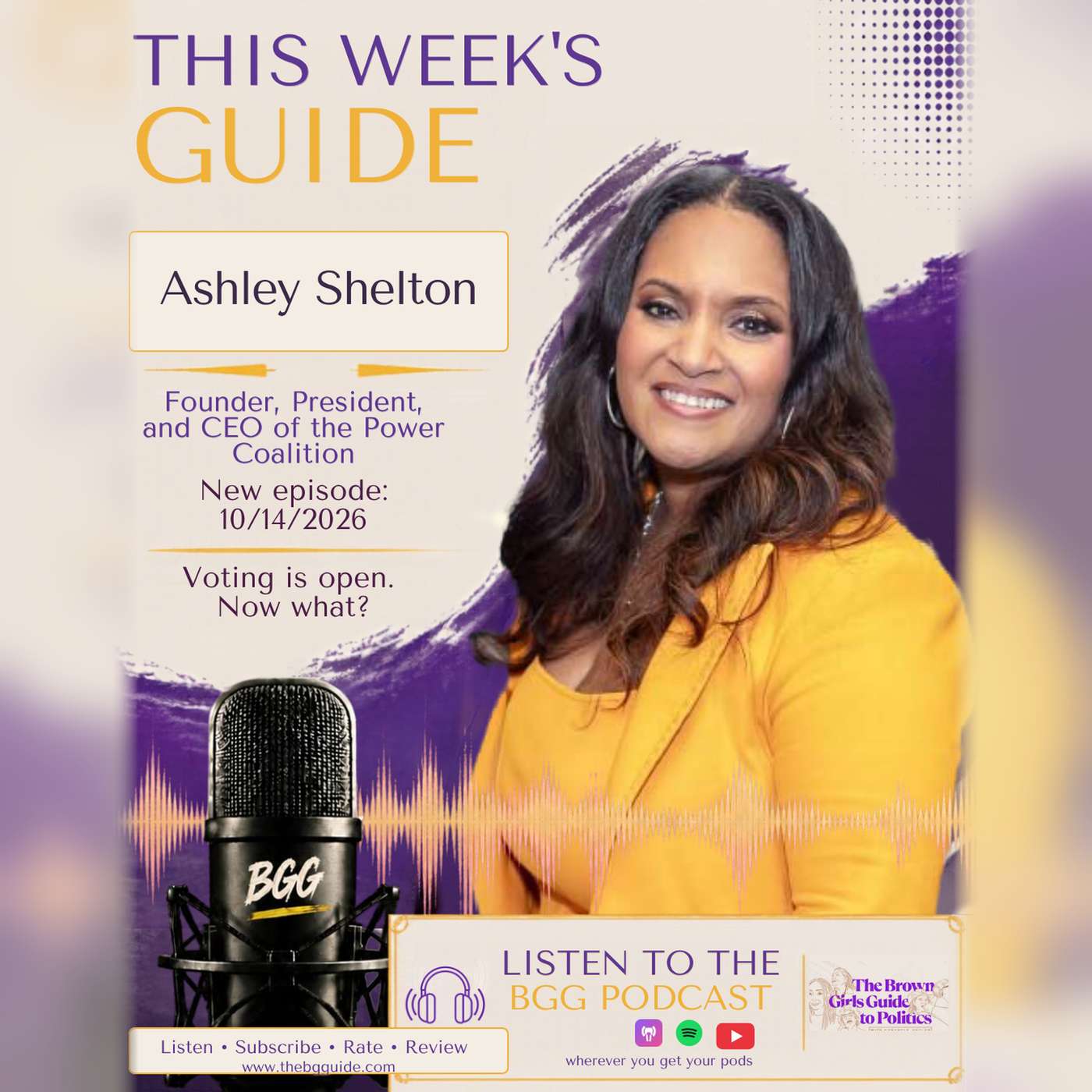
Episode 1 opens Season 12 with Ashley Shelton on what the gutting of Section 2 of the Voting Rights Act means for voters this November, and how to protect your ballot anyway. The Brown Girls Guide to Politics is a production of The BGG Media. This season is produced by Cinthia Pimentel of Ombie Productions. Our audio engineer is Kayden Wong. About the episode: Before we talk about who is running, we have to talk about whether your vote is going to count. Season 12 of The Brown Girls Guide to Politics opens with the rules that changed this year. A’shanti is joined by Ashley Shelton, President and CEO of the Power Coalition for Equity and Justice. Ashley was a plaintiff in Robinson v. Landry, the case that gave Louisiana a second majority-Black congressional district. Her organization then intervened in Louisiana v. Callais, the case the Supreme Court used to gut Section 2 of the Voting Rights Act. Ashley explains in plain language what Callais did, why it reaches every level of government, from Congress to the school board, and why the fight isn't over, with the case headed back to federal court in Shreveport on October 27. She makes the case that racism is expensive, that the confusion around voting this year is intentional, and that the only answer is unprecedented Black voter turnout. They also get into state voting rights acts, why electing a Congress that holds the line matters this November, and the voters we assume are already voting but are not. Ashley closes with her takeaways: check your status, know the law, pick how you vote, and never go to the polls alone. In this episode: How the Power Coalition organizes Louisiana voters year-round, from door knocking to a policy agenda built on deep listening Callais in plain language: from a fair map in Robinson v. Landry to the gutting of Section 2 Why Reconstruction-era amendments are now being used against the voters they were written to protect “Racism is expensive”: what packing Black voters into one district costs the people drawing the maps Why the confusion about voting this year is intentional, and how to tune out the headlines Early voting, voting by mail, and why to get your ballot in days ahead State voting rights acts, including Louisiana’s Senate Bill 365, and why representation is the heart of citizenship The redistricting fights to watch after the midterms Ashley’s takeaways, plus why you should bring the kids and get the sticker About the guest: Ashley Shelton, Founder, President and CEO: Ashley K. Shelton is the Founder, President and CEO of the Power Coalition, a statewide 501c3 table in Louisiana. The Power Coalition uses a broad-based strategy that combines community organizing, issue advocacy, and civic action all while increasing the capacity of community organizations throughout the state to build and sustain power. Mrs. Shelton has led both C3 and C4 strategies to move more than a million voters throughout the state of Louisiana having significant impact in elections...
BGG Ep 1 - Voting Is Open Now What === [00:00:00] of women of color by blending politics, culture, and lifestyle into conversations that inform, inspire, and empower our communities. And by connecting women who want to be politically involved to the women already doing it. If you're new here, I'm your host, A'shanti F. Gholar, founder of the Brown Girls Guide, president and CEO of Emerge, the nation's largest network of women elected officials and candidates, and a proud womanist. And now, this is a time where we must all come together to uplift social justice, support movement building, and stand up as family, as friends, as neighbors. And most importantly, as a country that aligns for freedom and liberation for all people, for all nations, and for our earth. Welcome to season 12 of the BGG, What the 26 Midterms Decide. Before we get into today's guests, let's catch [00:01:00] up. We are 20 days out from election day, and the rules changed underneath people this year. So let's talk about voting and the Voting Rights Act, and the Supreme Court's decision in Louisiana versus Cali. If you haven't heard, the Supreme Court ruled that Louisiana's redistricting was racially gerrymandered. And the final injunction blocking the administration's mail voting order was lifted weeks before election day. If you listened to our previous season on Project 2025, none of this is going to surprise you. This was something that they always had planned. And as Black and brown people, we know that our ancestors truly fought and died for us to have the right to vote. But as I say, the reason why they're attacking the right to vote is because they know that Black and brown voters are a powerful voting demographic, and they know that our voices matter. So in order to win, they have to cheat, [00:02:00] and that is what they're doing with this rules change. So to help us talk more about this, we invited the one and only Ashley Shelton, founder, president, and CEO of the Power Coalition, an organization that uses community organizing, issue advocacy, and civil action to change politics in Louisiana. All right, Brown Girls. We are back, and we have the perfect guest as we dive into what the freak is going on with voting rights, elections. There is just so much happening under this administration, but if you listen to my episode on Project 2025, we talked about this. So unfortunately, none of this is surprising, but we know that we have women at the forefront fighting back, especially Black women. Uh, that is why today [00:03:00] we are joined by Ashley Shelton of the Power Coalition. Ashley, thank you for joining us today. Thank you for having me. So excited to be here. And, you know, so much has happened on the political stage around voting and our democracy, but undeterred and unafraid . Woo. So first, tell our listeners a little bit about you and the work that the Power Coalition does. Absolutely. So the Power Coalition is a power building table in the state of Louisiana, and we focus on helping voters, you know, Black and other voters of color, you know, really walk in their power and agency as voters across the state. And so we do work year-round, and so we're either doing get out to vote w- through any number of different engagement strategies, knocking doors, phone banking events, text messaging. And then we spend the other half of the year doing deep listening and then moving a policy agenda based on that deep listening. And so for us, this is a year-round [00:04:00] task that we, you know, like, that we undertake every single year to try to change, y- you know, the material conditions that people live in in the state of Louisiana, in particular for those that have been historically disenfranchised, which of course is the 30% of the state that's African American, as well as other minorities. Um, we have a growing Latino population, as well as a really strong API population in New Orleans and along the Gulf Coast. Mm-hmm. And thank you for those stats because I really think it's important for people to remember how diverse the South is, and how those demographics- Yes ... are changing. And in my opinion, it's another reason why we see them just going so full throttle with testing out their attacks on voting rights and these horrible policies in the South. Absolutely. And what I really want to dive into today is the Supreme Court's Calais decision that came down. We have heard about this so much. I mean, attorneys general have talked about it, secretaries [00:05:00] of state, the various different voting groups, even the legal analysts on social media. It's been Calais, Calais, Calais. But I really wanna hear from you. Can you just break down for us in plain language what it was, what happened, and what do we do now as we're nearing election day? Absolutely. So, um, you know, I had the pleasure of being a plaintiff in Robinson versus Landry, which was the case that actually established a second majority-minority district here in the state of Louisiana. And so Robinson was the precursor to Calais. And so what Robinson did was give us two majority-minority congressional seats, which is fair because, again, thirty percent of the population in Louisiana is African American. We have six congressional seats, thirty percent, a third of six is two. And so what happened in Robinson was that we just created a fair map in, for the state of Louisiana, and then Calais [00:06:00] comes along, and these nine white plaintiffs said that their rights had been trampled upon because Louisiana had created a fair map. And I don't know how that's possible that their rights had been trampled upon because we had a fair and equitable representation. Again, Louisiana has the second-largest Black population proportionally, second only to Mississippi. And the idea that we don't get to have representation because somehow it's an affront to white voters is a wild thought in, in a democracy in twenty twenty-six. But as you see, and you know, as you noted earlier, the South has always been the seed, right? Like that, if you look at Dobbs, if you look at so many of the policies that have come out of the South and then impacted so much of this nation, and I remind people all the time, you know, folks like to look away when they... It's like, oh, when all of the redistricting was happening in Louisiana, Mississippi, Alabama, Tennessee, folks wanted to look away. And I said, "At the end of the day, you can't look away because this is coming to a community near you." And let me tell you what actually happened in the [00:07:00] Calais case 'cause we were interveners in Calais. And as we went to court and watched this play out, one, it went to the Supreme Court twice. So the first time they refused to, to decide and then came back and clarified and wanted to know how, how did having a fair map not violate the Fourteenth and Fifteenth Amendments, which I find particularly cruel because the Fourteenth and Fifteenth Amendments are Reconstruction Amendments. And so the very thing that the Fourteenth and Fifteenth Amendments were trying to protect is being used against minority voters, um, to, you know, like, to undermine and destroy the Voting Rights Act, which I think, you know, what people need to understand, and in fact, I've stopped calling it Calais 'cause I was like, "Let's get straight to what it is." It is the gutting of Section Two of the Voting Rights Act. And what this means is that Black and other voters of color have no opportunity to, not a real true opportunity to elect candidates of choice. This, like, this started out as a fight about a congressional seat in Louisiana, and now this case has created law that basically says that Section Two of the Voting Rights Act, [00:08:00] which by the way, if you can think of any person of color that is sitting in a seat at any level of government, more of chance, more, more than not, many of those seats are section or seats that were created by Section Two of the Voting Rights Act. And so we're gonna see the South, of course, had to kick us off and had to show what was possible by, you know, trying to fight for... They do these unpopular things where they're taking away fair maps, taking away representation, and I think that the only reason you saw that it slowed was because people were really upset about it. Mm-hmm. Um, you know, like that there was certainly, you know, kind of this national conversation that started to happen. And even though people were saying, "Oh, it's the South being the South," they understood that this was really gonna have an impact on the midterms. Mm-hmm. And so they stopped. But I promise you, after the midterms, we're gonna continue to see these power grabs and, and them lo- you know, and then really them locking in power to subvert the, you know, the growing, growing minority majority. And I think, you know, I think it's also important to note, you [00:09:00] know, with Calais That it's not even over, and I want people to understand this. We go back to court October 27th, so just a few days before the election. The Calais plaintiffs are saying that the Louisiana legislature didn't go far enough because they left one majority-minority district. Right. So, and I- we're going back to court. We're going to federal court in Shreveport, and I'm really... I, I am, you know, I would say, like, I, I would think it would be impossible for them to take away a district for what is 30% of the population- Mm-hmm ... now only having representation in one district. You know, but I, but it is also, I live in a time, we live in times that I'm not sure what to expect from, you know, from our court system. But also, too, there's the downside and the miscalculation that they're making, right? Mm-hmm. Is that with 30% of the population, no matter what you do, there's gonna be one Black district . Right. No matter what you do. Yeah. And then you force Black voters into other districts that you might wanna protect, like Speaker Mike Johnson's district. Mm-hmm. Maybe the majority whip, Scalise's district, right? And so at the [00:10:00] end of the day, you know, racism is expensive. Mm-hmm. And it, it is, um, a really scary game to play when you're trying to, when you're trying to really hold and hoard power, right? Yeah. It's just like, well, you can try to do that, but if you try to do that in places like Louisiana, Mississippi, where you have such large Black populations, you're gonna find out some things you don't wanna know about what Black voters can and are willing to do, um, to send a message. Because again, when we think about November 3rd, we are, we are going full steam ahead. The only answer to Calais has to be unprecedented Black voter turnout. Yeah. And not just in Louisiana, but across this country, and we're already seeing it. I mean, the m- the spring elections in Louisiana. Mm-hmm. Voters, by 78% of voters destroyed this governor and legislator's agi-, uh, agenda by killing five constitutional amendments. And so we saw increased voter turnout for the spring elections that are usually very low turnout elections, and we saw more Black voters turn out in that election as well. And so I do think that as we enter into the fall, that there's gonna be a reckoning, and we're doing [00:11:00] the work to make sure that there's a reckoning and making sure the voters understand what's on the ballot and know all the ways that they can make sure that they can cast their vote and walk in their agency. Oh my gosh. I love it, and that's so powerful. You know, we first saw all of this, everyone, play out in Texas, if you remember way back th- when. Yes. But it really wasn't way back when. It was this year. And they did all of those shenanigans. And what they ended up doing is actually making a lot of those seats more competitive, especially for Latino voters and Latino elected officials. We saw what happened in Louisiana. We saw what happened in South Carolina. They tried to come for Congressman Clyburn's seat, and that did not go over well, and you saw a record turnout from Black and brown people in their primary- Mm-hmm ... especially during early vote. So I like to say this fool can't even dictator right because he keeps coming for things that people really like- and enjoy, [00:12:00] and we're fighting back. So what would you say to people right now? Because we have to admit there is confusion between Calais. There's things that are happening with the SAVE Act. I've even had women say, like- Mm-hmm ... "Do I need to have my passport and my birth certificate? Can I vote?" Things that have happened on college campuses. The confusion is part- Mm-hmm ... of the system of chaos they wanna create- Absolutely ... where you're just so stressed and overwhelmed, you wanna say, "Oh, well my one little vote won't count," when we know that there are elections and our longtime listeners, you have heard me say this every year, 'cause every year is an election year, there are Emerge alums that I call who lost their race by one single vote. It is real. So as we're thinking about this moment, early voting has begun in some states. Some people are getting their ballots now. They're gonna do their mail-in ballot. I recommend dropping it [00:13:00] off in person if you can, everybody. Yeah. What are some of the things that we should be aware of during this time to protect our vote? Yeah, I mean, I think, um, the confusion is intentional, um, and very purposeful. And what I would tell folks is, you know, like, like, to stay the course, right? Like, I mean, that is the point. The point is to frustrate, um, to, you know, to, to make you feel like, you know, like they're working so hard to disenfranchise you that it's not even worth it. And the reality is, is that you actually do have a lot of power and a lot of agency as a voter. And even though the headlines are gonna continue, I think, unfortunately, to be confusing, I think we're gonna continue to hear them. There was just one around from the Supreme Court and about them being able to use certain databases, but none of that will actually go in effect for this election. So it's something we certainly should worry about. But for November 3rd, what we need folks to do is to vote. We need to have your voice on the record. You know, and here's the reality is that we have been living in a country where we've always had three branches of [00:14:00] government, but what our experience has been over these last few years is that we've had Congress abdicating its role to the executive branch. Speak on it. And so what voters- Speak on it ... yeah, and so what voters have the opportunity to do this November is to elect a Congress that's gonna at least hold the line so that, you know, like, we can at least begin to do some of the repair that needs to happen. And then also, too, to at least stop this president from moving further into Project 2025, which we are seeing play out. And I mean, if you read it, every single move, every single thing that we're seeing has, was included in this plan. And so, you know, and so for me The most important thing is that we all have an opportunity to elect members of Congress in this country. People are saying, "Oh, it can't be done," but we absolutely can elect candidates that will actually do the work of the people, and we've been seeing it happen all across this country, and we need to keep it going. We can have candidates that will work for us, but we have to be able to vote and jump over those hurdles. If you're gonna vote by [00:15:00] mail, yes, it is more complicated. Make sure it's postmarked early as well, so even if, you know, or bringing it to the post office personally, you still gotta get it there a few days in advance because we're unaware of what exactly they're gonna do, which is why we've, you know, we've grown and expanded our election protection program so that we can help protect voters as much as we can. And, and to be, be honest, we don't know what to expect from, from law enforcement, ICE, any of these folks on election day, which is why early voting and vote by mail and some of the other avenues are the best way to have your voice and your vote counted. It's just like, okay, well, I always tell folks, pick your weather. That's the beautiful thing. If you've got early voting in your state, that you should absolutely engage. And in a lot of places, people are making it fun. You know, we're gonna be doing some, you know, some early voting events and, you know, with music and good food and fun. And those are the kinds of things that, like, make it easy for folks. And so we, we definitely have been seeing so many great ideas coming from around the country. We'll be providing transportation. We'll be [00:16:00] doing all of those things. But just don't be discouraged, because I think the whole point is, is for you to be confused by the barrage of headlines. Ignore the headlines. Pull your ballot off the, your secretary of state's website. Um, in Louisiana Power Coalition, we put the sample ballots on the website. We have 10 constitutional amendments in Louisiana that'll also be on the ballot. So we have a long ballot that folks will be having to deal with. And so we're like, "Hey, here's the ballot. Spend some time with it. Understand." You know, we're not partisan, but on the issues, right, which these constitutional amendments are, we've taken a stance. We're like, "Hey, why are they trying to enshrine so much of this stuff in the Constitution?" Well, they're trying to enshrine it into the Constitution, so at a time when maybe they're not in power, it can't be taken out. And so you have to, uh, you know, kind of be playing both the game that's in front of you, but also the long game. And so, you know, we have to understand all the, all the tools that they're using To try to lock in power and, and keep it away from those who've traditionally not held it. And, um, and so it's so important to j- to vote, to engage. You know, and I tell people all the [00:17:00] time, too, one of the things that's funny is that everybody has their own made-up idea about who they think doesn't vote. It's young people. It's this person, it's that person. Let me tell you, it is more people than you think. It is people that look just like you. Mm-hmm. It is the person that works at the desk across from you. It's the person that walks, works across the hall. It's your kid. It's your, your niece. It's your auntie. There are so many folks that just aren't engaging, and I think that we have to have real conversations in our families and, and in our workplaces about the only way we're gonna, only way we're gonna change the current circumstance is by all of us using our voices collectively, and actually doing what democracy, i- getting the gift that democracy promises us, which is an opportunity to have a say. And, um, and so I just wanna encourage everybody to vote. Don't listen to the headlines. Don't get discouraged. Mm-hmm. Because that's the point. And for those of us on the ground working, I'm happy to s- Power Coalition's happy to sit down with anyone. We're on the doors. We're on the phones. We've got the national [00:18:00] 1-88-OUR-VOTE number, so you can call if you've got questions or you're experiencing a problem while trying to cast your vote. But the point is that there's so much support that we're wrapping around voters across this country, but in particular in the South. And definitely wanna make sure that folks know that you have every resource at your, you know, at your beck and call in so many states across this country. Through tables much like Power Coalition, there are C3 tables in so many states. And then there are also just groups that believe in voting rights and democracy that are also doing this work and providing community with rides to the polls and so many other things that are necessary so that everybody can actually engage in the electoral process. Mm. I love that. Choose your weapon. Are you gonna early vote? Yeah. Are you voting on Election Day? And what you said about Congress was so important. Mm-hmm. Because right now we don't have that checks and balances, and for me, I talk a lot, and you do, too, about the importance of our state and local races- Absolutely ... and [00:19:00] elections, and this is why. And I really quickly just wanna ask you, you've talked about just having state level voting rights acts. Mm-hmm. And just tell me a little bit more about it, because I feel that is so important right now when we can't rely on our federal leaders. You know, when we have people in control who don't wanna work for the people. They just wanna serve a wannabe dictator. Mm-hmm. It is important now more than ever what our state and local elected officials are doing. You know, especially when it comes to protecting voting rights. So talk a little bit more about why you think that is so important. Yeah. So, you know, we even tried to move a State Voting Rights Act piece of legislation here in Louisiana. It was Senate Bill 365, and part of it was about making the point to voters, as well as to our elected leaders, that they actually do have the power to give us our voting rights. I mean, you know, the federal government certainly [00:20:00] provides a guide, but at the end of the day, the states absolutely have the right to do so. And so even though we knew the political climate wasn't such that we could force them to actually do the right thing, but it was more important about getting them on the record and making it clear to voters across the state that this legislature and this legislative body had the power to give us our rights, to protect our voting rights, and to protect the rights of a, of literally a third of the population of the state of Louisiana, and they chose not to. You know, but these... You know, but we've seen them have some success in other parts of the country, but it is a way for you to solidify and protect the voting rights and the voices of your communities, regardless of race or ethnicity, and to be able to elect candidates of choice. Because one thing that we haven't really teased out about what the gutting of Section 2 of the Voting Rights, it's about representation. Mm-hmm. If I can't choose a candidate of choice that looks like me, that has experienced this country the way that I experience this country- Mm-hmm ... then what is citizenship? 'Cause then it calls the question- Mm ... that, you know, key to citizenship is [00:21:00] the ability to have representation. Mm-hmm. And so now you're telling me that I don't get to have a voice in the calls of Congress, in my state house, in my local city council, my school board, and I don't think that's what citizenship is supposed to look like. I don't think that's what any of us signed up for. And I think, again, even though we saw this play out initially in the South, I promise you we're gonna see more redistricting as soon as the midterms are over. Mississippi's already doing redistricting at the state level because much... North Carolina, they found out that messing with Benny Thompson was not a very good thing to do. And it's like, and again, they were really scared that they were gonna activate, fully activate Black voters if they were to d- take away Benny's seat. Mm-hmm. And they are doing the math and the calculus as well. Mm-hmm. And, you know, and, and what we have to do as Black voters is really lean in in this moment. Yeah. And again, like I said, when people take your rights away, you know, they're... Like I always tease of like, "So you might be able to gerrymander me out of a house district, but what you can't actually do is, is do anything about the 30% of Black people that can show up in a statewide election." And so for the first time [00:22:00] since Reconstruction, Louisiana has a Black man who is running for the US Senate. Mm-hmm. And, you know, like... And this is something that we haven't had since literally, you know, Reconstruction, and the ability for Black voters to be able to move in these statewide races in a way that we haven't been in a very long time is really exciting and really a powerful opportunity, you know, for us to, to show folks what Louisiana really can do and what Black voters are willing to fight for. I love it. So powerful. Everyone, you heard Ashlee, is gonna keep working for us, everyone at the POWER Coalition. We're gonna send them all good vibes as- They have to go back to court here soon. But Ashley, I would love for you to deliver the takeaways for, to our listeners. What are at least three big takeaways for them as we head into this election season? Yes. I mean, the takeaway is, is that your vote matters now more than it ever has. Um, your vote and your voice are critical in this moment. We need you. I [00:23:00] know it is messy, but I think that what we've learned as a populace, that you might say you're not political, but everything around you is political. And so we need folks to lean in. I think it's also important to continue to pay attention to what's happening with this kind of, this voting rights, uh, case, that is Calais, and how it's continuing to undermine, you know, the, the rights and the voices of Black and other minority populations across this country. And I think the other thing is, is that th- there's still, regardless of racial gerrymandering, there's so much power in Black and other minority communities, and we have to lean into that, and we have to walk in that, and believe in the agency that we have as voters. And as much as folks try to tell us that our votes don't matter, it's not that big of a deal, don't worry about it, or we're gonna make it as stressful and as hard as possible, that's fine. At the end of the day, in most states across this country, you can still go to your polling location, have your vote heard, and handle your business and do what you need to do. Check your voter status. You know, we've seen a lot of purges. Mm-hmm. We've seen a [00:24:00] lot of folks put on inactive voter lists. So make sure to check your status, and make sure to engage. And bring a friend, bring a neighbor, bring a cousin, bring a kid. Yeah. You know? Like, bring a, a voting age kid, of course, but also bring your children, too, 'cause I always brought my kids with me when they were little 'cause I wanted them- Mm-hmm to understand how, how, what a privilege and how powerful it is. Yeah. And so, um, so definitely don't ever go to the polls by yourself. Yeah. Load the car up. Let's get our friends and our family engaged. And if you are formerly incarcerated, please know the law. Mm. You don't s- in some states like New York, you can't vote, right? That is true. And I always tease folks that everybody's grandma watches Law & Order- ... and it's based in New York, and so now everybody thinks they can't vote. But in a state like Louisiana, if you are formerly incarcerated and you've been, been on probation for five years, you can vote. Mm-hmm. And so please know the law. Please check in to make sure that if you're not currently registered, that there actually might be, you know, an opportunity for you to vote. And so know your status. That's the, that's the most important thing. And also let them know how they can follow [00:25:00] you and the Power Coalition. Yes. You can find us at www.powercoalition.org, and then we're also on socials at @powercoej. And so you can find us online at Facebook or, uh, social media, but our website is powercoalition.org. And again, sample ballots on our website with breakdowns of if you vote yes or if you vote no, what it means, um, as well as all of your early voting locations, as well as information about polling times on actual election day. And so just encouraging folks to get out early, lock your vote in. Pick your weapon, pick your weather ... pick everything. I don't think that there's been a more, a, a more powerful moment than this moment when our votes actually have a message to send to this country, that we will not be excluded. We will not be put into a position where actually we don't have representation. And so the only way we can do that is by showing up on November 3rd, or earlier if you have early voting in your state. Love it. [00:26:00] You have it right there, everyone. Make sure you're bringing people to the polls with you, especially the kiddos. Get them excited about voting. Literally one of my favorite photos, and it is when my nephew was a baby, and my brother took him to vote, and he put the I Voted sticker on him. And like, and my nephew- That's awesome ... was just, like, smiling, like, so cute. So g- get the kids excited about voting. I mean, even for the sticker. Absolutely. Who doesn't love the sticker? I mean... Absolutely, and, and Louisiana just redesigned our sticker. Ooh. And it's a artist out of New Orleans, and it's spectacular. It's a trumpet, and a magnolia, and- Ooh ... all the joy of New Orleans in one sticker. So, so, you know, yeah, get your sticker. Yes. And even if it's not as cool as a Louisiana sticker- ... you still want your sticker nonetheless. Yes. Get those bragging rights. Ashley, thank you so much for your time today. We really appreciate having you on. No, thank you for having me. I appreciate the opportunity. Thank you so much, Ashley, for [00:27:00] being our guest today, and for always being in the fight for all of us. So what do we do next? Ashley left us with some good takeaways. I want you to confirm your registration today. I mean right now. If you're planning to mail in your vote, check your mail ballot deadline right now. And last but not least, have you made your plan to go vote? If not, you need to do that today. If you're planning to go before work, on your lunch break, after you drop the kids off at school, just make sure that you have a plan and it's in your calendar or planner. Make this an event. These midterms can change everything, and the only way change happens is if we do this together. Next Wednesday, we keep going down the ballot, past the candidates to the questions most people scroll right [00:28:00] past: the ballot measures. The ballot measures that include questions on our wages, our healthcare, and so much more. Information is only the beginning. Action is the key. The Brown Girls Guide to Politics is part of the BGG Media. This season is produced by Cynthia Pimentel from Ombi Productions. Our audio engineer is Caden Wang. We appreciate you listening, but please make sure you like and subscribe. And while you're doing that, please give us a nice rating. It helps us not only reach more people, but also fight the trolls. Until next time, brown girls.