
The Atlas Society Presents - Objectively Speaking · The Atlas Society
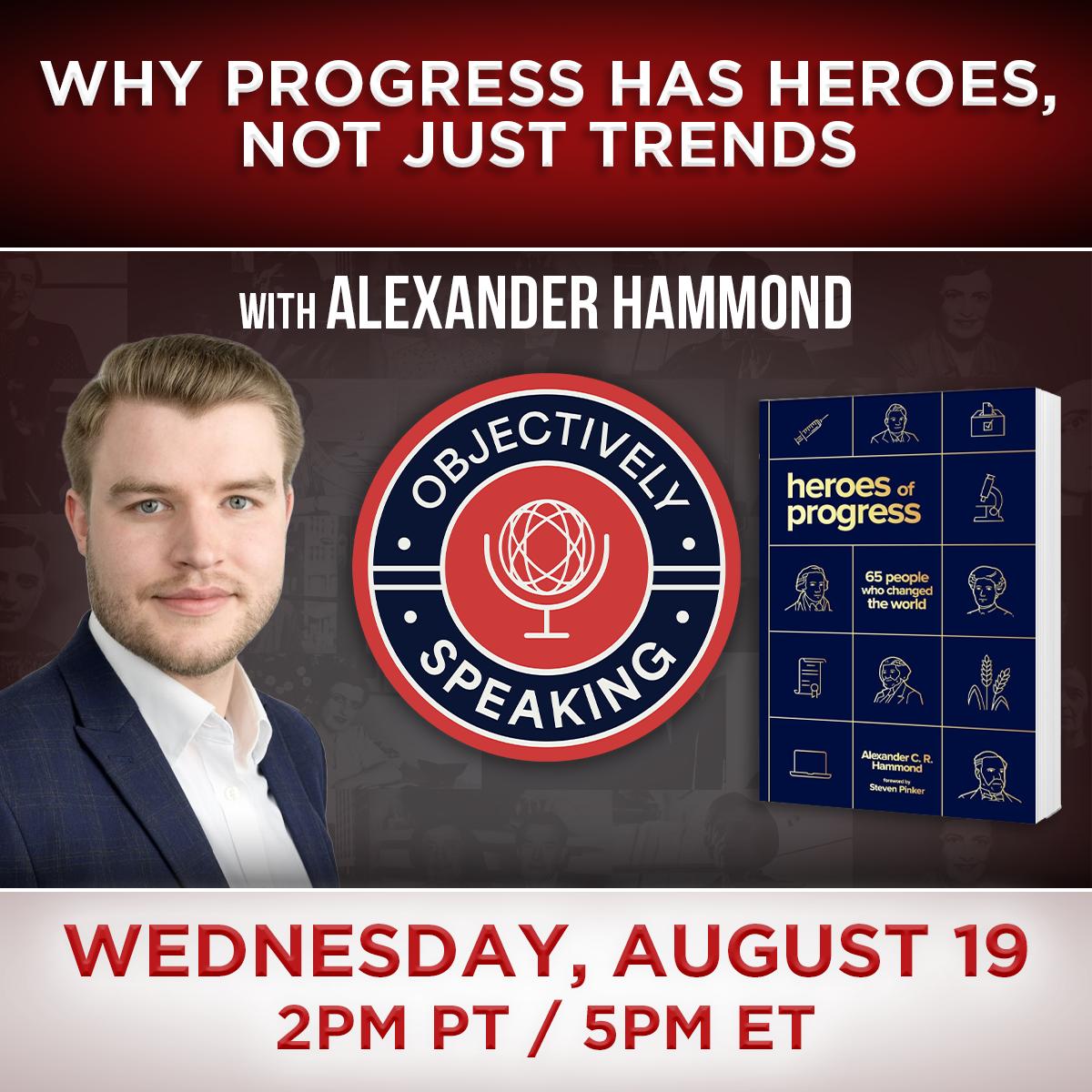
Why do most of us believe the world is getting worse when the data says otherwise, and who are the people actually responsible for the extraordinary progress we've made? Join Atlas Society CEO Jennifer Grossman for the 316th episode of Objectively Speaking as she sits down with author Alexander Hammond to discuss his book "Heroes of Progress: 65 People Who Changed the World," which profiles the scientists, inventors, and thinkers whose innovations helped save billions of lives, changed public policy for the better, and lifted millions out of poverty—even though most of their names have been forgotten. Hammond is the founder of the Initiative for African Trade and Prosperity, a free trade fellow at the Institute of Economic Affairs, and a senior fellow at African Liberty, with work focused on the history of economic growth and innovation, African development, and global well-being. He is the Deputy Editor for Humanprogress.org and policy analyst at the Cato Institute.
0:00Speaker AEveryone and welcome to the 316th episode of objectively speaking. I'm Jag CEO of the Atlas Society. Apologies especially to our regulars for our slight delay, we had some technical difficulties. But I promise you it's well worth the wait because I'm very excited to have Alexander Hammond join us from Switzerland where it is I think past 11pm he's going to join us to talk about his book Heroes of Progress. 65 people who changed the World. Alex, thanks for joining us and thanks for your stick to it.
0:41Speaker BIveness, thank you so much for having me. It's a pleasure to be here. Yes, 11pm Here in Switzerland, joining you from the attic of my Swiss house. Yes, great to be here.
0:53Speaker AYes, well obviously very hard worker, working 24 7. We're going to want to hear a bit about your new endeavors but our guests are always interested in a bit of our audience is interested in our guests backstories. So tell us a little bit about yourself, where you grew up, how you became interested in these ideas of human progress and how you got involved with the liberty movement.
1:23Speaker BYeah, so I grew up in the United Kingdom, as you may have been able to tell by my accent, but haven't really lived over majority of my adult life. I became interested in classical liberal and libertarian ideas at about 17 years old while I was at school and then moving on to university. Just so happened that one day everyone in my university knew my views of course. And one day I just happened to be sitting next to a housemate at the time who opened an email from the Adam Smith Institute and the Institute of Economic affairs, which is a great two great classical liberal think tanks in the uk. The second he opened that email I just so happened to be looking over nosying at his screen and I saw that it was an email about what's called Freedom Week. It's a summer seminar for a week long that brings together students interested in classical liberal ideas along with lots of great scholars in this movement and lots of friends who I know you've had on your podcast before. From there the rest is history really. I immediately found the cater institute online, said oh I really want to work rare managed to do an internship fair a year later, finished my studies in Exeter University down south in the UK and then began working at Cato. And I've moved around different free market think tanks, set up my own initiative that focused on African prosperity and trade and very recently now I'm back at Cato but most of my adult life not been in the uk I'm afraid it's hard to compare to Switzerland.
3:11Speaker AYes, I would definitely choose where you are if I had to choose between the two. So we both have Cato in our background. I was director of education policy there and it's a great place to work. Of course, the chairman of the board of the Atlas Society is also chairman of the board at the Cato Institute. So it's a happy family. And speaking of history, you started writing these profiles as a Weekly [email protected] how did you go about choosing the heroes you profiled?
3:47Speaker BYes, my Heroes of Progress. The goal of it really was to uncover people who have saved or improved, tangibly improved the outcomes of millions of people. That was the goal from the outset. Often these are unsung heroes, not always, but often they could be from a range of backgrounds, whether it be agronomists whose hybrid crop saved a billion lives, or intellectuals who changed public policy and pushed the world in a free direction. It could be business people whose inventions raised living standards and revolutionized how we communicate, or other parts about our lives, or scientists that had huge medical breakthroughs that eliminated diseases and ended pandemics. So quite simply, those in the book, if they did not exist, many of us would not be alive and if we were alive, would be far poorer, hungrier, sicklier, less free and less enlightened. Each biography as well is, I'd say, historically verifiable. So I don't really touch on the ancient world because it's quite hard to verify who actually did what and when and how. So my earliest hero is from 15th century all the way on to the modern day.
5:11Speaker AWell, it's your book and not my book. Although I would say that those Heroes of progress might, if there's a second edition, might want to include some of the great artists and novelists and Ayn Rand, certainly. I mean, Cato co founder Ed Crane called her the greatest all time recruiter for the liberty movement. And it's certainly a way that many, many people come in and start, get, get more involved and get more educated. So running the Atlas Society, running a non profit, one of the frustrations that I sometimes encounter when meeting with donors is sort of a pessimism like, oh, the world is going in the wrong direction. There's nothing that we can do about it. You know, we're doomed. So I think I'll just say spend my money and my time hanging out on my yacht. But your book is a real antidote to that. What do these breakthroughs of the past, these seemingly insurmountable challenges and problems. How can they better inform our mindset and sort of an informed optimism today?
6:20Speaker BYeah, I would say to the friends of Atlas Society, they're really not in bad company, though. If you look across not only America, but the world, people are feeling pretty gloomy. Half of all young Americans report feeling anxious all or most of the time. It extends to about one third of people when you look at the whole population. YouGov regularly does studies that asks people if they think the world is getting worse or better. And it's Normally in the UK, Switzerland, US it's always 65, 70% of people think the world is getting worse. So I think what these people tell us and show us about the world is that real, tangible progress can still be made. This progress can still improve millions, if not billions of lives. That progress is not just an abstract phenomena in the data. As you know, I work for human progress, which is. Does a lot on the data that shows how much better the world is getting, looking at extreme poverty for mortality, life expectancy. But I feel this book goes beyond just the data to show that progress is not only possible in the abstract and in the data, but that drastic leaps have happened ample times before. And quite frankly, because they've happened so many times before, it'd be really foolish to think they can't happen again or they're not currently happening again when we look at new technology around us.
7:51Speaker AYes, one of the things that I point to when I'm talking to my pessimistic donors and friends is I can certainly remember 10 years ago when I came to the Atlas Society, that I thought Latin America was doomed. And I, you know, in my less benevolent moments, was more akin to Ayn Rand saying, brother, you asked for it. And I was frustrated. Why can't they learn from these mistakes again and again and again? And, you know, as I went on, I learned that it, it wasn't just the same as any other region of the world. There has been a historical entrenched effort by the Soviet Union and the, and Cuba to really go out, recruit labor movement activists, bring them back, educate them, indoctrinate them. But, you know, 10 years ago, who would have predicted that we would have Argentina and Peru and Ecuador and El Salvador and Chile and, you know, all, all of these places that are now Colombia, most recently turning towards freedom. So it's important to remember that no fight is ever truly over with no hope of reprieve or reversal unless we say it is. And it also tells me a little bit about gratitude, you know, which is one of the big themes of ours here at the Atlas Society, I like to say you can't be objective if you don't have perspective. Now Steven Pinkert wrote your forward and talks about, quote, historical ingratitude, end quote. What do you think ingratitude towards these people actually costs us?
9:37Speaker BI think ingratitude and not only in gratitude but just the act of not knowing them, forgetting them, it not being taught at universities and schools for example, I think all round it leads to less permissiveness without gratitude. For a heroes that have come before, I think it's far less likely that we would look at the types of environments and societies that they came from that made their innovation possible. In turn, if we're not looking at what makes innovation possible, I think this makes crackdowns on basic freedoms that are crucial for progress. Speech, freedom to associate, take risks, disrupt the status quo, give it a try in the market. As the great historian Deirdre McCloskey always says. I think crackdowns on those things are far more likely if we don't know or don't care about the results that we've yielded. And I think ingratitude as well really touches on, I think it makes people think that the progress we've seen around us is much more of a natural baseline as such, rather than a fragile hard won achievement that could be undermined at any time with the wrong actions or wrong policy decisions or a lunatic with nuclear weapons. It's a fragile thing we have and to be grateful for the hard worn trodden path that's came before is crucial.
11:14Speaker AYeah, Matt Ridley also blurbed your book, but he, he's famously argued that innovation is a collective, almost seemingly inevitable process. Ideas having sex. Your book puts individuals at the center. Is there a tension there?
11:35Speaker BYeah, that's a great point. So yeah, Matt's really big on this. He did write a nice blurb from my book. In the blurb he still pointed out that it was. He believes it is a networked thing that emerges often simultaneously. The way I see it is with Matt's point, and I respect Matt hugely, is I completely agree with him. But it is of course the case. We stand on the shoulders of giants when we share ideas. Sorry, when we have ideas, we're often sharing them or brainstorming them within larger teams. And we rely on centuries if not millennia of aggregated knowledge to do almost anything in our day to day life. Not only the wifi we're having this call over, but the laptop or the electricity or even the language we're speaking. That is actually still some knowledge, aggregated knowledge that we've built on has been built on by others over centuries. So I agree with him in that sense for sure. I also agree that there's some very strange phenomena throughout history that has meant a lot. Several innovations have happened rather simultaneously. A few examples of this could be Alexander Graham Bell when he the day he handed in his patent for the telephone in the 1870s. On the exact same day, just a few hours later, Alicia Gray handed in a patent for pretty much the same telephone, only very marginal differences. It's happened if we look further back and look at something like calculus. Both in the late 17th century Isaac Newton came up with it. And then just a couple of years after, without even being aware of the other one's work, a German chap called Leibniz also came up with it. And there's a few other examples like the light bulb. However, I think the purpose of writing this and how it doesn't disagree but I think complements we can put it compliments that to work is there still needs to be an individual spark. Nations, governments, committees, societies, clubs do not have ideas of themselves. It is the the only thing that has new innovative ideas are the human brain, at least for now. Maybe we can touch on AI later, but at least for now new ideas are human. And this book then focuses on individuals because they do represent the accumulated knowledge, but also because they had the gusto in a way to push it over the line, to turn it into a practical real world application that in many cases changed the world for the better.
14:29Speaker AAll right, well again thanks to our veteran folks that almost never miss an episode, my modern G lock, stock and barrel iliation. Thanks again for your patience. I like the comment up here. Just getting a little nervous. So let's get to some of their questions. My modern Galt asks if Alex, do most of these hero have a common origin story?
14:57Speaker BYes, this is an interesting thing, kind of looking at the commonalities between the heroes. I didn't set out initially to I didn't pick heroes based on my commonalities. But here's what I discovered because the book's also laid out chronologically so that actually allows for quite a nice way to see what's what's similar throughout time and how it changes as the centuries progress. So what we can see at the beginning and as it moves on is the actual innovators, their race, their sex, their whatever sexuality, whatever other characteristics people talk about. It becomes extremely diversified as time and as freedom worldwide accelerates. At the beginning of the book, you'll notice the first 10ish or so heroes, they are all mostly English, all men, some northern Europeans more generally from about the 15th, 16th, 17th century, quite frankly, these were the people in society who had a decent degree of freedom to learn, to test things out, to speak freely and to do their thing. As the book then goes on, you can see over time as freedom spreads or America becomes established and freedom spreads, there a lot more Americans, I mean, kind of in the middle of a book or mid to late end of a book, Americans have endless dominant, which is I think as audience of his podcast would expect. And you then see a lot more people of diverse backgrounds, people of color from different countries. So that's interesting. There are a few examples of heroes not born in free societies. And the way they survived and did their thing was one of two ways. First was through migration. People especially hundreds of years ago, when even today, of course, but these aristocrats who developed a lot of innovations of the past, they moved an extraordinarily amount to find new networks, mentorship, education. In the 15th century, for example, 16th century, sorry, Erasmus moved from the Netherlands to the UK to Belgium to France to Italy to Switzerland, back and forth throughout. And this was a time, you know, 500 years ago, it was pretty difficult to move. You couldn't just get in your car or jump on an airplane or have a big truck come and pick up your things. So migration is key. And of course we still see that when it comes to people from unfree countries stay moving to America, Western Europe. And the second really important thing that we may not like, but it did yield results, was people in the past who didn't live in free societies but managed to innovate, got special permissions from the government, which is not good at all because you imagine millions of people who didn't have these permissions and couldn't innovate and they were in a very special position to do so. So Sir John Harrington, the inventor of the toilet, he got expelled from English court for writing, translating risky poetry. He was a bit of a, just a troublemaker, rubble rouser all around. However, he kept getting invited back and being allowed to do his thing because he, because he was the godson of Elizabeth I, the queen at the time. And there's a few others from China that got special permissions from party officials and without them they would have been sent to prison. So, right, that's, I think a few other commonalities.
18:58Speaker AAll right, a nice comment here from Lock, stock, Barrel, who says, I think if you spend most of your time online, it is going to skew your views towards negativity. Flying Custard says there's a lot of nihilism these days. A book like this is a good palette cleanser to see that things are still getting better. Elation asks, what role does competition play in progress? What about risk taking? And do you think that people are becoming more averse to taking risks?
More The Atlas Society Presents - Objectively Speaking episodes →