
The Atlas Society Presents - Objectively Speaking · The Atlas Society
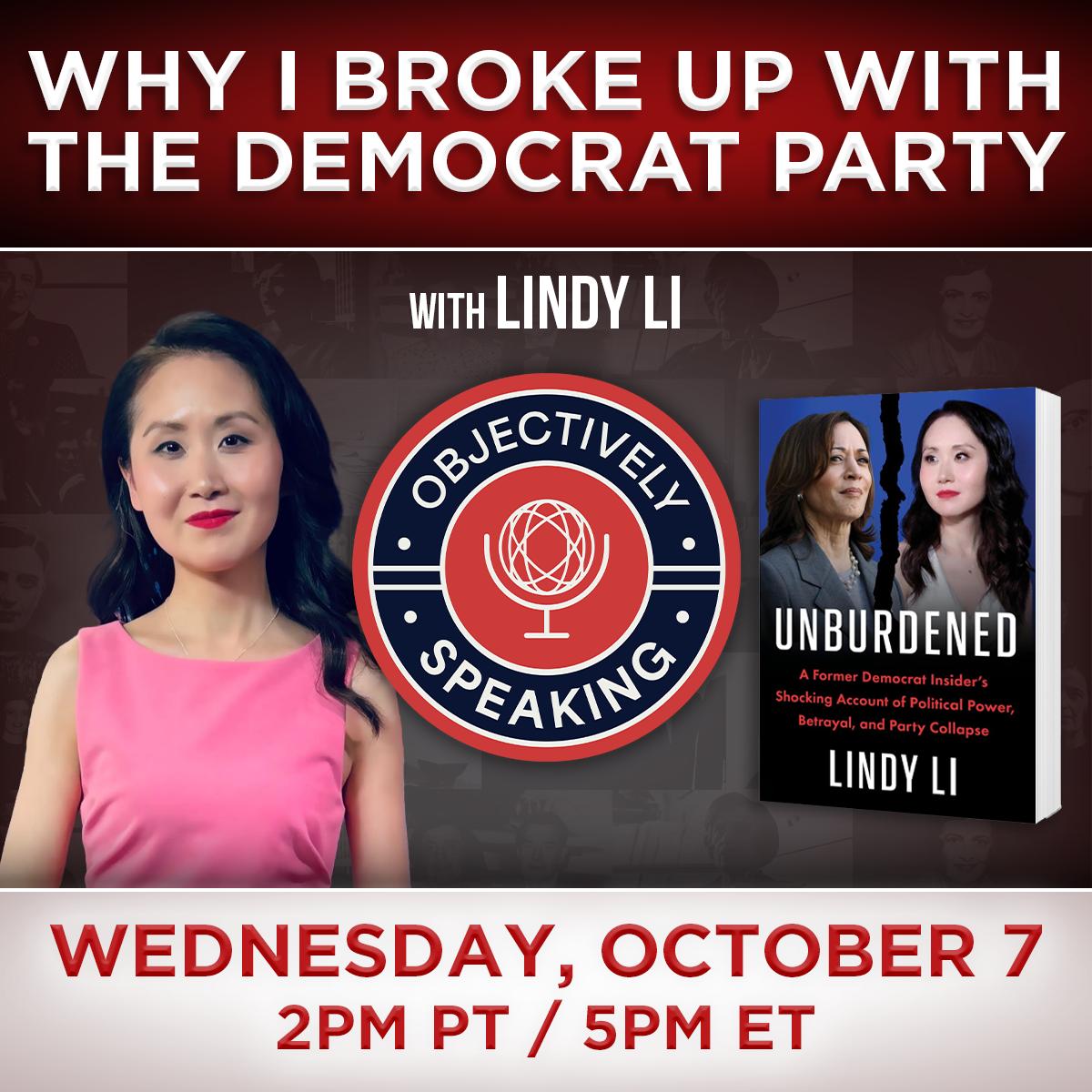
What happens when a party insider who raised millions of dollars for Biden and Harris decides to tell the truth about what she saw behind closed doors? Join Atlas Society CEO Jennifer Grossman for the 323rd episode of Objectively Speaking, where she sits down with Lindy Li to talk about her new book, "Unburdened: A Former Democrat Insider's Shocking Account of Political Power, Betrayal, and Party Collapse," which rips back the curtain on a rotten system that rewards failure and punishes honesty. As a member of the Democratic Party's National Finance Committee, Li raised millions of dollars for Biden and Harris and co-hosted some of the party's most significant fundraisers. In "Unburdened," she offers a first-person account of the machine she helped build and watched collapse, detailing what she describes as a deliberate cover-up of Biden's cognitive decline, a $45 million celebrity payoff scheme, and a donor fundraising system she compares to a multilevel marketing operation. She now works as a political strategist and commentator, co-hosting the podcast "Her Take."
0:00Speaker AWelcome to the 322nd episode of objectively speaking. I'm Jag CEO of the Atlas Society. I'm very excited to have Lindy Lee join us to talk about her book Unburdened, a former Democrat insider's shocking account of political power betrayal and party collapse. Lindy, thank you so much for joining us.
0:27Speaker BI'm so happy to be here. Thank you so much for having me. Heard a lot of great things about
0:31Speaker Ayou and likewise, looks like we now have some mutual friends in common. And I just wanted to congratulate you on your book. I know it's now a New York Times bestseller and it just was. As a former presidential speechwriter myself, it just was really so beautifully written and it reminded me of a certain book which we're going to get into in a bit. But our audience is always interested in our guests origin stories and yours is more interesting than most. You were born in Chengdu and your parents were farmers. So tell us a little bit about your parents experience coming to the United States and how that informed your outlook growing up.
1:18Speaker BI applaud you on the very accurate pronunciation. First of all, that's very good. It's Ch. Chengdu. It's actually where the two pandas that. It's the same place where the two pandas we got recently came from. Remember how during the state dinner the Chinese president announced that there would be two pandas? Yeah, it's from Chengdu. Chengdu is a panda panda genesis center of the world. So my, my parents weren't farmers. My great. My grandparents were. My grandparents are illiterate farmers. In fact, they can't even speak Mandarin Chinese. And my Chinese is bad to begin with. So they, the two, they. We have no way of communicating. My grandfathers are dead, but I have no way of communicating with my grandmother except through hand gestures because her level of education is so poor due to the Cultural Revolution.
2:13Speaker AYeah, well, just. She must be very proud of you
2:18Speaker Bthat I don't think she realizes anything that's going on. It's hard for her to conceive, you know, like she has no idea. The New York Times bestseller charge. She has no idea of anything.
2:29Speaker AWhat Princeton even means.
2:31Speaker BShe has no idea. And it's hard for me to teach her. Like how do you tell her that's an entire planet. It's hard for me to tell her that, you know, I, she just knows that I'm doing a job like in general.
2:44Speaker AWell, and she can just see that you're put together and you look beautiful. So before we get into Some of my other questions we were talking previously. I said that the book, in a way, reminded me a little bit of aspects from Atlas Shrugged and that your story kind of reminded me a bit of Dagnes in that you had to learn to. You were trying to make something work. That was an unworkable situation. You finally needed to learn to shrug. So I didn't know till five minutes ago that you finished reading. Was it Atlas Shrugged the day that you went to Princeton?
3:28Speaker BSo the day that I got into college, yeah.
3:31Speaker ASo what? Any characters or any ideas that you've really stuck with you.
3:39Speaker BActually, I don't think I realized the significance of that intersection until I started talking to you about it. I mean, what are the chances of me? I read a lot. I devour books like food. I don't eat that much to begin with, but I am an intense bibliophile. And the fact that such a monumentous day coincided with Atlas Shrugged is also just a big deal to begin with. In Fountainhead, I thought was beautiful, but I wrote the book live, as in I had no idea how the book would end.
4:11Speaker AWow.
4:11Speaker BSo in retrospect, it's almost amazing how the two stories of the book were running on parallel tracks. And you said something very beautiful and poignant. You said, I tried to. I tried to basically preserve something that was unworkable. And it wasn't just the political situation. It was also my personal situation.
4:36Speaker AYeah.
More The Atlas Society Presents - Objectively Speaking episodes →