
The Atlas Society Presents - Objectively Speaking · The Atlas Society
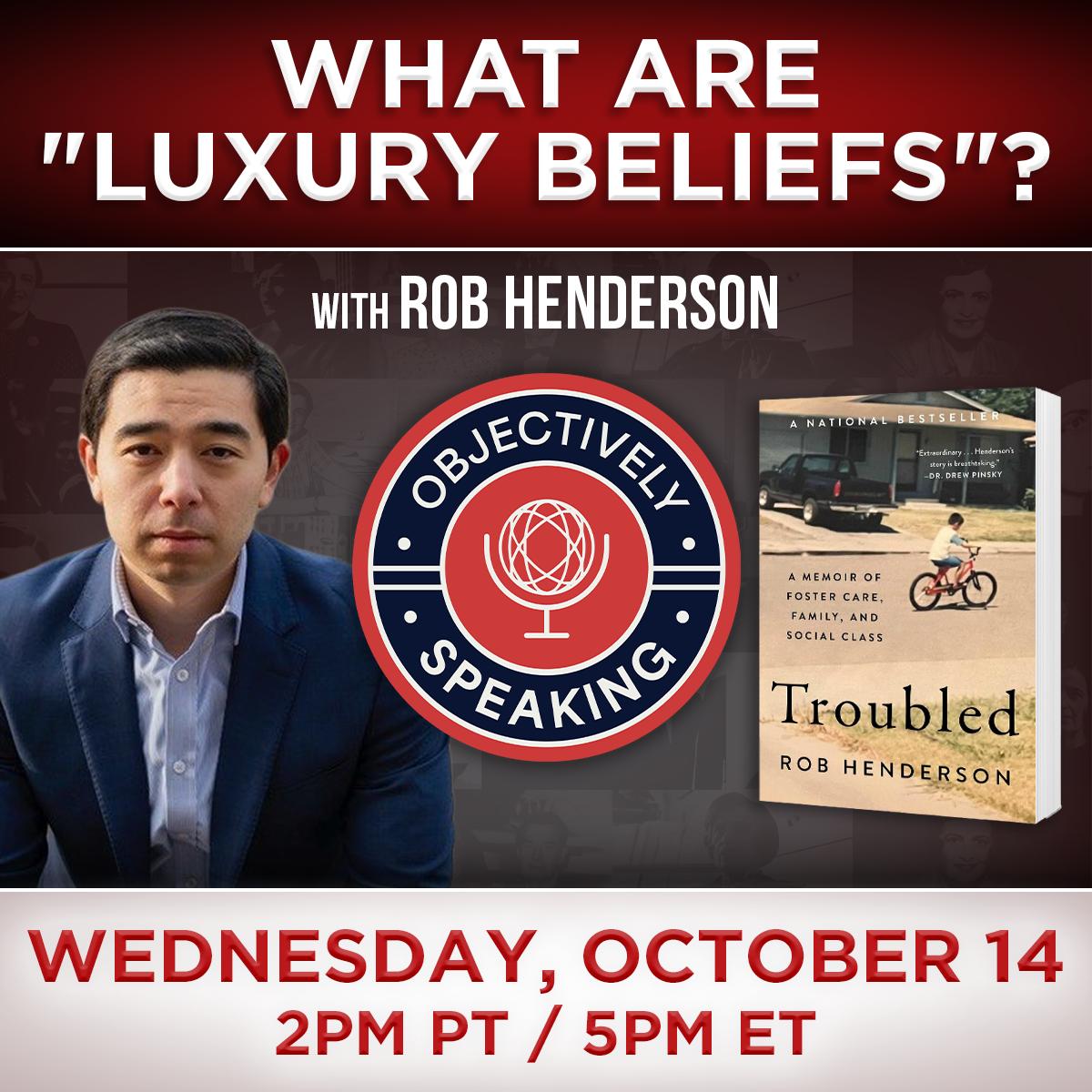
Join Atlas Society CEO Jennifer Grossman for the 323rd episode of Objectively Speaking, where she sits down with author Rob Henderson to talk about his book "Troubled: A Memoir of Foster Care, Family, and Social Class," where he vividly recounts growing up in foster care, enlisting in the US Air Force, attending elite universities, and pioneering the concept of “luxury beliefs”—ideas and opinions that confer status on the upper class while inflicting costs on the less fortunate. Rob Henderson is a senior fellow at the Manhattan Institute and a contributing editor at City Journal, who publishes articles on his Substack, with other writings appearing in The Free Press, The New York Times, and The Wall Street Journal.
0:00Speaker AHi, everyone. Welcome to the 323rd episode of objectively speaking. I'm Jag, CEO of the Atlas Society. I'm very excited to be joined by Rob Henderson, one of the most interesting public intellectuals in America today and author of his best selling book, A Memoir of Foster Care, Family and Social Crisis Class. Rob, thanks for joining us.
0:28Speaker BHey, thank you, Jack. It's great to be here.
0:31Speaker ASo I am not just a reader of your book, but I am a subscriber to your substack. And you recently ran a poll of your Substack subscribers and the results surprised you. You'd pictured a mostly younger male readership, yet your audience turned out to be more varied. You were also struck by how many of your readers have lives they could not have pictured when they were 18. So I have to start with the question, how has your life turned out differently from what your younger self may have expected?
1:11Speaker BYes. Well, I mean, my life is dramatically different. And I was interested. I've been writing an online newsletter for several years now, so I think we're coming up on six years. And I've been on substack for coming up four years. And I was curious how many of my readers have had this similar kind of trajectory where, you know, is your life kind of better than you expected, worse than you expected? How different is it? About 60% of my readers said their lives were dramatically different, which is the answer that I would have chosen if I were the one taking this survey. And the reason it would be that way is as I describe in Troubles, I had a very unusual and kind of series of adverse experiences that led me into higher education and then to my subsequent career as a writer. And just briefly, I was born into poverty in Los Angeles. I was placed into foster care at 3 years old. Never knew my father. My mother suffered from addiction and living in the foster care system. I was adopted. And then from there there was a sort of periods of stability. But there were divorces and separations and financial catastrophes and a lot of other things that occurred that I witnessed firsthand. Kind of emblematic of what's been happening in a lot of poor and working class towns all over the country. So I fled as soon as I could. When I was 17, I enlisted in the military and with some setbacks and some hiccups along the way, eventually went off to Yale on the GI Bill and then off to the University of Cambridge to get a PhD on a scholarship. And then I was originally going to be a professor. I wanted to be a professor, but I finished my PhD in 2022, and this was not a great time. If you are not kind of aligned with the modern progressive orthodoxy, it's very difficult to get a job in academia anyway. But if you are heterodox or have ideas that are outside of what people would prefer, the dogma of the day, then it's even harder. So started writing and then built an online following. Had a pretty successful writing career. And that led me to run that survey to see who's reading my work, who's interested in this material. And I was surprised to see just how many people had a similar experience to me. And it was kind of hopeful, I thought, because there's a lot of pessimism out there and cynicism about, oh, the American dream is dead, there's no such thing as upward mobility. But that's clearly untrue. A lot of people have started in one place and have, with hard work and some talent and some luck, managed to improve their circumstances.
4:27Speaker ASo in preparing for this interview, I made the assumption that most of those tuning in would have read your memoir, Troubled. After all, it was a USA Today bestseller. But given your own survey results, maybe I shouldn't be so quick to make that assumption. So I'm going to ask our viewers if you have read the book or started the book or haven't read the book. I'd love to just do a flash poll if we could get some answers. And then, of course, feel free to ask any questions for our guests. Now, I have read the book twice, and both times the experience nearly brought me to tears. Your first memory at three years old, bawling and clinging to your mother as the police are taking you away, the garbage bags in which you pack your meager belongings every time you are moved to a new house. The foster family who treated their charges essentially as unpaid labor. The adoptive father who refused to talk to you after your adoptive mother divorced him just as a way of hurting her. These and many other instances you recount in your book are enough to break anyone's heart. But beyond these, I suspect there's a deeper reason this book has affected readers so emotionally. Why do you think that is?
5:53Speaker BWell, I think one reason is, and this was not my expectation going in, was that people can relate to a lot of this. You know, when I was writing the book, I wondered, could anyone really connect with these experiences? You know, most people are never in foster care. They've never kind of experienced the same set of adverse events in their childhood and upbringing. But you know, when I, after the book came out Readers would contact me, and they say, you know, there was addiction in my family, or there was a divorce, or there was, you know, financial downturns or mental illness or something that they could sort of relate to within the story that resonated with people. And I wrote the book to the best of my ability. I tried to write each chapter from the perspective of the age that I was during those experiences. So there's kind of, you know, two ways to write a memoir. One way is kind of is the remembering self, which is you as you are now as a sort of mature, reflective adult, going back in time and offering commentary and reflection on these memories. The other way is the experiencing self, which is you are attempting to recreate these events as you were at that time without the benefit of hindsight, without offering too much in the way of commentary, of just sort of letting the moments exist as they are and your reactions to them as you were at those various stages. And that's what I tried to do. And people could connect with it and said, like, I remember feeling that way as a kid or as a teenager, you know, being neglected or mistreated or overlooked in some way. So, no, that was surprising and gratifying in a lot of ways that readers could connect with that. And the other thing is, a lot of those things that you'd mentioned, you know, the foster homes, the divorce, the ways that, you know, adults can be selfish and what, neglectful and those kinds of things, a lot of that isn't rooted in poverty. I think there's this myth that the only reason that people suffer or that kids in deprived or dysfunctional circumstances don't succeed is because of an absence of money. And the solution here is just more cash transfers, redistributive schemes. It can all be solved with programs and government funding of some kind. But in this book, I point out repeatedly that a lot of the bad choices people were making had nothing to do with money. You know, there was some material deprivation and some struggle in that regard, but for the most part, a lot of these decisions were made for other reasons. And, you know, if we could, you know, what I tried to do is sort of argue for a return to, you know, putting kids first, families first, that there's more to upward social mobility than money alone. A lot of it comes from attachment, connection and caregiving, responsible behavior, role models. And a lot of that can't just be signed with or rather solved with money.
9:26Speaker AAll right, we're getting some of our instant poll results back, and I'd say roughly half of people have read it. Valiant Mike has clearly read it. He says your life is inspiring. Alan Turner started the book has half to go. Candace Morena reread it leading up to the interview. Modern Gault hasn't, but plans to do so and same with King Fisher. So that's good, guys. You're. You're not going to be sorry. Oh, you might feel a little sad.
10:02Speaker BThere's a good, There's a happy ending. So.
10:05Speaker AOh, yeah, yeah. So you, by the time you were taken from your birth mother at 3, until the time you enrolled in military at 17, you were shuttled around to, I think, like 10 different foster families or situations. Why did, why do kids get shuttled around so frequently and what effect does it have on. On them and did it have on you?
10:32Speaker BYeah, so the reason why we see this, you know, kids being placed, kids in the foster system in so many different, what they call placements in the jargon, is that, well, one important reason is that oftentimes someone from the family of origin can re. Enter the picture and take custody of the child. So, you know, as, as an example which is the case for me, was my. Was addicted to drugs. I was taken from her, placed into the system. And in some scenarios like this, you know, the mother strings together a few months of sobriety and can take the kid back. Or maybe the father enters the picture or a grandmother or an aunt or someone says, okay, well, I can take the kid. But if the child has been with the same foster family for, you know, a year, two years, three years, this can create obvious issues around loyalty and attachment where, especially for a little kid, you can imagine if a kid is taken at three years old like I was, and then they're five or six years old, you know, they've spent 40 or 50% of their lives with this foster family, they may be reluctant to go back to their mother or to some other family member. And so the way that the system has attempted to resolve this conflict is to intentionally prevent any attachment or bonds from forming. So they move the kid from one home to another every few weeks, every few months, definitely not longer than a year, so that those bonds never form. And of course, the bonds form in the other direction too, where foster parents can understandably become attached. They take a small kid in and start to feel affection and care and warmth toward him or her, and then off the kid goes. And after a few experiences like that, that can be very difficult. And I think that's charitably, maybe one reason among others, I describe the kind of coldness that I felt from most of my foster parents for my caregivers, where you may go into it with the best of intentions, showering every kid you get with love and warmth. But then if you see them go, you may start to protect yourself emotionally too, and not give too much, because you know that eventually the kid will be placed somewh else.
12:56Speaker ASo was there one chapter or one experience that was particularly difficult for you to write about?
13:04Speaker BYeah, I mean, so, you know, this connects to your earlier question, which I didn't fully answer, which was, what are the effects? Well, you know, the effects of constantly moving, at least in my case, and, you know, this is. My experience is supported. It's consistent with a lot of the research on what happens when kids grow up without sturdy, solid attachments. I was moving homes every few months. The shortest day I had. There was one foster home I was in for, I think, three weeks. And it becomes. Initially you get flooded with all of this negative emotions. And it was extremely upsetting for me. First being taken from my mother, and then the first foster home and the second foster home. Each time it was. It felt like emotionally catastrophic. But by the third home, fourth home, fifth home, you know, your. Your body and your. You start to adapt psychologically in this way such that you shut down. You know, I experienced this kind of psychological numbness by that point where I was unwilling to feel anything because I knew on some level that it would just be extremely painful. So those emotions get switched off. Was there a chapter that was particularly difficult? I mean, the first maybe three or four chapters were the most difficult. The first one may be the hardest. It was really what I noticed was that as I acquired more agency with each sort of stage in my life, the easier the chapters were to write. When you're a kid, you're completely powerless. You are at the mercy of adults, parents, foster parents, caregivers, teachers, social workers. They get to control every aspect of your life, understandably. I mean, little kids are not mature, sophisticated enough to obviously be off on their own or. But it just felt in a lot of ways, just sort of belittling, humiliating because I never felt like I was being listened to or heard in any way. But then by the time I reached my teenage years and then adulthood and was able to make some decisions for myself, some good, some bad, those were easier to write because at least they were my decisions. And at least I was the one who was directing my life mostly in a positive direction, but sometimes not. But yeah, those first few chapters, if I had known in advance how difficult it would be to write those. I probably wouldn't have agreed to write the book.
15:47Speaker AWell, given the popularity of the book, I'm curious whether any of the people you write about, say foster parents, social workers or therapists, have reached out to you.
15:58Speaker BYeah, I mean, a few have a lot of foster parents and some social workers and people in the system. And I haven't had any negative feedback from any of them. I think people are well aware that the system is imperfect. It's broken. There are a lot of kids in need of homes, not a lot of families who are taking them in. And, you know, these kids come from. In order to be taken from your family, you know, something must have gone seriously wrong. Oftentimes to do with addiction or mental illness or sort of overt abuse or mistreatment. And, you know, it's just an ugly thing all around that people don't really want to talk about. They shy away from. And I tried when I was working on Troubled, I tried to find other memoirs from foster youth, former foster youth, people who had had similar experiences to me. There are vanishingly few memoirs written by former foster kids. There are a lot of. Not a lot, but there are quite a few written by foster parents who are writing from their perspective as someone who, you know, takes kids in and cares for them. But the thing is, if you enter the system, you probably had a pretty tough life already. And then the system itself doesn't always make it much easier, especially if you age out of the system. There's not a lot of resources in place. So the trajectory to becoming an author or becoming someone who's in a position to speak about these things and get other people to listen, there just aren't that many. So I tried to be clear that these were my experiences. And other people who went through the system may have a very different opinion, but I haven't really been challenged on what I've said, so.
17:50Speaker AAbigail Schreier spoke at one of the Atlas Society's events about her books, including Bad Therapy, which takes a dim view of most therapy. Now, given you're relatively helpful experiences with therapy, both as a child and then later in treatment during the military, I'm curious whether you read her book and have any thoughts about it.
More The Atlas Society Presents - Objectively Speaking episodes →