
The Atlas Society Presents - Objectively Speaking · The Atlas Society
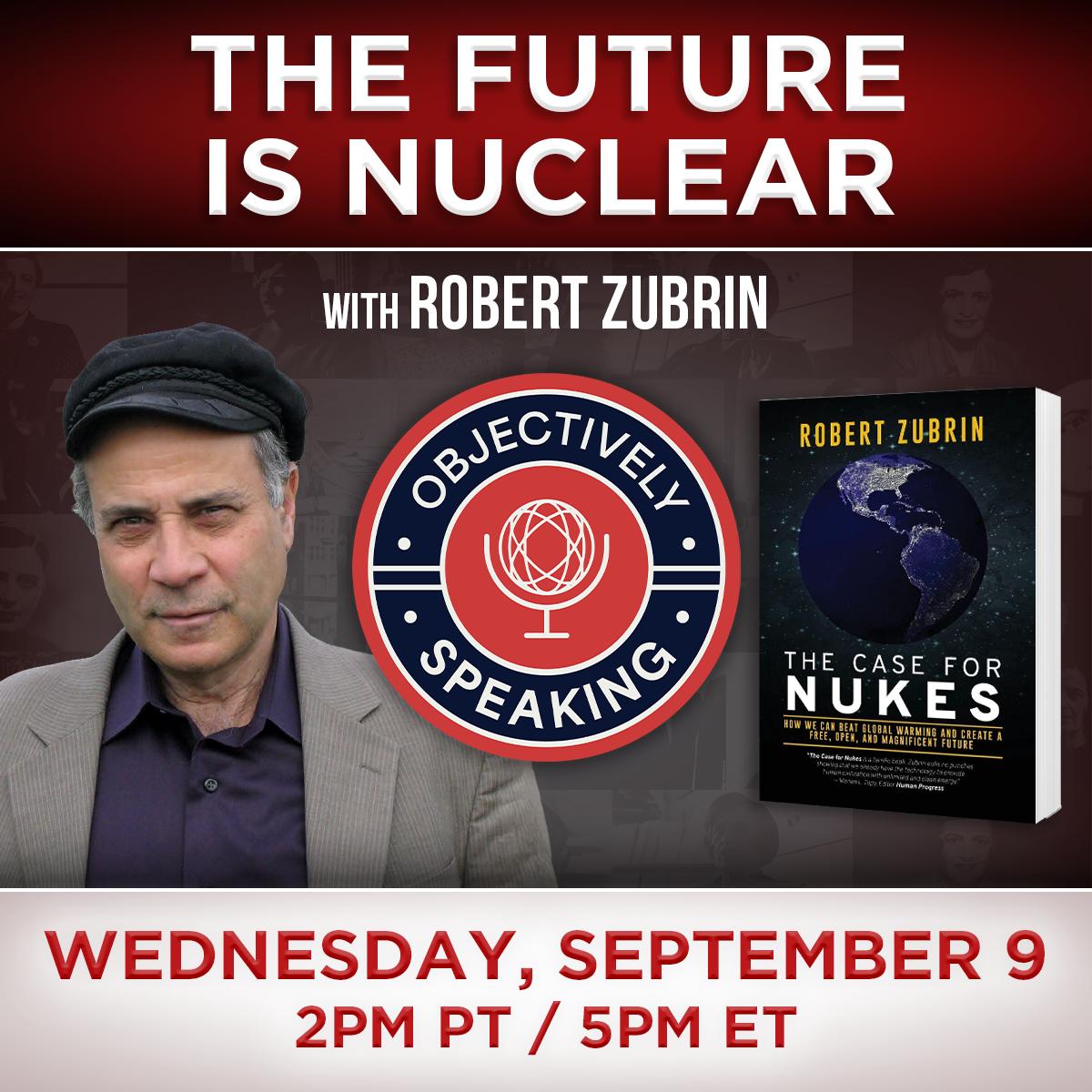
Could nuclear power solve our energy future, and could Mars become humanity's next frontier for civilization-building? Join Atlas Society Senior Scholar Richard Salsman, Ph.D., for the 318th episode of Objectivley Speaking in which he sits down with returning guest Robert Zubrin to talk about his new books "The Case for Nukes: How We Can Beat Global Warming and Create a Free, Open, and Magnificent Future," which argues that nuclear power is essential to solving the climate crisis while preserving human freedom and prosperity, and "The New World on Mars: What We Can Create on the Red Planet," a vision for the settlements, industries, and societies that could take root on Mars. Robert Zubrin is an aerospace engineer, founder of the Mars Society and Pioneer Astronautics, and the architect of the Mars Direct exploration plan. He is best known as the author of the seminal book The Case for Mars, which helped shape modern thinking on human space exploration. Learn more about The Mars Society's upcoming convention: https://convention.marssociety.org/
0:00Speaker AOkay, we are live. Hello, everyone, and welcome to the 317th episode of objectively Speaking. I'm Lawrence Olivo, senior project manager at, here at the Atlas Society. I'm excited because even though Jennifer Grossman has the week off today, Atlas Society senior scholar Richard Salzman will be reviewing returning guest Robert Zubrin, who has a couple of new books out. So we are going to go ahead and get this started. I'll pass it over to Richard now, but if you have any questions, please, please don't forget to post them in the comment section. We'll try to get to as many as we can. Richard, take it away.
0:35Speaker BThank you, Lawrence, and welcome. Dr. Zubrin, so wonderful to meet you. I've, I've read some of your books and seen many of your interviews. I'm a fan, a big fan, so this is a delight for me. I'm glad to be able to pinch hit for Jag. I also saw the 2022 interview you had with her. So I, I know you're an expert in both nuclear and space to put single words on it for those who don't know. By the way, the background, quickly. Dr. Zubrin is a astronautical engineer as well as a nuclear engineer. And for more than four decades he's been a pioneer in advocating an extension of human exploration into space, especially to Mars, but has also been a steadfast defender of all sorts of energy. But in including, including nuclear energy, which, as you know, has been opposed so for so many years. So. So there's two themes I see running through both of these. These are advanced technologies, or if you will want to look at it as advanced human activities and achievement, which face a lot of opposition. So, but I wanted to start. I'll bring in some of your other books in a moment, but I really wanted to start with an excerpt from the most recent one, the Case for nukes. Robert, in 2023, you write, the greatest threat facing humanity is now. At this point, most people think
2:00Speaker Aglobal
2:01Speaker Bwarming or nuclear war, terrorism and the national debt. But you say instead, the possibility we will turn on each other as we did in the 20th century under the false idea that resources are finite, unquote. You know, it's basically the zero sum game that necessitates antagonism. And you conclude, only in a world of freedom can resources be unlimited. And that's the world we can create, must create. Can you elaborate? That's a great thought.
2:31Speaker CWell, yeah, the, the greatest danger to humanity right now is bad ideas. And in particular, one bad idea which Comes come in a multitude of forms which is that there isn't enough for everyone. And so we need to kill each other to see who gets what is there. I mean, this idea is out of the worst of the past 200 years. In particular those the 20th century. You know, I mean, look, in 1914 Europeans were living far better than before in human history. But in 1912 a intellectual association with the German General Staff von Bernhardi had Germany next war which was a bestseller and international bestseller in fact. And he basically said the following. Look, you know, there's only so much here and who's going to get Eurasia? It's either going to be us Germans or the Russians. We're the only ones that can do it. And so we're gonna have to fight them for it sooner or later. Should it be sooner? Should it be later? Well, let's make it sooner because they haven't industrialized yet and now time when we can take them down. So two years later the Germans and Austrians to use the pretext of the assassination of the to initiate World War I and to just settle the matter and 20 years or 25 years later Hitler. You know, even more hysterically Germany needs living space unlimited killings the better may live. That's quite now this was all nonsense. Germany did not German. Germany today is significant population actually higher standard. And how was that achieved? It was not achieved because they managed to invade other people's lands exterminate and seize their livestock. Germany today is much richer than Germany of the 1930s or 40s because of the advance of human technology which has been a global project to which many peoples have contributed including but also many peoples they were trying to exterminate. Had they won and implemented the extermination, they'd be far poorer than they are today. You are today for a fact, because I have spoken to them that there are American national security establishment believe that war with China. Why? Because in the world and driving cars, the billion of them, there's not going to be enough oil for them. And you can bet your butt there are people in Beijing who are their opposite numbers who think exactly the same kinds from the opposite sides of the chessboard. And if this kind of thinking is allowed to prevail, then we will kill each other. And we'll do a much more thorough job of it than we did in the 20th century. Because our weaponry is a lot better right now. So this is
6:01Speaker Ba lot of the themes in your book. Remind me. In the early 80s, Julian Simon wrote this book called the Ultimate Resource and he Too was pushing back against this idea of finite resources. And his answer was, well, what is the ultimate resource? He went through energy, he went through population fears and things like that. But he basically said what I find you saying very often, reason, science, confidence, optimism, pioneer spirit, however you want to put it, that is the ultimate resource. Is that close to what you're saying, is that.
6:34Speaker CYes, it is. It is exactly what I'm saying. You know, I read Simon and he had a significant influence on me, although I was already thinking along roughly parallel lines. But I, I absolutely agree he's right. And this is why as the population of the world has increased the standard up, not down. I mean, look, when I was a boy, there were 2 billion people on this planet.
7:04Speaker BYeah, yeah.
7:07Speaker CNow there's eight. And the average. Yeah, exactly. Okay. You know, population activists or extremists or whatever, alarmists of 1960s, Paul Ehrlich and people like this wrote the Population Bomb. He predicted fairly accurately how the population would increase in the rest of the century. He, he predicted we reached 3 billion people, I don't know the year 2000. And it was about right. But he got it exactly wrong. How this would affect the, the standard of living. It, it's exactly the reverse of what he said. People today, there's much fewer people as a percentage on Earth that are hungry than was the case in the 1960s. And this is because of the advance of science and technology. And why is that? Well, the more people, the more inventors and the more inventors, the more inventions. And inventions are cumulative. And not only that, inventions multiply each other. Okay, if you have a motor and a motor and a bicycle, you can make a motorcycle. Okay, so you take two together and now you can and do something that virtually impossible before. And so, but, so this is true is true, resources of the Earth are infinite. But it appears to be possible to people to see that it's very hard to convince people of that. For the same, it is very difficult to convince an illiterate person that there's an infinite number of points in a 1 inch line segment. But anyone could believe there's an infinite number of points in a line that goes in both directions infinitely. Okay, so yes, nuclear power is extremely critical in making it clear that we don't have energy limitations. But in terms of other kinds of limitations, I think human expansion into space is necessary to make the point clear.
9:29Speaker BYou've also characterized this, I think rightly, as a political economist, I know this is true as Malthusian. So going all the way back to the late 1790s, Thomas Malthus also feared population, feared that population growth would outstrip food growth. And Paul Ehrlich, you're right, as late as years, a couple years ago was still saying the same thing. So maybe some of this is some of this pessimism or some of this dog eat dog, zero sum game view could be due to a denigration of reason, just people not being more rational, they're going to be more fearful, more super superstitious. It also, earlier you wrote a book, you get two books really, on environmentalism and energy and nuclear. The earlier one, interestingly, 2011, which I also read, I think that was the first one I read actually, years ago, and it's called Merchants of Despair. So this also gets to the issue of, you know, intellectual outlook and confidence or not psychology of it. You referred to radical environmentalists to criminal pseudo scientists. This is in the subtitle the Fatal Cult of Anti Humanism. I like that philosophically. And by the way, listeners, one of the reasons to read Dr. Zubrin's books is he not only knows the technical engineering aspects of these two fields, he is very learned on the history. I've noticed the politics of it. You seem very pro liberty, you seem very pro humanistic. You want a free system. But I just philosophically, historically, you know, some economics about it. It's this full case, by the way, this full polymath, interdisciplinary case is very, very powerful. But in Merchants of Despair, is that more of like a psychological profile of these environmentalists or they're not all environmentalists? Maybe you say some of them are practical environmentalists, some of them you call ideological, well, mercenary. What about the. How do you see the movement? Is it really anti human? Yeah,
11:34Speaker Cthe term environmentalist adopted by anti humanists is disingenuous. As for instance, we also see the term liberal adopted by socialists. Okay, so this is a question of manipulation of language. But it is so accepted, for instance, that you say, well, the Sierra Club is an environmentalist group and certain point, you can't really dispute that. It's just that's what we call an environmentalist group. But are they environmentalists? Is that a correct label? Okay, well, for some of them it is. Okay, there are some people in the Sierra Club who don't like smoke coming out of the smokestacks going into their air and are against people putting toxic waste into the reservoir. And such people do deserve properly the environmentalist as someone who is concerned about a pleasant environment. But there are other people who are using the pretext of concern about the environment in order to make a case against liberty, okay? If you say humans are destroyers, humans do bad things to the environment and therefore their numbers, activities and liberties must be severely constrained, okay? And this is a variant of use the pretext, resources are limited and therefore human numbers, activities and liberty. And at a certain point you have to say, well, these people who are pushing this stuff, their point is that human activities, numbers and liberties must be constrained, okay? The pretext is always different. The solution is always. And so such people really, I think, should properly be called anti humanists. They are people for constraining humanity, okay? On any pretext. And you know, of course we do know that in the 70s, for a certain period of time, the environmental panic du jour was global cooling. And global cooling was supposedly being caused by industrial pollution. And so human numbers, activities and liberties must be constrained. Now it's human warming. The, the problem's always different. The solution is always the same. And you know, there's a Chinese saying where there's a will to convict, evidence is never lacking. And so, so if your program is to constrain human liberty, you find reasons to do it. And, but I do in, in some of my books distinguish from such people, practical environmentalists who point of view is to benefit human flourishing and therefore propose measures that would, for instance, reduce noxious pollution. And at one point, for instance, in the. Such people were very enamored of nuclear power because it didn't release noxious thing human environment. And that should be the position of a practical environment. Okay, but you know, I mean, look, I used to have debates with the Sierra Club and you know, then they were against coal and they were against oil because it makes a lot of smoke and all this and, and we're going to run out of it. And, and this would be very bad. And I said, well, then you should be for nuclear power. It doesn't make any smoke and we're never going to run out. And they would say, but we hate it. And in fact they hate it. Then they hated fossil fuels. And I couldn't understand it until I realized they hated it because it would solve a problem they needed to have.
15:55Speaker BYeah, well put. And they, they basically said, that'll lead to excessive economic growth and population growth. And we don't, we don't need those things, therefore we don't need this. I remember someone at the time saying, we're not looking for safe nuclear energy. We're looking for no nuclear energy. And yes, when you scratch deep and ask why this humanistic side you have by the way is a good distinction because I remember in the 70s they called it ecology, not environmental. It was the ecology movement concern about clean air and clean water, which is humanistic, right. We don't want humans, but when they switch to nature's to be defined intrinsically as intrinsically valuable regardless of any connection to humans. And then isn't it true they often say humans themselves are not natural? So humans are like this invasive force, they're a cancer on the planet. So humans are to be excluded from this calculation. And that can lead to inhumane policy, can't it?
16:51Speaker CRight. And actually it gets even worse than that if you can imagine, because they adopt not just anti, but a fundamentally anti life point of view. You know, recently there were these wonderful mountain goats on the Olympic Peninsula in Washington State. I don't know if you know about this, but these magnificent creatures which somebody had brought over in the 19th century and they had multiplied and prospered there and they were know a thrill for hikers and others to, you know, get a glimpse of these creatures out there. Years ago these self called adopted the position that it was unnatural that these creatures should exist there. They were a quote unquote invasive species. And so they had them killed. They killed the wonderful mountain goats of the Olympic Peninsula because they were unnatural. Now in fact all species did originate at one particular point and any species has a significant range spread from its point of origin. Okay, yeah.
18:08Speaker BAnd yeah,
18:11Speaker Cso this is the ultimate extrapolation of this philosopher is not just to eliminate the liberty of humans, it's to liberate animals.
More The Atlas Society Presents - Objectively Speaking episodes →