
The Atlas Society Presents - Objectively Speaking · The Atlas Society
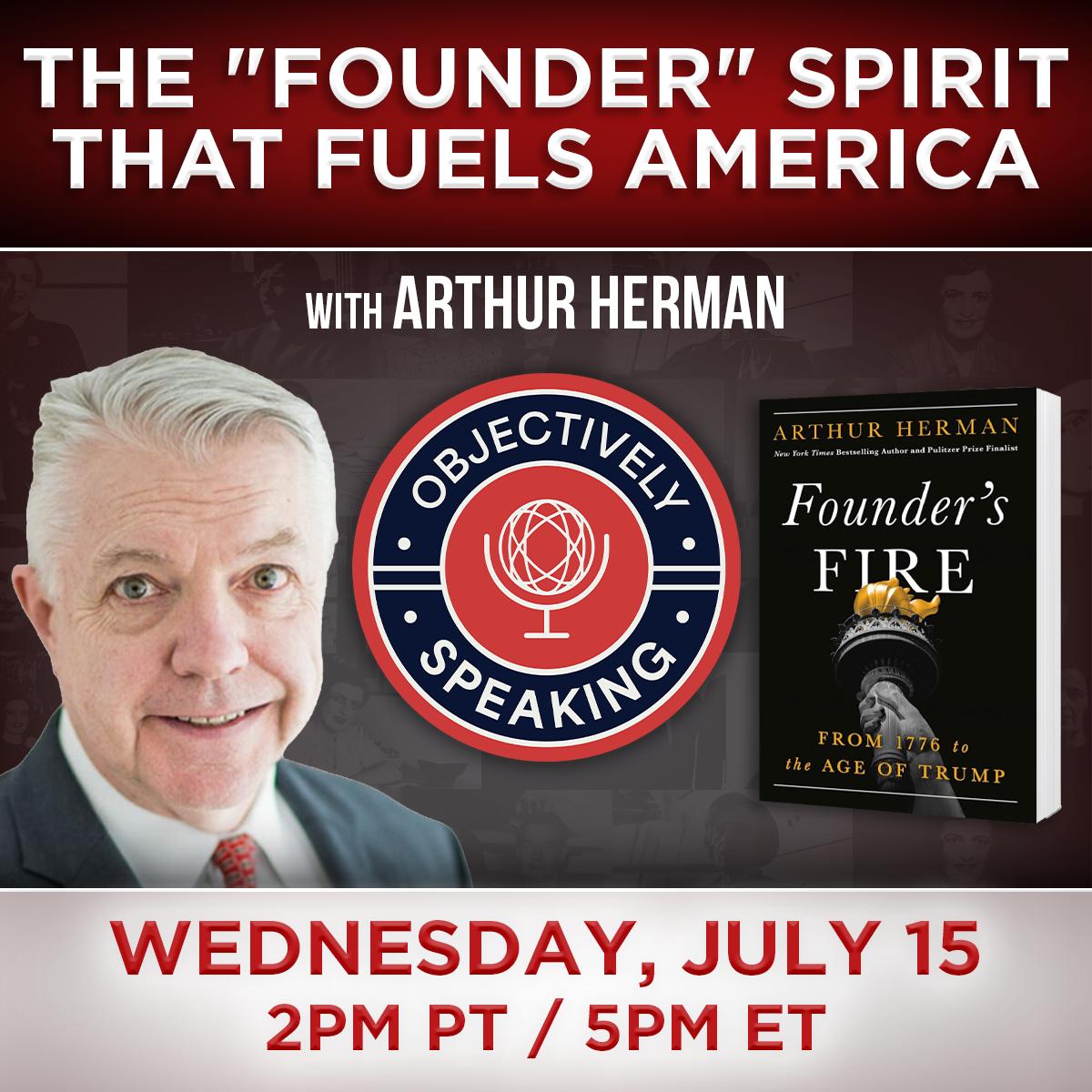
What makes a true founder, and why does America keep needing them to break the cycle of stagnation? Join Atlas Society CEO Jennifer Grossman for the 306th episode of Objectively Speaking, where she sits down with returning guest Arther Herman to talk about his latest book, "Founder’s Fire: From 1776 to the Age of Trump." In "Founder’s Fire: From 1776 to the Age of Trump," Arthur Herman argues that America has always been driven forward by a distinctive type of leader—the founder—who, through visionary risk-taking and a willingness to build from first principles, has repeatedly rescued the nation from stagnation. Returning for a second time on Objectively Speaking, Herman previously joined to discuss his book "The Cave and the Light: Plato Versus Aristotle, and the Struggle for the Soul of Western Civilization." A senior research fellow at the Civitas Institute, Herman is a Pulitzer Prize Finalist historian and biographer, authoring nine books, including the New York Times bestseller "How the Scots Invented the Modern World," "Freedom’s Forge: How American Business Produced Victory in World War II," and "1917: Lenin, Wilson, and the Birth of the New World Disorder."
0:00Speaker AHi, everyone. Welcome to the 311th episode of objectively speaking. I'm Jag. I'm CEO of the Atlas Society, and I am super stoked to have returning guest Arthur Herrmann join us to talk about his new book, founders fire from 7,076 to the age of Trump. Arthur, thank you for joining us.
0:23Speaker BIt's a pleasure to be here again.
0:26Speaker ASo are you surprised by the super hot reception of your book? We were talking before. You just came from a lunch with a certain senator and he brought his copy all heavily annotated and bookmarked. What do you attribute the popularity of this particular book at this particular moment to?
0:50Speaker BWell, I gotta say, as you point out, it's very gratifying to have that kind of response and to have people get the message right away that this is a book which on one hand is a celebration of the original founding, the America's founding on the 250th anniversary. One of the reasons why we did this book and timed it when we did, but also I think, two, those who have realized that when we talk about founders, that we're not just talking about founders in terms of the founding Fathers or founders in the political stance, but we're also talking about founders as being the soul of the entrepreneurial tradition in America, the one that really embodies what I think of as American exceptionalism and what I wanted this book to do in terms of its historical sweep from 1776 and the setting within which the. These group of men, the original founders, put together a declaration of Independence and take that bold and very risky step of declaring independence from the greatest empire in the world, Great Britain, at the time, that you can watch this same spirit of vision, of this drive, this sort of can do attitude, and the willingness to take risks, in fact, in certain circumstances, to risk everything in order to achieve that vision. That you can trace that same kind of a spirit, what I call the Founder's Fire. You can trace it all the way through the major episodes in American history. And this is what the book does and brings it right down to today, to the. The way in which we've seen political forces and economic forces shape around the second Trump administration, in which we sort of see a gathering of founders who come to realize that the time has come for. For a similar kind of refounding of the purposes and direction of American governance, that the role of limited government, of recognizing and celebrating the spirit of free market capitalism, of entrepreneurial capitalism, of founder capitalism, that that moment has come again. And that although there are we see counter currents running in certain isolated pockets in American, American politics today. That, that what we really, what I think we've really sensed now taking place is that there is a fundamental sea change that's taking place in our politics and our economy that really is one that I think someone like Ayn Rand would be very pleased about. I think to think that, I like to think that this is a book that, that she would be interested in reading and, and celebrating as well.
4:13Speaker AI think she would. Obviously, Atlas Shrugged is full of. Of founders and re founders and, and great entrepreneurs and industrialists. But speaking of founders, you begin this book with the story of Zach Yatagari. Who, who is he? And what does his experience tell us about how entrepreneurship is viewed by many of our elite institutions?
4:39Speaker BI found Zach's story really fascinating when I first heard it. It's this young man, high school student at the time, who had created basically an AI driven app, a very simple little thing, the kind of thing that you'd expect some contestant to bring to bear on an episode of Shark Tank. And I talk about Shark Tank in the book because I think that's also a television program that really captures that entrepreneurial American spirit in very powerful ways. But Zach's experience was to create this app that made him and his business partner basically millionaires while they were in high school. An extraordinary story, but a great success story. And yet he found that when he was applying to colleges, universities, that he was getting turned down at one elite institution after another and that the, and that what he had accomplished, the singular success that he had accomplished as an entrepreneur, as a founder, seemed to rack to matter not at all. Or America's leading educational institutions and colleges against him. In fact, in fact, you could say, couldn't you, that it probably, it probably hurt his admissions chances for. By being involved in something that, that was actually bringing value to the world, to customers, as well as, as well as the success for himself. And I thought that this opposition between, on the one hand, the American spirit of capitalism, of entrepreneurship, of founderism, I can coin that phrase, and then of the, of, of a status quo, an educational status quo which is blind to the value of that entrepreneurial spirit, that this opposition, opposition and confrontation between these two forces would make a, a great way to start this book. Because what the story I tell in Founders Fire is of a way of seeing American history in a fresh light. I think of a, of a constant struggle and confrontation between, on the one hand, this founder mentality that Zach as a teenager really embodies and epitomizes and on the other side, what I call this manager or managerial mentality, which is about de. Risking situations and enterprises, which is about slowing down the progress and development of capitalist enterprise. And then ultimately in its more extreme versions is one that kind of subsides into this sort of bureaucratic inertia and even, let's face it, sets the stage for a kind of socialist, a collectivist kind of mood which is that those who do get rich and enriching our lives are doing so unfairly and that we need to find ways in which to restrain that energy and dynamism and creativity.
8:15Speaker AYeah, that.
8:16Speaker BThat embodies the capitalist, the capitalist spirit. So American history. This is a, this is, this ongoing conflict is what I'm getting at, that we see played out and that I, I spell out in the course of the book.
8:28Speaker AYeah. You know, it reminds me of in Atlas Shrugged, the star family heirs running 20th century motor into the ground. So I'm wondering if that manager capture is the default fate of every great enterprise, including America itself.
8:47Speaker BWell, you know, that's a wonderful way to pose the question and I think you've really got something profound there because as I explained in the book, it is the fate of so many successful corporations and companies of one in which the original vision and drive and creativity innovation of the founder in the next generation, either generationally in a. In a sense of the. The sons and daughters who then take over the corporation or the enterprise, but also simply the next generation of managers and vice presidents and others who step in to help to manage the success that this great corporation has achieved thanks to its founders vision and drive. That what you see is that the creativity tends to get smothered and begins to sort of slip away. Sometimes for the best motivations we have to slow everything down because we want to be able to enjoy the success we have or consolidate the success we have here. That we want to be able to move more incrementally in order to not to arouse the ire of competitors of government. And eventually what can happen? It's not the case every corporation, but it is, I think, very typical. The life cycle of corporations is that the bureaucratic mentality takes over and the desire to take risks is drained away. The push to new horizons, to adopt new technologies begins to. Begins to fray and eventually disappear. And eventually the corporation becomes then part of the status quo and itself then becomes challenged by a new wave of founders who step forward. And I point out how this happened when you look at big companies like an IBM for example, which was A very dynamic company in the hands of the hands of the Watsons when, when it was originally founded. Enormously creative and innovative. But it gets bigger, becomes big blue, and then grows to become this mammoth, you know, sort of monolithic presence. And what happens is it is then challenged by a figure like Steve Jobs who has a very different and innovative version of what computers can do and how they can relate to people's lives and become part of their, part of their everyday life in ways that IBM and IBM's managers were never able to conceive or understand.
11:38Speaker AYeah, no, I think so.
11:40Speaker BThere's an historical cycle. Yeah, I see the cycle that takes place of, of birth, of growth and then of slowing growth to stagnation and then decline. And then out of that, out of that comes a rebirth, a rebirth and a re growing. And that's been a big part of American history. Those moments of those, well, decline and
12:04Speaker Athen rebirth on that kind of refounding. Because you say that, you know, founders aren't necessarily just responsible for origination, for starting something new, but that a founder can also be part of a re founding. So I'm wondering, you using one of the examples in the book, is Diocletian the Roman emperor, how does he illustrate that concept?
12:31Speaker BWell, this is, this is of course not part of, this is long before America's history and long before, but it is. Diocletian is part of a generation of soldiers, soldier emperors who come in in the third century, third century of the Christian era, who confront the fact that the Roman Empire at that point sprawling as it does from the Pillars of Hercules and, and Gibraltar all the way across North Africa, across Europe to the Tigris and Euphrates rivers, that this is an empire that's gotten way too big for being administered or controlled or even, even governed by a single emperor. And after a series of upheavals and near extinction of the Roman Empire in the course of the third century, is Diocletian and his colleagues. These are not men born to the purple. These are not men from the senatorial aristocracy. These are men who've in, in Dian's case, worked his way up from buck private to become emperor based on his skill as a soldier and his understanding of military strategy, that this is an empire now that needs to now be governed not by a single man, but by four men. The Tetrarchy, as it's called, co emperors, who divide the empire, the Roman Empire in half, Eastern half and then the western half. And each of them having a co emperor, a Caesar who serves under them as their subordinate. And the result is he not only saves the Roman Empire, but also creates a division of labor that enables the Roman civilization to survive and survive in the eastern part of that empire. In fact, for the next 1,000 years. It's a again the kind of creative leap of a re founding of the Roman Empire in this way. And I think one of the figures I focus on in the book Founders Fire in American History, who does this is Abraham Lincoln, who sees an opportunity when the Southern states decide to secede, that this is an opportunity to carry out a refounding of the American Republic, of the American ideal expressed in that Declaration of Independence, of that all men are created equal. That a refounding to make that statement finally and irrevocably true by ending slavery and then refounding the American Union on the basis of free men and citizens coming together instead of having a union which is half free and half slave. It's the kind of moment that happens very rarely in American history, but it is ones that give a new sense of life, a new sense of purpose and direction for, for America and for the United States. And, and I think that for that reason I include Lincoln. Although he never created a business himself in any kind of way. We don't think about him as a founder in a business sense, but as a founder in a refounding sense. As you just put it, he's a hugely important figure
16:17Speaker Aat a business. He did have a role that I read about in the book in creating the trans continental railroad system. Can you elaborate?
More The Atlas Society Presents - Objectively Speaking episodes →