
The Atlas Society Presents - Objectively Speaking · The Atlas Society
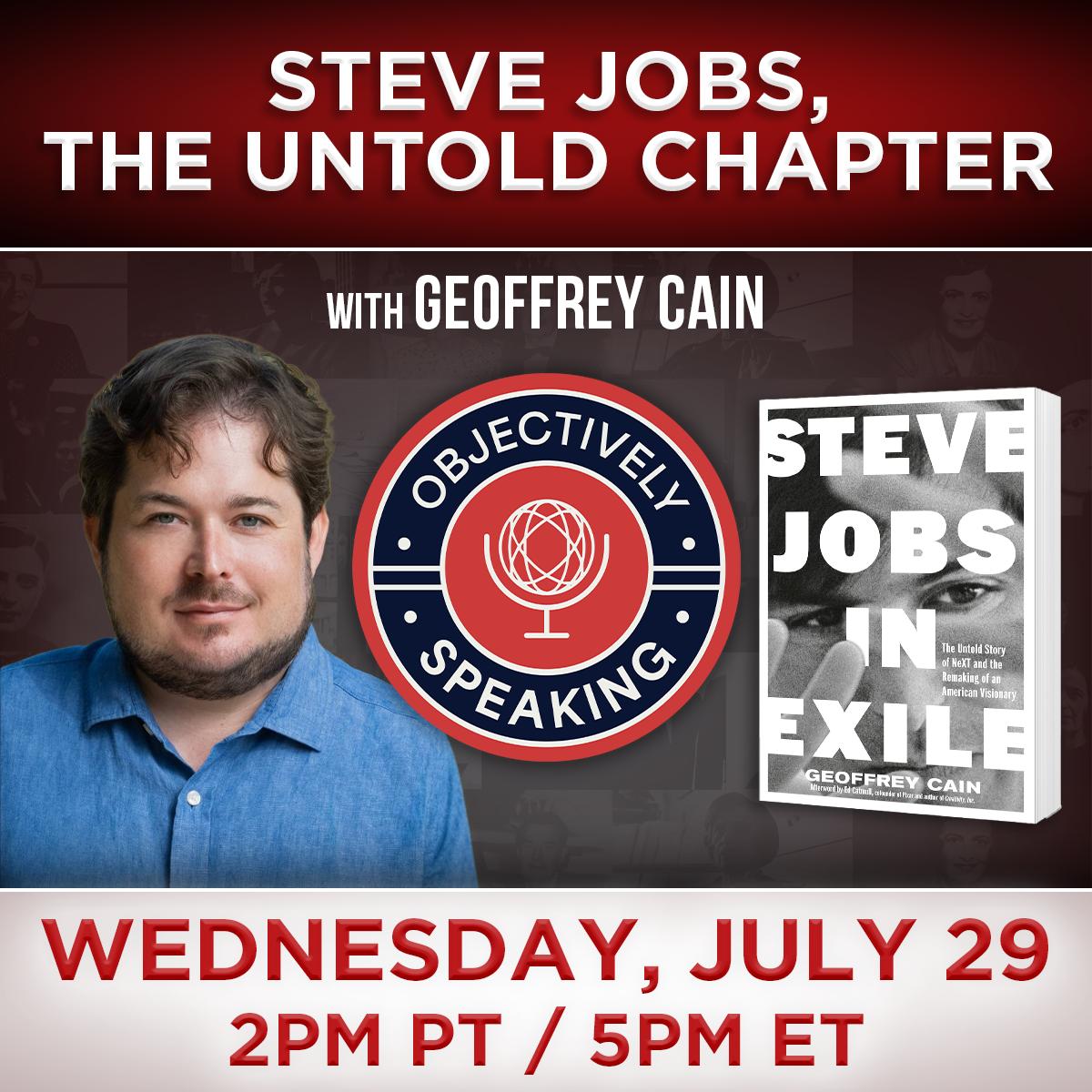
Join Atlas Society CEO Jennifer Grossman for the 313th episode of Objectively Speaking as she sits down with returning guest Geoffrey Cain to talk about his new book “Steve Jobs in Exile: The Untold Story of NeXT and the Remaking of an American Visionary,” which draws on previously unpublished materials and new interviews to reveal the untold story of Steve Jobs's “lost decade”—the twelve years of failure, near-bankruptcy, and humiliation at NeXT that forged the discipline and vision behind his legendary return to Apple. An award-winning investigative journalist, Cain is a returning guest to Objectively Speaking, having previously joined us to discuss “The Perfect Police State: An Undercover Odyssey into China's Terrifying Surveillance Dystopia of the Future.” A former correspondent at The Economist and regular commentator in The Wall Street Journal, Time, Foreign Policy, and a frequent guest on CNN, NPR, Fox News, and Bloomberg, Cain sits down with world leaders, tech founders, and dissidents at pivotal moments in history. His previous books also include “Samsung Rising,” longlisted for the Financial Times and McKinsey Business Book of the Year.
0:00Speaker AHi, everyone. Welcome to the 313th episode of objectively speaking. I'm Jag, CEO of the Atlas Society, and I'm very excited to have returning guest Jeffrey Kane join us to talk about Steve Jobs in Exile, the untold story of Next, and the remaking of an American visionary. Jeffrey, thanks for joining us.
0:27Speaker BGreat to be here. Jag. Good to see you again.
0:29Speaker AYes. And I want to apologize in advance. Hopefully this is not going to be an issue. But folks, as you may notice, I am not in the studio. I am on the road. I'm actually here in Houston, Texas, and I am at the mercy of the consistently unreliable hotel Internet connection. So we're going to try to do our best. Jeffrey, about Samsung, about surveillance states. In fact, you know, you, you wrote about really, in a very prophetic way, talking about how the beginning of using this surveillance technology in one area of China has now become a global phenomenon. So I'm curious, what pulled you towards Steve Jobs lost decade, if you will, as, as your next subject?
1:26Speaker BRight. So it was a topic that I think it found me as much as I found it. And you're right, previously I was writing about topics that were a little bit different. I wrote a book called Samsung Rising, about the rise, the emergence of the Samsung empire of South Korea, one of the most powerful companies in the world. You know, rightfully a successful company. I wrote about the Chinese surveillance state, a book called the Perfect Police State. I was in China, I was kicked out for my reporting, and I was looking into how surveillance technology is being deployed to create a perfect surveillance dystopia where everything you do is tracked. Now, you know, when I was originally there and I was writing about this topic in China, it was about 10 years ago now, and time goes fast. But, you know, just cracking that book open again recently, I realize that this dystopia is starting to envelope much of the world. And, you know, obviously, you know, China is a communist country and it has, you know, its own communist system, but the way that we've deployed cameras and software and, you know, so, so much out there that documents our everyday life in such detail and it's, you know, sent to the government and sent to companies really is something that took. I did not realize how big this topic was going to be. I thought it would be more confined to China, but that's not true. And so the question is, how did I land at Steve Jobs? Well, the stories I was writing about before were essentially stories of the wilderness years of people and companies and success stories. One of the great facets of so much literature and so much biography is the fact that great people, great visionaries, great leaders, and also great companies, not just individuals, have almost always gone through a period in the wilderness. And by wilderness, I mean a period in which they were ousted from the comforts of everyday life, where they had to be tested by the world, tested by what people needed from them, and had to find their true calling. And then once they were able to face a certain demon, whether that demon is, you know, an actual opponent, an actual opponent out there in the world, or an inner demon that had been haunting them, once they had learned to face that down and to become who they were meant to be, this is a profound moment when they're able to return and to do great things in the world. And me being a technology writer, author and biographer, I was drawn to Steve Jobs because I knew that he was one of the most written about visionaries and entrepreneurs of our era. But there was an entire period, a stretch of 12 years of his life when he had been just knee deep in the wilderness, trying to navigate a series of setbacks of failures. He learned a lot about himself and he learned a lot about what the world truly needed from him. And he came out changed. And he came out changed in the sense that he was fired from Apple originally and he was finally able to return to Apple, the company he co founded, and he was able to save it from bankruptcy. It was about 3/4 away from bankruptcy, according to some estimates. And he was, he was able, with the lessons he learned from failure, to lead Apple into greatness. So if this period of life had never happened, these 12 years from 1985 to 1997 at a company called Next Computer, if this failure had never happened, he would have never returned to Apple. And that means that today there would probably be no iPhone, no MacBook, no iPad, and in fact, no Apple to speak of, it's very likely that Apple itself would have collapsed and gone bankrupt and out of business. So, yeah, it's something that. It's one of those profound stories of failure, but how failure can lay the foundation for what it is that you truly need to do for your calling.
5:38Speaker AYeah, well, I mean, and along those lines, the book opens with this quote from Steve jobs at a 2005 Stanford commencement speech. Quote. I didn't see it then, but it turned out that getting fired from Apple was the best thing that could have ever happened. To me, the heaviness of being successful was replaced by the lightness of being a beginner again, less sure about everything. It freed Me to enter one of the most creative my life. So most of us in the audience are familiar with that triumphal arc. What happened in those 12 years to turn his resentment into gratitude?
6:25Speaker BWell, the resentment began because he was fired, as you just said. He was removed from Apple, the company he co founded. And he decided that he was going to outdo Apple, that he was going to make a computer that was so much cooler and so much more cutting edge and revolutionary. At Next Computer, he said that he wanted students in Stanford dorm rooms to be able to cure cancer. Literally, that was his goal. That's extremely ambitious and it takes a long time to get there. I mean, we have, you have to remember that this was 40 years ago and even today with developments. And I were just starting to see this potential where artificial intelligence can solve mathematical problems that have confounded us for hundreds of years and find medical cures to diseases that have always haunted us. Steve Jobs was so far ahead of his time. And what happened was that he, in being so far ahead of his time, was in a failure mode for 12 years. So the resentment was building because he would release these computers. He released these new systems that were really at the frontier for the 1980s and the 1990s. But the market kept rejecting him. It's kind of a lesson in how capitalism works and how the markets work. You can have the greatest idea ever. I mean, you can be a brilliant visionary, you can be a genius. And Steve Jobs was very much a genius. I mean, he had, he had that talent, but his talents were misplaced because he kept trying to force feed consumers and force feed computer users with these systems that they just simply didn't need. You know, he would say, this thing is beautiful. It was a perfect cube, a computer shaped like a perfect cube, made of this exotic magnesium alloy, which is very expensive and painted in a matte black, black. You know, these are cosmetic features, beautiful artistic and aesthetic features that drove up the price. The computer was, you know, in, in the 1980s, it cost more than $10,000 with all the necessary add ons to make it work. I mean, in today's money we're talking that's like a year's of a year's worth of tuition at the typical private university. So imagine that. Imagine somebody, you know, releases a computer today and tells, you know, students like, yeah, you're going to pay $80,000 a year for this, this computer that's going to change your life. I mean, most people wouldn't buy that at all. No matter how beautiful and how revolutionary the system is. So his resentment came from the fact that his products were failing. Something that we don't remember about him. We tend to remember him solely as a success. And second, his resentment continued building because he wanted to get revenge on the people who hurt him. He wanted to show them what he was truly made of. And by building this structure, building this company as a monument to his own genius, but also a monument to his own vengeance that he wanted to see, you know, he wanted to see his own work be vindicated. In the end, he was setting himself up for. For enormous failure, which eventually culminated. He literally fell very close to personal bankruptcy. During these years. The people who knew him best said that he had about two to three years worth of Runway left in this company. These were not public companies. He didn't have a ton of investors. And the investors he had, he had chased off. So two to three years. Imagine that. Steve Jobs at rock bottom, he's being rejected. His co founders have left him. His investors are angry at him. They've left him. And because he is now being marked as a failure, the media is calling him a snake oil salesman. Literally. That's what Fortune called him. And if this had gone any differently, if he had continued on this path of failure without learning the lessons he needed to learn, he would have been forgotten and written out of history. You know, he would be a footnote. We might remember the old Steve jobs of the 1980s, but he would never have been the larger than life figure who we now know, the guy in the black turtleneck who holds up that black rectangle, this beautiful machine that he says is going to change the world. That was only possible because he had been through the crucible, the fire and the tribulation of what it feels like to be so hurt and so beset by failure that you have no choice but to pick your life up and to do something great with it.
10:54Speaker AYeah, you know, we were talking right before we went live. You had this. This great kind of thought experiment. What would a conversation between Ayn Rand and Steve Jobs be like? Because they both were visionaries, right? They both had a message or a product or a technology or an aesthetic that they were bringing forward. And in some cases it was important, embraced, and in other cases, it was resisted. And I think that, you know, we forget the Fountainhead was rejected, I think 12 times before it eventually found a publisher. And, you know, even. Even the Atlas Shrugged was a wild popular success. But of course, you know, it was savaged not just by critics on the left, but on the right. And, and that kind of like, leads to a certain resentment and a desire to overcome, to have vengeance. And of course, you could see how Ayn Rand might have been carrying, obviously, even a bear wound with what the Bolsheviks did to her country, to her father, to her family. And so sometimes it takes that burning desire to bring something new, but also prove others wrong, to come forward and persevere against such adversity. All right, let's turn to some audience questions. Flying Custard, I haven't seen you here before. He or she is asking how much of Jobs eventual success came from personal development and how much came from favorable circumstances or good timing. Timing wasn't very good for him.
12:42Speaker BBut yeah, yeah, actually that's a very good question because there's no single answer. And it really is a mixture of both. It was personal development, but understanding how to use timing to your advantage. Steve Jobs in the late 1980s, so the year 1988, I have old emails that have never been published by him. And he was talking about deploying advanced AI systems to solve scientific problems and medical problems. He was experimenting with a, an exotic AI programming language that he was going to put on these computers. And, you know, I mean, this was a time when AI like, I mean, this was the age of the Terminator movies and AI was still so far off. I mean, it sounded like a fantasy to so many people. AI was just not ready yet. This is only one example of one of the things he was doing. He also had invented this, rather not invented the software, but he had adapted a kind of software called Object Oriented Programming, which is essentially, think of it as if you have an iPhone. It's essentially that drag and drop, these little items on the phone or on the computer called objects. If you're developing software, you don't have to go through lines and lines of code to create it. You just drag and drop things and you put an item there and a box there and a dialog box here and there, and you have your software. And that was revolutionary because, you know, in the same way that developing, you know, the automobile required many components and parts that had to come together first. This was the equivalent revolution in software because now the components were coming together and with all these parts starting to fit, software was finally beginning to make sense. So without this revolution in software, we, we wouldn't have been able to develop the worldwide Web invented on a next computer. We, we wouldn't have been able to develop, you know, many of the other you, you know, the operating system, the Apple operating system, like a lot of these Things came from Steve Jobs specifically in this failure period of his life in the late 1980s. The World Wide Web did not catch on until ten years later, even more than ten years later.
14:55Speaker AThe.
14:57Speaker BThe operating system did not get on every iPhone until 20 years later. So we're talking a guy 20 years ahead of his time. Artificial intelligence did not become a force until 30 to 40 years later, just the last 10 years. So the question here is, you know, how do you take that vision, that brilliant vision, and how do you develop it and mold it into the here and now and understanding what actually works in the moment that you're in? So he was able to harness timing. That's one of the big lessons of this period. The timing is so important, and, you know, you can have a great idea, but if you miss the market, that. That free market out there moves by its own logic. And if you're two years too early, that's two years of lost time. Because the moment that you release something two years early, every competitor out there is going to jump on it. They're going to take it for their own idea, and they're going to release it two years later. And they were not the innovator, they were the copier, but they're going to be more successful than you because they had timing on their side. So it's really a lesson of Steve Jobs navigating failure and trying to learn how the arc of history works. The arc of history is not always orderly. There's a Marxist. You mentioned the Bolsheviks earlier, Jag, and, you know, like, that's a great example. They were trying. They had a historical theory, and they tried to force it onto the world, onto their countries, and they created atrocities. I mean, millions and millions, millions of people dead because they had this. This grand vision of what history was supposed to look like, and it turned out to be wrong. It just wasn't true. Now, obviously, we're not talking about Bolsheviks in the life of Steve Jobs. This is a much tamer topic. But it's kind of a similar, you know, I guess a comparison that, you know, he was just so forceful in the way that he tried to put things out into the world, but he was creating disaster after disaster for himself because you can't force history to move in one direction. You have to use history. You have to bring it towards your will and see how to harness it to do something great.
17:12Speaker AYeah. You know, in reading the book, listening, actually, it's a great audiobook, folks. So if you're an audiobook person like me, then I highly Recommend it. But it actually reminded me of another visionary entrepreneur that I personally worked for for about a dozen years. Because just as Steve Jobs could be mercurial, could be gratuitously cruel to people that disappointed appointed him. This particular entrepreneur that I worked for, David Murdoch, who was the owner of Dole Food Company. He could go on a rant and a rage for hours. And I always asked myself, on one hand I said, well, you know, these are the guys with the billions and you can't argue with success. But on the other hand, how much more successful might Jobs have been or might, you know, Murdoch have been if they had, you know, maybe taken their rational self interest and, and asked themselves, if I alienate all these people, if I get this terrible, you know, reputation, how might that not advance my goals?
18:29Speaker BRight, That's a great question. So rational self interest, I think that's the key word. And Steve Jobs in, in the next computer period of his life, he was not acting in rational self interest at all. He was being completely irrational. And one of the things that I found writing the book that was so fascinating was that there were these moments, there are these touch points throughout the story where Steve Jobs has everything lined up for him. I mean, he, he has a clear rational self interest to sign the contract, to take the payment and send the product, but he repeatedly self sabotages and blows up these wonderful deals that his backers have been setting up for him. I mean, people who work so hard to make him a success. And he keeps self sabotaging and rejecting their help and then just, just creating chaos in everything that he does. So what's interesting about these touch points is that if he had acted in rational self interest and he had taken the route that the market was pointing him towards, all of the history of technology since then would be completely different. So let me give one example. He was going to sign a deal with IBM. IBM was the computer giant of the age, the 1980s and the 1990s, kind of a, you know, lesser known company today. But that was the pinnacle of technology at the time. And they were going to take his software called NextStep, which was the extremely advanced software that he was developing, and they were going to port it and put it onto IBM computer workstations in the 1980s. Now IBM has massive distribution, massive company appeal in particular. So, you know, we're talking, you know, millions of these machines going out into the world with the Steve Jobs, the brilliant operating system that he had created. Companies, you know, like Disney would be buying this, you know, compaq all the big, you know, companies of the day, ge, General Electric and so forth, they would all have this at their corporate headquarters and they would have just thousands of these machines at each building. So that is an entrepreneur's dream. That is what you want, that you want big contracts, you want big customers who can keep you afloat because that is the cash cow that keeps the company going. But Steve Jobs was so stubborn and so difficult and he only wanted to sell his brilliant computer to university researchers, to scientists, to the brightest minds of the time. And he wanted them to use his computers to win Nobel prizes and solve major problems in math and science. So this is self sabotage and this is not rational self interest. A rational market player would have taken that deal with IBM that sets up your cash cow and then, you know, that money flows into the higher end of the market that you're trying to develop, which is the brilliant computer that can, you know, for researchers, that can solve mathematical questions. That's how markets work and that's how businesses work. And by the way, he made the same mistake at Apple when he was younger. That's one of the reasons he got fired from Apple, because he did something similar. And I won't get into the weeds here. So if this had gone any differently, here's what would have played out. This is what the people who worked with Steve told me. Steve signs with IBM. IBM, you know, essentially absorbs Next computer and puts out its software. Steve Jobs never returns to Apple. And then today we would have a different technology ecosystem. We would have a choice probably between the Microsoft Windows computers that a lot of us use and then we would have computers loaded with NextStep operating system. So that would be like the replacement for Apple. So Steve Jobs would have been much wealthier much earlier. He would have had kind of a different legacy cemented. He's lucky in many ways that he was able to recover from the these failures later. But it's just so fascinating how these decisions that appear throughout the story, it's like Steve has clear decisions he can make. And if he makes the decision just a little bit differently, all of the history of technology since then would have gone in a completely different direction.
23:05Speaker AYeah, you talked about him creating chaos around him. In reading your description, there was a lot of drama as well. He created a lot of drama. And as I was listening to this, I was like, somebody should get a hold of this. This would actually make a really unique and really interesting film. Who knows, maybe Pixar will. So question here before I get to that. You mentioned Microsoft. How did the rivalry between Steve Jobs and Bill Gates play out within this context?
23:42Speaker BBill Gates was the villain to Steve Jobs, but, you know, if you were Bill Gates, then Steve Jobs was your villain. It depends on where you stand. And the disagreement between these two men came down to a fundamental philosophy of goes beyond technology alone. It's a philosophy of life, a philosophy of business, and a philosophy even of art. Steve Jobs believed that technology should be best deployed on a closed and heavily proprietary system that, you know, you buy your iPhone, you buy your Macintosh, and it is closed with one operating system, one piece of software, and Apple controls it end to end. So it's like when you buy an Apple computer. His. His vision for Apple was that Apple sells artwork. It's like you're buying a Macintosh computer or an iPhone today, and you know you're buying a beautiful piece instead of just a tool that you can use for this or that. But Bill Gates was the pragmatic one, and we tend to forget this today, but Bill gates in the 80s and 90s was far, far more successful than Steve Jobs. And that was because Bill Gates was willing to work with the market and work with people. So companies such as IBM, you know, Hewlett Packard, Compaq, these were the computer. The hardware makers of the day, Dell computer. And he said, look, we will divorce our software, our operating system, from one single computing system, and we will make it flexible. So you can load Microsoft Windows on any PC. And it's like, if you want to use Windows, you can use Windows on whatever computer is sitting around in your office. And people like that, because it didn't confine them to one closed system where they're trapped in this. Trapped in this Apple cage. It's a beautiful cage. It's like a cage made of gold. But nobody wants to be in a cage with Apple. Not at the time. But that has changed since then. Originally, Microsoft Windows was the massive success. Windows 95 made Bill Gates a billionaire. This was at a time when Steve Jobs was already being written out of history and written off as a failure. But Steve decided in the end to adopt that Bill Gates sensibility. He realized that you do have to take different elements of your product, and you can't sell the whole bundle together. Sometimes you have to pick things apart, and you have to take your software and you have to sell it on other people's computers. You just can't control the whole thing. It's just not realistic. And what we tend to forget today, Apple is so successful today with the close, closed, proprietary ecosystem. Hardware and software fused together into this beautiful technology. But the only reason Steve Jobs was able to pull this off with the iPhone was because of these years when he built a strong negotiating position. He needed, you know, he needed different things. He needed money in the bank, he needed a great team, he needed a great software that he could sell to people. But he could only achieve this through these lessons. And once he was able to sell, you know, sell, act in that rational self interest, as you said, build up a strong position where you have cash reserves, you have, you know, lots of computers on the market, so you, you, you can dictate to the market what it is that people need. Once he did this for about 15 years, building up this position, then he was able to develop that proprietary closed iPhone. He would walk into a telecoms company and he would tell them, we're going to do it this way and I have the power to negotiate here, so we're going to do it how I need to do it. And that's why he was so successful later.
27:32Speaker AYeah, we touched on Ayn Rand a little earlier, and I don't know whether or not Steve Jobs ever read the Fountainhead, but it's likely he would have, at least in those earlier days, much more identified with Howard Rourke and his unwillingness to compromise the integrity of his vision and go and, you know, break rocks in a quarry rather than capitulate. So, all right, great question here from Alan Turner. Great to see you, Alan. He wants to know, how did NEXT employees view Jobs during this time? And did any of them follow him to Apple?
More The Atlas Society Presents - Objectively Speaking episodes →