
The Atlas Society Presents - Objectively Speaking · The Atlas Society
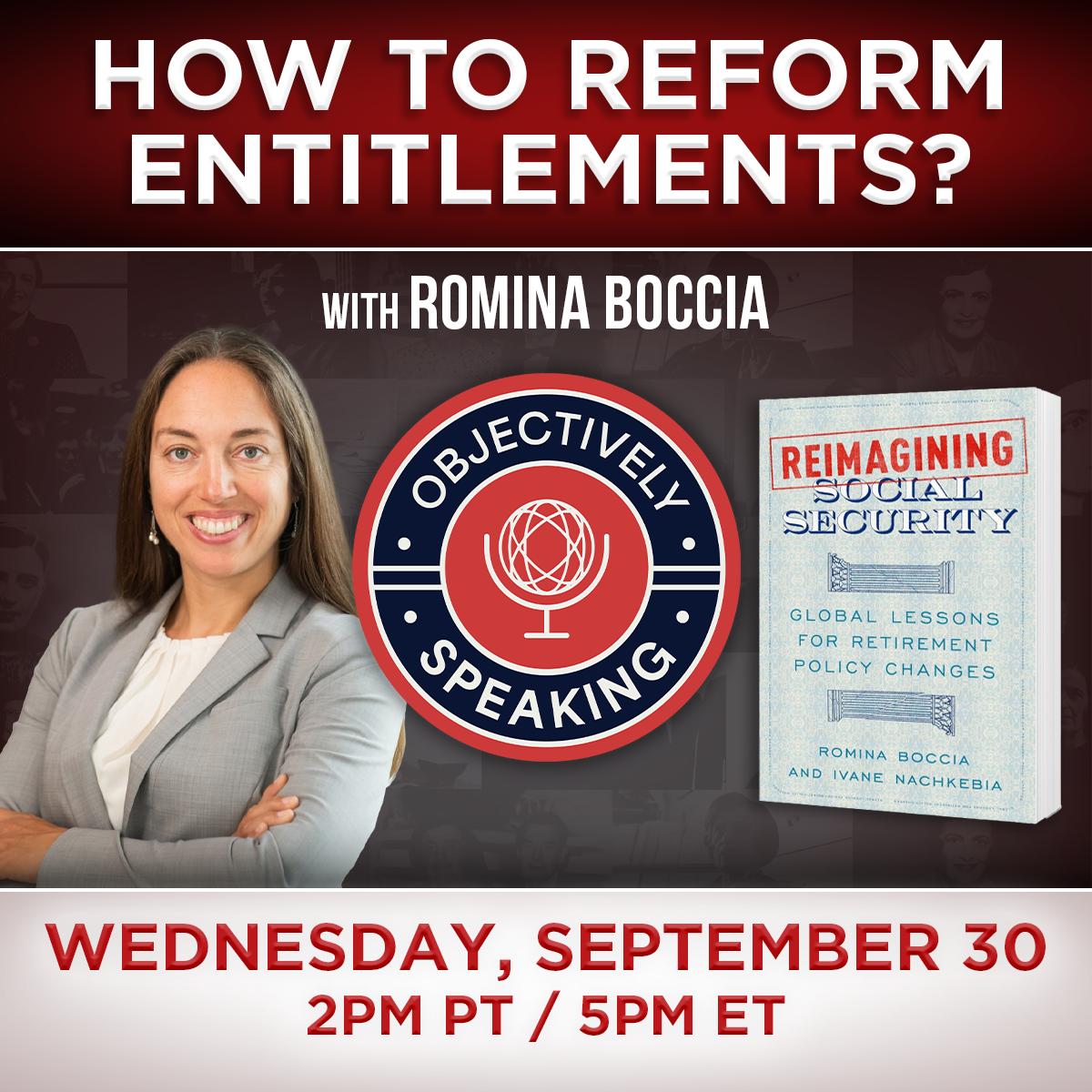
As Social Security and Medicare barrel toward insolvency, what can the United States learn from how other countries have restructured their retirement systems—and does Washington have the political will to act? Join Atlas Society CEO Jennifer Grossman for the 321st episode of Objectively Speaking, where she sits down with Romina Boccia to talk about her co-authored book, Reimagining Social Security: Global Lessons for Retirement Policy Changes," which explains what is wrong with Social Security and how major retirement program reforms from Canada, Germany, New Zealand, and Sweden could work in the United States. Romina Boccia is director of budget and entitlement policy at the Cato Institute, where she focuses on federal spending, the budget process, the economic consequences of rising debt, and reforms to Social Security and Medicare. She is the principal author of the Debt Dispatch Substack, the leading fiscal policy newsletter read by members of Congress. Boccia previously served as director of the Grover M. Hermann Center for the Federal Budget at the Heritage Foundation, where she was the principal author of the Blueprint for Balance, the organization's flagship budget plan, which informed President Trump's first-term budget proposal.
0:00Speaker AHi everyone. Welcome to the 321st episode of objectively speaking. I'm Jag CEO of the Atlas Society and I am very excited to have Romina Bhatia join us to talk about her co authored book, Reimagining Social Security Global Lessons for Retirement Policy Changes. Romina, welcome.
0:24Speaker BThanks so much for having me. It's good to see you again, Jaguar.
0:29Speaker ASo before we get started, our audience always enjoys learning about our guests origin stories. You grew up in Germany. Any early experiences or mentors that maybe helped shape your later public policy trajectory.
0:45Speaker BThank you for asking. I did grow up in West Germany and I have this memory when I was 8 years old and my grandfather brought me to southern Italy to meet our ancestors there. And. And I was just struck how the living conditions were so different. In western Germany. We had paved road, most families had automobiles. Cats and dogs were confined to the home. In southern Italy it was dirt roads. People were mostly walking, lugging things around. There was a lot of stray cats and dogs. So it was just a complete contrast for me and I. On that trip I also met a teacher from East Germany and we started a pen pal ship for about two years. And I regret that I did not keep those letters. But I learned a lot from her about what life was like behind the Iron wall. And it just for me helped me understand the differences between what makes societies flourish and what causes people to be trapped in a cycle of poverty and hardship. And oftentimes it's, it's the rules of the game. And that got me interested later in life into economics.
1:56Speaker AWell, and maybe reading Ayn Rand and Atlas Shrugged also had something to do with it. Apparently Atlas Rugged is the book that you've read more than any other book. What were your takeaways?
2:11Speaker BThat's true. I read Atlas Shrugged three times. I think because I just enjoyed it so much. It was so refreshing. I found the story extremely captivating. So I read it basically three times in a row, kind of like you would binge watch your favorite show. And it was just a story about the power of the individual and the state trying to crush the individual and industry and pushing back against that was something I found very inspiring.
2:42Speaker ASo you first moved to Washington D.C. as so many do, to become an au pair when what was the biggest culture shock in moving to the United States?
2:52Speaker BFrom a personal perspective, it was just everyone was super friendly. In Germany, people tend to be more reserved unless they become your close friends. And in the United States everyone was just extremely friendly. But that doesn't necessarily mean that they're going to be best friends with you. So that's something I had to learn. I think also you have this aspect in commercial society where being very friendly is, is much more common. And Germany really doesn't have as much of a service culture. There's some example examples I could share, but you really get, I feel, in the United States the impression the service culture is very strong, the customer is king. And in Germany, you're much more likely to have someone say to you you're wrong, even if you're, if you're the customer. So it's just different perspectives on how we conduct ourselves.
3:47Speaker ASo turning now to reimagining Social Security Global lessons for Retirement Policy Changes, tell us a bit about the impetus behind the book.
3:59Speaker BYes. So we are within six years of Social Security's trust fund being depleted in 2032, and the Medicare trust fund is not far behind in 2033. I have been working on budget policy for about 15 years now and the fiscal situation has only deteriorated. It's become much, much worse. And yet we seem even further away from a solution as the debt is now rising to be larger than the entire US Economy is measured by GDP with no end in sight, and interest rates are now costing more than what we spent spend on national defense or what we spend on all of Medicare. And yet Congress doesn't seem any closer to a solution to fixing those key drivers of growing spending. So with the book I wanted to look at, are we the first ones to be in that situation? No. It turns out that in the 1990s and early 2000s, many other OECD countries that have older populations hit very similar roadblocks. Their interest rates skyrocketed as their demographics collapsed. Kind of like in the U.S. now we're becoming an older society. People are having fewer babies. All of that adds pressure to the budget and especially through these entitlement programs, how can they be reformed? And so I wanted to learn from how other countries overcame especially the political obstacles to reform and then also what could we learn from the different approaches that they tried? So here in the United States we can make evidence based policy decisions instead of making all of the mistakes ourselves.
5:48Speaker AYou referenced that grim reality that in a few years the system could become insolvent and that payments could be cut by 21%. This is a big question, and I know we're going to spend a lot of the interview talking about it, but how do we get in this situation?
6:07Speaker BHow we got into the situation is really, it's politics. It's the fact that the United States doesn't have a constitutional balanced budget requirement. I think that's really the key. Politicians have been able to promise benefits, curry favor with voters through bestowing them with benefits that they didn't ask their own voters to pay for because we've been able to borrow and borrow at fairly low rates. And that's what politicians chose to do. And that's the problem you run into when you are not limiting politicians propensity to deficit spend. You may find yourself with bondholders eventually limiting politicians propensity to do so, which is why many countries and most US States have balanced budget requirements to prevent today's politicians from buying votes and making future generations pay for it. But that's really how we got there. Early generations in Social Security and Medicare made out like bandits. They received massive returns on the taxes they were asked to pay. And now we're down the road where those returns have shifted. And now we're basically talking about who has to bear the cost of reforming these unsustainable programs. We can no longer uphold these political promises that were ultimately not backed by anything real.
7:39Speaker ASo as you can see from the book, with its many bookmarks, I got a lot out of reading this book and it seems like in part it grew out of this panel that you organized. And on the panel you noted that Social Security is actually called old age and survivors insurance. Then you ask the question, what are we insuring against? Do you have an answer?
8:05Speaker BThat's right. I think that there is a legitimate case that could be made that perhaps one thing government can do best, that might be more difficult to do on a voluntary basis, especially for a very large, dispersed and diverse societies such as the United States, is to ensure against poverty in old age, to ensure against destitution. Some people, through no fault of their own either, never had the opportunities, the skills, the talents, the motivation to work enough to be able to sustain themselves not just during their working years, but also when they were too old to do so. Previously, generations ago, people would rely on their families to support them, but that's not necessarily the case for many people. Families moved apart. Some people decided or couldn't have any children, so there's no one to look after them. So maybe it's a legitimate purpose of government, we could argue could be to protect old people from destitution. And for the rest of us, perhaps even providing that longevity insurance that you just, you can plan for retirement. You know you're going to get older and there might be a time where you may not want to work as much or can't work as much or at all. But you don't necessarily know how long you're going to live. And so that's a little harder to insure against that you might run out of money. But what the program does right now, it looks very different than that. So that kind of social insurance function I think could be a more legitimate use for a program like Social Security rather than what we're doing now, which is basically wage replacement for everyone, regardless of their ability to plan and save and invest for their own retirement or not.
9:56Speaker ASo we're going to get to audience questions in a bit, but I noticed that you have argued that terms like earned benefits, contributions, even the trust fund encourage Americans to think Social Security works like a retirement account. What is actually happening to the payroll taxes I pay and have paid for years?
More The Atlas Society Presents - Objectively Speaking episodes →