
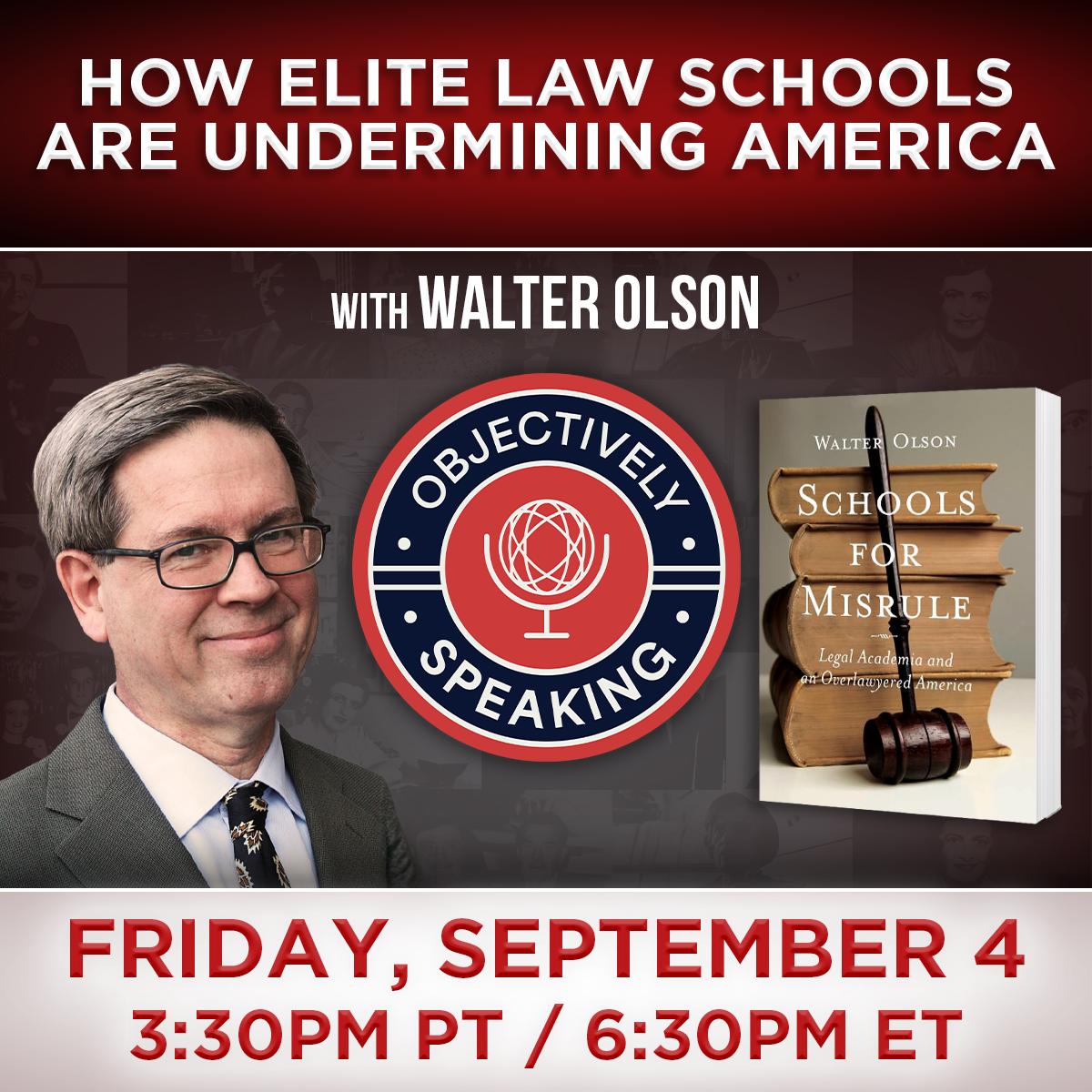
The Atlas Society Presents - Objectively Speaking · The Atlas Society
When lawsuits become weapons and law schools become factories for bad ideas, what happens to justice and the rule of law itself? Join Atlas Society CEO Jennifer Grossman for the 317th episode of Objectively Speaking as she sits down with Walter Olson, Senior Fellow at Cato, as part of our mini-series on tort reform to discuss the relationship between civil litigation, accountability, and the proper role of law in a free society. Walter Olson is a senior fellow at Cato and is known for his writing on law, public policy, and regulation. He is the author of several books about the U.S. legal system, including "The Litigation Explosion," "The Rule of Lawyers," and "Schools for Misrule." His first book, "The Litigation Explosion," was one of the most widely discussed general-audience books on law of its time, leading the Washington Post to dub him “intellectual guru of tort reform.” He followed it with "The Rule of Lawyers," on mass litigation, and most recently "Schools for Misrule," which traces how the ideas taught in elite law schools in one generation often shape national policy in the next—from class-action lawsuits to court takeovers of school funding.
0:00Speaker AEveryone, welcome to the 317th episode of objectively speaking. I'm Jag CEO of the Atlas Society. I am very excited to We've been saving the best for last. Walter Olson is the final guest on our series of episodes to talk about tort reform. And in particular we're going to talk about his book Schools for Misrule, Legal Academia and an over Lawyered America. Walter, thanks for joining us.
0:34Speaker BThanks for having me on.
0:36Speaker ASo we were chatting just a few minutes before we went live and I was asking you for an Ayn Rand story and you had a bit of one that was a little anti climatic. But you have thought a lot about Ayn Rand objectivism and the intersection with justice and law. So maybe give us a little background.
0:59Speaker BI sure will. Over the years, as I have talked with people, many of them very familiar with Round's work, many of them influenced by it, there's several points that may at first seem odd looking in retrospect to the period, maybe the early 60s when she was at her peak of writing about public policy, the specific applications to what the government was doing. And she concentrated on issues that might seem strangely assorted, things like broadcast regulation and antitrust. And she would get into quite a bit of detail about them. But why those issues? Why not other ones that were bigger in the newspapers at that time? So a couple of things that joins the areas that she wrote about. One of them is that those two areas and others that she wrote about were the subject later of major, major influx by intellectuals doing work generally on the right side with broadcast regulation. The central issue which she spotted is that the government could revoke the license of a business enterprise that had invested hundreds of millions of dollars in creating a productive broadcasting enterprise. And it could vaporize that by revoking the license. And something was very bad and dangerous when licensing could do that. So you saw the growth among economists and lawyers of attempts to develop theories of spectrum ownership in which spectrum would not be revocable, it would be instead freely traded and would become a kind of property together regulatory changes that would tie the hands of the Federal Communications Commission so that it couldn't do that. And you notice that this issue is still in the news. It's hard to win these battles permanently when there are people in government who have so much to gain by rolling back our progress. But on antitrust, you know, after she wrote, there came the wave of interest for economists and lawyers, correctly perceiving that antitrust law in America was very difficult to predict in its operation was potentially restraining some of the nation's most productive enterprises. And in came the so called consumer theory of antitrust, which said if you have one of these antitrust doctrines that Washington is so enthusiastic about enforcing and economists show that consumers are actually being made worse off, if you enforce it, then maybe get rid of that. Now, this was not a perfect reform. More thoroughgoing repeal would have been better, but it nonetheless defanged a lot of the worst operations. So again, so point number one is that she was very predictive. The things that she wrote about, and you could add military conscription to that, the things that she wrote about tended to be the subject of a lot of very intelligent people's analysis and reform in the years after that. But also uniting the broadcast regulation with the antitrust and, and with some other areas that she wrote about is that they come down to the rule of law. They come down to the fact that what you do, if you are running a business or maintaining property that you own, should not be subject to the whim of some enforcer who may switch around the rule as it operated last year and the rule of law, and we'll get into this in the show, because of course it's important in tort law too. But the rule of law starts out with a number of very basic premises. Rules must be announced. You have to be able to find out what they are that the law is expecting you to do. They must be pre announced. It's not enough to find out after you act, you have to be able to get it pre announced by the authorities. It can't be contradictory setting you up so that whichever way you decide on some issue, you're going to break some, some law, one law or the other, and there are other components to it too. But she saw that basic issue of someone who is trying to carry out a productive enterprise and finds themselves short on rule of law. They can't know what the rule is by which they're supposed to act. They find themselves deliriously exposed to a different rule than the one they told was probably applying. And they find themselves in these whipsaws in which they were told that they had to avoid breaking one law and that set them up for being accused of breaking another one. So, you know, this testifies, I think, to the fact that even though she was not trained in law, even though this was not her big area, it wasn't even one of her three or four biggest areas. She saw the uniting philosophical background of these, which is the country and businesses specifically need rule of law. And if some sector of law is badly, badly failing at providing it. We need to do something.
6:15Speaker AWell, that is so interesting because again, I have not spent a lot of time on this intersection and clearly you have, even though, as you say, it was not among the big three or four topics that she covered. So no one's done a book on this. Maybe we will get one from you. Anyway, I also just want to say to our audience how great you are making me feel because we rescheduled this at least once because yesterday I returned from Burning Man, Black Rock Desert in Nevada, and tomorrow I'm headed off to Portugal because we've got our European student conference. And so to see so many familiar handles here and all of the praise that you've got for our guest is terrific. And I will be getting to those questions. But first, as you might imagine, I have a few of my own. I do want to get to your book, Walter In Schools for Misrule. You make the case that many of the legal ideas that eventually transform American public policy begin years earlier at elite law schools. Can you walk us through that pipeline? How does an idea go from, say, a law school seminar to something businesses and individuals are eventually forced to contend with?
7:40Speaker BThere are a bunch of different routes, and I trace in the book about a dozen areas in which this happened, in which the ideas bounced around in law schools, wound up creating massive litigation or massive changes in law that produced these compliance problems. But basically sometime by the 30s or 40s, although it started as early as the founding of Harvard Law School's new approach, where they tried to bring on philosophically oriented professors, but leadership of practical law began moving to law schools. The people consulted them and it varied from one area of law to the next. In torts, which I write about, there was one particular professor who was hailed as the most influential tort professor. Well, it turns out he was close friends with one of the justices on the California Supreme Court, and they would whisper and confer. And then when an issue came up through the California courts where the law could be changed in a more liberal direction along for more recovery and more litigation, that justice led the way and was promptly celebrated and written up by Professor Prosser, the academic. So sometimes you've got that direct relationship with the judge. Many other times the legal movement in a law school will have backing from, let's say, big foundations will know a lot of people in the press will be able to get attention for what they're trying to do. I trace through areas like class actions were very clever lawyers. Law professors laid out the idea that class action should be much more available for many more types of litigation than otherwise. It extends into areas like sexual harassment law, where, if it were not for one particular University of Michigan professor, Katharine MacKinnon, we would probably have something that allowed some litigation, but it would look very different, different from what we have now and on through Indian land claims reparations, international human rights, as a imposition on locally what laws will be upheld or struck down, and somewhat different methods. One of the things that underlies it as a constant is where do judges get their clerks? And their clerks, of course, have just come out from an atmosphere steeped in whatever the most current fashion in law schools is. I will not claim that most judges turn their opinions over to their clerks. That would be wrong. But on the other hand, this is the bunch of people who they see every day as they turn over in their mind, what is the proper resolution of this? And if all the students are saying, hey, have you heard that? Maybe we should use this to socialize the risk, or whatever, some judges will listen.
10:41Speaker AAll right, I usually wait a little bit longer, but we have so many great questions that are. Are bubbling up here. Let's get to a few of them. Kingfisher asks whether, Mr. Olson, you know, if Ayn Rand had anything to say about voting laws. I don't know the answer to that. And if we, if we don't have an answer to that, then he would like. He or she would like to know. Do you think voting laws are stronger or weaker than in the past?
11:12Speaker BOkay. Election law is a current specialty of mine. Unfortunately, I don't remember what Ayn Rand might have written about it or whether she did write anything about it. Whether the law is stronger or weaker isn't the question I would ask because the laws are mostly the same as they were before. The processes and the protocols are different in part because technology has come in with both different voter preferences on things like mail voting, which used to be relatively rare and is now the rule in a dozen states and very popular out west especially. But also the one thing that people I hope will find encouraging is that the combination of audits and ways of analyzing election data in order to catch the. The possibility of fraud or imposture have gotten much better. We can much more quickly spot the types of things. I'm old enough to remember when the Chicago machine, for example, and the Philadelphia machine and some others got away with some things that would curl our hair now. And fortunately, detection improved in part because it was helped by the mechanization of some of the things and the ability to apply security to things like the register of votes piling up on a voting machine in part through other advances. And so that led to prosecutions in Chicago and elsewhere and Philadelphia and elsewhere. It hasn't stamped out voter fraud. There are still bits of it. There was prosecution in Bridgeport, Connecticut, but it now means that mostly voter fraud is accomplished in the dozens of votes rather than the thousands of votes. And that, of course, is directly relevant to whether or not it's likely to change the outcome in any big races.
13:15Speaker AAll right, Iliation asks, given that America just celebrated its 250th birthday, what philosophical advances or regressions do you think have occurred in the practice of law today?
13:30Speaker BBig, big question. And I love the history of law because it often shows us that the things we took for granted, we don't necessarily have to take for granted. Let me start with law schools themselves, because it's widely remembered that Lincoln trained for the bar through effectively an apprenticeship method. But that was actually the predominant way in which people trained for the bar was by studying alongside and helping experienced lawyers. And academia came in, and I have to say, academia had sharp elbows because they used accreditation and they used state laws to require people to go their way route. Fairly long ago, they cut through things so that only about two states still allowed the apprenticeship route. So that's one area where the restriction of competition in the interest of the academic class was successful, but I think possibly harmful to a lot of people who make good lawyers, but could have come up through the other method and saved enormous debt that they currently owe. So that's one thing about the training. If you look at areas like legal ethics, and this is the subject of some of my earlier writing before this book, but if you look at legal ethics, there were a lot of things that came under pressure from progressive movements and that were dismissed as medieval. You're not supposed to take an interest in litigation that doesn't pertain to your financial interest. I mean, and you're not supposed to stir up litigation with someone else because you might be able to make fees at it. A lot of that got down to the idea that lawyers were officers of the court. Now, that sounds kind of collectivist, but if you look past the verbiage, lawyers obligations as officers of the court often had to do with not bringing dishonesty to the court. A lawyer who allowed a client or witness to perjure himself or herself had betrayed the interests of justice, and it was couched as basically betraying the court, as if it were somehow insulting the judge. But it was getting at a very important element of professionalism and ethics. And again, there was a bit of a big wave in the 60s and 70s to toss out a lot of old legal ethics rules as just, you know, a meaningless inheritance. I think that the many, many ethical fiascos that we've had since in which lawyers have made themselves vast sums of money by techniques like teaming up with the attorney general of a state to represent the state, except that they collect a contingency fee from it. You know that right there through most of American history, they would have said, no, you can't represent a public entity like a state on contingency fee because it ain't poor in the first place. That was supposed to be the use of contingency fees was for people who couldn't afford ordinary legal issues, but also because you are behind the scenes harnessing together someone who's getting rich and someone who has a great deal of government power and that has now been abused so terribly. There is some backlash, but there needs to be much more examination of what we got into when we allowed private lawyers to team up with government lawyers that way.
16:59Speaker AAll right, you have argued that legal academic academia tends to generate ideas that expand the scope of law and the power of lawyers. Is there something structural about law schools that create that bias, even apart from their often progressive politics?
17:19Speaker BYeah, I think there is. And I could compare it. Part of it is going to happen with any specialized body of professionals. If you turn to medical school, if you research at a medical school indicates that doctors probably can't be of some use on a condition. It tends to kind of sag as they turn to things where maybe they can be useful and a bunch of people they train can become cutting edge practitioners. So in that sense, it's a version of what can be innocent in many other professions. However, as I keep coming back to argue, when law expands, as opposed to when medical therapy expands, someone didn't consent to be part of it is at the other end of the new kind of lawsuit you've invented. Someone is at the business end of the new type of prosecution over something that used to be legal. And on down the lines, law being adversarial. New activity for law means new bids to take away the rights, the property rights or the freedom of action of some group that is targeted by the law. And that's why ultimately I don't think it's like medicine that way.
18:34Speaker AAll right, my modern G, nice to see you here has a question. Is there a meaningful difference between rule of law and simply having a large number of laws and regulations.
18:49Speaker BThere is a connection between those two issues, even though I see them as different issues. One of them is that if law proliferates to the point where you have too many laws to keep track of, of even too many laws that are relevant to your own line of business, then you have lost an important part of the rule of law, because part of the rule of law is supposed to be. And this traces back to the bad Roman emperor who put new laws up at the top of an obelisk where the print was too fine for people to tell what was the new thing being forbidden. Now, you can tell that that's tyrannical from the fact that it's an anecdote that has survived to this day. But on the other hand, when the Federal Register prints 20,000 new pages having to do with construction or whatever, the intent may not even be there to make it uncompliable to be in that area of enterprise. But the effect can be there even if the intent wasn't there. So the generation of lots of new law can, on a practical level, make it closer to being uncompliable. It also multiplies the chances of conflicting obligations regulations that I mentioned earlier. I can't hear you. You're.
20:05Speaker AThere we go. Box Doc and Barrel asks what studies have there been on the regulatory state? Is there a good way to measure the cost of regulations that discourage activities or businesses that never come into existence in the first place?
More The Atlas Society Presents - Objectively Speaking episodes →