
The AI & Marketing Podcast for Local Businesses · The AI & Marketing Podcast for Local Businesses
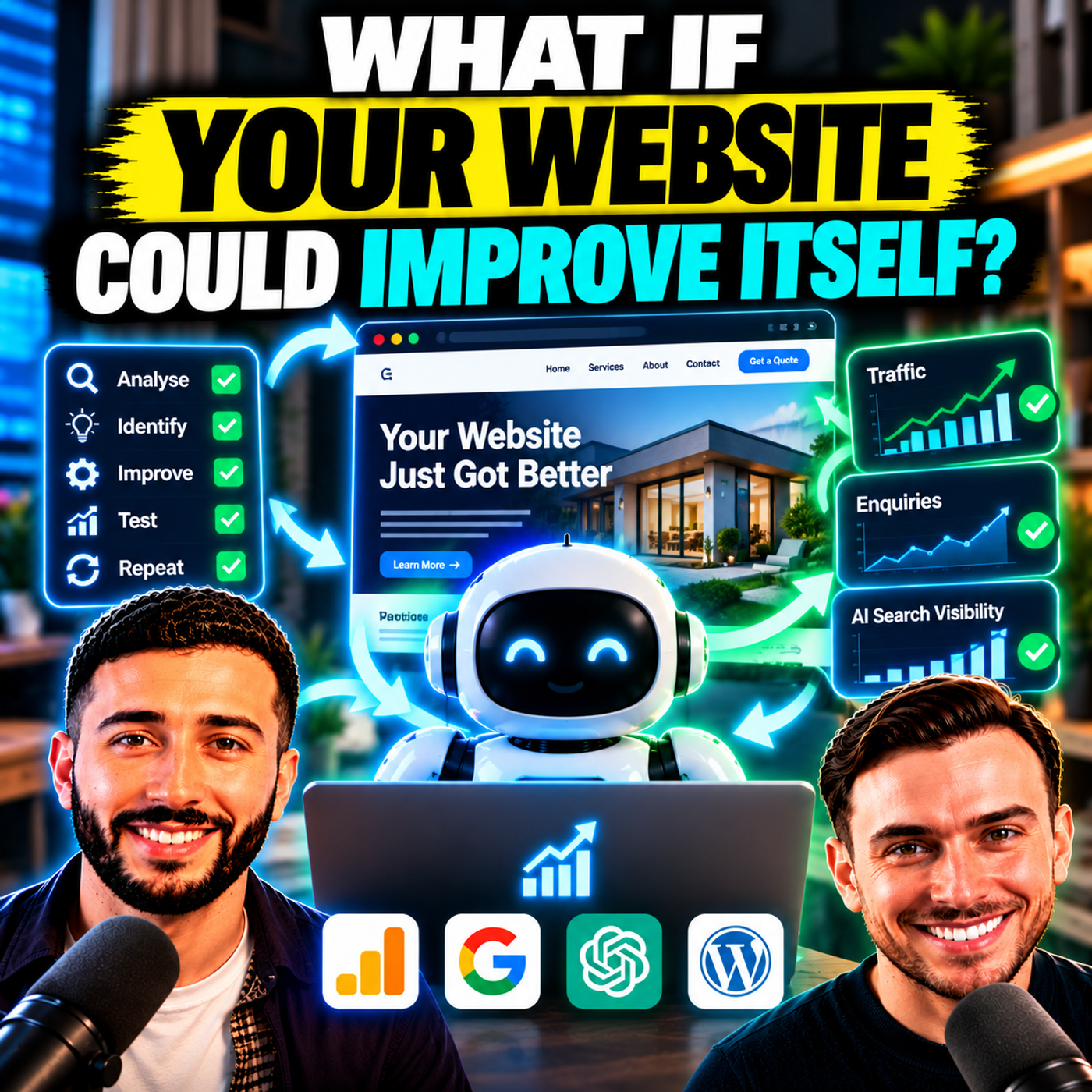
🤖 What if your website could improve itself every single day? Imagine AI monitoring your Google rankings, spotting pages that aren't generating enquiries, suggesting improvements and learning from the results. Instead of launching a website and leaving it untouched for years, what if it could keep getting better? In this episode of The AI and Marketing Podcast for Local Businesses, Adam and Josh explore self-improving websites, AI agents and MCP, and how these technologies could transform SEO, website design and lead generation. Here's what we break down 👇 🤖 What is a self-improving website? A website that uses performance data to identify opportunities, test changes and learn what works. 🔄 The improvement cycle: Analyse → Identify → Improve → Test → Learn → Repeat. Why measuring real outcomes matters more than simply making constant changes. 🔌 What is MCP? Model Context Protocol can help AI connect with tools and data, including website platforms,Google Analytics, Search Console and customer management systems. 🔍 AI-powered SEO. Could agents monitor rankings, identify content gaps, flag technical issues and propose improvements to your service pages? 📈 More enquiries, not just more traffic. AI could spot a page attracting visitors but failing to convert them, then suggest clearer calls to action, better mobile layouts or simpler forms. 🔧 A plumbing business example. We walk through how AI might analyse a boiler installation page, improve its content and test whether changes produce more qualified enquiries. 💷 Focus on revenue. The best-performing page isn't necessarily the one with the most traffic. What matters is whether it brings in valuable customers. ⚠️ What could go wrong? AI might misread data, make harmful changes or optimise for the wrong goal. We explain why approvals, testing, backups and the ability to reverse changes are essential. 🚀 How to start today. Use your existing website data to find opportunities, have AI recommend improvements and introduce automation gradually. -- 💥 Exclusive Listener Offer: Get 20% off Website Design or SEO & AI Search services when you quote PODCAST20. Website Design: [email protected] | www.websitedesigners.london SEO & AI Search: [email protected] | www.improvemysearchranking.com -- Keywords: self-improving websites, AI website optimisation, AI agents, MCP, Model Context Protocol, AI SEO, automated SEO, local SEO, conversion rate optimisation, Google Search Console, AI marketing, website lead generation, future of websites.
Adam: Imagine launching a website that doesn't just sit there waiting for someone to update it, but instead it starts analysing how people use it, it identifies problems, it makes improvements and then it learns from the results. Essentially a website that could potentially get better every single day automatically. Josh: And imagine it doing that across your entire marketing strategy, checking your AI search visibility, analysing your website traffic, looking at what pages generate inquiries and identifying opportunities to improve. Not just giving you a report, but actually helping implement those changes. Adam: So in the era of AI agents and something called an MCP or an API, we're getting closer to making this possible. We've already seen AI go from writing content to building entire websites in a few clicks. The next stage could be AI autonomously, continuously improving the website it's built. Josh: Which raises a pretty interesting question. If a website can analyse itself, improve itself and learn from the results, could we eventually build websites that never stop getting better? Adam: Today we're exploring the extremely exciting concept of the recursively improving website. How AI and MCPs could make it possible and what it might mean for your local business. Welcome back to the AI and Marketing Podcast for Local Businesses, the show that gives you practical proven marketing advice to help you grow your business right here in the UK. My name's Adam. I'm a best-selling Amazon published author, an AI enthusiast, an AI presenter and a founder. Of www.website designers.london. We've helped businesses generate tens of millions online through smarter design and marketing. Josh: I'm Josh, I'm the founder of ImprovemysearchRanking.com, a specialist SEO and AI search agency based in London and three-time winner of the UK search awards. Over the past 10 years, we've worked with well over a thousand businesses helping them generate over 200 million pounds in sales. Adam: We've spoken before about AI website builders and how easy and quickly you can now launch a website using tools like Claude and Lovable, etc. Today we're doing something a little different in that we're showing you and explaining quite simply how you can really quickly build a website and intelligently but automatically, autonomously, let that website improve after it's launched. Josh: Exactly, because when you launch your website, even if you're very happy with it on that day, it's never really finished. Your competition your competitors kind of do new things, your customers change behaviours, Google changes, AI search changes, business changes. So traditionally someone needs to keep reviewing all that and deciding what needs to what you need to improve on your website. But what if instead AI could handle much of that and work on that continuous improvement process for you? Adam: So, what is a recursively sorry, recursively improving website? So let's start with the terminology because recursively improving website, it sounds a bit technical, but the concept's simple. So think about this. Imagine your website collects information of how it's performing. So think about the analytics in Google Analytics, the clicks, the impressions, and then it uses that information to identify areas for improvement. Then it makes those improvements, tests those improvements, and then learns from the outcome. And then just keeps repeating and repeating and repeating. Josh: So let's have a think about an example. So imagine you are a a local electrician. Your website's getting a thousand visitors a month and you're generating about 20 leads. So in that case, you've got a two percent conversion rate, which is pretty standard. An AI agent might identify that your main electrical service or rewiring page or EI EICR page is is getting plenty of visitors, but very few of those people are inquiring. Adam: Absolutely. So now what it does, it'll try and find out why. It might look at the user experience. It might identify that maybe the inquiry form. It's just too long, too many questions, and there's a bounce rate there. People just getting fed up and not completing it. Or perhaps they, the customer, the user, doesn't know how to to reach you. Maybe the call to action isn't obvious on the mobile. Maybe it's just not clear what you do as a service or what happens after someone contacts you. So the the idea here is that AI suggests the improvement and then improves and prepares a new version of that same page. Josh: Exactly. And then essentially you need to test that versus the original. Do an AEB test. You can work out if the new version produces more qualified inquiries, increases your conversion rate. If so, then you have evidence that the change was beneficial. And if not, you can reverse it yourself or the AI can do that for you as well. So importantly, the next improvement is informed by what happened previously. Adam: Exactly. So quite simply, it becomes a the process comes becomes an a continuous loop. So analyse, identify, improve, test, learn, repeat. Analyse, identify, improve, test, learn, repeat. It's very different from building a website where you just kind of build it, leave it alone, and then you pay for a complete redesign if you want to redesign it later on. Josh: Exactly, and there's there's an important distinction here. Just because AI makes changes doesn't mean the website is improving, however. So the system does need to continuously review the analytical data and make sure it's actually improving, otherwise these kind of continuous changes are pointless, essentially. Adam: Absolutely. Josh: So next, let's maybe touch on what an MCP is and why it matters. We've we I know we spoke about this in previous episodes, but it's probably worth bringing it up again. So one of the technologies that makes this concept interesting is MCP, which stands for model context protocol. I believe, if I'm not mistaken, that Claude or Anthropic may may have developed the original idea. Now it's kind of open source and available to for all sorts of different businesses. It's essentially a standard way of AI applications like Claude or like ChatGPT to connect with external tools, systems and data. And that's important because a website's performance information is usually spread across all sorts of different platforms. Adam: Exactly. So as I've previously mentioned, you have a Google Analytics telling you how people use a website where they're coming from in terms of countrywise or source. Search Console shows how the website performance specifically in in Google. and then a website platform controlling the actual content and design. So that might be WordPress. And then a CRM recording tool which records or records the inquiries that become customers so think about your like a hub spot or something. Normally somebody has to go into all these different systems, interpret the information and work out what to do. It's quite a investigative process. Josh: Yes, very laborous manual kind of process to review all those different places. But instead, if you could imagine an AI agent with controlled access to all of those different places, those different systems through MCPs or APIs or other types of integration, it could potentially identify trends and information. It could work out, you know, this page is getting a lot of impressions in Google, but not many clicks. Then it can look at that page's content, it could compare it versus other results that are on page one of Google now. It could link to surfer API or data for SEO API. It could analyse the guys in front of you and work out where you need to catch up. Adam: Absolutely, absolutely. So let's let's think about From f f for example, from a website design perspective, it could look at the structure of the page, the the layout and mobile experience, the different forms, maybe some accessibility needs or the loading performance, and then prepare those changes and shoot them over to website code and content. Now every platform won't have that mcp integration because it's quite a new thing so you've got a lot of companies now developing these mcps but and some of those connections will need a custom development and what what I'll say here is WordPress which is one of the most used CMSs out there at the moment I I I actually tried to to to have a little go. And so there are a couple of plugins out there you can use. However, if you if you want to kind of go official down the official route, Jetpack, which is I believe owned by the same company as as as as was WordPress, which is I think called Automatic Inc. or something like that. they have actually got their own subscription based MCP. So if you they they've got different plans, and then on a certain plan you get access to the MCP and that allows you to update the content. I don't think it allows you to update the design unless you've used a specific kind of page builder. I think it's only available for you to amend the content or design if you've used WordPress's own. I think it's called Gutenberg or you know, it's this the structure and the way the page is built and the type of model they use. So it's worth exploring. Jetpack. There are a couple of other plugins out there, but again, there are depends on what CMS you've used. Josh: elementor for WordPress as a page builder also has a brand new MCP where it's completely free. You can you can link that into Claude Adam: Fantastic. Josh: and you can ask it to redevelop, redesign your website and it can it can handle all that for you. So another quick thing just to we should probably distinguish is between MCP and web mcp, which is something Adam: Sad. Josh: we did bring up brief briefly in a previous podcast episode as well. So Just to clarify that MCP is about connecting AI applications to tools and data. So for example, Claude to data for SEO. And a web MCP is an emerging approach for websites to expose structured actions that AI agents can use. So that's you know enabling an AI agent to go to your website and book a date in the calendar for them to come to a restaurant or schedule an event of some sort. So they're they're related ideas, but not the same technology. Adam: Exactly. And an MCP doesn't automatically create a self-improving website. You'll need to build the AI agent the the various connected systems and a way to evaluate results, permissions, controls, and safeguards, and that'll be built into the AI agent. So it's the the the kind of the magic formula invol you know, making those integrations with MCPs can make it easier to organize, but the magic formula is creating this AI agent. and then having a bunch of different integrations, these MCPs. So essentially your AI platform can talk to the various different things, whether it's your your WordPress, whether it's your Elementor, whether it's your HubSpots, etc. So let's talk about a real-world example for you guys. Let's talk about imagine an AI-powered plumbing website. So imagine you're running a plumbing company in Croydon, South London. You've got a website generating about 2,000 visits a month, but you're only getting about 30 inquiries. So just over 1%. one point five percent maybe or however many percent it is conversion rate to inc into from from con to inquiries from visits. Where might an AI agent start, Josh? Josh: So it could start with the commercial data. So, you know, which pages have attracted visitors, which of those pages has generated inquiries, and most importantly, which inquiries actually turn into paying customers. So that might be through your HubSpot or CRM system, it knows which leads actually led to a sale. So in this example, perhaps it found the boiler installation page attracts fewer visitors than the general plumbing page, but actually produces significantly more valuable jobs. That might tell the AI that boiler installations deserve more attention. Adam: Absolutely. And the AI then might have a look at that boiler installation page and think, okay, look, it's the the mobile experience isn't great. Maybe the kind of main call to action isn't very visible, you've got to scroll down a lot for it, or maybe the con quotation form ask about twenty-four qualifying questions before someone can even get someone to call them back. So it'll say, look, have a simpler form and and a fair few more kind of call to actions so people can easily contact you. Josh: meanwhile, another tool in your MCP toolkit s search console might show that that page is appearing for searches like a boiler installation Bromley or Croydon or whatever keyword you're looking to pursue, but isn't generating many clicks. The agent could then review the title tag, the meta description, the on page content and competing search results, then suggest ways to make that page more relevant, more useful and and Better for the customer. Adam: Yeah. and another example it could say, look, the customers are regularly asking about time and scales of how long boiler take the boiler insulation takes, for example, and if there are financing options and then it'll say, Okay, why don't you just create an FAQ section to address those questions? and again, you're just making a significantly more helpful website. because it's based on what people are are searching for. And a a great example here is the North Cypress hyphenguide.com website that I made. I I l anonymously kinda can see the themes that people are asking for in the chat bot. And then I'll I'll look at that on a regular basis and I'll say, okay, let's create a page on I don't know, how much h Haluma cheese you can you can bring back if if any. And and I think the answer is you can't by the way. But or maybe you can, I don't know. But either way, I guess the point here is whilst that's me that's that's not really recursive automatic automated self-improvement it's just the concept of being able to understand what the user is searching for but in this case it'll automatically create those those new bits of text to answer those questions for the user Josh: Exactly. So this then the system can kind of test those changes and measures what happens over time. Did the did these updates make more people inquire or less people? Were those inquiries more qualified or less qualified? Did the business win more work or less? Because obviously ultimately that the reason of this recursively self improving website is ultimately to make the website more efficient and effective at generating the outcomes we want. Adam: Absolutely. And ultimately w when the if the changes work, well, there we go. It's just a continuous loop. The system's gonna keep learning, and then you'll have clearer pricing information, that'll improve conversion, or visitors will respond better when you know, when they can kind of book a callback rather than complete a long form that people just won't wanna do and they'll just exit from your page. Josh: Yeah, that and that visit to visitor information that's recorded in Google analytics, that information will then continuously influence future experiments. That's where that kind of rec recursive element becomes particularly interesting. The system isn't just following a fixed checklist of do this, do this, do this, and it's done. It's reviewing continuously and then using the previous results to inform what it does next. Cool. so yeah, another another kind of concept to think about is what could AI actually improve? And the opportunities extend you know well beyond just adjusting a headline or changing a little bit of text or changing a color of a button. From an SEO perspective, for example, AI could continually analyze keyword performance, identify contact gaps, review internal linking and detect technical problems. could also compare the performance of different services and different location pages for you. Adam: Absolutely. And from a web design perspective, that all that all that there's a huge amount it could look at, right? Think about the the the various different variables that are that go into making a website, whether that's the the responsiveness of of of the website, the the usability on on on mobiles, how accessible it is, how fast it loads, the navigation, broken forms etc. We've already talked about all of those. and it could make those improvements to the to the code of the website, test it, in a kind of sandbox, so in a in a test environment, which that's what a sandbox is, before it's even published. Josh: Also, another kind of obvious opportunity for AI to help have it on that is that October 1st, Google's new guidelines kind of said they are somewhat against AI content, or particularly if it's being mass produced. There's case studies for and against showing that's Adam: Mm. Josh: maybe the case or maybe not the case. And so it doesn't it I'm not saying AI content is bad, you can you can definitely use it, but always pay attention to what Google's what Google say. So AI could of course help produce content. If you if you imagine you know a business starts receiving lots of inquiries about a new service, an AI agent could then recognise that demand, investigate relevant search terms, look at the trends and suggest a dedicated new page, or it could identify existing pages that need additional, more useful information to to better serve the the content that's that will work best. Adam: Exactly. And we've already talked about the concept of I gave the example of the chat bot on North CyprusHaving Guy dot com. Customer feedback can play a role as well. If people are asking the same questions, use that information to to improve the website. Josh: Cool. was there anything you wanted to add there? No? No? No? Adam: No, Josh: Cool. Yeah, so one of the most exciting parts really is connecting all this to revenue rather than simply chasing more traffic, the system could prioritize pages and service that generate profitable customers. And that's a you know a big, big difference between a website that just attracts visitors and one that genuinely contributes to business growth. Adam: Yeah. And look every business will have a different objective. For example, with a a dentist it might be okay, let's get appointments booked. With a builder it might be let's get good, solid, serious, what they call qualified quotation requests. If you're selling something online in an e-commerce company, then you're gonna want people to to buy. So it you're gonna need to have a bespoke system so it understands exactly what does good look like, what does success look like for your business, what's your main objective, and and accordingly tweak what you're doing there. So what could go wrong? Well, it obviously it does sound like a game changer, but not to I was about to rhyme here. Sounds like a game changer, but there's obvious danger. And that doesn't rhyme. so you've got to basically think about the risks here. For example, even today, if reading in the news, a couple of financial institutions have realized that AI agents have been accessing people's accounts. So yeah, so you've got to kind of be very wary of when AI does start making changes, Are you improving the website or are you making it worse? Or does it removing something important because it thought it's hurting the conversions? But in reality, you need that that detail there. For example, if you're a solicitor, best practices to have your solicitor regulation authority number on on your website. If you're an accountant, you might want your accounting membership number. It might think, gosh, that's un not very useful. Let's remove it and then you know you get in trouble. Josh: Yeah, maybe remove all the small print. R Adam: Mm. Josh: it might remove all the small print to make conversions better. It probably would help, but then you're doing something illegal. So Adam: Yeah. Josh: that's yeah, I suppose that's where measurement and kind of human oversight, having that human in the loop are you know absolutely essential and required. And yeah, just just you need to make that sure that you're there's still a human in the loop. Because AI can if you have this AI recursively self improving website, it could make lots of changes quickly. But speed doesn't always equal quality. So you need to know whether a change is generally improving performance or if it's gonna potentially backfire and cause you problems in the in the longer run. So I'm thinking about it for smaller, smaller local businesses, this could be difficult because you may not have enough traffic to even have a statistically meaningful experiment as well. So that's something else to consider if you're only getting a few hundred visitors. Adam: Yeah. No, to your point, i if if if you if you are, then it it but even if you change something, right, and you end up saying, Okay, this is great, because I used to get three inquiries, now I get f next month you you're getting four. You could be like, well, the change that it made to that headline is it's it's that's that's the reason why it's improved website, but in reality it it's it can't it's not a exact science. You can't attribute to that that headline being the sole reason why you've got an additional inquiry. It could have been several many factor other many factors. so, you know, whether it's seasonal demand or change in type of visitors, or maybe someone referred, you know, y an extra backlink or you've been featured in the news, there's so many different variables that could have caused it. But again, just Josh: Yeah. And it's also the risk of c optimizing for the wrong thing. So the AI, your your recursive self improving AI website could discover that a free service increases inquiries. That's great for your conversion rate. Maybe you're going to get fifty more inquiries, but if it's a free service, it's not going to give you any more revenue or income and therefore maybe it's not worth doing that. So it's it's worth considering that as well. Adam: Exactly. So y this is exactly why you kind of you probably maybe you want to kind of have some some principles, some boundaries. So, you know, perhaps the AI can automatically identify the problem, give its its suggestion of what it you know, what it recommends you do, and then do a number of kind of low risk checks. But if and that you could say to it like never change anything that involves pricing or legal information or customer data or etcetera always require my input to do so. And another reason why you might want to do that is could cost you a lot of credits if you're using Claude, you know, and it goes keep credits going round and round and making a lot of changes. I've I've made that mistake recently. I've spent so much using, you know, cowork and and and agents and it just seeking perfection, but it sometimes does go into a bit of a loop and involves a lot of credits, which is the way cowork kind of charges you or Claude charges you. Josh: Yeah. So yeah, on those on those important points about pricing guarantees, legal information, customer data, all that kind of stuff. You if if the AI recursive improvement system does something wrong, you do need a proper rollback system in place. So if something you know does go wrong, you can restore and revert back to the previous version quickly. So the objective shouldn't be maximum automation at any cost. It should be continuous improvement with continued risk, controlled risk, sorry. Adam: Okay, absolutely. So let's let's bring this back to to our listeners here. So if you've listened to this, you're like, okay, now what? So what? How can we how can we crack on and start today? I love the sound of this. you might be thinking, well, I don't have a developer, I don't have an AI engineering team, I'm not really familiar with all this. How can how can we start, Josh? Josh: say start with the data you already have. So you may, I'm sure a lot of you listening are very savvy business owners. So you probably have Google Analytics setup, Google Search Console, some sort of CRM system like HubSpot and or website inquiry system. Just link all those systems up into into Claude in or into into chat GPT. So you can then use AI to analyze that information and identify opportunities for you to pursue going forward. I'd yeah. Basically from that data, the AI could recommend based on data what it feels are the best actions moving forward, rather than having a some sort of recursive system. That's a that's a nice, easy starting point. Adam: Absolutely. Then you can introduce some sort of AI assisted implementation. So for example, ask it to prepare a better page layout, simplify an inquiry form or draft a clearer explanation of a service. You then as a human in the loop, review the change, check you're happy with everything, test it before you hit that live button and and happy days. And then next, Josh, what do we do? Josh: Next next you could kind of look to introduce a proper measurement process. So you can you know record what's changed, when it changed, why you changed it and what happened after that change was made. So this creates a history of experiments that AI can then learn on learn from going forward. Adam: Absolutely, absolutely. and then once you've established a process, then you could start thinking about automating some of those lower risk tasks, and a check for broken links, tech technical performance being monitored, checking pages that are kind of maybe you created a long time ago that you might want to refresh. you don't need to kind of give full control to to get some of the benefit here. Josh: Yeah, and I'd focus on the biggest commercial opportunities first. So if your website's generating fifty inquiries a month, improving your conversion rate process might be far more valuable than automatically generating another thousand blog posts. So start with improvements most likely to affect customers and revenue for your business. Adam: So yeah. So f final takeaways here. So the big question is will websites eventually improve themselves? that is a question we need to answer here. And I think I absolutely ha feel like I I mean i even in the past two weeks I've used a lot of AI to to really help improve websites. So I definitely think we're moving towards that more dynamic, intelligent, kind of responsiveness to comp custom behaviour, but also what good looks like. And as these t tools become more available and more user friendly and and smarter, I think the amount of manual input we'll need to to to kind of maintain and improve a website will will just be a short amount of time, it'll be so much easier to do so. Josh: I think s one of the biggest opportunities is the the feedback loop. So analysing performance, identifying opportunities, making improvements, measuring the outcomes, learning from the results, repeat, repeat, repeat. That's what makes this recursive website self improvement system so powerful. Adam: Agree. So, if you think about the traditional approach to a building a website, you launch and then you just cross your fingers and then a few years later be like, okay, well maybe it looks a bit dated now, let's let's let's redo it. This approach that we've talked to you guys about, it just treats it as a living, breathing project evolving all the time. Josh: exciting thing is that you don't necessarily need to wait for some futuristic AI technology to start because actually it's already here and you can start building parts of this process today, even the very basics of it. And the challenge is then just simply connecting systems, measuring results properly and deciding how much autonomy you're comfortable giving AI. Adam: So I guess we we can end this by saying perhaps it's not all about building a perfect website on day one at all. Josh: Yeah, it's just about building a website that's designed to continuously improve. Adam: Absolutely. that's it for today's episode. But please do give us a little comment, let us know what you think. please do hit that follow button as well because it helps us continue doing what we're doing. Give us those five stars. We really appreciate that. And we'll see you at the next episode. Thank you.
More The AI & Marketing Podcast for Local Businesses episodes →