
The AI & Marketing Podcast for Local Businesses · The AI & Marketing Podcast for Local Businesses
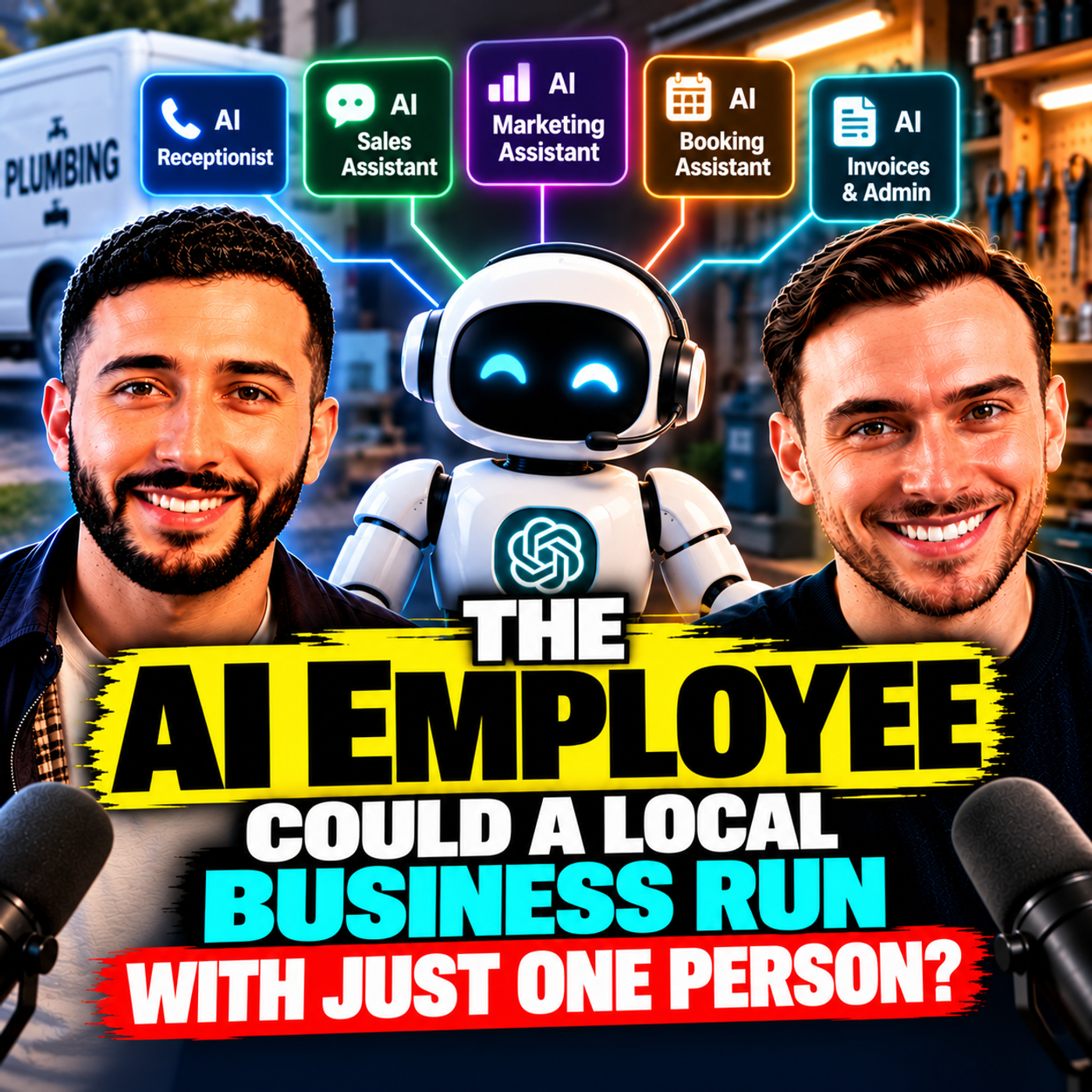
🤖 Could AI replace 10 employees and allow you to run a £1 million business completely on your own? Imagine having an AI receptionist answering your calls, an AI sales assistant following up with customers, an AI administrator managing appointments and invoices, and an AI marketing assistant generating new business. All working alongside you, without hiring a traditional team. Is the one-person business powered by AI becoming a reality? And what does this mean for the future of employment? In this episode of The AI and Marketing Podcast for Local Businesses, Adam and Josh explore the rise of AI employees, how AI agents could transform everyday business operations, and whether small businesses could eventually achieve the results of much larger organisations with significantly fewer people. Here's what we break down 👇 🤖 What exactly is an AI employee? We explain how AI agents differ from traditional ChatGPT conversations and how they can carry out tasks, access business systems and complete multi-step workflows. 📞 The AI receptionist that never misses a call. Imagine being a plumber working on a job while AI answers enquiries, gathers customer details, checks availability and books appointments. 👥 Five AI employees every small business could use. We explore AI receptionists, administrators, customer service assistants, sales assistants and marketing assistants, including how they could work together. 💰 Could one person really run a £1 million business? We examine which industries could benefit most, why digital businesses may have an advantage, and the important difference between revenue and profit. 📈 Growing your business without growing your workforce. Could AI help businesses handle more customers, increase productivity and improve profitability without increasing staffing costs at the same rate? 🔄 From individual tasks to entire workflows. Discover how AI agents could capture an enquiry, update your CRM, prepare a quotation, arrange an appointment and follow up with the customer. 🔐 What happens when AI gets something wrong? From incorrect quotations and double-booked appointments to exposing confidential information, we explore the importance of permissions, safeguards and human approval. 🚀 Will AI replace employees or make them more productive? We debate whether the future belongs to one-person businesses or smaller teams using AI to achieve what previously required much larger workforces. -- 💥 Exclusive Listener Offer: Get 20% off Website Design or SEO & AI Search services when you quote PODCAST20. Website Design: [email protected] | www.websitedesigners.london SEO & AI Search: [email protected] | www.improvemysearchranking.com -- Keywords: AI employees, AI agents, AI receptionist, AI sales assistant, AI automation, one-person business, AI workforce, AI replacing jobs, AI business automation, ChatGPT agents, AI customer service, AI marketing, business productivity, small business AI, future of work, AI for local...
Adam: Imagine running a business with 10 employees, but turning over 100 million. You've got someone answering the phones, someone handling inquiries, someone booking appointments, managing and marketing and chasing invoices. Now imagine replacing much of that administrative work with AI, not just say chat GPT and answering a question or two, but an actual AI agent carrying out all those tasks on your behalf. Josh: Imagine what that could mean for a small business like your own. You could have AI receptionists answering calls while you're out working, an AI assistant following up on inquiries, an AI marketing assistant preparing your social media posts and analysing advertising, and some sort of AI administrator organizing your daily diary quotations, invoices. Adam: So I know you probably have seen some of this on a sci-fi movie or anything like that, but today that exists. You can do that today. Those individual capabilities exist today. the most effective, or the question, the interesting question here is how effectively you can get them to talk with one another and get them to connect. So could one person then eventually operate a business? that previously needed maybe 5, 10, 15 employees. Josh: Another thing to think about is, would that actually be a good thing for humanity, for for business, for for for our day-to-day lives? would customers have a better service? Would businesses become more more profitable? Or would we just end up with thousands of thousands of businesses where you never speak into a human and there's all sorts of AI slop going on everywhere? Adam: Robots taking over. Today we're exploring the AI employee, the rise of a one person business powered by AI and what this can mean for your local business over the next few years. Welcome back to the AI and Marketing podcast for local businesses. The show that gives you practical proven marketing advice to help you grow your business right here in the UK. My name's Adam. I'm a bestselling Amazon published author. an AI enthusiast and AI presenter and founder of www.websitedesigners.london. Josh: Shosh, I'm the founder of ImprovemysearchRanking.com, an AI search and SEO agency based in London, and three-time winner of the UK Search Awards. We've worked with well over a thousand customers and generated in excess of 200 million pounds for our clients. Adam: So we've previously explored how AI can build websites and even AI agents might be able to recursively improve and continuously improve those websites. Today, we're going to be taking that concept beyond marketing. What happens when AI starts performing the roles that you traditionally would hire someone out for? Josh: This particularly interesting for small local service-based businesses because a lot of business owners aren't just doing the work they're paid to do. They're also answering the phone, chasing payments, sending quotations, booking appointments and trying to find the time to do their marketing and advertising. What if AI could take a meaningful proportion of that work off their hands? Adam: So before we get into it, this is happening today. Just this week, and today is the 24th of October, 2026, just this week, Barclays Bank announced 5,000 people being laid off because of AI. Enterprises, multinational companies, and other companies are implementing this today. It is happening. So. With that being said, what's the difference between say a chat GPT or Claude and an AI employee? First, I think we need to think about how those differ. So most people are familiar with asking your chat GPT or your Claude to write an email or produce perhaps some marketing graphic. But an AI agent takes that 10 steps further. It can be given a goal. You can connect tools. retrieve information from the different tools and carry out a sequence of actions on your behalf. Josh: So rather than, as you just alluded to, asking ChatGPT to write you a simple follow-up email, the agent could potentially be checking your CRM system every morning, identifying inquiries that haven't been followed up with, prepares appropriate messages, depending on the permissions that you've given it, and then either sends an email to follow up with that individual or asks your approval before doing so, and then also records the outcome. Adam: Absolutely. So that's the big difference here. An AI agent will pause and ask for you to give it another prompt. It's essentially a question, answer, question, answer. Whereas an AI agent can be configured to respond to a series of events and carry out either a scheduled or unscheduled workflow. So for example, if we think about, if we think about something in between, which is the likes of cowork Instead of the chatbot where it's a question and answer, then co-work would sit somewhere in between that AI agent and the chatbot, whereas it will connect to a various different kind of tools and then perform that series of actions. Whereas an AI agent can almost be a specific persona. So for example, when an inquiry comes in, the system automatically creates a CRM record, checks availability and offers the customer an appointment. Mind blown. Josh: I suppose an important thing to think about here as well is that these AI agents aren't necessarily going to replace people entirely. It could just replace certain parts of a job or, you know, certain tedious activities you don't want be doing. So instead of those ten boring tasks you need to do chasing up invoices or suppliers, you can save two, three, four, five hours of your own time. And that's where there's some immediate value with these AI agents can come in. Adam: And I would slightly argue against that in that I actually think... It could I'm more bullish, right? We talked Josh and I just talked about, for example, an AI receptionist. So, you might've seen on, on Instagram or social media, lots of companies now creating these AI agents. So instead of having a receptionist answer the phone, you have an AI and you might've received a cold call from one actually, where it's a, it sounds like a real person, but it's an AI agent. And depending on what your response is, it will give you a different response of, of. of how it deals with you talking to it. So I'm a bit more bullish, but what we're saying here is it can at least save you a few hours, if not, in my view, replace people. Josh: Yeah, exactly. So let's let's think about a an example. So imagine that you are a self employed plumber based in South London. You're really, really good at what you do. You're an excellent plumber, but you're terrible at answering your phone because normally you're under someone's sink or you're you're doing some sort of manual task actually doing the work that you're being paid for. Every missed call could be a potential missed customer. Adam: Absolutely. So I already touched on this, but your first AI employee could be that receptionist. So picture this, someone calls an AI voice system answers. You can say I'm a virtual assistant. doesn't, mean, probably ethically might be helpful if you want it to, but it would say, Hey, I'm a virtual assistant. Tell me what the problem is. And I'll gather the information you need. We've all been there where we're calling a bank, for example. And it will say, please tell me your 10 digit customer, your customer number, for example. This is taking it just a few steps further, right? It's not just customer number. You can say to it, I don't have my customer number. I've left it upstairs. Could you bear with me one moment whilst I get to it? And then it will understand that and it say, sure, I'll wait for you. Instead of saying, I did not recognize that. Please try again. So it's really taking to be able to understand and provide a meaningful response. So if we go back to this example here of the plumber, Someone calls an AI voice system answers, explains that it's a virtual assistant, optional, asks what the problem is, then gathers the information required. It might ask whether there's a leak, where the customer's located and whether the situation is urgent. And then it will say, okay, you know, it might even give a quote and say that this will be between X 50 and 500 pounds. That's a wide range, but just for argument's sake, I don't know, 300 and 500 pounds, depending on how severe the situation is, but. we'll be able to give you an accurate estimate when we arrive then it will check the plumber's calendar offer an available appointment if the person is keen to progress. Josh: Yeah, this is super, super valuable for a number of reasons, but one of the most valuable reasons, in my opinion, is is what's marketing people call speed to lead. How quickly do you get back to your lead? So if you have an inquiry come in and it takes you twenty-four hours, forty-eight hours a week to get back to somebody, the likelihood of them converting into an in into a sale is very, very low. The s the faster you get back to somebody, the more likely they are to turn into the sale because at the moment when they inquired, there was obviously in the market, they were actively searching and they wanted that solution to their problem. So they're not gonna wait hours for you to call back. If you have this AI assistant, that's gonna really, really, really be helpful. Adam: Absolutely, and ultimately you're capturing that appointment. The system sends a kind of the customer confirmation, it adds the appointment to the calendar, provides a partner with a summary, and then after the job you can just prepare an invoice and then send an appropriate payment reminder and ask the customer for feedback just for your Google reviews. Josh: Exactly, yeah. And we haven't even discussed things like marketing yet. AI could could turn after that job is completed, turn that job into a case study, draft social media content, monitor the performance of it, identify ideas to attract other customers going forward. So the plumber can focus on plumbing while the AI agents handle those administrative tasks. Adam: Absolutely. Now we have to be careful here because if the AI promises the customer you'll arrive at 9 a.m. but you're already booked until midday because there's some sort of glitch or you've forgotten to update your calendar or something then you're to be letting people down. you need to make sure there's accurate information, do lots of testing, reliably integrate different systems whether you're using calendarly for your work and then something else for your personal life. Make sure you can change those settings in calendarly. to ensure that you're blocking out that calendar, that you're blocking out the time for your personal things as well, for example, and also set those boundaries and the parameters that you don't want the AI to exceed. So let's move on. So let's think about if we had five AI employees, what could those employees be for your business? So if we're designing that virtual team for a local business, I'd start with these five roles. Number one, I'd go AI receptionist to handle any income inbound calls, appointment requests, inquiries. Then I'd create a AI admin that manages scheduling, reminders and paperwork. My third one would be... an AI customer service assistant that will filter out any FAQs, frequently asked questions and direct any more complex issues that can be escalated to a person, a human. How about you, Josh? Josh: Yeah. So yeah, to add to that, probably we'd have a AI sales assistant of some sort who could in who could kind of monitor incoming leads, organise follow ups, prepare quotes, that kind of stuff. And then maybe finally an AI marketing assistant, which could from an SEA standpoint, maybe do some keyword research, it could do some social media posting, email campaigns, all that all that kind of stuff. Adam: Absolutely. And what's interesting here, you can get those agents to work together. So a customer contacts the AI reception, the inquiry gets recorded in the CRM, the sales assistant prepares a quotation, administrative assistant schedules the appointment, customer service assistant handles the routine. Just one beautiful loop. Josh: Yeah. But it's one thing we should be careful about is that these five agents aren't, in my opinion, the equivalent to five experienced employees. They're obviously high quality and they do they do their job well, but a human receptionist might recognize things that an AI agent may not, for example, if a customer sounded distressed. A a real salesperson with experience might spot an unusual opportunity. A marketing manager might think of a more creative way that isn't obvious from the data to to to improve your advertising. And yeah, AI can certainly support all of these workflows and do and do a very good job. And particularly if you're a small business, this is a very cheap and effective way of doing so. But it doesn't automatically mean they're better than than a human doing this job. Adam: No. Josh: So yeah, an an an interesting c thought experiment is could AI make it realistic for a one person business to generate a million pound in revenue? And yeah, I I think my my initial th thought to that question is yes, I think it's definitely possible. But it does depend on the type of business you you do. Some some would be more easy than others. May maybe you know, a high ticket consultant that could be quite an easy way of of doing this. If you're selling low ticket services, maybe maybe it would be the case. Adam: Yeah, no, I agree. I think if we're selling something like a digital service, like a training package or software, a lot of the work can be delivered using computers. So 100 % AI could help with that, whether it's the marketing or research or sales, your customer onboarding, even... helping to deliver some of the service. But if you're more of a hands-on physical based service provider, plumber, electrician, baker, you're going to have to have somebody do the work, right? Yeah. Josh: Yeah, yeah. I suppose there's a difference between a million pound business as well in terms of revenue and profit. If you're making a million pound in revenue, that's not necessarily doesn't mean you're being profitable. But with these AI agents, would it make a business more profitable? Possibly, yes, because that may may have less overhead, less less staff and just more efficient business Adam: Yeah. Josh: as a whole. Adam: No, agree, agree. I guess if we think about opportunity here. If your business has five people that can serve as many customers as much as a company that has 50 employees, happy days. Instead of having your workers or employees kind of have to do those more menial administrative things that people might not want to do in the company as a business grows, your AI can handle more of that repetitive administrative mind numbing workload. Josh: Yeah, absolutely. Absolutely. So w yeah, an another kind of thing to to consider is about would customers of a business actually want to deal with AI? What what's your thoughts on that, Adam? Adam: That's a great question. Now, personally, I know we talked about this offline, but personally, I feel like AI is getting significantly better in that, scarily better in that there are times when I can't even tell when, and when I'm getting a call from AI to the extent, and I feel like I'm quite clued up in the industry. So I got a cold call. a couple of weeks ago and I was just stepped out for a meeting because I thought it was an important phone call that I was waiting for. And I actually asked the person on the phone, whoever was on the phone, I said, are you an AI agent? And I mean, it wasn't, it wasn't, but the fact that I couldn't tell whether it was a human or an AI agent, that could mean the human was just not very personable or it could mean, you know, that the that I've experienced AI being that good, right? But I have experienced AI that's, I've experienced poor AI and great AI and things are only going to get better. What would you think? Josh: it from both sides of the table as well. So if would a customer want to deal with AI? Me personally, if I phoned up a business, I would prefer to speak to a human. But if they didn't have a human available, or if it's going to take them 10 hours to get back to me otherwise, then perhaps I would be happy to speak to it to an AI instead. So I guess I I I would be fine. I think a lot of older people Adam: No, yeah I agree. Josh: wouldn't like it at all. Adam: I agree. Josh: And maybe yeah, and then also I was thinking about sales AI people, I do wonder if how ethical it will be in the future when you have these kind of AI sales superstars who no know how to handle every objection and they can psychologically hypnotize you into into buying a service every time they phone you. So that that could Yeah, I don't know if that would ever be an eventuality, but that that's something to worry about. Adam: Agree. So we talk about the costs and risks about using AI. Josh: Yes. Yeah, absolutely. So these are often get overlooked in discussions because people forget that AI employees aren't free. You've got your software subscriptions, you've got the integration costs, you've got the MCPs, the APIs, the setup time and costs, the maintenance, the monitoring, making sure it's working, the the the humans in the loop, I suppose you you'd you'd want to maintain as well. So there's lots of hidden costs that people don't really think about. Adam: Agree, agree. So think about this, right? If you have an AI sales assistant that sends a quotation for 500 quid when the job costs five grand, well, you're 4.9 grand out of pocket. So, or for example, your receptionist books three customers into the same appointment slot. Again, you're gonna let two people down. Bad for your reputation, bad for business. Or imagine the AI, or sorry, the agent accidentally shares. sensitive custom information from another person. Again, there's some real risks there, so you've got to be careful. Josh: Yeah, and I suppose the more systems you connect together, the more carefully you need to manage everything and the permissions. An AI agent could read your calendar, which is, you know, one thing. but sh you know, sh should it know what you're doing at at the weekend. Adam: Hahaha Josh: and is it gonna share that with customers or something? I don't know i i c could that could that be a problem? an AI agent could issue refunds, but once it starts overdoing it and just it has a just as is figured out that makes customers happy if it does a refund, so it just refunds your last six months of of sales. So there's yeah, there's there's obviously a lot of controls you need to have on these things. Adam: 100 % and lots of testing, lots of testing. So I treat AI agents almost like a new, fresh employee with little experience. You've got to tell them exactly what you want, give them a drop spec, define what information they can and cannot access. set parameters, limits on things that they can do as well. And also, again, to your point, Josh, absolutely, those controls need to include a human in the loop. So for high risk or for tasks or things that you know are important, you might want to say, you know, get human approval first. Josh: Yeah. And as you say, it's it's y you should treat it almost like a human employee to some degree. So you need to have some measures in place to understand if they're doing a good job or not. So that might be, how many inquiries did the AI receptionists successfully capture, how many appointments were booked correctly or incorrectly, how many how much time was saved, how many errors were there. Just yeah, think about these kind of measurements you need to c consider as well. Adam: Absolutely. So will the businesses of the future have fewer employees because of the rise of AI? And that's the big, big, big question, right? Could a local business eventually be so efficient, just run it with one person and a team of AI agents? I think it's already happening today. I think, Josh, I think you previously talked about how there's a company, it's like a one-man band turning over lots of money. I don't know if you have, they to put you on the spot, but I don't know if you can remember that company name or anything. Josh: Yeah. It was a it was a US based company. It was a billion a billion dollar company. It was selling it was selling is is it GLP ones, those kind of yeah, it's like a weight Adam: Chubs. Fat lost chubs. Josh: loss weight yeah, weight loss stuff, yeah. Adam: So how many employees? Josh: think it was two, him and his brother. Adam: Two employees valued at a billion pounds. I'll just let that sink in. So for me, that answers the big question, right? Could a local business eventually just run with one person, a team of AI agents? Obviously it will depend, industry and what you're doing. Certain types of businesses, 100%, you're gonna see more kind of extremely small teams doing a huge amount of work, but that's not to say every business will be like that. Josh: Exactly. and I suppose you know the future isn't necessarily about replacing every single employee you have with AI. Instead it could be increasing the output and the productivity that each individual person can can accomplish on their own. So y definitely, yeah, there could be a one one man company that's that's doing a million pounds. But we if you had ten employees, could that mean it's a a ten million pound company? And that's something another another th thought to think about. yeah, and there's there's obviously lots of lots of benefits from A AI assistance, saving time, administration, chasing invoices, lots of benefits. Adam: great. And as I mentioned before, the tech will improve. So I think there's this huge opportunity here. So we're going to go from, Hey chat, help me draft an email to, chat, manage this entire start to end process for me. You know, organizing appointments, updating a CRM tool, preparing the next steps, et cetera. Josh: Yeah. The business owner, I suppose, still at this stage is setting the direction of the business and and what what's going to be done by the AI agents. So they need to understand the customer and you know plan everything out. But the AIs can start taking off tasks. Adam: Yeah, absolutely. So maybe you got to ask yourself here the question, it AI replacing your employees or Josh, what's the alternative question we could be asking here? Josh: Yeah, what could your business achieve if every single team member had a team of AI assistants themselves working alongside them? Adam: Exactly. So start small, spend some time to create it and be curious like every AI tool. And before you know it, you might be able to grow your business tenfold without hiring additional people. We hope you've enjoyed this episode. If you have, please do hit the follow button and the reminder button and give us a five star review because it does really help us get found. So thank you very much for listening.
More The AI & Marketing Podcast for Local Businesses episodes →