
The AI & Marketing Podcast for Local Businesses · The AI & Marketing Podcast for Local Businesses
💸 What if the cheapest AI model is actually costing your business the most money? A cheaper model might take ten attempts to complete a task, while a more expensive one gets it right first time. Add the hours spent correcting mistakes, and suddenly the cheaper option doesn't look so cheap. In this episode of The AI and Marketing Podcast for Local Businesses, Adam and Josh unpack Anthropic's research into the real cost of AI, Claude Opus 5.5's new pricing and why businesses should measure the cost of completing a task, not simply the price of an AI subscription. Here is what we break down 👇 🤖 What are you actually paying for? We explain AI models, tokens and APIs in plain English, including how usage-based pricing differs from a monthly subscription. 💰 Fresh input, output and cached input. Why AI companies charge for new information, generated answers and previously processed information that can be reused more cheaply. 🧠 Are you paying for AI's thinking time? Advanced models can perform additional reasoning before answering, and that processing can contribute to your costs. 📉 Claude Opus 5.5's price reductions. Anthropic reports 20% cheaper standard input and output tokens, plus 60% cheaper cached input reads compared with Opus 5. 🔄 The hidden cost of repeated attempts. Every correction and retry can increase processing costs. A cheap first response does not necessarily mean a cheap completed task. ⚡ When paying more saves money. A more capable model may complete complex work with fewer mistakes, while a simpler model may be sufficient for straightforward administration. 🧩 Why reasoning effort matters. We explain low, medium and high reasoning settings, and when additional thinking could prevent expensive mistakes. ✅ Why AI should check its own work. Testing website functionality, checking calculations and verifying content can catch errors before they reach you. ⏳ Your time is the biggest hidden cost. If AI generates something in 30 seconds but you spend an hour correcting it, are you really saving money? 🏢 Five practical ways to reduce AI costs. Give better instructions, choose the right model, introduce useful checks, reuse information and measure the finished outcome. 🎯 The biggest takeaway Stop asking: "How much does this AI model cost?" Start asking: "How much does it cost to get the job done properly?" The cheapest AI model is not necessarily the most cost-effective. Measure the total cost of completing the task, including AI usage, repeated attempts and your own time. -- 💥 Exclusive Listener Offer: Get 20% off Website Design or SEO & AI Search services when you quote PODCAST20. Website Design: [email protected] | www.websitedesigners.london SEO & AI Search: [email protected] | www.improvemysearchranking.com -- 📚 Anthropic research: https://claude.com/blog/what-a-task-costs-on-opus-5-5 -- Keywords: AI costs, Claude Opus 5.5, Anthropic, AI pricing, AI productivity, ChatGPT vs Claude, AI tokens, cached input, AI...
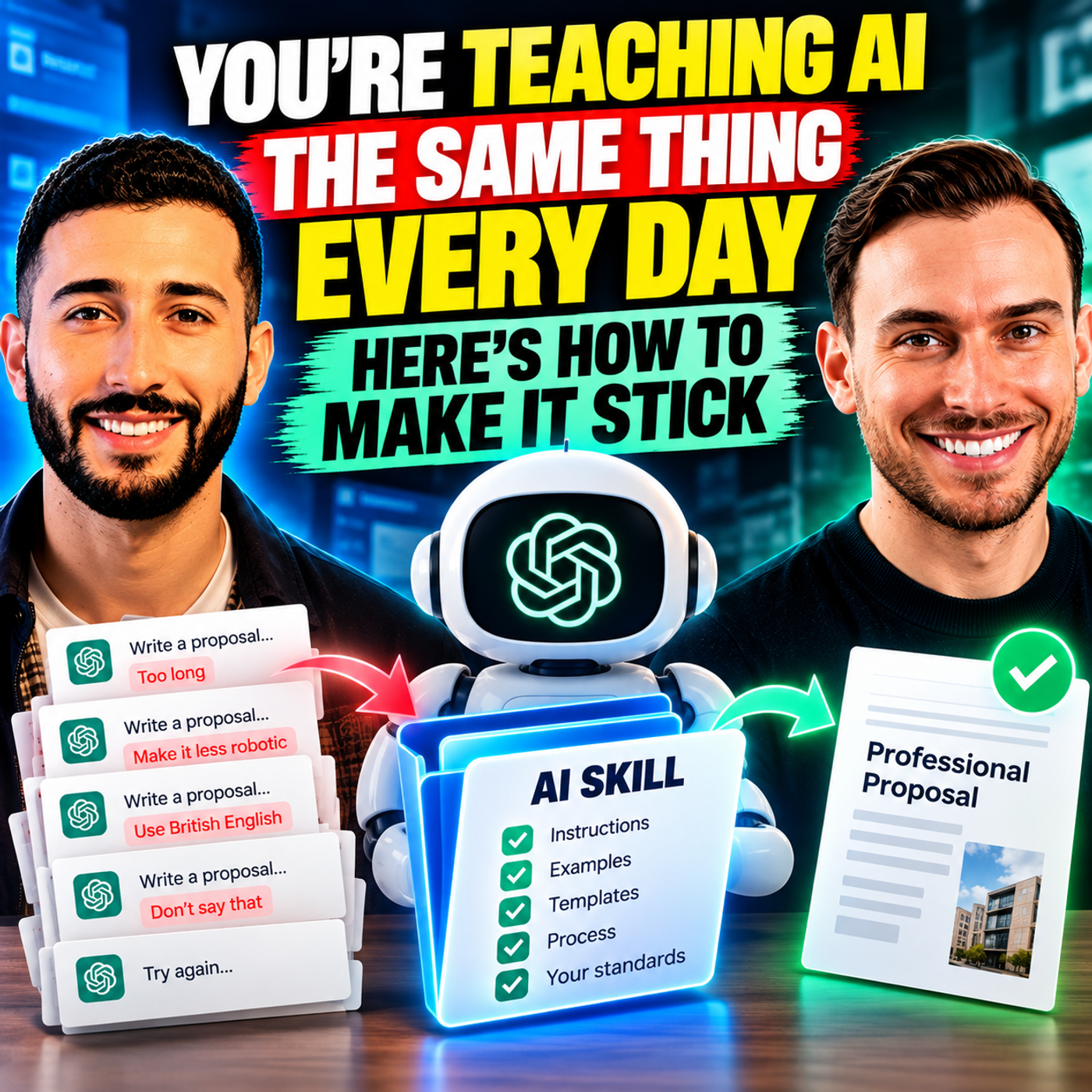
Adam: Josh, have you ever asked ChatGPT or Claw to do something where you've got an answer, you didn't really like it, and then you had to spend the next ten minutes going back and forth and correcting it? Josh: Absolutely, yeah. Pretty much everyone listening to this has done that. Adam: Yeah, and y some of the kind of prompts that I tend to use are, you know, sound less robotic, don't use dashes, use British English, not American English. That's too long. Be more punchy. That's not how I would speak to customers. This is my tone and I'd attach a kind of document there. Josh: And then the next day you come back, you do a similar prompt, and you ask it to do the same things over and over again, those same specific improvements, and you're asking it to do it time and time again. Adam: Yeah, spot on. And and to be fair, now imagine a member of staff doing that. So you show them how to prepare a proposal on a Monday and Tuesday you have to explain the whole thing again. By Friday you're thinking, Well, I probably could have just done that myself instead of spending the time to explain that. Josh: This is probably how a lot of business owners feel at the moment about their use of AI. Adam: So, and today we're gonna package this up. You can package those instructions up in fact and reuse them and we're gonna explain how to do that. It's called the AI skill or an AI skill. You can create one for how you write a proposal, you respond to an inquiry, how you prepare socials or your posts for your socials, and even put together a podcast like this to be fair. Josh: Instead of constantly correcting AI, you can give it a process die. Adam: Absolutely. And the the kind of really interesting part for me is, you know, creating that skill forces you to explain how your business does things. So it's it's quite a reflective thing. and sometimes that's where you kind of discover a problem. So you're asking AI to follow a process that really is only in your mind and not written down anywhere. Josh: So how can you get that process out of your head and into Chat GPT or Claude? Adam: And today we're covering exactly that, what a skill actually is, how to create a skill, how to avoid building a skill that confidently repeats your mistake. So with that being said, welcome back to the AI in marketing podcast for local businesses, the show that gives you practical, proven marketing advice to help you grow your business right here in the UK. My name's Adam. I'm a best selling Amazon published author, an AI enthusiast and AI presenter. and founder of www dot website, designers dot London. We've helped businesses generate tens of millions of pounds online through smarter design and marketing. Josh: My name's Josh. I'm the founder of Improvemysearanking.com, an SEO and AI search agency based in South London and three time winner of the UK search awards. Over the past ten years, we've worked with well over a thousand businesses helping them generate in excess of two hundred million pounds in sales. Adam: So let's talk about firstly how and why do we have to keep correcting AI and going back and forth. Some people it can be super, super frustrating. I've had people approach me and want to, you know, smack my head against the wall of how frustrating it is going back and forth. business, I mean, as a business owner, you often give AI a task without explaining your kind of wider standards or your context or or even the persona you're trying to assimilate. So for example, if you say to to ChatGPT or Claude, write a proposal, that does leave a lot of unanswered questions. You know, what do you sell? Who is a customer? What information must be included? What can you promise? What should a finished proposal look like? Is it a PDF, a PowerPoint, etc. And obviously AI does fill the gap where it doesn't have the information. It just assumes and that's the way AI works. and the owner then spends that time undoing those assumptions. And sometimes it can it might feel obvious to you, you know, why on earth didn't AI pick this up, but AI needs them to be explicit. And we've already talked about creating going into your settings, I think in a previous episode and having the ability to change what they call the personalization or its memory where you can add a few things about yourself, but this goes one step beyond that and it specifically can target a specific task. So that's the interesting and and exciting bit about this. Josh: Yes, let's think about this from a business's point of view as well. So imagine instead of using AI, you've just c hired a new member of staff and you know compare the prompt you're giving AI to the prompt that you're giving your new member of staff. It's all about precision, it's all about context. If you're not giving AI that information or your new member of staff, how would you expect them to produce the result that you want? A vague brief is always going to produce work that needs greater supervision and back and forth. So you need to be super, super precise with the with your language and what you essentially want to get out of the out of the prompt. If you're always making the same correction over and over and over again with your employees or even with AI, then it makes sense to build those corrections into the prompt in the first place, into the instruction so it doesn't output that issue up front. And I suppose also from a business's point of view You have different types of staff. You might have a marketing team, you might have a HR team, you might have different elements of the business. You don't give the same person the same prompts for the variety of different services or that you offer in the business. You should probably have separate rules, separate processes, separate members of staff, separate AI agents, bots for the for those different things. Adam: Absolutely, absolutely. So think about your three most frequent AI corrections that you often ask the LLMU use. And those corrections are a great starting point for creating a skill. So let's just break this down. What on earth is a skill in AI world? But let's break this down in normal kind of lay English here. So a skill is essentially a reusable package of instructions. and supporting material for a particular job. So think of a business instruction manual, for example. So it lists out when to use it, what information is needed, what steps do you follow, and what does a good result look like? And finally, what should the review look like of that finished piece of work? That can be templates, reference documents, you can include those sorts of documents in the skill as well. procedures and and policies, or and and SOPS, Josh's favorite acronym. You know, you can include SOPs in there. standard is it standard operating procedures, Josh? Yeah. Josh: Yes, yes. Adam: and look, simple skills can rely on on writ on written instructions. More advanced skills, they can actually include small programs that can carry out particular steps. And we get into the territory of agents, but we won't go there. Josh: A wonderful reference for everybody, I think, is to look at Michael Gerber's book The E Myth Revisited, which is a very old book, it's probably written twenty years ago and it's all about processes, SOPs. And that knowledge in that book will help you write better prompts and use AI in a more efficient manner and also help you develop that business manual and run your business in a in a better way too. So side note. so with regards to skills, what is the kind of everyday benefit? of these skills and it is quite simple. You might get new customers all the time, but the method for preparing their proposals or the service that you offer will stay broadly consistent. And therefore this skill can be repeated over and over and over again with a one time setup. You simply provide the skill with the new information. the new customers information. For example, with an SEO agency, we might need to input their keywords, we might need to input some information about their business. And then it could the skill could then run with the next action in in the process. Adam: Absolutely. I've this is genuinely real, by the way. and I'm not sure this is Josh yet. Right now, as we speak, I have a skill running in Claude. because I've I've just developed this new site, askBritain.org, and I want to rank for it. right, I want the site to rank organically. And so I've actually created a skill whereby it scrapes keywords from Google and from a and and from one of Josh's favourites tools called data for SEO, identifying the volume of traffic and the difficulty of traffic for a respective keyword, then it kind of does essentially what they call keyword research, identifies the keywords that I can target, and then it creates it and then I I've asked it to look at look at who's ranking number one for that particular keyword. How many words do they have? What does it look like in terms of the the page or the the whether it's an article or post, whatever? And I want you to replicate that and do that for every single keyword. So and Josh, I mean, how long will that typically take you to do? For example, roughly? Josh: If it was done manually, I mean doing the research, finding the keywords, writing the content, uploading the content, all that, it would take hours. It would take hours to do that. Adam: There we go. Look, and all I all I've asked it to do is to stop at various points and I review it and I say continue. and I I imagine I'll probably be done in a couple of hours. As in, not of my time, but it will take a couple of hours for the for the for that to complete. My time wise, I mean what if it if it stops about nine to ten times because I've asked it to I type in the word continue and I spend two minutes reviewing what it's produced. What, 20 minutes? But I've created like a couple of hundred pages that I then upload to my website. Mind blowing. So that is a great example of a of a skill. And we're gonna give you guys more examples of how you can create skills. so look, I I do want to distinguish here though. There is a difference between a long prompt and a skill. A long prompt or a prompt or a saved prompt is often adequate for a more of a simple task. Okay. So things like top five news articles today in the world of AI. I've I've got a prompt that I scheduled again every single day, every single weekday, that then says, Give me the top five news thing, news articles in the world of AI. that's a great simple prompt that you can repeat. You can schedule even. A skill that a skill organizes a more complete process alongside examples, resources, with a description of when it applies as well. And you can bring in to a chat. For example, the way I do it is I start a new chat and in Claude, for example, and a lot of other tools, I think like Copilot as well. You just do a forward slash and then it brings up all your skills. So then you can type the skill you want to bring into the chat and you'll say. User skill to blah, blah, blah, blah, to create whatever, an SOP for my new team member or something like that. So the benefit is whether it makes repeated work easier and more consistent. That is what the skill brings. And giving AI a skill doesn't permanently retrain, obviously, the underlying model, the underlying LLM or guarantee. It will obviously follow every instruction. You still need that human in the loop to review. i.e., review your work. So let's use this podcast as an example, right? The podcast is a very specific format. We could probably create a skill for it. We probably should. But what I've found is because we've created a project, well, I've created a project in my chat GPT, and it really remembers the the format, what I like, what I don't like when I create an episode. So I haven't needed to so far, but again, it is a Quite a simple task. But if I added, and and I always bring the topics to to chat, but if I wanted chat to go through the whole process of research the top things in the world of AI and marketing, then give me the then produce the top five, then find out which one's gonna be the most helpful for our listeners, and then find you know, if I gave it multiple things to do, then I'd probably create a skill. So that's a great example of Of of Of creating a prompt versus a skill. Josh: So if we were to develop a skill, perhaps what we could give it, thinking out loud, would be firstly maybe a set of rules and source about you know the sources, the factual claims, the use of language. Perhaps we would give it a detailed description of our target market, our target audience. We'd give it numerous examples of sh of strong hooks and potentially previous episodes so it can understand the way we speak and type of language you want to use. And also, as you mentioned, the s specific format we have, we always use the exact same introduction, so we'd o of course need to provide the skill with that exact introduction so it could reuse it each and every time. Adam: Absolutely. So Josh, I'm gonna I'm gonna ask you a question here. which skill should you create first? What if if I were if I were to to kind of give you that, where where would you suggest our listeners as listening? I appreciate I've I'm probably skipping a bit here. So Josh is like what what you're you're skipping a chunk of stuff text here, but what what skill should you create would you would you suggest our listeners create first? Josh: Yeah, f I suppose first and foremost you need to I would pick something you do time and time again that you understand really well, that you perhaps already have a detailed process outlined already. So in that case, you already got SOP, you've got the process from start to finish, you can create a skill around that. You can then run the skill and you can review it easily so you can recognise if the the result is good or bad. And you could start off by asking it to do kind of a draft version. So in my business, what we could do is we we run competitive analysis for all of our clients. So we might work with a new customer, they want to go after keyword X. We would then create a skill for this competitive analysis. So we'd take keyword X, we'd then run data for SEO API, review who's on page one of Google for that, what's the average word count, what's the you know see how many heading tags do they have, what are they, what's the title tag, what's the method description, what's the most common use of words, how many backlinks do they have, what's their domain authority, get all this information. So currently we well well, previously we could do this manually, somewhat easily with different SEO tools, but now with AI you could create a skill that does this automatically and then saves everybody the time and effort. Adam: Absolutely. Absolutely. okay, let's let's think about potential our potential listeners here. So let's think about estate agents. What what what how could they use a skill? Josh: Yeah, a skill estate agent, of course, they're selling houses most of the time or letting out houses. So they could get information from their prospective new client, or when they turn up they they'd write notes, take photos, how many bedrooms, how many bathrooms, how big is each room, measurements, all this kind of information. They could then use an AI skill to automatically take their notes and publish them on their website with the photos and with all the Relevant information. That could be one example. Adam: Yeah. Tradesperson, they could preparing an inquiry reply and identifying missing job details, for example. A restaurant could create social media posts from an approved menu that they've just upload and about their current offers. an agency, any sort of agency could turn their meeting notes into a client update, just use AI to transcribe the meeting, then pop the AI. You should even try and connect it with some sort of MCP API, but We won't go into that too much. MCP model context protocol API. I can't remember what that stands for, the top of my head, but it's a sort of MCP where you can connect two tools together, connect the transcription notes from the meeting, pop it into it, feeds your LLM, and then it can provide a client update. Look at that magic. a retailer, you can draft product descriptions from confirmed specifications of your product as well. So look, It that there are so many fantastic use cases for building a skill here. So let's talk about how to build the skill without knowing how to code, because you do not need any coding to do this. Step by step, step one, open up your used platform, let's say ChatGPT or Claude, explain the task in everyday language in a new chat. Describe what starts it, what you do, and what the finished result should be. Now, if you go to, for example, I I'm on Claude right now, right? If you open Claude, it needs to be on the desktop. You can't have it on the mobile application. You can't create a skill, or in fact, I don't think you can use a skill either. But let's say you you open Claude and then on the top left hand corner you have a new button. You can click the new button and then it in the chat function it says type forward slash for a skill. ultimately you can then If you go to bottom left hand corner, click on the plus icon. You go to skills, then you go to manage skills. Top top right hand corner, it says add. And then it says upload skill, create a skill, create with Claude. Click on create with Claude, and then all it does is produces a prompt which you could type yourself instead of having to go through those steps of saying let's create a skill together. Using your skill creator skill, first ask me what the skill should do. You can literally type that in a new chat in in Copilot or or Claude without having to go through those steps. All right. So all we're doing here is describing when you want the skill to come in, what you want the skill to do, and what you want the finished result to do. The great a great way of preparing this. Skill is using my favorite acronym TCOP, Task, Context, Output and Persona. That gives you a nice framework of being able to really generate a good skill. So I mean, we've kind of covered the job there. How would you think about the judgment calls that one might need to make, Josh? Josh: I guess that's step two in the process. So step two would be, as you say, to describe those judgment calls. So you need to build in things like, you know, for example, when do you ask another question? When do you refuse a request? When do you involve somebody else? When is there enough information to proceed to the next step in the in the process? So these decisions also need to be built into the skill and thought about beforehand. Adam: Fantastic. So and you can provide examples as well. you know, supply supply two or three examples that you would approve, explain why it makes them good, remove any kind of sensitive data. and you can if you want to, you can include a approved template. Honestly, we're we're gonna we're we're getting into details that it doesn't need to be this complicated, I promise you. It could literally be create a skill using your skill creator and help me create the skill and then it will prompt you asking you various questions and you just answer the questions. And you're done. That skill is created. We're just going through the the the kind of step by step quite a bit in detail here. Josh: Yeah, yeah. Another step after that could be to define the boundaries of of the skill and what you want where you want it to stop essentially. You want to specify the structure, you know, the tone, and it's the essential information you want it to provide, you want to tell it what claims require evidence, if any, explain what it must do when the facts are missing. So an example that might be if instead of you know inventing a price. making something up based on its own judgment to flag the school, to flag the fact there's not a price for this particular thing that that's he've asked it to do. Adam: Absolutely, absolutely. So finally, once you've done that, review your instructions. AI can help turn your explanation into that skill for you. read the instructions that you've that it's generated, look for any assumptions that might have crept in use that from AI, and then check that process reflects how you want the job done. And then finally, Josh, as if as in all cases, that human and loop, right? Josh: Exactly. Human in the loop you need to test it, make sure it's doing what you want it to do. So run the run the skill, review it yourself, make sure it's working. And I would do that not just once. You wanna do that con every now and then to make sure it's actually doing what it's supposed to do. Don't let it run wild and complete tasks for forever. Adam: Absolutely. Okay. Just to reiterate, I know I've said it already, but creating a skill is so, so easy. You do not need to go through every single one of those steps. I'm just gonna summarise it by saying you just open up Claude or chat, new chat. Help me create a reusable skill for a task I do regularly in my business. The task is, then you describe your task. And then it will prompt you thereafter. Just hit send and then it will prompt you thereafter. So it's and I mean it's it's such an easy, an easy and useful way of of doing that, right, Josh? Josh: Yeah. And it's it's it's it's super useful. And as you kind of alluded to earlier, even this whole conversation about developing a skill opens up a conversation and a reflection in your own mind about the process and the systems you have in place in your business and it helps you refine those and the AI LLM I'm sure will help improve upon your process if you do that interview process and go step by step through the different things we spoke about. The only yeah you don't you don't need to write a technical specification to develop a super complicated piece of code and and software. It handles all this for you. And it's just an incredible use of time. You spend a half an hour, an hour doing this, it's gonna save you hours, tens of hours in the future. Adam: Fantastic. So, you can also at the end, by the way, a great t tip for you guys, just ask it to summer ask the AI tools to summarize what it has understood before it builds. Care you can correct that summary, you can provide examples, etc. But I think we've buried and it's over explained everything of how you can create that skill. So a challenge for you guys, find one task that you've explained to AI more than once, write down the corrections you keep making, gathering some examples of work you do like, what what does good look like, and then ask AI to interview you in the way we've described to help create that focus skill. Josh: Once you've done that, test you know three, four, five, six cases, make sure it's given the output you want, measure how much editing still remains, fix any recurring problems by adjusting the the the skill, and aim for one useful skill before building tons of these. Try to perfect one before doing the next one. Adam: Fantastic, fantastic. and so this is where we round up towards a close. Please send this episode to a business owner that keeps making the same AI corrections or if they've shared with you their frustrations with AI, something if you've heard something like, I've asked this AI tool so many times to correct it, it's so stupid, it's so silly, I hate this, send this to send this to that send this episode to them. Josh: That's it for today's episode. Please do give us a follow and leave us a five star review wherever you listen to your podcast. It helps a great deal and gives us humongous amounts of joy when we see those those comments and those reviews come in. So please do that. And finally, I'll leave you a quick weekly challenge. Maybe pick that one recurring job you keep doing over and over and over again and build a new and better way of doing it with AI. Adam: Thank you for listening.
More The AI & Marketing Podcast for Local Businesses episodes →