
The Action Catalyst · Southwestern Family of Podcasts - Southwestern Family of Companies
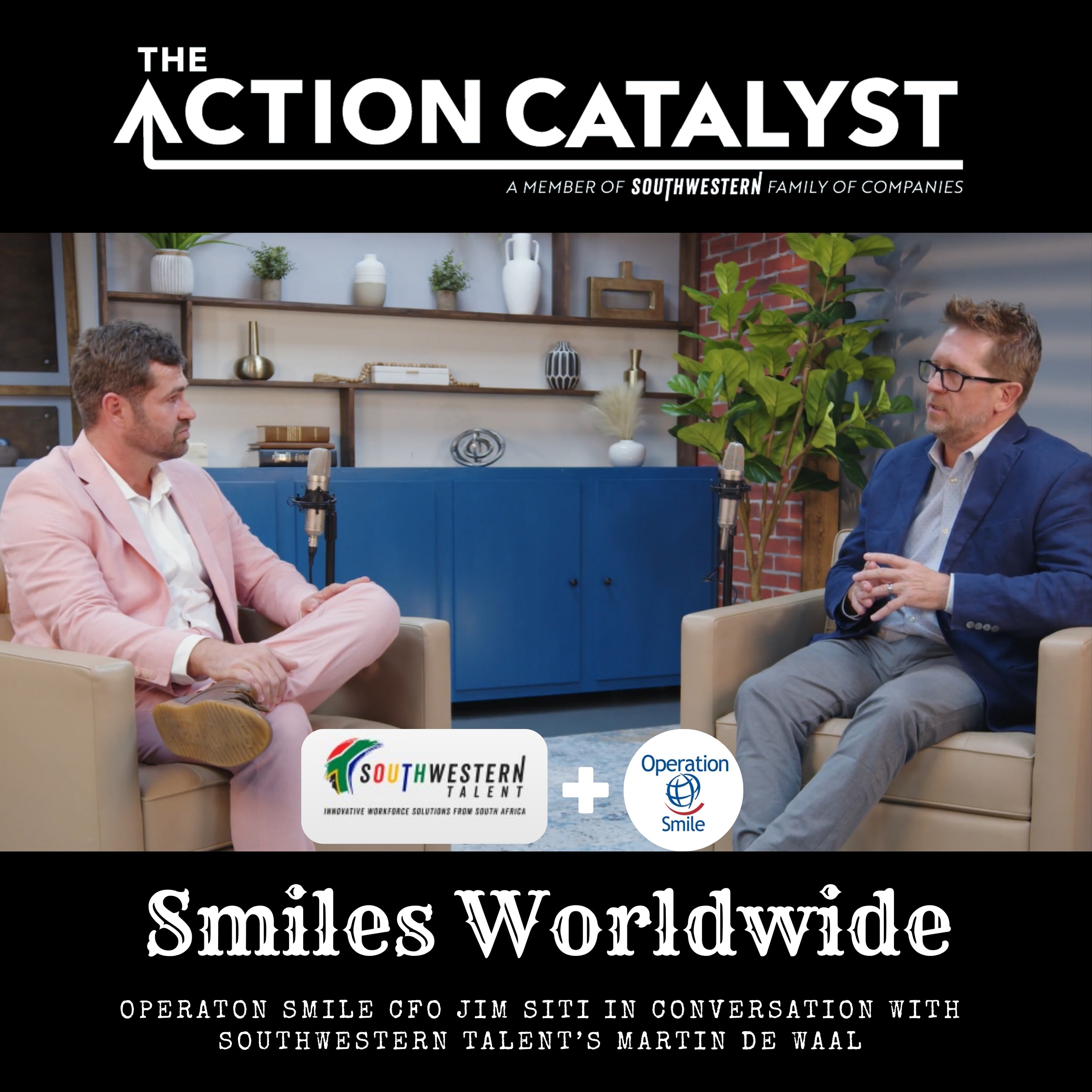
In this special bonus episode of The Action Catalyst, Southwestern Talent's Martin De Waal guest hosts, sitting down with Jim Siti, CFO of Operation Smile, as he shares how the global healthcare nonprofit is transforming lives by providing cleft lip and palate care to children in underserved countries while building sustainable local healthcare systems through medical training and education. Siti discusses the challenges of scaling a rapidly growing nonprofit in a post-pandemic world, the importance of strategic financial management, and how leveraging offshore accounting talent, process optimization, and AI-powered tools has improved operational efficiency and mission impact. He also offers valuable insights on nonprofit leadership, financial technology, workforce development, and using automation to reduce manual work so organizations can focus more resources on serving communities. This episode is a must-listen for nonprofit leaders, CFOs, finance professionals, and social impact organizations seeking innovative strategies for growth, operational excellence, AI adoption, and mission-driven success.
0:23Martin De Waal: I'm Martin De Waal, Head of Operations for Southwestern Talent, sitting here with Jim Siti, CFO of Operation Smile. Jim, nice to have you with us. Thank you.
0:45Jim Siti: Hello, Martin. Thanks very much for having me. Great to be here.
0:48Martin De Waal: Wonderful, Jim. Tell us about who you are, the organization you work for, how long you've been with them, and what your role is.
0:55Jim Siti: Great, thank you. I'm the CFO of Operation Smile. We are a healthcare nonprofit. We are known for taking care of children with cleft lip and palate conditions in lower and middle income countries. The organization was started almost 45 years ago now by a couple by Bill and Kathy McGee. Bill is and was a one of the foremost plastic surgeons, really in the world that did this type of work, and Kathy is his wife, and she's she was a nurse and a social worker at the time, and they lived in Norfolk, Virginia. And in Norfolk, Virginia, there's a large Filipino community, and they they just had a lot of friendships and relationships. And some of their colleagues from the Philippines had told them again in the 80s, that there were a number of children with unrepaired cleft lip and palate conditions, and they weren't likely to receive care where they lived. So they asked the McGees if they and some of their other medical colleagues would take a trip over to the
1:55Philippines and take care of those children. And they thought there would be 10 or 15 of them, and they were prepared to do that once, and then sort of get back to the rest of their lives. And then when they got over there, there were certainly more than 10 or 15. I think there may have been over 100, so they were able to take care of perhaps half of them or slightly less. And they said, "Okay, don't worry about it. We'll come back again in a year, hopefully less, and we'll take care of the other half of the patients, and then we'll get on with the rest of our lives. And so, as you can imagine, they came back, and there was there wasn't 50 more; there was 500 more. So, just you can just roll the tape forward, and that just kept happening. And it turns out that there are actually millions of patients in the world. The rough estimate in lower and middle income countries right now is any given time. There's about 7 million patients in need of some level of care, and way less than
2:455% of them on the planet are getting the care that they need. So the McGees realized that then, and they started Operation Smile, and the organization has grown. We are active in 35 countries, and then the main element of our strategy is we, in addition to providing clinical care, all of our activities and programs are set up to provide very hands-on training for clinicians in the places where we work, so they can eventually and quickly be able to provide the same level of care on their own and within their own health system. And that's really what our strategy is to strengthen and support hospitals and health systems in the places where we work, so they can be self-sufficient.
3:26Martin De Waal: Well, Jim, I must say it seems that you guys have really grown over the years, and you know, scaling might be a challenge, seeing that you've you've grown. So, yeah, what challenges were you and Operation Smile facing in particular that led you to reaching out and looking for client advisory services.
3:42Jim Siti: So scaling up the organization-it's always been a challenge, but in the last five years, coming out of the pandemic, it's become a fairly particular challenge. And the reasons are-and these would be common amongst many or most nonprofits, and certainly amongst the colleagues that I have in the sector-we all sort of say the same things. Our organization grew very rapidly. Our donation base, which I thought would contract during the pandemic, actually grew. People were at home and they were very generous, and so our revenues just went through the roof, which was great. Alongside of that, we, as we were getting back to work, coming out of the pandemic, we sort of tweaked our strategy and refocused our strategy to make sure that we were providing activities that were helping build sustainability in local healthcare systems, and there was just a real appetite for that. And so we were able to now that we had more money coming in, we were able to just ramp up our our
4:37operations and our activities also very rapidly, and that's a good thing, and we're still doing that. The scale challenge, however, comes in because by the nature of our organization, we're a global organization. People did get used to working at home during the pandemic, but then coming out of it, people sort of stayed at home. But then we're also in many different countries, so there's silos just by definition, and that's okay. We can. Through that with communication tools, but it gets more challenging because accounting and operational and planning the systems have grown up in many different locations differently. They don't talk to each other. We end up with sort of a Frankensteined global system that underpins our finance, accounting, operations, etc. So you have folks in silo, teams that are in silos with systems that don't really speak to each other, and then the the staff and the teams that work on them have gotten very used to working on the the technology
5:32and the process situation that's been developed somewhat independently, depending upon where they are. And then when you try to put all that together because you want to support rapid growth, just for all the obvious reasons, that becomes very challenging.
5:44Martin De Waal: That makes a lot of sense. So at Southwestern Talent, we provide offshore talent, specifically financial professionals in the accounting, bookkeeping, payroll space, to partner with organizations like yours who are looking for cost savings and flexibility that allow you to put more money focused towards your mission. We're a proud partner with Operation Smile. How was it that we helped your team further the mission so far?
6:08Jim Siti: So for me, when I was faced with this challenge, and we were having there was an accounting shortage a few years ago, and it's still there to some extent, although maybe it's getting a bit better. But there was a real shortage three years ago, and we were experiencing turnover. We weren't able to backfill the roles that we needed, and we were running into real like nuts and bolts operational problems because of this. And so, initially, for that reason, I said, "Well, let's look into outsourcing solutions. And so, I was familiar with this concept. You have a unique situation in South Africa where you have a highly talented, highly trained workforce that is because of the economic situation in South Africa. Perhaps is under deployed locally, so supply and demand kicks in. You have a wonderful supply of talent. The different levels of experience and skill set, we were able to match that all together and start to fill in the gaps that we need, and we were
7:06able to do it really, really quickly. I've found it to be fairly easy and very straightforward, and I'll tell you why that's the case. So a few years ago, but even now, as I mentioned, there was a shortage of accountants. But even if there's not finding and recruiting staff to hire takes a lot of time, and we're all busy. We don't necessarily have time to do that. We have an excellent HR team, but they're also really busy. So there, I'm competing with recruiting resources across the organization, and that's okay. They they can service that very well, but ultimately, me and my team are left to figure out if what people say on their resume is actually true, and then so you go through very extensive interviewing and you do some reference checks. It's helpful, but not that helpful, and it's essentially a gamble. And sometimes it works, and sometimes it doesn't, and everybody's familiar with that. But I get to skip all those problems because you all have already
8:01done all that, so you've already vetted the talent pool, and you have a very well laid out. You have some way to match the skill sets and the experiences with what our specific needs are. Needs are, and you can do that really quickly. And it just wouldn't be possible to do that without that service. The second thing is you can do it really quickly. So generally, like a recruiting process takes months and months, and then you go through many, many candidates, and sometimes you have to start over. And this this is just the nature of it. I get to jump to the head of the line on all of those things. That's really, really important. In addition to that, I don't have to be the HR department now. So like, if if something's not working out in a friendly way, we can make changes. So, all of those things are just much more difficult to do if I'm trying to hire people directly. My goals were and still are to have the right firepower. We want enough capacity to do the things that
8:57we need to do. The things that we care about the most are we really care about the money that donors give us, and we want to spend it really, really well. At the top of our list of OKRs, we say in very plain English, "Spend the money well. Spend the money well means most of it goes to what people want us to do, which is take care of kids in lower and middle income countries. They don't want me to spend tons of it on admin and overhead. I could spend a reasonable amount of it on that, but most of it has to go to the mission. That means the the administrative and the administrative and other support services have to be excellent. So not only do I not want to overspend on them, but I want to get the absolute most out of them because I want to spend the money over here really, really well. So while it's it's it is true that the the I guess because of the currency situation, the strength of the U.S. dollar, and just the economic situation in South Africa, as we mentioned earlier, there