
The 1937 Flood Watch Podcast · Charles Bowen
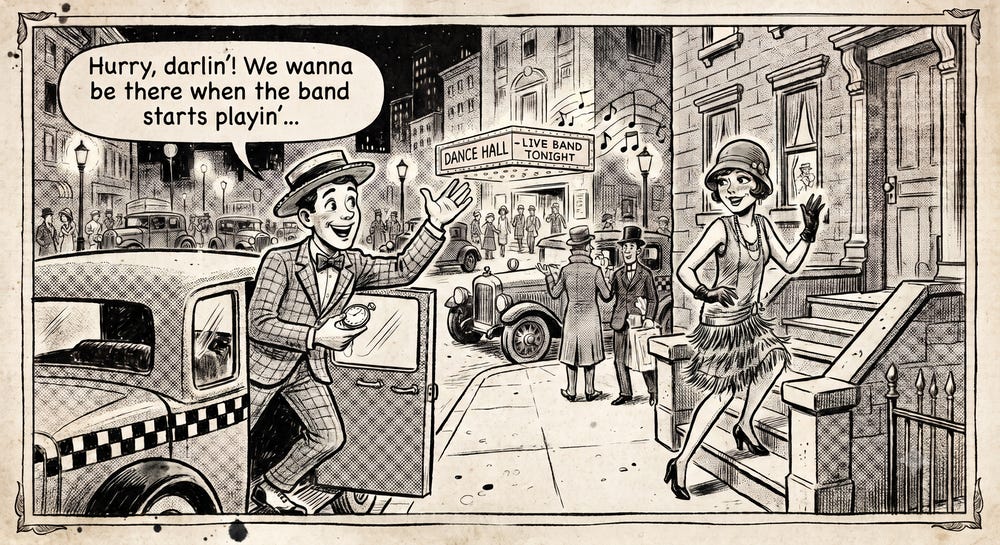
The story goes that a century or so ago there was a strange annual ball in Chicago. A model of irony, it was a fancy affair in the city’s sordid South Side, financed by wealthy society folk but reserved for the community’s prostitutes and their sugar daddies. Some believe that songwriter Shelton Brooks so loved those tales that he celebrated this modern equivalent of the medieval carnivals of misrule with his most famous composition. “As far as I can find, this event was not called ‘the Darktown Strutters’ Ball,’” writes our favorite song sleuth Elijah Wald, “but I guess that seemed like a more marketable title than ‘Pimps and Hookers Ball.’” Shelton Recalls In 1972 British singer/music historian Ian Whitcomb located and interviewed Brooks just three years before the venerable composer’s death. During their visit, Brooks told Whitcomb that he wrote the song after hearing a story about an ordinary working stiff who got “an invitation to an affair to be given by the local pimps. A big ball. All a mistake and he should never have been asked.” (Incidentally, some sources suggest Brooks’s song referred instead to a ball at the 1915 San Francisco Pacific-Panama Exposition. ) Shelton’s Biggest Hit In either case, it was a real-life party that inspired the song that became one of the first monster hits of the early recording age. Brooks, his composing cred already established with hits like “I Wonder Where My Easy Rider’s Gone,” brought “Darktown Strutters’ Ball” to vaudeville in 1917 where it was introduced by stars like Sophie Tucker. After that “Darktown Strutters’ Ball” sold more than three million copies as sheet music. The first recording of the song was made by Canadian vaudeville band Six Brown Brothers in May 1917 for Victor Records in New York City. This was followed a few weeks later by the Original Dixieland Jazz Band’s instrumental version for Columbia. The latter is one of the earliest commercial jazz records and was the No. 3 song of 1917, later inducted into the Grammy Hall of Fame. The song quickly became a staple of dozens of pop and jazz artists including Count Basie, Dave Brubeck, Fats Domino, Jimmy Dorsey, Benny Goodman, Al Jolson, Django Reinhardt, the Savoy Quartet, Wilbur Sweatman’s Original Jazz Band, and Lieutenant James Europe’s 369th Infantry Jazz Band. Ted Lewis and His Band had a hit with it in 1927. The Flood’s Take on the Tune We had our old buddy Jim Rumbaugh in the band room last week. As we’ve reported, Jim will be sitting in with us next week when The Flood plays at the latest Diamond Teeth Mary blues festival. After we’d worked on the blues tunes we’ll do for the show, we switched this rocking old Roaring Twenties number for a happy change of pace. It all went well until we tried to tag the tune with a classic ending that our late Chuck Romine always favored. Hey, who knew there’d be spelling?! More Tunes from the Teens and the ‘20s? Meanwhile, if this week’s podcast has you in the mood for more of the tunes that...
0:00SPEAKER_00Hey there, it's Charlie Bowen with the 1937 Flood.
0:04SPEAKER_00We had our old buddy Jim Rumbaugh.
0:07SPEAKER_00In the band room recently,
0:09SPEAKER_00Jim will be sitting in with us when the Flood plays at
0:12SPEAKER_00the latest Diamond Teeth Mary Blues Festival next week.
0:16SPEAKER_00Last week,
0:17SPEAKER_00after we'd worked on the blues tunes we'll do for that show,
0:20SPEAKER_00we switched to this rockin' old Roarin' Twenties number from Shelton Brooks.
0:25SPEAKER_00It all went well until I tried to tag it with a classic Chuck Romine ending.
0:30SPEAKER_00Hey, who knew there'd be spelling?
2:35SPEAKER_00I didn't spell so... What was that?
2:38SPEAKER_00You spelled those words and I was like, what did he say?
2:43What?
2:43I didn't know there'd be spelling!
2:47SPEAKER_00At least there's no math.