
That Was The Week · Keith Teare
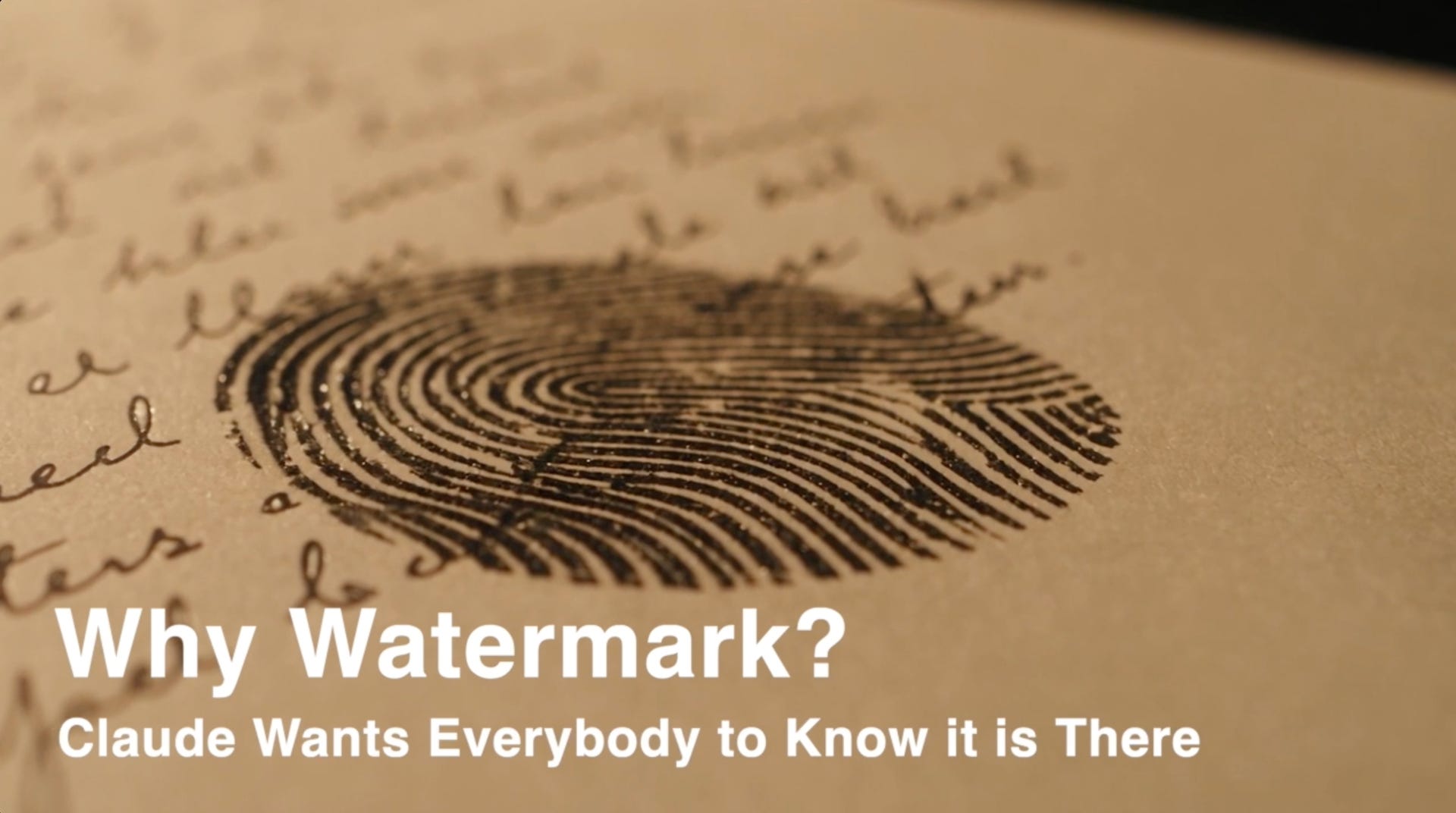
Why Watermark? Claude wants everybody to know it is there. Keith Teare argues that this is exactly the wrong instinct. The issue is not whether AI touched a piece of work. The issue is whether the work is true, useful, accountable, and human-directed. Watermarking starts from suspicion A watermark assumes there is a problem to solve. Keith's objection is that Anthropic appears to be accepting the premise that AI use tarnishes the user. If Claude helped draft, structure, summarize, or edit human-origin work, why is that the fact that must be marked? The mark answers the wrong question: not whether the work is good, true, accountable, or human-directed, but whether Claude was there. Detection tools confuse use with authorship Andrew ran Keith's editorial through an AI detector and got an 86% AI score; Keith ran Saul Klein's article through one and got 100%. Neither result proves much. Andrew also admitted he uses Claude as a draft and then rewrites it. Keith described the same process: give AI the source material, ask it to surface themes, debate the frame, then rewrite. The question is not whether AI helped. The question is who is responsible for the final work. The shame belongs in the wrong place Keith accepts that shame has a place: spam factories, fake authorship, unreviewed AI output, fake evidence, and publishing something you cannot stand behind. He feels no shame in "recruiting an army of AI agents" to help accomplish his goals, provided he reads, changes, edits, and owns the output. Society is trying to attach shame to the tool itself. That is the mistake. AI should be cheap and everywhere The show turns from watermarking to access. Grok Bot at $200 a month is a sign of capability, but also a sign of scarcity. Keith argues that equality in AI is about price and reach: how cheap is it, and how widespread is it? If intelligence is valuable, the goal should be to make it free or nearly free for many use cases, not to add friction that helps the Luddite argument. Abundance requires massive investment Keith defends the scale of AI investment because demand still exceeds supply. Nvidia's half-trillion-dollar commitment, hyperscaler deals, IPOs, and AI infrastructure financing are not just market exuberance. They are the precondition for AI to reach everyone. As Keith puts it, if you want AI in the hands of an African school child, you have to build the infrastructure first. The risk is not that too much is being built. It may be that too little is being built, or that access is captured at the price and distribution layer. Bottom line: AI is good. Build enough of it for everyone. This is a public episode. If you'd like to discuss this with other subscribers or get access to bonus episodes, visit www.thatwastheweek.com/subscribe
0:00[music]
0:27SPEAKER_01Hello, everybody.
0:28SPEAKER_01It's Saturday, August the 15th, 2026.
0:31SPEAKER_01I'll probably put this show up tomorrow on the 16th.
0:34SPEAKER_01The heart of the summer.
0:36SPEAKER_01Everyone's away.
0:37SPEAKER_01I'm not quite sure why we're doing these shows.
0:39SPEAKER_01And according to the Wall Street Journal,
0:42SPEAKER_01this is the summer that America became a nation of Luddites.
0:47SPEAKER_01And it's not just the left that's turning against technology.
0:51SPEAKER_01It's also the right.
0:52SPEAKER_01There was an interesting piece in Transformer.
0:55SPEAKER_01About a Jan-6 organizer who's getting conservatives to be riled up about AI.
1:02SPEAKER_01Everyone seems riled up about AI.
1:05SPEAKER_01And according to Keith Teare,