
That Was The Week · Keith Teare
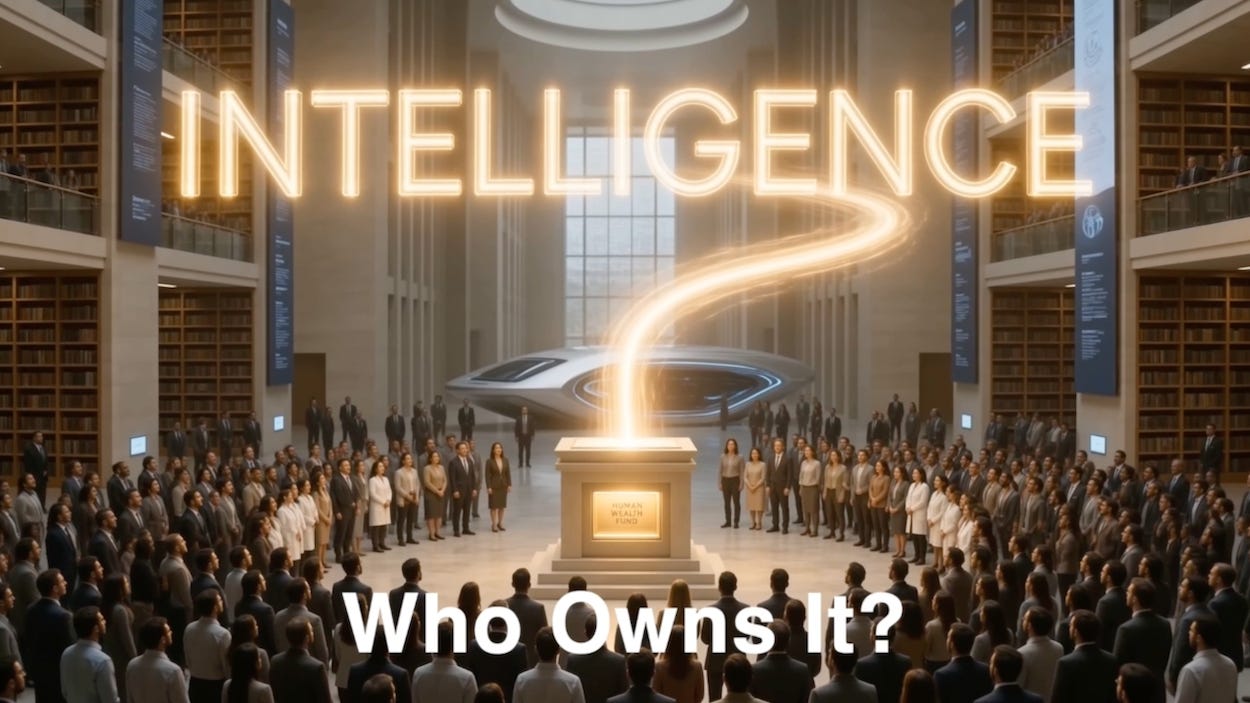
This week’s video transcript summary is here. You can click on any bulleted section to see the actual transcript. Thanks to Granola for its software.There was an issue with this only going to paid subscribers, so sending it again. Apologies to those who get it twice. I appreciate being paid so feel free to upgrade if you enjoy TWTW. Editorial Intelligence: Who Owns it? This week the word “AI” feels too small. AI is a technology. Intelligence is its product. And if intelligence is the product, the question is no longer just: Which model is best? Who has the cheapest tokens? Who owns the weights? Who controls the data center? Those are important questions, but they are lower in the stack. The bigger question is simpler and more political: Who owns intelligence? That sounds abstract until you make it concrete. Intelligence is becoming something companies can capture, package, serve, meter, route, improve, and sell. It can write code, answer questions, design molecules, automate offices, run agents, draft legal work, advise scientists, serve consumers, and reshape workflows. It is not merely software. It is a general-purpose capability. And all humans could benefit from more of it. General-purpose capabilities have a habit of becoming public questions. But the default answer, that public good is best delivered by government, is the wrong answer in this context. The Product Is Intelligence We should stop talking about AI as a feature and start talking about intelligence as the universal thing that is delivered as an input to the world. Water is an input. Electricity is an input. Literacy is an input. Connectivity is an input. Once a society depends on them, access stops being optional. Nobody needs government to build every well, power plant, school, or network. But everybody understands that a civilization cannot be organized around less than universal and reliable access to foundational inputs. Intelligence is reaching that level of importance now that we all know it is real. Government should not own it, operate it, or develop it. Quite the opposite. Companies are the right actors to build fast, compete hard, improve models, serve customers, and discover the real use cases. Self-interest is a useful framing here. Markets are good at finding demand, reducing costs, and turning invention into services people actually use.Companies are the right operators, developers, and owners. But that does not settle the real question of who owns the benefits. That is an economic question. If intelligence becomes metered infrastructure, what happens to the value it creates? The Ownership Stack This week’s articles keep circling the same issue from different directions but in the nature of ‘circling’ never quite nail it. Jamin Ball’s “Own Your Weights” starts with the enterprise version of the question. Owning a model file is not enough. The durable asset is the loop: the data flywheel, the evaluations, the reinforcement system, the workflow learning, and the...
0:00[music]
0:28SPEAKER_01Hello, everybody.
0:29SPEAKER_01It is Saturday, the 18th of July.
0:34SPEAKER_01Last week,
0:35SPEAKER_01it's time,
0:35SPEAKER_01of course,
0:36SPEAKER_01for our weekly tech roundup with That Was The Week, publisher Keith Teare.
0:40SPEAKER_01Last week,
0:42SPEAKER_01he or we asked what time it was,
0:46SPEAKER_01and we concluded that it was a revolutionary moment,
0:50SPEAKER_01but maybe one that wasn't going to turn into a revolution.
0:54SPEAKER_01We headlined the show 10 days that didn't Shake or change the world.
0:59SPEAKER_01And Keith remarked that it was rather like 1905,
1:03SPEAKER_01the failed Russian Revolution, as opposed to 1917.
1:07SPEAKER_01The revolution,