
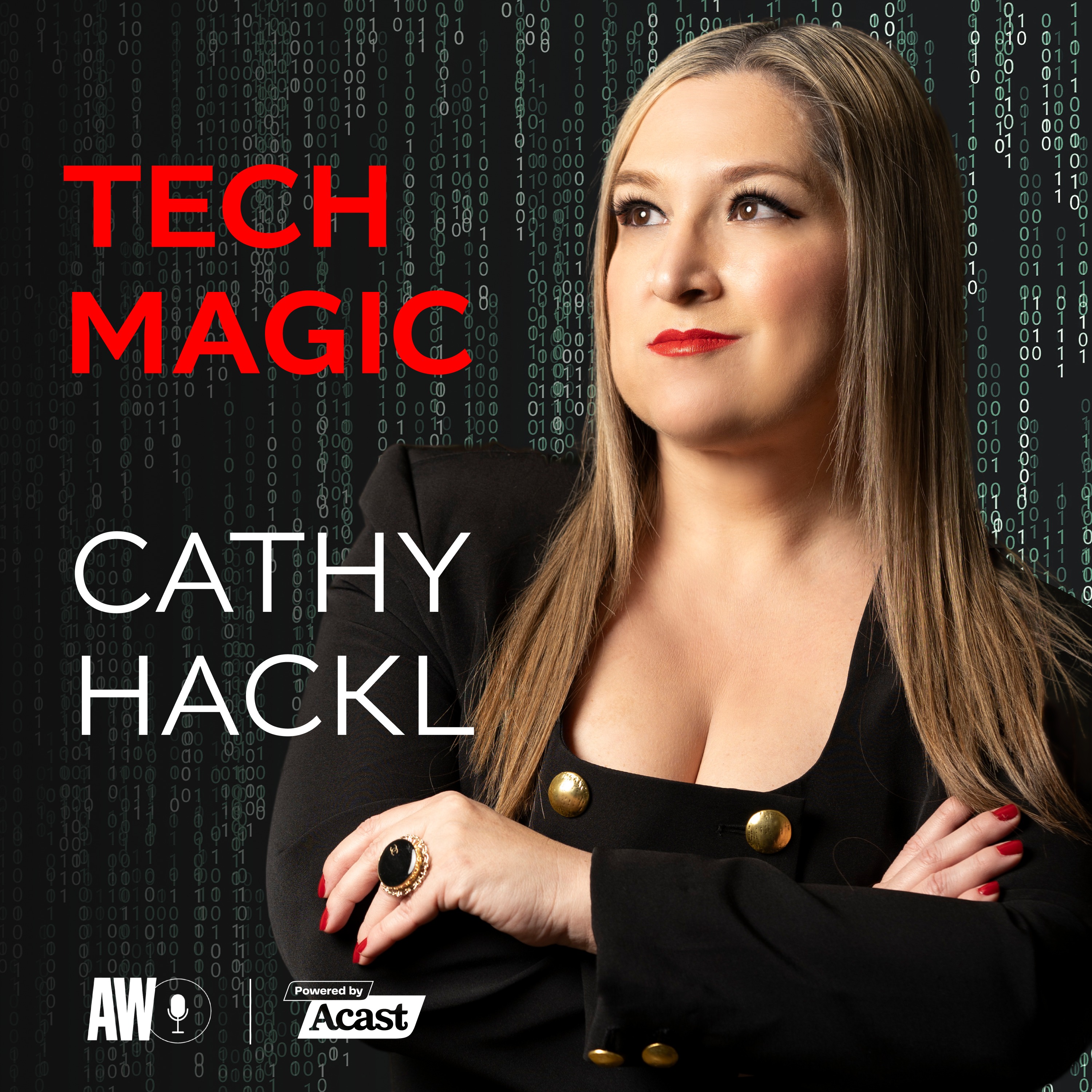
TechMagic with Cathy Hackl · Adweek
In this episode, Lee and Cathy explore the impact of AI on content creation, social media platforms, and the future of technology. They discuss the challenges and opportunities AI presents for creators, platforms, and consumers, emphasizing the importance of ethical use and innovation. Outside of their tech executive roles, Cathy and Lee are also creators. Cathy is one of the top B2B creators and a top tech voice on LinkedIn and speaker. She recently launched a Travel and Tech video series on LinkedIn, Instagram and Youtube where she travels the world and brings her perspective on global tech. Lee is a talented musician with a significant following on Instagram and gifted writer too. He recently launched Dig, an animated short story series. Key topics AI's influence on content creation and monetization Challenges faced by platforms like YouTube and TikTok due to AI Opportunities for platforms like Roblox and LinkedIn in the AI era Privacy concerns and data ownership in AI applications The role of human creativity versus AI automation Legal and ethical considerations of AI-generated content The future of AI in sports, music, and entertainment The importance of authentic human stories in a digital world Key takeaways AI is transforming content creation but raises ethical and monetization challenges. Platforms are adjusting thresholds and policies to combat AI-generated spam and maintain quality. Opportunities exist for platforms like Roblox and LinkedIn to innovate and monetize differently. Privacy and data ownership remain critical concerns with AI and digital platforms. Authentic human storytelling continues to be valued over AI-generated content. Legislation and platform policies will shape how AI is integrated into media and entertainment. Sound Bites "AI is generating so much garbage that platforms have to increase thresholds" "People want to watch humans, not AI robots" "Hate the system, not the technology" Sections 00:00Introduction to the episode and guest overview 02:11Lee shares his new web series inspired by a solar eclipse 03:55Cathy discusses her travel series in Greece and personal passions 05:07The creative process and overcoming fears of rejection 07:22YouTube's monetization changes and AI's impact on creators 10:40The rise of AI-generated content and its effects on platforms 12:20Juxtaposition of real creators versus AI content for kids 14:01Opportunities for platforms like Roblox and LinkedIn 16:53The challenge of AI in music and media industries 18:20Concerns about privacy and data ownership in AI 20:18The importance of human storytelling and authenticity 23:12AI's role in sports and entertainment, maintaining human element 27:38The future of AI regulation and ethical considerations 33:54Media partnerships and trust in AI-generated news 40:55The limits of AI in entertainment and human connection 42:15Closing thoughts and call for positive stories in tech
cathy hackl: Hello everyone and welcome to Tech Magic. I am your host, Kathy Hackle. This is the podcast where we talk about technology news, AI, spatial computing, spatial intelligence, and everything in between. I am joined, as always, by my co-host, Lee Kiebler. Lee, how you doing? Lee: I'm good. It's been kind of a crazy week for me, but but doing doing all right. We had a I had a big day today, actually. I cathy hackl: Ooh, can you share or no? Lee: I can. so a while back I wrote a short story and we decided that we were gonna turn it into a mini-series, like a short series, web series. one caveat was no AI would be used in the creation of this web series. And so connected with some amazing artists and talent out of Ringling college down in Sarasota, Florida, which happens to be my hometown. they're an art school and I knew a couple of the students down there. They read the story, they dug it, and yeah, so we we put out we're putting out like a 20 episode series animated, it's like still animated, it's like a comic book series, but for web. It's like a webcomic. and so we launched the first episode today. I'm not gonna give away any of the story, but the premise is basically the sun goes out, and we decided this is crazy. This is genuinely crazy. I did not do this on purpose, but I'm sure everyone will think that I did this on purpose. I wanted to just out of timing was like, we're gonna release this in mid-August, whatever, just looking at the timeline because they're students, they had to get back to school. and we chose today, August twelfth, which this'll launch this podcast will launch in a couple days, cathy hackl: Yeah. Lee: but we chose today, August twelfth, to launch it and it j and it takes place in Iceland. Like the story all of this is true. This the story takes place in Iceland. And it just so happens on August twelfth in Iceland, right now, there's a total eclipse. So cathy hackl: Yeah. Lee: it just like the timing was was crazy. It was insane. So yeah. Twenty episodes. Yeah. cathy hackl: Synchronicity, my friend. Synchronicity. That's what that's called. Lee: I I I wish I had done that on purpose. cathy hackl: You were newsjacking it, weren't you? No, no, no. Lee: But yeah, cathy hackl: wow. Lee: so we'll see how that goes. but yeah, it'll be up on my YouTube and on in in my substack and my Instagram. yeah. Yep. Yeah. So how cathy hackl: Yeah, you're gonna share on Instagram as well. Fantastic. Okay, we'll definitely be sharing that out. that's exciting. How many episodes? Lee: we think it's about 20, but I know that sounds like a lot, but no episode's more than like two minutes long. It's all designed to fit in like YouTube shorts, in in like Instagram reels. So Yeah, it's they're all about a minute and a half to two minutes long. yeah. cathy hackl: that's fantastic. And is it like general audience or like who do you recommend who would like to watch this? okay. So I can't like okay. G I'm glad I Lee: It's not for kids. y cathy hackl: asked. Lee: teen I would call it PG thirteen. I would call it PG Yeah, yeah, yeah, yeah, yeah, yeah, cathy hackl: Okay, so like my kids, like my older kids could totally dig it. Lee: yeah, yeah. Yeah. It's it's nothing insane. cathy hackl: Okay. Lee: but you know, it's it's a it's a I wouldn't exactly call it a horror, but it is a psychological thriller horror. You'll cathy hackl: Mm. Lee: see as you get into it, and things are not as they seem. it's a little cathy hackl: Well, they watched obsession with me, so I think I think they're fine. And my son watched the back rooms. So yeah. So I think we're okay. I think we're okay. All right. All right. So that's awesome. Lee: then they're fine. No it's na it's not even not even close. Not even close. Yeah. Yeah. Yeah. So how are you? cathy hackl: I'm great. I am doing great. life has been wonderful. I put out the second episode of my travel and tech series. Lee: Okay. cathy hackl: this time the episode is actually in Athens, Greece. So, The first video is actually me at the Acropolis where the Parthenon is, talking about, you know, kind of everything that came from Greece that changed society radically. And then how the moment that we're in. so the next couple episodes will will continue to be in Greece at different locations. and my perspective on technology and kind of what I'm seeing. Lee: That's great. cathy hackl: really exciting. Yeah. And it's it's I'm getting so many great comments about it and I don't know. I just, you know, when you do something, it's and this probably what what your what your short story feels like and your series feels like. When you do something, you're just like, I'm just gonna do it. And then now it feels so good that you did it. Right. see, I feel Lee: I don't know if I feel that way. I'm not there yet. cathy hackl: great. I've this is episode two, but I feels like aligned. It feels really aligned to my passions and yeah. And I was I wasn't doing Lee: I think I re cathy hackl: it for anyone, I was doing it for me. And I think that that comes off and then people are really excited. Lee: That's huge. Yes. That's you when it's for you. But I think like I'm feeling a little bit of George McFly Back to the Future, like feeling of like, what if people don't like it? I don't know if I can deal with the rejection. Like that whole thing, like I've got a little bit of that going on for sure. cathy hackl: No, it's awesome. And it's called is it called dig, right? Because I said my kids would dig it. I did the whole thing there. yeah. That's exciting. You know, Lee: Dig. Dig. Yeah. Yeah. Yeah. Yeah. Yeah. It's called Dig. yeah, well. cathy hackl: and and this is like for people listening here, and you probably know this. I'm not sure because you've got you've got a good number of followers on Instagram. You can create a series. Yeah. Lee: Yes, I'm working on figur okay, but see here's the thing, is that like, yeah, I've my Instagram definitely has a huge following for cathy hackl: Mm-hmm. Lee: whatever reason. And I have no idea how to use Instagram. I don't know how to y leverage it. People have asked me, like, so what what's your method for Instagram? I d I throw crap at the wall and see what sticks. Like I have no method. I am a caveman just seeing what I can paint on a wall, and there's there's no rhyme or reason. So this is the first time where I've like Take a moment and ask myself about the algorithm. I hate all of it. cathy hackl: goodness, there's so much you can do. We should chat because there's trial reels. I mean, my goodness. I've started got gotten really I've gotten really savvy at it. I I'm doubling down on LinkedIn because that continues to be amazing, for me. Lee: that I'm kind of wondering if I don't move it over to LinkedIn too because the the whole cathy hackl: Do it. Lee: end goal is to find like a literary agent. I've got novels I wanna publish and things like that. So I'm taking I'm going I'm cathy hackl: Mm-hmm. Lee: flipping the whole idea of like publishing as a grind to like, okay, well let me just do this over here. I don't know if it's gonna work, right? cathy hackl: Yeah. I would put it I I mean, it's strategically done, I think it's very smart. Lee: Yeah, well, okay, then you and I need to chat because I'm I'm literally cathy hackl: Yeah, absolutely. Lee: just finger painting over here. I've no idea. cathy hackl: Well, I think it should come to no sur like it's no surprise to anyone listening to this podcast that you and I are podcast co hosts, but we're also friends. So yeah. Lee: Yes, yes, yes, yes. We're close friends and could not be more different as people. cathy hackl: Lord, yes. That's when we get along though. That's where we get along. It's fantastic. Lee: It is, it is. cathy hackl: All right. So getting to tech news. my Lord. I just don't think anything's slowing down. I feel like these agents keep breaking into all sorts of things. whether it's a gym, whether it's hacking someone, like hacking companies or banks. I'm I don't know. I like I don't even know I don't even know where to start. Lee: I I wanna start with YouTube because I think YouTube is proving where there's a problem. cathy hackl: Okay. Lee: so this week YouTube announced that in twenty twenty seven they are changing significantly the requirements of traffic needed for a YouTube creator to monetize. It's almost double. It's significant. I'm not gonna get into the weeds of the numbers here, but it cathy hackl: Mm-hmm. Lee: has caused a stir of these numbers might be unobtainable. especially for new you people new cathy hackl: yeah. Lee: getting into YouTube. and It's indicative of YouTube trying to solve a problem that cathy hackl: Mm-hmm. Lee: their parent company is responsible for. And this is where I start seeing maybe we c as like outsiders, we can see a little bit of like the internal politics of what's happening here. what happens when your parent company is going all in full throttle on AI and generative AI content? cathy hackl: Mm-hmm. Lee: But you have a platform that is now being so heavily bombarded because of how easy it is to make this content with slop and then expecting that slop to get paid because if you throw enough data fast enough, you cathy hackl: Yeah. Lee: will hit the necessary required margins, right? So cathy hackl: Mm. Lee: now YouTube's got a problem that they're getting so much AI garbage that they have to increase. The threshold to monetization because they're trying to not monetize AI-generated content. It does make sense at like an upper management level problem solving, but it doesn't make sense from the creation point of view. Because cathy hackl: Mm. Lee: effectively, and I've heard a couple of other YouTubers Talk about this as well as I'm going through and I'm watching these reactions of like pretty big YouTubers. We're talking people who have got millions of followers, and they're just saying this is potentially having the negative effect of now I've got to create so much content that I have to use AI to hit these numbers. And so a lot of the creative stuff that may not hit the is unlikely to hit that threshold, the new threshold. Is gonna go away and now we're just gonna see a bunch of Mr. Beast clones. Or AI cathy hackl: That's interesting. Lee: generated Mr. Beast clones. cathy hackl: Mm, God, no. Lee: It and so there's this there's this there's this issue happening in YouTube right now where they spent the last three years making cathy hackl: Mm-hmm. Lee: shorts the the the golden child of YouTube, right? Like this is where we want to move everything. cathy hackl: Uh-huh. Lee: And then AI came in, thanks to Gemini and everything else that's generating content and said, this is an easy target because I can output short form video. So now their golden child is just be it's it's like a kid being born into a world full of like natural foods and then you're just shoving sugar down its throat, right? Like it's it's just the cathy hackl: Oof. What a great analogy. Lee: but it's what we're doing. cathy hackl: I'll add this to your commentary because I think it's really indicative of the moment we're in. Here's a couple things I've seen. our I don't know if you know Corey Williams. Lee: I don't. cathy hackl: So Corey, Unreal, he uses Unreal Engine for development. I mean, I know I'm from the XR space, but he started creating something called the silly crocodile, which was a series on YouTube for kids. He was doing he was doing so well. He was doing amazing. I mean, I follow him, I follow him on LinkedIn of all places, but Corey's fabulous, and I actually would love to have him on the pod. he was doing great, really great with silly crocodile. I mean, exceeding everything. AI slop just starts hitting. His numbers go way down, his like potential for earning goes way down. Eventually he does like he complains. Eventually, like his silly crocodile gets elevated because it's a real like he uses Unreal Engine to create it, but not AI. Like he's he's a real creator. Like this is a Lee: Yeah. cathy hackl: real children's series with real messaging, a really good, like. Like they're it's thought out for for the good of children. Okay. And then it gets elevated. So he's back to where he used to be. I love his story. That's in juxtaposition to the story of this other woman that I actually saw on Instagram, where she's like, Let me show you how I've made $20,000 a month creating AI videos with for kids. But there's no no no no reasoning behind the videos. It's just feeding them Lee: Right. cathy hackl: slop. It's like using create create a story about this and this, but it's bad. It's the Lee: Right. cathy hackl: stuff that these little kids get hooked on and they watch on YouTube kids or on YouTube, but has no real meaning or story. And I was like, you know, she's she's doing it to gain her, you know, a living or whatever. But I'm like, at what cost? So it's this interesting juxtaposition of a real life human creator who uses technology to create amazing work, who's been doing great, who's trying to do something better for kids, as opposed to someone that's like, let me just hijack the system. make as much money as I can feeding kids sugar. Exactly. Lee: Right. Right. cathy hackl: So I I see this juxtaposition on how people are approaching this. So very interesting. so I don't know if you have any comment on that because I've got two other things I want to bring up related exactly to this. Lee: Go for cathy hackl: No? Okay. So Lee: No, go for it. Yeah. cathy hackl: here are two other things I see. One of them is that this is a really interesting opportunity for several platforms. Okay. Lee: Yes. cathy hackl: One of them is Roblox. Okay. Lee: Mm. cathy hackl: Roblox, you and I have talked about this many times, but actually there's data that shows that Roblox is minting, quote unquote, more millionaire div more millionaire teenage teenage millionaires, quote unquote, than YouTube. Because they're building games now, Roblox Studio. There's more access to tools. Yes, they're using AI to be create some games, but like they're they're actually making games and getting money there, as opposed Lee: Mm. cathy hackl: to how hard it's becoming to get become that in YouTube. So that's one. The other, the second comment is the opportunity for LinkedIn. You know, I'm a LinkedIn power user. LinkedIn is my platform of choice. I absolutely loved it. I would not be where I am today if it were not for LinkedIn. you know, as my LinkedIn influencer. are you serious? Lee: Yeah, I don't think you and I would know each other if it weren't for LinkedIn if I if I'm going far enough back. I I don't think so. cathy hackl: thank heavens for LinkedIn then. Lee: Yeah, I think I think like in the early days of LinkedIn we were like very quickly connected. Yeah. cathy hackl: Yeah. And I also see an awesome opportunity. If it becomes harder for people to quote unquote monetize YouTube, it's, you know, Instagram you can still monetize. The game gets a little bit harder as you go, but you know, where do you monetize? I mean, I'm not interested in monetizing on TikTok. That's just not my audience necessarily. I feel Lee: Sure. Me either. cathy hackl: like LinkedIn has a good quality audience. Granted, there is still there is also a lot of AI traffic, but there There actually there's a button now where you can press and say, this looks like AI slop or this is like AI, this looks like it's AI generated. Lee: Right. cathy hackl: And LinkedIn is in the process of finding ways for creators, real life human creators that have, you know, business expertise to monetize a little bit more. so I'm excited. I'm excited about what it also means for LinkedIn. I just don't want LinkedIn to become YouTube, if that makes sense. Lee: You know, it's it it's interesting because in I in in another part of my life, I've been fighting this battle, trying to get people to like pay attention. the music industry, which is a big chunk of my background, is really interesting because it's so ingrained in like credit and and getting your cathy hackl: Mm. Lee: percentages and who owns what in publishing. And so when music came and got its own platform like Spotify, there was at least an expectation that if it gets played, it gets paid. And yes, it is down to fractions of pennies of nothings. And I get cathy hackl: Yeah. Lee: that that's a whole other argument in discussion. But that is still more than what the average person uploading content to say YouTube cathy hackl: Mm. Lee: or Instagram is getting paid. Right, because there was this expectation, this legal precedence that was already put in place thanks to television, radio, and broadcast. So now we are trying to throw as much content as we can at this machine that is ultimately going to make money off of it because cathy hackl: Mm-hmm. Lee: even if you just scroll past it, because it's content to keep someone in ja But you have to hit a threshold for you to in order for you to make money. See, like Spotify doesn't have that. Like we just know cathy hackl: Mm-hmm. Lee: it's fractions of pennies, and if it does better, it makes more money. Now we've got these weird zero two pennies threshold in all of these other platforms. Spotify, because of this, has had to take this way more seriously. And they have started implementing cathy hackl: Mm-hmm. Lee: AI detection, AI reporting, because this is really going to game their system. if they can't get under get it under control. So for me, of all the platforms to watch on how do they solve this AI slot problem, Spotify, maybe Apple Music, is the one to keep an eye on because they have the most at risk immediately. because they can't just say, Well, we're not gonna monetize any of these songs cathy hackl: Mm-hmm. Lee: until it hits five billion plays. Like I they would love to do that, but they just can't, right? But YouTube can. So yeah. cathy hackl: That's that's an interesting point because I literally just saw the news that Spotify is gonna not start to recommend AI artists or songs by because it was bothering Lee: yeah. cathy hackl: a lot of people. Like I I have Spotify and Apple Music and it happens a lot more on Spotify. I'm gonna be a hundred percent honest in my experience. And when we would get like an AI recommendation, my kids would literally skip. Especially my son who's a musician, he's like, gross. Like he gets physically like, I don't want to listen to an AI artist. Let's like move Lee: Yeah. cathy hackl: on. Lee: Well, in in part of what they're doing is the the AI persona, right? So they're letting cathy hackl: Mm-hmm. Lee: you they're not necessarily stopping AI music. And I kind of understand that from a business perspective. But they are asking you if this is AI generated, if you're trying to make an AI generated artist, you have to define that as an AI generated persona. That goes into its own like artist space. Because ultimately, and this I can see this coming further down the road from a legal legality. Position, Spotify is trying to separate what is a real artist that has intellectual property in this other kind of wishy-washy area that we don't know if it's intellectual property, if it doesn't, if it is even legal to pay it out because it's based on learning from actual intellectual property. And so there's such a gray area, they really, cathy hackl: Mm-hmm. Lee: for the future prosperity of the company, need to separate that and say, well, you. y'all gotta figure this out and we're just gonna call it an AI persona and if people skip it 'cause they don't cathy hackl: Mm-hmm. Lee: wanna listen to AI, that's on you. Welcome to the free market, right? And I'm all for that. And if you hear something that you suspect is an AI persona not labeled as such, as a listener you can actually report it. cathy hackl: Mm-hmm. Lee: now, how well that will work, I don't know, but the fact that they're doing it at all, it's better than what I see on Facebook and and you know, better than what I see on Instagram. cathy hackl: That's that's the thing. Sometimes I mean I I enjoy Instagram. Like I've been able to kind of curate it in such a way that most of the stuff I it feeds me, it's relatively good for my soul. Lee: Mm-hmm. Yeah. cathy hackl: Not everything. but sometimes I'll find if I like if I get one of those ads for like a supplement or something, we talked about this last time, Lee: Yeah. cathy hackl: I will literally stop for a second. I'm like, is this a real person like trying to sell me this or is this fake? Like I'm like, it's so sad that you gotta think about that now, right? Is this real or fake? Lee: Well, and I think courts are starting to decide a lot of that of what cathy hackl: Yeah. Lee: this damage actually costs. I mean, it looks like Fed Facebook or Meta's lawsuits actually going forward. They can't stop cathy hackl: Yeah. Lee: it from going forward. That didn't not get appealed. So we'll see how this plays out. I think there's a lot of questions that are starting to come up when it comes to things like the meta raybans and like the glasses cathy hackl: Yeah. Lee: that are recording and things like that. Though that's starting to spiral out of control. We have a As people, I feel like we're coming up against a lot of privacy concerns, but cathy hackl: Mm-hmm. Lee: at least it's actually getting harder for the tech companies as well. and that's put that puts you and I in this very awkward position of trying to keep tech podcasts going, of like, how cool is this technology? When nine out of ten on you know, news articles are like, This is not so cool. It's getting rough. cathy hackl: It's getting rough. I agree with you. It's like hard. It's like, how do you comment? How do you comment on something? well, especially, you know, like if we eventually want to get, you know, we're we're starting to get some interest from like advertisers right now. We don't have to get advertisers, we'd like to, you know, that's I think a different story. But it's more like, how do you, you know, walk that fine line between, you know, saying, Hey, we'll accept this company as an advertiser, but we're have we retain the the editorial, you know, independence of Being able to be critical of something. So I think that's it's a very fine line. I think also, even with you and I being so different, I think we are excited most of the time about new tech, right? Lee: We are. Yeah. Yeah. cathy hackl: I mean, I was excited about the Ray Bans when they came out. I was like, this is so cool. Now I've taken a step back. So I have them, I own them. Am I using them right now? No, because it feels icky. It feels really icky out there to use them. And I maybe seeing it in the context of the dating space. at an event that I went to the other day, one of the guys Lee: Whoof. cathy hackl: was wearing them. And I could tell that I don't think he was wearing them because he's he apparently uses glasses and their prescription and and he's got those. but I remember just like a couple of women were like, gross, he's wearing those meta glasses. Like I had read stories and I hadn't experienced it in real life until I saw this. And I was like, Lord, wow. Like there's a real ick. Lee: Yeah, I you know, I looked at the glasses and I almost bought a pair. And I'll tell you the reason I cathy hackl: Mm-hmm. Lee: almost bought a pair was really simple. Not to wear us in every day. I spend a lot of time on stage as a music performer cathy hackl: Mm-hmm. Lee: with a band. And it's a really convenient way for me to get B roll cathy hackl: Mm-hmm. Lee: for our, you know, social media and for whatever we're gonna piece together. But when I really started looking into what I would have w what that rus reaction would be, I was like, Man, I d I actually don't know if it If the juice is worth the squeeze, as they say, you cathy hackl: Mm-hmm. Lee: know? And so I backed off. it it does say something for society. I'm cathy hackl: Mm-hmm. Lee: really happy that people are at a position where they're cathy hackl: Mm-hmm. Lee: finally starting to ask the question of why was this made? cathy hackl: Mm-hmm. Lee: Why is this being put in front of me? That is a wonderful place to be in because. As millennials, we typically think that we've done everything right and the rest of the world is wrong. But we royally screwed up from about the year two thousand and five to about twenty fifteen, where we were like social media is the greatest thing ever and w cathy hackl: Greatest thing ever. Ooh. Lee: we didn't w s to to Gen Z Gen Alpha are cathy hackl: Mm-hmm. Lee: bad. we didn't know. you know in in Yeah. cathy hackl: Yeah. My kids don't enjoy it. Like I'll be honest, my kids do not enjoy like the social aspect. Like social media, they don't really enjoy it. Like my daughter was, I had I had let her choose a social media platform. I said, You can choose one, because granted Lee: Mm-hmm. cathy hackl: she is in high school and she is a teenager and it took me forever to give her a phone, but then I was like, She was asking for social and I said, Okay, choose one platform. She initially wanted Snap. We did Snap and then she was like, I don't like how I feel. And I'm like, okay. I mean, I kinda like Snap personally, but whatever. she was like, no. So then she did Instagram. And then she didn't like Instagram either. So her go-to is Pinterest. That's the one she loves. So Lee: Totally makes sense because Pinterest had an end goal that still focused on the user. cathy hackl: Mm-hmm. Lee: Where a lot of this had gone wrong is when the when they stopped focusing on the user and started focusing on the client, the advertiser, you know, or the algorithm, right? you know, and cathy hackl: The advertiser or what? Yeah. the algorithm, really, more so than the advertiser, yeah. Lee: so a lot of the advertisers aren't even like the first and foremost. I I sometimes cathy hackl: Yeah. Lee: I'm watching this stuff kind of come together and I'm like, who's who's thinking of this? Good example. I've been, and you can see it in the background if you're watching this on video, I've been a proponent of MetaVR since you know, since it was Oculus and it got purchased. Like I've I've wanted to see this work. Meta VR is in a with the quest series, is in a real dire straight situation. They've let go a lot of developers, but they've kept moving cathy hackl: Mm-hmm. Lee: forward. The new user interface is an absolute atrocious mess. And their big announcement this week was. We got threads working in the Quest VR headset. Nobody asked for that. cathy hackl: I'm like, whoa, yeah, no, I didn't even see that. So Thres is working down the VR heads. Okay. Because we're all Lee: As a native app, but cathy hackl: needed that. Yeah. Lee: that's that's not that but that's not actually what that headset is ever going to be good for to do, right? Like it's great once you get it working on mobile, but there's just some head scratching moments in in a lot of watching the news rollout, just going b bwa but why? cathy hackl: Who asked for this? Like, why is this yeah. I mean, I will tell you this going back to my Amazon days, because I worked at AWS for a short period of time, Lee: Mm-hmm. cathy hackl: that is very customer focused. Like, well, that's one of the one of the main mandate, like not main, it's but one of the main ways that people operate within AWS is like customer obsessed. That's the word. And it's like you're trying to solve an issue for the customer. So, Lee: Yeah. cathy hackl: and customer is very broad. Customer could be, you know, the partners or whatever. So Lee: I or whoever's with AWS or any of it. cathy hackl: so yeah, it's like, what is this solving? What what is this solving? technology, I think when technology technology can be great, but if it doesn't have a problem to solve, right? There's no product market fit, it doesn't have a problem to solve, it's not making someone's life easier, then how is it useful? Right. How is it useful other than being a nice, shiny thing? Lee: Amazon is consistently one of the companies that while everyone wants to shake their fist at them and say, they're Amazon's big and it's evil, and I'm not saying that they don't have some work practices that could use some improvement. Don't put me in that. But I but cathy hackl: Any company, right? Yeah. Lee: I understand why they're as powerful as they are. I can look at them and say, Yes, all of the money makes sense. All of it. I might not like how they generated some of it. I might love how they generated some of it, but I understand it. It's kind of like looking at like a chip manufacturing company or any big boring company that's like you have to make a product and you make the money and then it goes out to the people and it's it's like basic economics. A lot of social media companies right now, a lot of digital entertainment companies, a lot of of just internet web service companies don't fit in that for me. I can look at it and go. This the n the math ain't mathin'. cathy hackl: Mm-hmm. Lee: and I don't know what it means for for a lot of these these product driven but not customer driven you know, projects that I see coming out. I don't get it. I don't get it. Maybe that's just me getting too far away from it. cathy hackl: No, no, no. I'm with you. I'm like, what problem is this solving? What customer needed this? Who needs this? I think Lee: Yeah. Yeah. cathy hackl: it's like, who really needs this? Is there a real market here? so I don't know. I think as someone that has worked in, you know, in launching products and services across my career, like I always wonder that. Like, how does this how this fit? Even in my time at Magic Leap, which was I was on the enterprise side. I could definitely see a big need in enterprise. Did I see a marketing consumer? Not really. That wasn't really why why they hired me. I was more on the enterprise side, right? so there's gotta be a need. Here's where I do think there's a need with AI and consumers is privacy. It's like, Lee: totally. cathy hackl: right? Like it bothers me to think that all these people are using whichever platform they're using, and they're inputting all this personal data in these platforms, not realizing that, you know, this is not private information. This is not private, does not remain private. It is your private information. But once you input it there, this is not private information. This is not remaining private. The company's using this in some way. and I don't know. I want to feel I want people to feel better using AI because it can be very useful. I think it can be very useful, but the amount of data that people are sharing with these platforms that are corporations concerns me. So I think you should be able to own your data and still be able to use AI. What are your thoughts? Lee: Until we have any form of legislation that understands cathy hackl: Hm. Lee: what you're saying, it won't happen, right? the only entity there's only a couple of ways that you can absolutely guarantee what you're asking for. And that is one, and I cannot believe I am saying this, but Apple and their Apple intelligence staying on machine is the best design. As simple as it is, it is the best design for generative AI functionality. And no, it is not as powerful or as amazing as what you're gonna get out of OpenAI or Anthropic or whatever. But it is on your machine or running a local LLM, which can be surprisingly powerful if you can get a powerful machine enough to do that. And right now, component shortages are keeping the masses cathy hackl: Mm. Lee: from being able to do that. And if I put on my tinfoil hat, I start wondering if that's not by design. cathy hackl: Mm, okay. I don't know. Let's not be cut like this don't let's not go down that rabbit hole of conspiracy Lee Keep. This is not that type of podcast. Okay. And it's neither and not not a true crime either. So we're I will say I think there Lee: Say it. cathy hackl: are startups out there that are trying to do something good for humanity. I don't know. I remain hopeful. I remain hopeful. Lee: I I I agree. I I I do too. I mean, one of the things that I absolutely miss is the the days of like startups trying to solve a problem. You know, I think I said this on the cathy hackl: Yeah. Lee: last episode, right? Of of like startups should try to solve a problem, not try to hitch their wagon to cathy hackl: Mm-hmm. Lee: a buzzword that will get them the most investment as fast as possible. And again, that is a product of the twenty fifteen technology boom of like we're just gonna build startups that hitch their wagon to Bitcoin or NFTs or VR, we we I mean w it was it was all of it and we're still doing it. but how many of those companies actually broke out outside of Oculus, right? Oculus was one of the few cathy hackl: Yeah. Lee: that got acquired for the big bucks, Instagram being another one, you know, of the twenty thirteen, twenty fourteen era, and WhatsApp. But a lot of people cathy hackl: WhatsApp? Mm-hmm. Lee: forget that like Snap was originally what Meta tried to buy and they said no, and so they bought Instagram instead. Instagram was the backup date. cathy hackl: That's so funny, right? That was the backup land. Look at what the backup land. Yeah, it's crazy. Lee: That was that was the backup prom date, you know what I mean? Of like, cathy hackl: They got the pink crossage even though they wanted the yellow one. no, no, no. that's funny. That is so true. Lee: think we forget a lot of those things. I'm I am curious to see how it plays out. I want to see more kind of come into play. I I I still think wearables are something that's interesting. I still think that there's a lot that this technology can do. We just need it to do first and foremost. And I think a lot of this stuff would get adopted faster if they just put out stuff that people want it to do. They might slide the darker stuff in on the once again that's how social media was, right? cathy hackl: Do it mo co do it mo more covert? What do you say, Lee? Lee: No, no, really, okay, this is gonna get problematic, but let's go there. The reason any of these companies that we're talking about today, and they're all in these negative lights, they started by doing something that people actually wanted. cathy hackl: Mm. Lee: And then they abandoned that and now they're wondering why nobody likes them. This is for real. Let's j just just say it is what it is. So if you're a new tech company, you kinda have to look at that and go, well, you can't just go straight to the dark side, right? Like y you can't. but they all are trying to go just straight to the dark side 'cause that's where they see the money. cathy hackl: Yeah. Lee: But that's not how this works. That's not how any of this works. cathy hackl: Well, here's and I'm not making any judgment here, but there's uproar in the journalism world because USA Today has decided to parent to partner with Palantir. Did you hear this? Lee: Yeah, I did. cathy hackl: To kind of create a better idea of their readers and how to monetize their readers. And there's like giant uproar in the journalism world. And by the way, we are not journalists. I used to be a journalist many moons ago, many, many years ago. I'm not a journalist currently. This podcast is not done by journalists. We are tech executives here. but yeah, there's like big uproar in the media world because of this like USA Today Palantir partnership. Thoughts? huh. Lee: it was a good run. I don't know what to tell them. Like 'cause it i it's going to be indicative of the quality that comes out that people actually want to understand. And if cathy hackl: Mm. Lee: peop if you start losing that trust, it becomes problematic, right? you don't regardless of your political affiliations while you're listening to this podcast, whether you watch CNN, MSNBC, or Fox News. When you turn on that channel, it's a real human being. cathy hackl: Mm. Lee: There isn't a single news channel, cable news network or late night or even streaming to your phone that is putting up AI generated news hosts. Not yet. And cathy hackl: Mm. Lee: I honest I said not yet, but I honestly cathy hackl: Mm-hmm. Lee: believe that that is because when you are watching someone speak to you and you know that that person is not real, their opinions are no longer. cathy hackl: Yeah. Lee: attached to anyone, right? And whether the person giving those opinions on screen believes them or not, whether they are real or not, the fact that you emotionally attach that to a real person talking is what holds the value of I'm going to watch this person. I'm going to watch this show because otherwise you're just watching a generated feed. And I don't believe humans actually consume media that way. They're trying. They would like that to be the case. But I I don't I don't see it. The personality, carries weight. cathy hackl: Yeah. It still does. I I agree with you. we're still humans living in the human world and personality carries through. Wired did have a story about AI reporters breaking news. I didn't dig into it, so I don't maybe we'll talk about it next time. but alluding to what you're talking about, and I always go back to this, right? As someone who loves motor motorsports and got invited to the Freedom two fifty Grand Prix in DC, which I'm excited about. I know not everyone's excited about it, especially people that live in DC, because the streets, it's a it's a mayhem. If we ever get a Formula One, it's gonna be insane. Like, I don't, I don't even know how we're gonna handle that. but I've always been of the premise of like, I love in Formula One when they use technology, right? They're using Lee: Mm-hmm. cathy hackl: AI for, but I still wanna watch Lewis Hamilton or Verstappen or whoever it is or Lando Norris, whoever it is, racing the car. I still wanna watch a human taking the risk, doing the strategy. I love the dynamics of the team members, the dynamics of the competition. I just don't feel it would be the same if it's an autonomous car or if it's a robot, because there's not, there's skin in the game, but there's not that much skin in the game. So once again, I always go back to like, I still, as a human, want the excitement of watching another human accomplish amazing things. And, you know, so yeah, like I I think Lee: So in cathy hackl: about that. Lee: in twenty twenty, twenty nineteen, twenty twenty, I was working at Intel and I worked cathy hackl: Mm-hmm. Lee: on one of their projects that was kind of the first their one of their earliest AI broadcast solutions. And cathy hackl: Mm. Lee: this was for the Olympics in Japan. cathy hackl: Mm-hmm. Lee: and what our system did was it would watch the it would watch the track and field runs and it could from way back in the stands. Way back in the stands, it could utilizing AI, pick up on the runners, pick up on their stride, and basically do a heat map of how they were running. And really close to real time, it could broadcast this information. It could also in send this information to to the commentators. And so we were not trying to replace the runners or even the commentators. We were simply leveraging cathy hackl: Mm-hmm. Lee: AI to show us what humans could not see. cathy hackl: Mm-hmm. Lee: I'm all for that. And one of the things that I have yet to find, and I have this conversation a lot, and I'm sure that you do too, is like you will talk you will bump into people that will tell you how much they hate AI. And I get it. I totally understand. But as soon as I talk to somebody who says, I absolutely hate AI, I ask the question, would you hate AI if it could s generate the solution for curing ALS or cancer or fill in the blank of whatever it is that Someone in your family is currently or had gone through. Nope, nobody would hate that. cathy hackl: Mm. Childhood cancer, whatever, yeah. Mm-hmm. Lee: What you hate is that the company generating this technology isn't doing that. Right? You don't hate the technology. You can hate that it's being predicated off of the creative intellectual property of artists that you respect and love and deserve credit. And you can hate that it's being utilized to generate content and garbage that is misleading and lying to people, but you don't actually hate the hammer, cathy hackl: Yeah. Lee: right? cathy hackl: Cause the hammer can be used for such good things in the world. So I I agree with you. Well, the promises have been made, right? I hope Lee: So s someone get on that, will ya, please? cathy hackl: and I do think there's startups working on this and and everything. Lee: I do too. cathy hackl: I do we just need to make sure that these startups, you know, I don't know. I I I will say something to this topic is like and you know, I love I love life sports, I love life music, all these sorts of things, right? And the World Cup for me is an example of like there was so much technology being used on you know on the field on in the field and the pitch and everything. but what people what people will remember from the World Cup will be the stories, the human stories of like the goalkeeper from Cape Bird, from Messi, you know, Messi's last game, all these sorts of things is what people will remember from the World Cup. And yeah, if their team won and how many goals are scored and everything, but but the human stories remain what we kind of hold on to as humans. And at the end of the day, the ones that are watching the games are humans. If there were robots and agents and some of them are. But at the end of the day, we're still the ones watching this. So so I agree with you. Don't hate the hammer if the hammer can be used for good. Lee: People still want to watch Twitch streams of of gamers beating a video game, but nobody wants to watch a tri a Twitch stream of a computer beating a video game. No one cares. cathy hackl: Mm-hmm. Lee: It's if that were a thing, it would it would already be up, right? Like and and I'm sure there's roundabout use cases of like, look, this computer beat you know the Super Mario level in the world's fastest time because it played it perfectly. That was a news story in 2013 that I remember because that was the one time. And I watched that video because I thought it was really interesting that a computer had figured out the most optimal route of beating the Super Mario Bros. Would I care to watch that 50,000 more times? Nope. Once was enough. You did it. Good for you. Moving on. But I'll watch someone else try to beat it. cathy hackl: Mm-hmm. Lee: That's where we're at. cathy hackl: I agree with you. That's where we're at. That's where we're at. All right. So yeah, I think anything else you want to talk about before we kind of switch off? Lee: You know, I is there anything I'm gonna ask you this, I'm gonna put you on the spot because we we didn't we haven't covered this. Is there anything currently happening that you see in the tech space that you find incredibly positive? cathy hackl: Incredibly positive in the tech space. Lee: Mm. cathy hackl: Hmm. I actually nothing comes to mind right off the bat. There probably are great stories. I just I no. Yes, but I have they're out there. I just don't know. Why? What did you see? Lee: I know this is part of the bleakness that I'm trying to work myself through. If I'm cathy hackl: Mm, okay. Lee: if I'm being completely vulnerable on this podcast cathy hackl: Mm. Lee: to all of our listeners, of hey, cathy hackl: Yeah. Lee: you follow us, you know where to find us, LinkedIn, Instagram, whatever. You got that positive story, send it to cathy hackl: Yeah. Lee: us. We could, the world could, use some positivity, and you know how to find us. You can cathy hackl: Mm-hmm. Lee: find us on our Instagram, our LinkedIn. or our substacks. You just have to look for Kathy cathy hackl: Yeah. Lee: Hackle or Lee Keebler or Tech Magic. That's where we're at. And you can find us and message us there. And with that, I'm gonna say thank you for tuning in to Tech Magic, where we always invite you to come for the tech, stay for the magic. I'm Lee Keebler with the incredible Kathy Hackle. We will be back next week.