
Teachers Unify · Teachers Unify to End Gun Violence
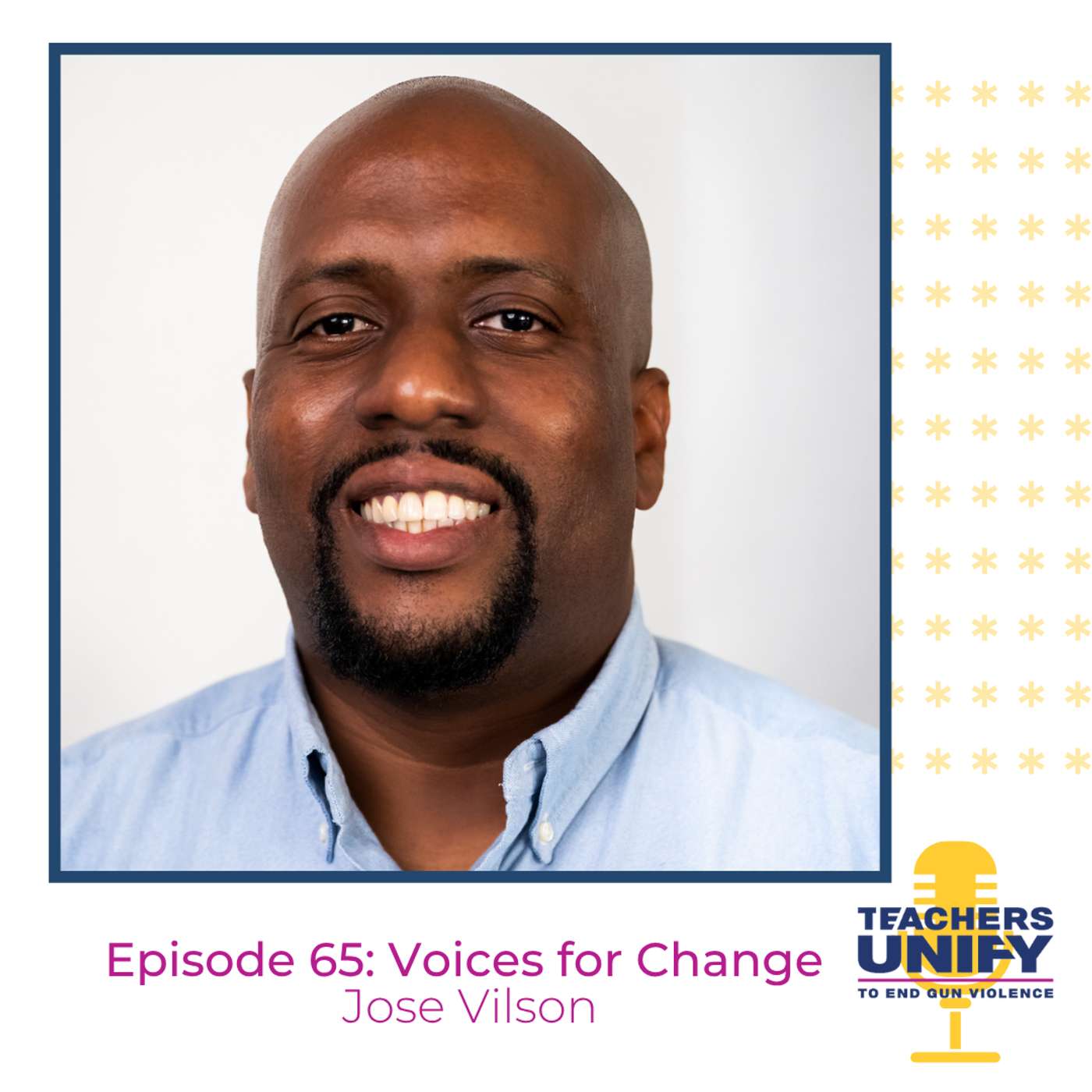
This episode features José Vilson, PhD, a New York City educator & the Executive Director of EduColor. He talks about what led him to education and creating EduColor, how he came to work with Teachers Unify to End Gun Violence and why he is committed to making change in the gun violence prevention space.
Speaker 1: Welcome to the Teachers Unify podcast. I'm Sarah Lerner. This episode features Jose Vilson, a New York City educator and the executive director of EduColor. He talks about what led him to education and creating EduColor, how he came to work with Teachers Unify to end gun violence, and why he's committed to making change in the gun violence prevention space. We are joined by Jose Vilson, who is the executive director of EduColor, as well as a recent PhD recipient. Huge mazel on that, and welcome to the show. Speaker 2: Thank you for having me. Speaker 1: So we'll jump right in. As I just mentioned, you recently got your PhD, so I wanna kinda backtrack from that. What led you to education, and what has been your journey within the field? Speaker 2: Well, I mean, number one, I'd start off with just being very fortunate to have gotten a world class public education in MPS one forty. I know a lot of people don't say world class in public education, but I'm a big believer in the power of education and furthermore, for those especially who might not otherwise be given the opportunity to have the educational experiences I did. I was born and raised in the Lower East Side Of Manhattan, back when we were still in transition from a predominantly Jewish neighborhood to a Puerto Rican, then Dominican as as well as, like, black of all types and specifically Chinese, immigrants. All types of folks is coming through. Like, I literally got to experience what I felt was the power of integration in PS one forty where you had a Puerto Vican principal, Jewish teachers all through pre k to six, mind you, and a set of multicultural kids, multiracial students from all across the board. And so, like, that vision carried me into where I went to two all boys Catholic schools, shout out to Nativity Mission, unfortunately, and Xavier High School, which is also all boys military. And, you know, Syracuse University, I was able to go as a computer science major. And within that, I became very active on campus with Lucha, which was the Latino organization on campus at the time as the education chair. I was doing a lot of sit ins and teach ins and those sorts of things, and I think that ultimately sparked this curiosity in me that I could actually become a teacher of some sort. So I did that for fifteen years, then I'd have some time around 2020 just a little after we got, over disaster distance learning. I didn't even call it virtual learning. Disaster distance learning was appropriate for that first semester, that we were, you know, under siege, I suppose. And, yeah, got my PHD in four years later, so pretty grateful. Speaker 1: That's awesome. My son got into Syracuse. He chose to go elsewhere because they chose to not give us any money. Speaker 2: I hear you. Speaker 1: My mom is a product of the New York City school system. My dad grew up on Long Island, but she went my mom went to PS one zero four for elementary school. I am also from New York, but did high school in Florida, so I don't have a a PS to share, but shout out to New York. I know you were asked to be a founding Teachers Unify board member back in 2021 when we first created this. Since you are such a busy guy, as you just explained, you agreed to be our first and now our longest standing Teachers Unify adviser. Why did you wanna be part of the organization? Speaker 2: I think for me, it just mattered that because I mean, you know, like, sometimes when you get asked by very specific people, it's not a matter of if but when. And I think especially given so much of what was happening, not just what I personally experienced, but also what was happening around the country, I felt it important to at least take a stand and find a way to do so. And this organization was specifically important for me in that way. And so I said, great. Like, if there's a role that I can take on with my really busy schedule, surely, but also recognizing that I needed to have something to say about it and be standing in solidarity with people who were actually doing the work on it, more power to all of us. Speaker 1: On 02/16/2018, you wrote a piece for HuffPost titled American School Teachers Are Heroes. They Shouldn't Have To Be. The piece came out two days after the shooting at my school, and you referenced three colleagues of mine who were tragically killed, Scott Beagle, Aaron Feis, and Chris Hickson. So I have two questions that you can answer separately or together. What impact did the shooting at MSD have on you? Beyond that, how have the seemingly endless list of school shootings and acts of community gun violence impacted you and the students in your community? Speaker 2: Well, it's a few things. Number one is, you know, growing up in the context that I did, my neighborhood got pretty infamous for students shooting each other over Jordans. And that was, like, the first thought, but then, unfortunately, the conversation stayed in the these black boys are a problem. This is not a community problem. This is specifically them problem. And so we need to over police, we need to over regulate children, we need to try to find ways to restrict their creativity and their schooling. Like, all a litany of issues that I felt were not actually targeting the issue, which was the guns. Fast forward and, you know, I become an educator, and I start seeing time and again truly how desperate so many of my students were to get out there and be part of situations that, unfortunately, they probably regret as they got older or they're still in in certain cases. And I've had students pass away via gun death, and that was not all the the most pleasant news to hear about when it comes to, you know, when it came to my former students. But then I also think too. Right? Like, as somebody who is a larger black man, I was constantly put in a situation where I was asked to, you know, prevent fights and prevent people from hurting each other and kids from hurting each other as opposed to trying to find ways for the whole community to step in and prevent the fighting from happening and try to create some sort of restorative justice situation. And so when that specific and by the way, obviously, it's been almost ten years, but it's kind of recurring anyway. So it's probably, in a way, fresh. Right? Because we we can't stop doing what we're doing because policies just will not have it. I just recall saying to myself, how often are teachers asked to be the folks who have to step in in the face of danger even when our contracts tell us otherwise? Paradoxically, we are told that we're supposed to care deeply about children and not step in as we see these children who we care about get hurt and or hurt each other. And so America has not yet reckoned with that paradox and refuses to in the way of being supportive. I mean, it does start kind of with the thinking that teachers, for example, you know, are underpaid, recognizing that the work is highly feminized. We have a predominance of women who are in our profession and, you know, just the identity alone, but then, you know, you go deeper and deeper and you start to realize that, like, actually, like, it shouldn't be. I'll put it another way. I feel like teachers get the brunt of what society has constantly put on us. And so when you put it that way, you start to realize that these things aren't by happenstance. This is actually manufactured and created in such a way where teachers have to necessarily step in in a way that they otherwise shouldn't or wouldn't because of the situation that we consistently get put in. And so I wrote that article specifically thinking about what would I do or what have I done for that matter in situations that were pretty perilous that at any given moment, I wasn't sure if I was gonna come back safe, whole, and all that other stuff. Luckily, I've never had to face a gun as a teacher, but I have had to deal with all sorts of situations where students would either harm each other or harm themselves. And that's not a great position to be in, but there are ways to at least prevent it, if not outright eliminate it via our policies and practices on a societal level. Speaker 1: I agree. And outside of the shooting at my school, I also have had students who have experienced gun violence in their homes, in their communities, have attempted suicide. It's a bigger problem, I think, than everyone realizes or wants to realize because what they see on TV are the school shootings, the mass shootings, but not the domestic violence, the friendly fire, the drive bys, the community violence. Like, all of those things, they just don't see or care to see. Something you said made me think, it was a week after the shooting, I was on CNN because I'm a big mouth, and I wanted to get it all out there and not have fifteen minutes of fame, but make sure that people understood what happened to us. And I was on opposite a sheriff from Ohio, and I've mentioned it on the show before. You can Google it. It's probably, like, angry teacher yells at sheriff. It was right after Trump, in his first arming teachers, that that would solve this problem, which we all know it won't. The sheriff, you know, was in favor of arming teachers, and I said, live on air, you know, I didn't go to college to be a bouncer. I didn't go to college to be a police officer, but I shouldn't have to have a gun to feel safe at school. And the money that they're spending or that they would spend to purchase this gun for me, to teach me how to use this weapon safely, that money could be better spent elsewhere. I may or may not have yelled, give me more money in my paycheck. Speaker 2: Never do that. That action. Speaker 1: I that's why it's angry teacher yells at sheriff. I think there are so many unknown variables. Speaker 2: Yeah. Speaker 1: Especially in schools with a large population of black and brown students, that does not make them feel any more safe knowing that their teachers are armed, Or any students in general knowing that their teachers are armed, and all you're doing is adding more fuel to the fire. When as you said, there are other solutions to fix this problem, but, you know, politicians, mostly on one side of the aisle, just want to push more guns. Giving teachers guns, having more armed people on campus will keep these children safe. But as we've seen, a good guy with a gun isn't any better than a bad guy with a gun. Speaker 2: I mean, the the trouble is is that when you have a and, of course, this is me putting my sociological hat on. When you consistently ask the culture to arm themselves with guns, when all you offer people is guns and not policy, then, of course, the natural solution is in their minds to just give everybody a gun in instead of finding ways to pull back from said culture. Right? By the way, like, yes, I too did not come into the profession to, you know, pop a shotty kid. Like, that would be that's wild. Right? Like and for that matter, again, it is incompatible to say, a, I care about kids, and then b, I have a gun just in case. Of what? Like, you know? And this is the struggle. And the struggle being that on the one end, yes, you wanna be able to, you know, protect yourself and others, but one little pew pew is not gonna do anything against a a k 47, for example. For what it's worth, the first class that I taught when I was a doctoral student was in 2021 over Zoom, and I think we were maybe three classes in when Uvalde happened. I am at my fifth time teaching this class, and yet I can never really shake that moment of even though I technically love teaching, that moment of terror has never left me. And, like, even as I think about the heroic teachers of the time, like, in Valdes trying to, you know, make sure their kids were okay, they saw one of their former students fully armed like they were at war, which, by the way, we also need to sit down on because that's also having real deleterious effects on people right here domestically, right, as well as overseas. Thinking more generally about gun culture, imagine saying to yourself, actually, I'm a come in and care about kids and love kids. And then the minute that you're faced with a gun, all of a sudden, like, that tool of care may not get you out of there. And so if we wanna create true environments of caring, then society needs to match that energy and ensure that, you know, people are authentically safe. And authentically safe doesn't mean that we just start putting, like, makeshift soldiers in the form of us in front of students. It means, like, literally stopping gun culture from being what it is. That that has to be the solution. And so that that's kinda where I sit on that too. And, like, condolences to all the folks who've had to suffer in this way. But, jeez, it feels so simple yet so difficult for too many people. Speaker 1: You're absolutely right. And something you mentioned was also part of my rant to the sheriff. I told him that a handgun is no match for an AR 15, which is what the shooter used at my school. And had he gotten into my classroom, which he didn't, but if he had, my gun would have been safely secured somewhere in my classroom, out of reach for my students. But by the time I would have tried to go get it, I would have been shot and killed. What happens if the teacher is armed and shoots the wrong student? What happens if a student gets a hold of your weapon? Like, this is what's so wild. Armed teachers, more guns on campus. Florida passed the Guardian program where they wanna have more people armed on college campuses, which is outrageous. In theory to them, this makes sense. But in practice to us, those of us who are in the trenches doing this daily, it literally makes no sense, and my students would have been no safer any of the students on campus would not have been safer if any of their teachers were armed. Furthermore, if I may continue my rant, the police officer, the school resource officer on campus that day did not go into the building. He did not fire at the shooter. He hid somewhere. So our armed officer didn't act, and he was on campus, like, within feet of the building. He's trained to use a weapon. He's trained for all of these things. And you want me? I'm barely five feet tall. Like, I give a big presence, and I'm from Queens, and I have a big mouth. But, like, you wanna give me a weapon? Get out of here. Speaker 2: To add on to that, and that's probably why, like, I felt my role to be so imperative with the org, is thinking about the racial justice component. I think to 2016 when a conservative substitute in my predominantly Latino and black student body, like, school, like, he came in and that day he said, I am so excited that, you know, Donald Trump is going to be elected president and because we need to get these illegals out of here and all this really awful terrible stuff that he just felt so empowered to tell kids. And these kids, mind you, are literally, like, holding onto their phones terrified because they don't know if their, you know, elders are gonna be taken away from them, which probably some of them were, or if they're gonna be more likely to be targeted by any number of forces. You know, these are things that if that conservative substitute had a gun when the students yelled back at him, like, what do you think you're doing here? It could have been pretty awful. And that's unnerving. And luckily for that teacher, that teacher didn't get touched, but they definitely ran over to my classroom, like, save me from that class. I cannot go in there. It is pretty awful. I was like, okay. So this is what my breaks are for. And so there have been big conversations in many communities, especially racialized communities about the role of teachers with guns. That is to say that when you have disproportionate disciplinary actions met against black and brown students, overwhelmingly black kids, but also like, black boys, but, you know, black girls are also quickly rising in that respect, native American boys, so on and so forth. It stands to reason that we just need to be more thoughtful about the way that we engage, like, guns more generally. And, you you know, like, to your story, it also felt like also, folks were okay with, you know, this what what is it? The the police officer who's supposed to be supervising SROs, school resource officer, they are supposed to be doing this. But if if they are trained and they see the perils in the a k 47 and they find themselves hiding, imagine the rest of us. You know? Like, that's a losing battle time and time again. And so being actually thoughtful about human lives would be a really amazing approach to actually building policies and laws across the country. Speaker 1: This kinda segues us into my next question. You presented with Teachers Unify at South by Southwest in 2024. This session was called educators on the front lines of the gun violence epidemic, where your HuffPost article was included in part of the session. You said that it's important to reckon with how race and class are contextualized after shootings. You went on to say that black children, Latinx children, native children in the media are portrayed that there is a problem with them. There's a problem in that community, not the shooter who is bullied or mental health issues. In white communities, the media always tries to humanize the shooter. Yeah. So can you talk to me about that? And I know we've already touched on it a little, but these instances of gun violence within black and brown communities, not necessarily school shootings, because we know that they're so much more prevalent than school shootings. Speaker 2: I wanna add a layer to this too. It's about the outcome. Like, how do we react to similar incidents across the board based on identity markers? We'll call them that. If the child is, you know, who's the shooter is back, then we know it's gonna be sanctions. It's gonna be punishment, some form form of jail, altification, particularly altification in that this child no longer gets to be a child. They have to be an adult, and they will be tried as such. And that happens, you know, disproportionately time and time again. When it's a white child, however, we see the smiling faces, the angelic, you know, halo behind them, or they get taken to, I don't know, you know, a fast food restaurant, offer a burger, offer fries, and they're able to, you know, have a semblance of a life before they finally get sanctioned by, you know, some sort of judge. They that might necessarily happen either. Right? There are sometimes when the child gets to, like, sit with the judge watching what happened and saying, oh, did you do that right there? Oh, okay. Well, I guess that's just not you. Like, you just get to little oh, you know, you get to live your life because that's what's been bestowed upon you. I would say that, you know, like, regardless of where you sit, whether you're totally, like, abolitionist, you believe that you need to clear all punishment or you're somebody who's on, like, super hard line, these sorts of punish punishments are not meted out equitably at all. So if you believe it in one way or another, then you need to treat these cases in the same exact way regardless and because of who people are. Right? From our perspective, since now I'm speaking with this hat, right, the Teachers Unify hat, we generally need to say to ourselves, okay. If students see that guns are the option for them to relieve their inner qualms and inner issues, what does that say about the resources that are given to them and the outlets that are given? For that matter, what the expectation is of them for them to release whatever their specific issue is. Right? Because if if it's mental health, then we have specialists for this. We have resources of types. We have approaches that allow for people to come off the ledge. Who gets that type of resource is disproportionate already there. And then at the point where the child's maybe, like, talked to in a specific way or is able to use different resources to be able to say, okay. I don't have to get that far in order for me to be taken care of. Generally speaking, I don't think America cares about children, period, in the ways that it should. And you know this well. And because if they did, then not only would they treat adults well, they'd actually have services and conversations with children a whole lot better. We care less and less about kids, and that's why there's this dystopia in front of them. And now we're raising a whole generation of kids who probably don't feel that same level of childhood, which is why, like, you know, this notion of I don't know if you've seen, but our children in especially, like, the elementary, middle school, they're a little grungier. Even the high schools, like, even with the white kids that I'm seeing, like, their hair just, like, all flippity floppity and and the dress code isn't, like, you know, spiffy or any of that stuff. They're like, I could just throw on whatever, walk in their jammas and whatever. That that's not just a style choice. Right? There's something about it that says, I need help, but I don't think society cares about me. So I'm just gonna walk around, however. And so, yeah, we have a lot to rectify, and I think it really just starts with saying to ourselves, how can we as a whole culture, white, black, etcetera, but particularly for our white children? Because, again, I'm not in that community, so I need y'all to do it. Talk to your kids and say, hey. We care about you. We like you. We love you. And being able to have that community that way. Because I I know that that's happening in my house. Custom reminders regardless of what society says because we have to. And people say, well, you know, what kind of conversations are you having? We're gonna ban those. You can't ban that conversation? Like, the conversations I need to have with my child isn't just about police. It isn't just about these, like, forces that may or may not like him. It's actually about just telling them straight up that, like, we need you to love yourself in the way that we love you. Can cultures do that that are not mine? I don't know. Like, that seems to be something that needs to happen because that's one way to tempt down some of this stuff that's happening with gun culture as well is just this idea that actually our kids deserve to be loved, and that needs to be reflected in our homes. Speaker 1: I think there also needs to be more emphasis within schools and communities about safe and secure storage. Because how many of these shooters and how many of these people are accessing guns that are readily available in their homes? Like, we don't have guns in my house. My son is 20. My daughter is 17. I have had conversations with them about going to a friend's house. I always check with the parents to see if there are weapons in the home, and if there are, they don't go over there. The other kid is welcome to come to my house, but I need my kid to come home in one piece. At first, it, like, embarrassed my kids that I would ask those questions. That was before the shooting at my school even happened. After that, I'm like, oh, no. No. No. This is not even a conversation that you, child, and I am having. I am your mother. You know what I went through. Outside of that, I still need you home. I had a friend who I've talked about on the show before, Andrew, who was at his friend's house. The friend's dad was a police officer. This is when I lived in New York. They were looking at or doing something with the dad's weapon, and it went off, and Andrew was shot and killed. And that was in March '95. Speaker 2: Mhmm. Speaker 1: And we were 15. I'm now 46, and all these years later, it still sits with me. It's the conversations about mental health. It's telling your kids that they need to love themselves. It's everything you said, but it's also access to these weapons. It's access to mental health resources and things within schools and within the community. I remember after the shooting at school, so many kids were talking about going to therapy because they had just survived something so horrific. Prior to the shooting, students wouldn't speak openly and freely about that. There was this stigma around going to therapy, about getting help for your mental health. Not to say that positives can come out of this, but something positive ish was this more open communication and open discussion about taking care of your mental health. And I think in certain communities, that is frowned upon or isn't talked about. Even if the resources are there, they may not be sought out because of cultural stigmas or cultural feelings. So that coupled with just as the parent talking to your child and asking these questions about weapons and making sure if you have them in your home that they're securely stored. That should be the conversation that we, collective, are having, not arming teachers and all of these other foolish things that are being talked about that aren't helping fix the problem at all. Speaker 2: And the research is bearing that out. Right? Like, as you said, I haven't yet seen research that tells me that having armed teachers is actually gonna be helpful in situations like this because the degree is just so different. Right? I'd also add to and I I thank you for reminding me of this is that, you know, I'm very happy to see that more people are talking about therapy openly. That's been very heartening to see, especially a young among young people. And, you know, I know that there's a bunch of different shows that try to deal with that in one way, shape, or form, and that's really that's righteous. And this is also why we're here is to also talk about this idea that it isn't just a personal or interpersonal. So that's, like, you know, what we've been trying to dig into a lot too. It goes right back also too to, like, saying, okay. Now that we've done our work, what are y'all gonna do? And so for me, I I think to something that I I think about is, like, you can do the self care to the umpteenth degree, but self care only goes so far. People get mad at me all the time when I say that because they're like, Jose, you don't sleep. You don't do this, and you don't do that. I'm like, okay. But, you know, like, this feels disingenuous because you're trying to maybe buy a bunch of products that told me how to, like, take care of myself. But it's not about me taking care of myself. It's that I see what my communities are going through, and that is having real serious effects on my own mental health. So, like, that therapy stuff like, I'm happy to do it. You know, I meditate, on a regular basis too. Like, there are things that I'm doing now as I get older that, you know, are being are helpful for my mental state. And, like, it'd be really good if we were able to get some things in place that actually temp down on how people are interacting with each other, and for that matter, are elevating how we can care more for each other, because, really, all we have is us. It it it's a old, you know, adage that some folks have used in community organizing spaces, but I I appreciate it because it's a good reminder that we need to actually look out for each other. And we we need to make that a thing that society does so that we are not solely responsible for handling everything that happens with our mental health. Like, that is kind of at the crux of this thing with the guns is that we don't know how to look out for each other as a society. Like, to say, actually, like, how do we help you? How can I help you? And even if I am not personally available to do it, can my government, whether it be local, state, federal, do we have pieces in place that allow for the helpers to go find the people who need to be helped? And if that's not a thing that we have yet, and that includes with all the serious situations we've had since Columbine, perhaps before, but definitely after, then we need to keep having the conversations and then we need to keep having politicians who are able to say, actually, I'll step in and do the right thing for us. So that matters a lot. Speaker 1: It would be nice if if they did that. Speaker 2: It'd be so, I mean, you could also yell at them one more time, and that'd be really fun. Speaker 1: I would like to. We'll get another clip. Teacher yells at politicians. Speaker 2: Or two. Speaker 1: Or all of them. It's not a problem. Speaker 2: I respect that a lot. Speaker 1: Thank you. I know you're the executive director of EduColor. The mission of the organization is to amplify the works and ideas of students, educators, and communities of color through supportive on and offline networks and professional development. Can you talk about the organization, how it was created, what you do beyond the mission? Speaker 2: Thank you. We started off in I mean, technically, in 2012, I I kinda came up with this idea with I was in the table with a few other folks who thought about diversifying education conferences, specifically from a racial perspective, and then we realized that was kind of a feudal mission because at that point, every, like, conference was white. All the speakers were so on and so forth. All the organizers who had the resources. Right? Like, I was like, okay. That's a worthwhile thing to talk about, but that's not all that interesting. But in 2014, especially post Trayvon Martin, it was evident to me that the education space needed to pick up the pace when it came to the conversations about what all the events that surrounded folks like him, Sandra Bland, Eric Gardner, like then, of course, the list goes on and on. Right? It was evident to me that we needed to pivot just a bit. And so me and at the time, a bunch of friends of mine decided that we were gonna get together an email and really have conversations with each other so we can, like, actually strengthen ourselves and talk about, like, what the critical issues were and then try to build something more sustainable and institutional that pushed back on this idea that we had nothing to say about the current moment. Education, as you know, often comes off as super conservative. And by conservative, I truly mean, like, very unwilling to change, unwilling to move forward. You know? And that felt like it typified 90% of people who we were trying to move the needle with. Now I think it's improved a bunch, but, you know, there's still more work to be done shortly. And, you know, we were mostly digital back when Twitter was a thing. And now, obviously, that it's the platform formerly known as Twitter, RIP Twitter. You know, we that was our thing. We were in the digital space, creating chats, having conversations, building out free resources, so on and so forth. And then, you know, like, we had to pivot in a very strong way. So sometime in 2020, we pivoted to other projects. Thankfully, we've had some really strong collaborations with different organizations, the Center for American Progress at the time. Ted, who we're still ramping up with too as well, the National Education Association. We have a list of folks we really care about. I think at the crux of it is we have some good partnerships. The first one includes the National Education Association, trying to help the teacher leaders get stronger when it comes to, you know, the racial and social justice stuff and trying to just build community through them. The second is our really awesome grant funded, work that we're doing here locally in New York City with the TC Center on History and Education, where we're trying to get more teachers to build the social historical lens about their work so they can look at education, activism, and history. Shout outs to Anzee Erickson who her class was the inspiration for this project. And then we ended up partnering with them so that we can quickly amplify that work. And we've been grateful to do so, and that's great. And we have book clubs as well, and we've been partnering up as well with them. So, like, one of our summers, we had Christina Jimenez as our speaker. We're going to have a Juicolor Summit come up soon where we try to bring up speakers who otherwise don't get the opportunity to have a stage to share their thoughts and their ideas, and we get to amplify them in our own way. But we've been a pretty malleable org because of the moment that we're in and because of the attacks that are happening at the federal level that are filtering down even to the state, even to places like New York State where you would think, oh, like, that's yes. It is happening everywhere. But, we have to continue because even though the words might change, the visual knots. And so that's us. Us. Speaker 1: You have a ton of resources on the website, and you mentioned the summit. Can you talk about, like, what the summit is? Is it an annual summit? Like, how do all of that? Speaker 2: The summit is funny. We did it for five years straight, and it was pretty well funded. And like we said, you know, we're now trying to think about what that looks like in this moment in time where people don't wanna be in front of a screen. But for five years straight, we were able to get together hundreds of educators to come together and listen to any number of, like, speakers, including educators, folks who are out there in the field, like, some really big names, but also we put them in parity with educators. So it wasn't like, oh, look at this really big speaker here. Was like, no. Actually, they're gonna be in conversation with somebody who's currently doing the work in the education and have them be in dialogue, and I thought that was really powerful from that perspective. There were a couple years where we gave it away for free. Eventually, we ended up, like, doing $20.30 bucks as a professional development course. So we attached credits to that, and that was really cool as well. But overall, I think what the experience showed was twofold, the power of building community. Even though we were physically distant, we were socially together, and that was cool. But then the second part is that, you know, the way that we think about professional development is so, like, in need of a remixing. And I think about so many of the movements that have, you know, taken place, I would say, over the last twenty years to change how we think about professional development. So much of it is focused on content and, like, standards, and that's all well and good. But there's also the stuff that, like, feeds you in order for you to be able to continue to do your work and go on to the next day. And I think EduColor Summit did its best to position our programming so that you can hear from people who have found ways despite and because of what's happening around them to build something anew, to stay in the work, to continue to build on what they, you know, have already been building on. So our I mean, our reviews were anywhere in the 90 percentile, and that was really prominent. Like, we actually got feedback back, and I was so excited about that. Like, if we had a cyber hour conference, the average attendee stayed six and a half. Right. And so that spoke volumes about the level of programming that we had throughout, and the student speakers were, of course, phenomenal. And we had all sorts of, like, stakeholders, including, like, parents, families, so on and all these topics. And but most importantly, I think at the heart of it is trying to find people who, you know, can build a clarion call for why we do what we do. And I think that's what EduColor Summit did super well, and we're hoping to build something anew in the coming years. Speaker 1: What can teachers do, educators in general, to amplify the work you do? If they wanna get involved with EduColor, how can they do that? Speaker 2: Well, we have two ways of doing it. The first, they can join our membership. We do have a membership platform community at Educolor dot org where we do have a small, you know, entrance fee. But I think with that, you're able to get the plethora of resources, including connections that we have on the platform to different people across the country. But, you know, we also have a free newsletter. Like, that actually helps sponsor the work. We have a handful of volunteers who we try to provide the honorarium for, and that's helpful there. But our newsletter has been well received by thousands of people at this point, and we're hoping to build out the newsletter so that people can continue to receive resources despite all the different bans that are happening. Like, they find a way to get information from people across the country in that way, and in some cases, the world too. You know, most importantly is, like, for folks to just keep the vision alive would be the most prominent thing. Regardless of what happens with the organization, we want the work to continue. So that's our next part. Like, it'd be nice if we lived in a world where EduColor did not need to exist. I can't believe I'm saying that as a nonprofit leader, but that's just that's the real thing. Right? And I'm I know missus Clemens feels the same way. Like, we both feel like, you know, like, it'd be nice if we lived in a world where the problem that we're trying to address wasn't a problem anymore. And so that's the work I'm trying to get to, and I'd love to see it in my lifetime. Speaker 1: Thanks for listening. Don't forget to follow Teachers Unify to End Gun Violence on Instagram and threads at Teachers Unify and follow the podcast on both platforms at Teachers Unify PC. If your school or community have been impacted by fear or experience of gun violence, please reach out to our Teachers Unify crisis intervention and support team at [email protected] or area code (203) 296-3689 and visit our website for more information. You are not alone.