
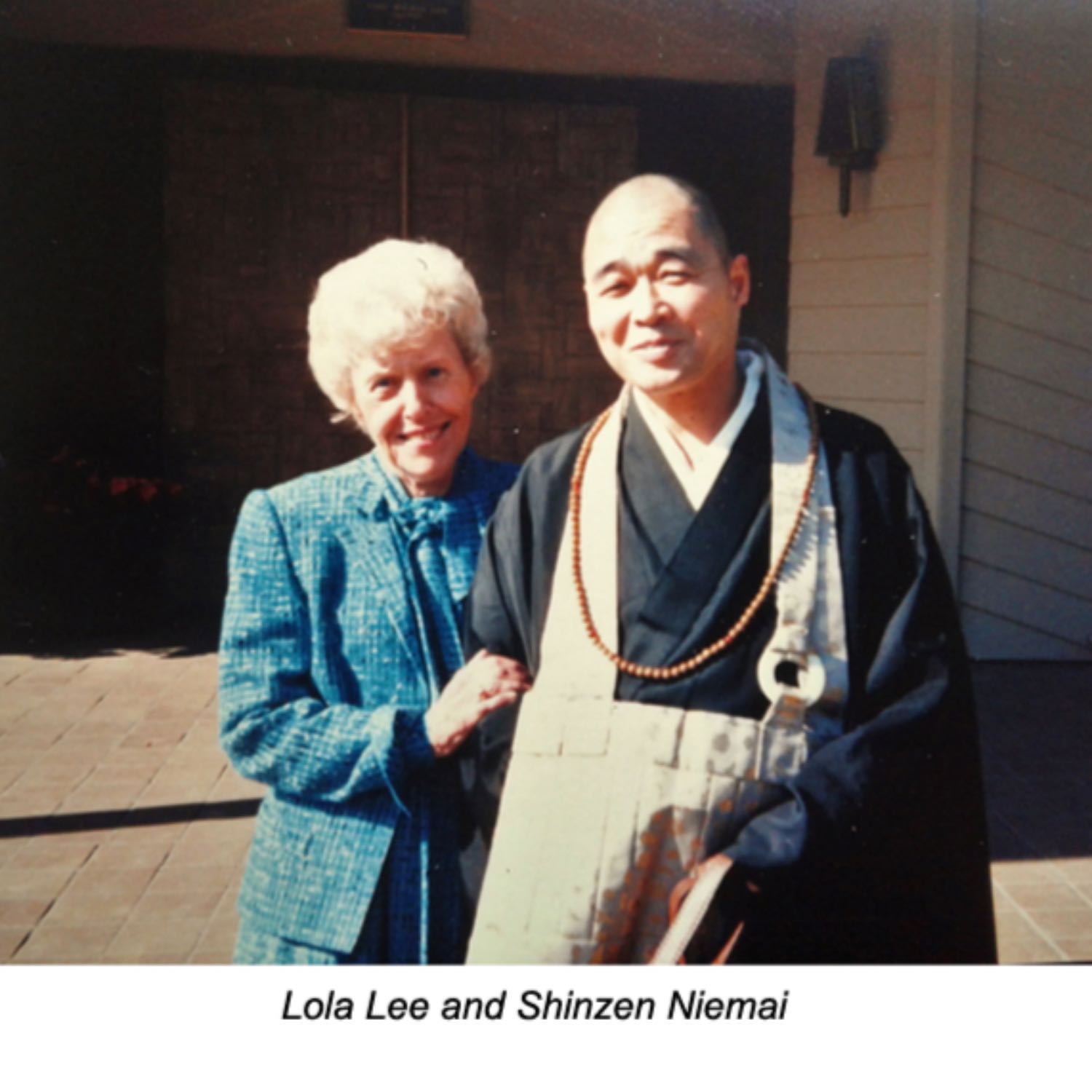
Talks by Zen Roshi, Lola McDowell Lee · I & A Publishing
Zen Roshi, Lola McDowell Lee, recounts Chuang Tzu’s advice: the purpose of a fish trap is to catch fish, and once the fish are caught, the trap is forgotten. So too with words — once an idea is truly grasped, the words that carried it should be released. Yet we find this nearly impossible. Words stick. They cling to the mind and take on a life of their own, trapping the very people who use them. She illustrates with two ancient stories. In Egyptian lore, a god wished to thank humanity for its devotion and decided to give people the gift of words — only to be warned by the great god Ra that this would put them in bondage. And the Buddha’s tale of five men who crossed a flooded river in a small boat. So grateful were they that the boat had saved their lives, they would not leave it behind. And so they hoisted the boat onto their heads and pointlessly carried it for the rest of their journey. Lola asks how many boats, ladders, and paths are we still carrying in our heads? Lola points to silence as the source of truly alive communication. When the mind is not churning with its stored content, heart can speak to heart--unlike ordinary social chatter, which acts as a relief valve for inner disturbance rather than genuinely meeting another person. Lola tells a humorous story of a Zen monk who calls a bartender repeatedly in the middle of the night asking when the bar will open. When the exasperated bartender finally shouts that he will have to wait until nine for a drink, the monk replies that he does not want a drink — he is locked in the barn and wants to get out. We are locked inside and mistakenly reaching outward. The real movement is inward. Lola describes the uncreated mind through the image of a polished mirror or a crystal ball. The mirror is originally clear and unblemished; our likes, dislikes, prejudices, envies and graspings settle on it like dust, obscuring it. Yet the mirror itself is never changed by what it reflects. But actually, the uncreated mind from the very beginning has not been anything else but pure. The created mind has accumulated so much authority that it has mistaken itself for the master of the house — when in truth it is only the manager, meant to serve something deeper. Glimpses of no-mind do arise in meditation, in a sudden beauty, in an unguarded moment with a butterfly or a ray of sunlight — but the moment the created mind rushes in saying “look what I’ve done, give me more of this,” the contact is lost. The appropriate response to such glimpses, she says, is simply gratitude. Delivered August 3, 1986
0:00Here is one of a series of talks by spiritual
0:02leader Lola McDowell Lee spanning two decades
0:06from the early 70s through the 90s. Lola was
0:10a Zen Roshi whose Rinzai lineage included Dr.
0:13Henry Plutov and renowned Zen master Shigetsu
0:17Sasaki. Lola was a religious scholar as well
0:21as an ordained Christian minister. While the
0:24talks are focused mainly on Zen and Buddhism,
0:27Lola drew on many spiritual traditions, including
0:30those of Jesus, Plato, Lao Tzu, the Hindu Vedas,
0:35Meister Eckhart, and Gurdjieff. Well, today we
0:41have some words from Chuang Tzu. The purpose
0:46of a fish trap is to catch fish. And when the
0:51fish are caught, the trap is forgotten. The purpose
0:55of words is to convey ideas. When the ideas are