
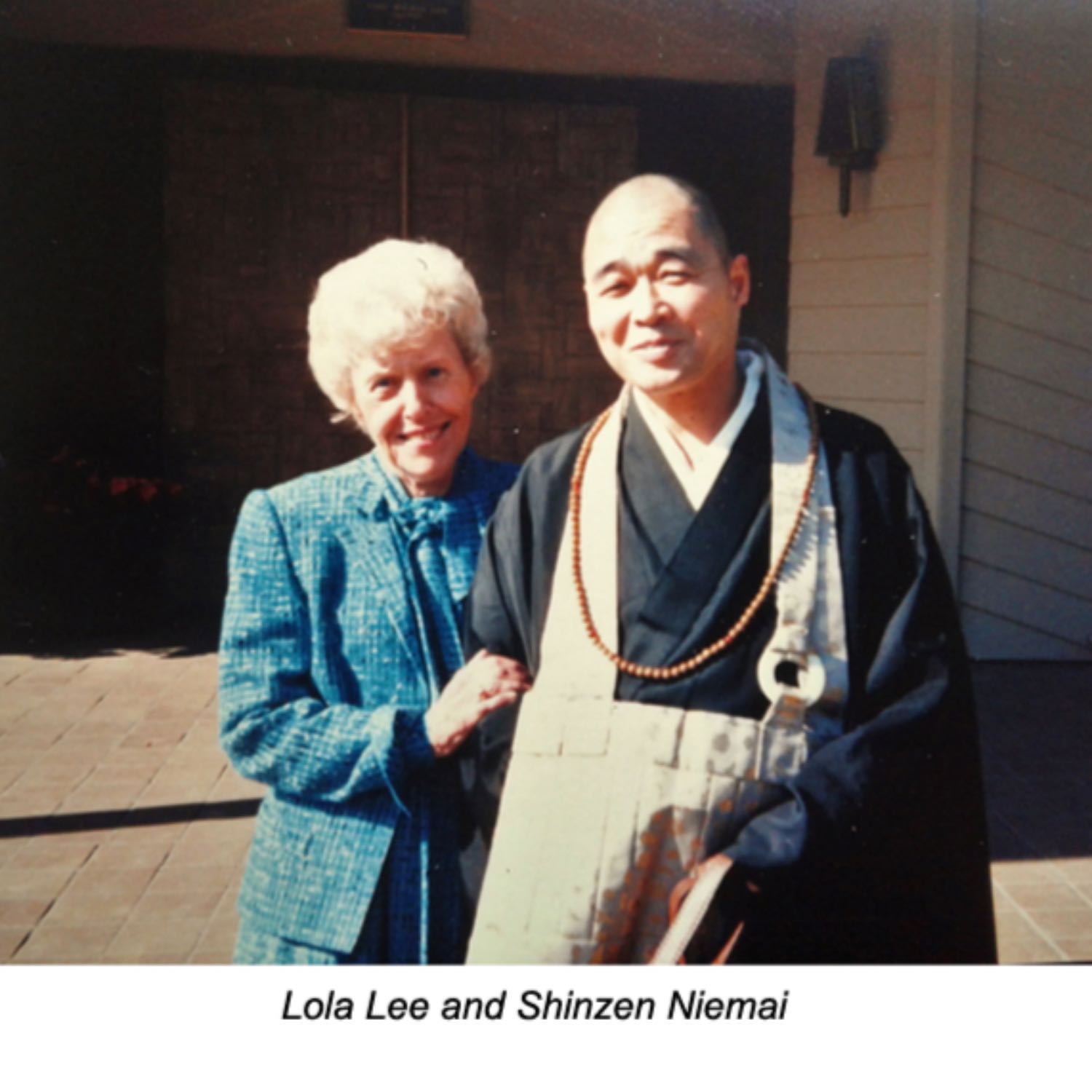
Talks by Zen Roshi, Lola McDowell Lee · I & A Publishing
Zen Roshi, Lola McDowell Lee, explores our tendency to confuse changes in external conditions with genuine inner liberation. Lola recounts the classic Taoist parable by Chuang Tzu, "Three in the Morning," about a monkey trainer whose monkeys revolted. The wise individual perceives both sides of dualism without partiality, viewing all phenomena in the unifying light of the Tao. Why are we so easily tricked by these superficial arrangements? Lola examines the "monkeyish" mind. For most of us, the mind leaps wildly from thought to thought. She compares this to a person holding a cracker in a river: thoughts flow through us continuously, and when one is partial to a specific thought, associated ideas and memories rush in like hungry fish, attaching themselves to it until the mental energy dissipates. This mechanical cycle, repeated countless times daily, makes up our subjective worldview—a reality rooted entirely in discrimination (like vs. dislike, pleasure vs. pain). Lola explains that as self-consciousness emerges from the unconscious in early development, a sharp divide is created between the observer and the observed. This separation conceals a third factor—a foundational, unexamined state of ignorance. Far from meaning stupidity, this spiritual ignorance refers to acting without direct knowledge, or noesis. Trapped within this subject-object dichotomy, human beings mistake relative dualities for absolutes. Spiritual understanding recognizes that all dualities are relative and grounded in a singular, non-dual source—whether designated as God in Christian theology, the Tao in Chinese philosophy, or Emptiness in Zen. Lola clarifies the concept of karma. Drawing from its Sanskrit root kri (meaning "to act"), she equates karma with samskara—the condition of living under the domination of bodily sensations and psychological conditioning. Most human beings live under the delusion that they are independent, free-willed agents. In reality, however, they are managed by their sensory reactions and emotional reflexes, swept about like leaves in the wind. When people attempt to "purify their karma"—they remain caught in the same monkeyish trap of manipulating details, neglecting the root cause of their suffering. Lola illustrates the futility of theoretical fixes the story of an abstract-minded doctor who observed a pneumonia-stricken tailor recover after eating 32 potato pancakes. When the doctor prescribed the exact same regimen to a dying shoemaker, the shoemaker died, prompting the doctor to foolishly note that potato pancakes cure tailors but kill shoemakers. This rigid approach to life ignores the nature of things. True transformation requires addressing the interior ground of consciousness. The resolution to this human dilemma lies in the practice of Zazen, silent meditation and cultivation of non-dual awareness. By sitting in total stillness, the gushing fountain of reactive thoughts and feelings settles, giving rise to subjective...
0:00Here is one of a series of talks by spiritual
0:02leader Lola McDowell Lee, spanning two decades
0:06from the early 70s through the 90s. Lola was
0:10a Zen Roshi whose Rinzai lineage included Dr.
0:13Henry Plutov and renowned Zen master Shigetsu
0:17Sasaki. Lola was a religious scholar as well
0:21as an ordained Christian minister. While the
0:24talks are focused mainly on Zen and Buddhism,
0:27Lola drew on many spiritual traditions, including
0:30those of Jesus, Plato, Lao Tzu, the Hindu Vedas,
0:35Meister Eckhart, and Gurdjieff. What is this
0:42three in the morning? Well, it's about a monkey
0:47trainer who said to his monkeys, and you know,
0:51he told them, as regards to your chestnuts. You're
0:54going to have three measures in the morning and