
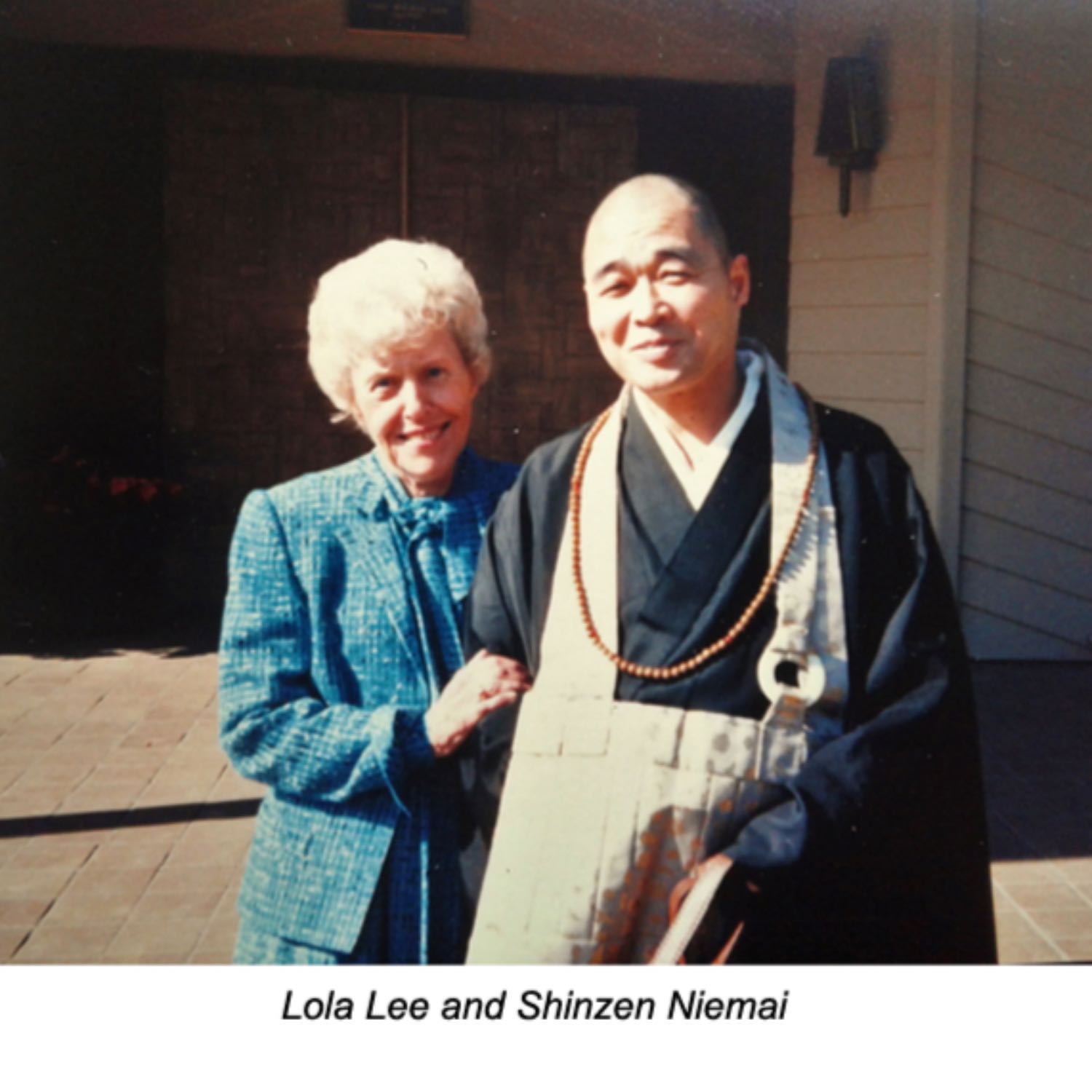
Talks by Zen Roshi, Lola McDowell Lee · I & A Publishing
Zen Roshi, Lola McDowell Lee, discusses the concept of the "Unborn," the central teaching of Master Bankei. Lola recounts the story of an arrogant Abbot trying to challenge Bankei. The Abbot told his congregation, “If I put a difficult question to him, I can stymie him with just one word. So saying this, he went off to see this supposed master. And here in this large crowd, in the middle of the talk, the Abbot shouted in his booming voice, “Everyone here accepts your sermon and believes it. But someone educated like myself doesn't accept. If a person doesn't accept, how are you going to save him?” And Bankei raised his fan and says, “Come forward.” So the Abbot went forward to stand before him. And then Bankei says, come a little closer. So the abbot shuffled forward again. And Bankei looks at him and says, “See how well you accept what I say?” Indian patriarch Nagarjuna’s doctrine of Shunyata, or emptiness. This emptiness is not a nihilistic nothingness or an absence, but rather an absolute state where relativity disappears. The Prajñāpāramitā represents a noetic leap across the abyss of contradiction. To explain, Lola uses the metaphor of passing through a chain-link fence into a garden that the mind could never have previously imagined. One should not waste time speculating about what is on the other side, as the mental process is inherently dualistic and incapable of grasping the Absolute. Lola discusses the human condition through the lens of the Five Aggregates. Everything in the phenomenal world—cells, organs, and thoughts —is a temporary aggregation of elements. By examining the body, one realizes there is no permanent, self-existing entity to be found. This leads to the practice of the via negativa, or the path of negation. Through non-attachment and non-judgment, the practitioner learns to perceive the formless within form. She tells Zen story of Basso, who sat in meditation for hours hoping to become a Buddha. Frustrasted, he looked to his master who began scrubbing a brick. When asked what he was doing, the master said, like you, I’m trying to polish this brick into a mirror. The Threefold Truth—the Real (emptiness), the Unreal (the empirical world), and the Synthesis (the Middle Way). Lola explains how the Middle Way transcends and embraces both the absolute and the relative. This synthesis grants the practitioner three eyes: the Dharma eye to see interdependency, the Wisdom eye to see unchanging silence, and the Buddha eye to see the union of both. Lola ends a week-long Sesshin with a reminder that even small enlightenments are worth our gratitude. The speaker reinforces that the market of spiritual truth provides exactly what the seeker demands. If one asks for childish toys, one receives them; if one asks for gold, one receives gold. This puts the agency of spiritual growth squarely on the shoulders of the individual. The teacher cannot eat or be enlightened for the student. By turning one's light inward, the root of false...
0:00Here is one of a series of talks by spiritual
0:02leader Lola McDowell Lee, spanning two decades
0:06from the early 70s through the 90s. Lola was
0:10a Zen Roshi, whose Rinzai lineage included Dr.
0:13Henry Plutov and renowned Zen master Shigetsu
0:17Sasaki. Lola was a religious scholar as well
0:21as an ordained Christian minister. While the
0:24talks are focused mainly on Zen and Buddhism,
0:27Lola drew on many spiritual traditions, including
0:30those of Jesus, Plato, Lao Tzu, the Hindu Vedas,
0:35Meister Eckhart and Gurdjieff. The laymen and
0:57the monks assembled in large numbers on the days
1:03when Master Bankai would appear to lecture. Right
1:09near there at Niwasi, which is now called Gifu
1:13Prefecture. Some of you know where that is, more