
Supreme Court Oral Arguments · scotusstats.com
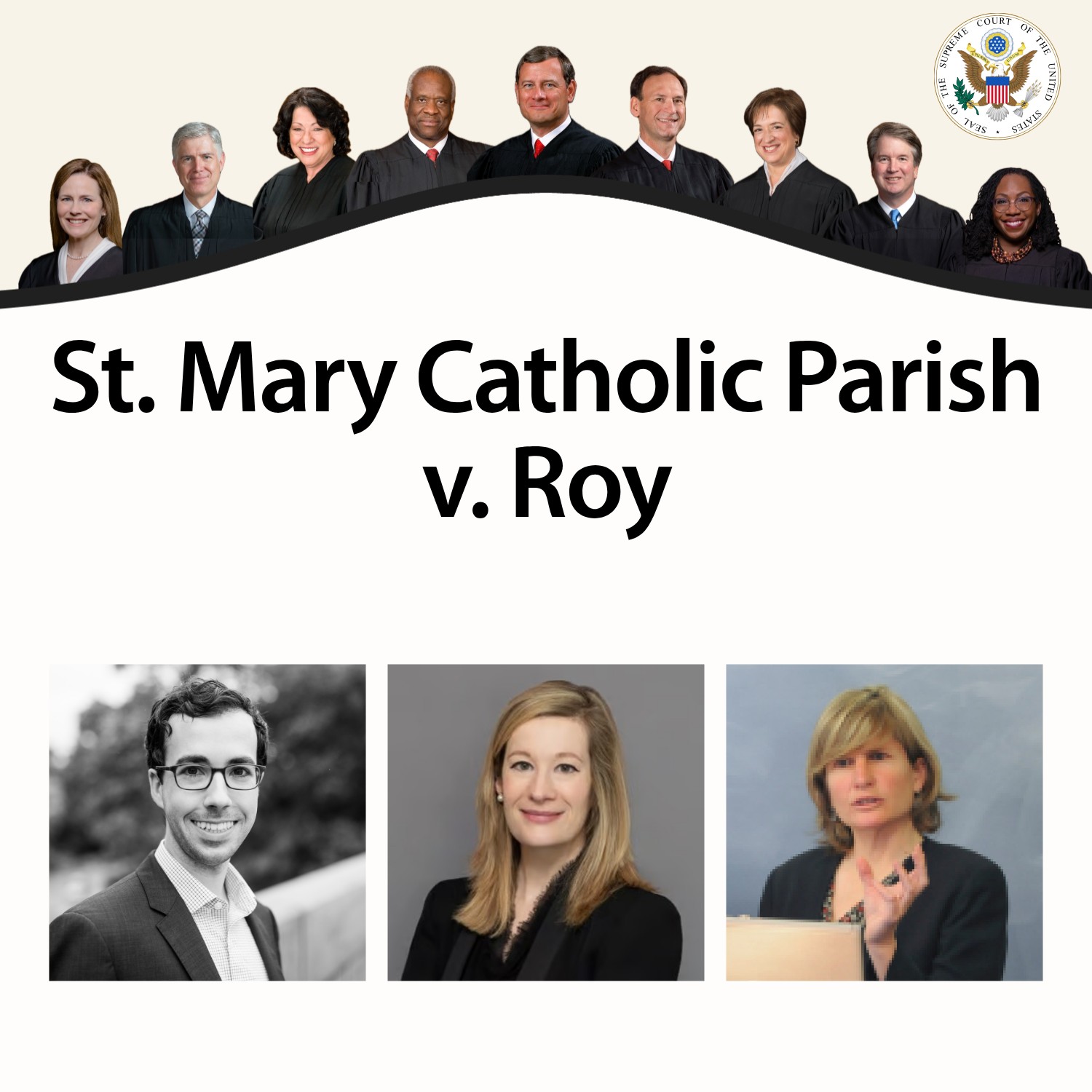
St. Mary Catholic Parish v. Roy Justia · Docket · oyez.org · YouTube Argued on Nov 3, 2026. Petitioner: St. Mary Catholic Parish, Littleton, Colorado. Respondent: Lisa Roy, in Her Official Capacity as Executive Director of the Colorado Department of Early Childhood. Advocates: Nicholas R. Reaves (for the Petitioners) Sarah M. Harris (for the United States, as amicus curiae, supporting the Petitioners) Helen Norton (for the Respondents) Facts of the case (from oyez.org) Colorado voters established the Universal Preschool Program (UPK) to provide free preschool services through a “mixed delivery system” of public and private providers. To receive state funds, providers must sign a nondiscrimination agreement that requires them to enroll students regardless of their sexual orientation or gender identity. Two Catholic parishes and the Archdiocese of Denver sought to participate in the program but refused to sign the agreement. They argued that their religious tenets require them to consider the sexual orientation and gender identity of families during admissions to maintain their religious environment. The schools specifically challenged the program’s “preference system,” which uses an algorithm to match families with schools based on categories like sibling enrollment or congregation membership. They also highlighted a “temporary waiver” provision that allows the state to grant providers extra time to meet certain quality standards. The schools argued that these features create a system of “individualized exemptions” where the state exercises discretion to favor secular interests. Because the state allows these secular preferences while denying a religious exemption to the nondiscrimination rule, the schools contended the program unconstitutionally penalizes them for their religious character. The district court denied the schools’ request for a permanent injunction, ruling that the nondiscrimination requirement is a neutral and generally applicable law. The U.S. Court of Appeals for the Tenth Circuit affirmed that decision, holding that the state’s program does not grant the type of unfettered discretion that would trigger strict scrutiny. Question Does a law lack general applicability under the Free Exercise Clause only if it permits unfettered discretion or secular exemptions, and does the rule against excluding religious institutions from public benefits apply only to explicit government bans on participation?
0:00John G. Roberts, Jr.We will hear argument this morning in Case 25-581, St. Mary Catholic Parish versus Roy.
0:06John G. Roberts, Jr.Mr. Reaves.
0:08Nicholas R. ReavesMr. Chief Justice, and may it please the Court:
0:10Nicholas R. ReavesThe Archdiocese of Denver schools exist to pass on the faith to the next generation. To do this, they ask all families who enroll to be open to and supportive of the church's teachings. Because of this sincere religious exercise, the State has denied Colorado families the ability to use Universal Preschool funding at Catholic schools. Under this Court's public benefits cases, that triggers strict scrutiny.
0:37Nicholas R. ReavesThe Tenth Circuit was wrong to cabin that precedent that this Court reaffirmed in Carson to explicit religious exclusions only. That can't be reconciled with Sherbert, Thomas, or Mahmoud. Nor can it be reconciled with this Court's instruction in Carson to look to the operation and the effect of the law, not for magic words.
0:58Nicholas R. ReavesAfter rejecting Carson, the Tenth Circuit applied Smith, but this too was wrong. When Colorado allows over a thousand schools to turn families away for a variety of different reasons, it has created a flexible and customizable program, nothing like the generally applicable across-the-board laws that Smith envisioned.
1:19Nicholas R. ReavesAnd Colorado's inconsistent and contradictory arguments further confirm the state's actions are anything but generally applicable. Colorado has flexibly interpreted the mandate to accommodate important secular interests, but it's called the same law a hard limit when Petitioners sought a religious accommodation.
1:38Nicholas R. ReavesAnd Colorado has discretion via the catch-all exemption to permit preschools to organize around "specific competencies or interests" and to serve "specific communities." Yet it has refused to extend that flexible treatment to Petitioners.
1:55Nicholas R. ReavesFinally, this is not a zero-sum game. Letting families use Universal Preschool funding at Catholic schools won't take away a single seat from the over 2,000 preschools already participating in the program. In fact, letting Catholic schools in will create more seats for everyone, even for families who disagree with Catholic teachings.
2:15Nicholas R. ReavesI welcome the Court's questions.
2:18Clarence ThomasDo you think your -- this case is on all fours with Carson, or would we have to extend Carson?
2:25Nicholas R. ReavesI think the rule this Court applied in Carson when it discussed Sherbert and Thomas is on all fours with this case. Both Sherbert and Thomas involved facially neutral laws, and that's my understanding of where this Court derived the public benefits rule it applied in Carson.
2:40Nicholas R. ReavesI would also look to the holding that this Court articulated at the end of its opinion in Carson, which says, "Regardless of how the benefit and restriction are described, the program operates to identify and exclude otherwise eligible schools on the basis of their religious exercise." So that's how I understand this Court's decision in Carson.
2:58Nicholas R. ReavesAnd I also think the focus of the way that this Court resolved Carson was to look at, you know, what is happening to the religious believer? It didn't focus on the text of the law in Maine. It focused on whether schools are being excluded on account of their religious exercise.
3:13Sonia SotomayorBut I --