
Supreme Court Oral Arguments · scotusstats.com
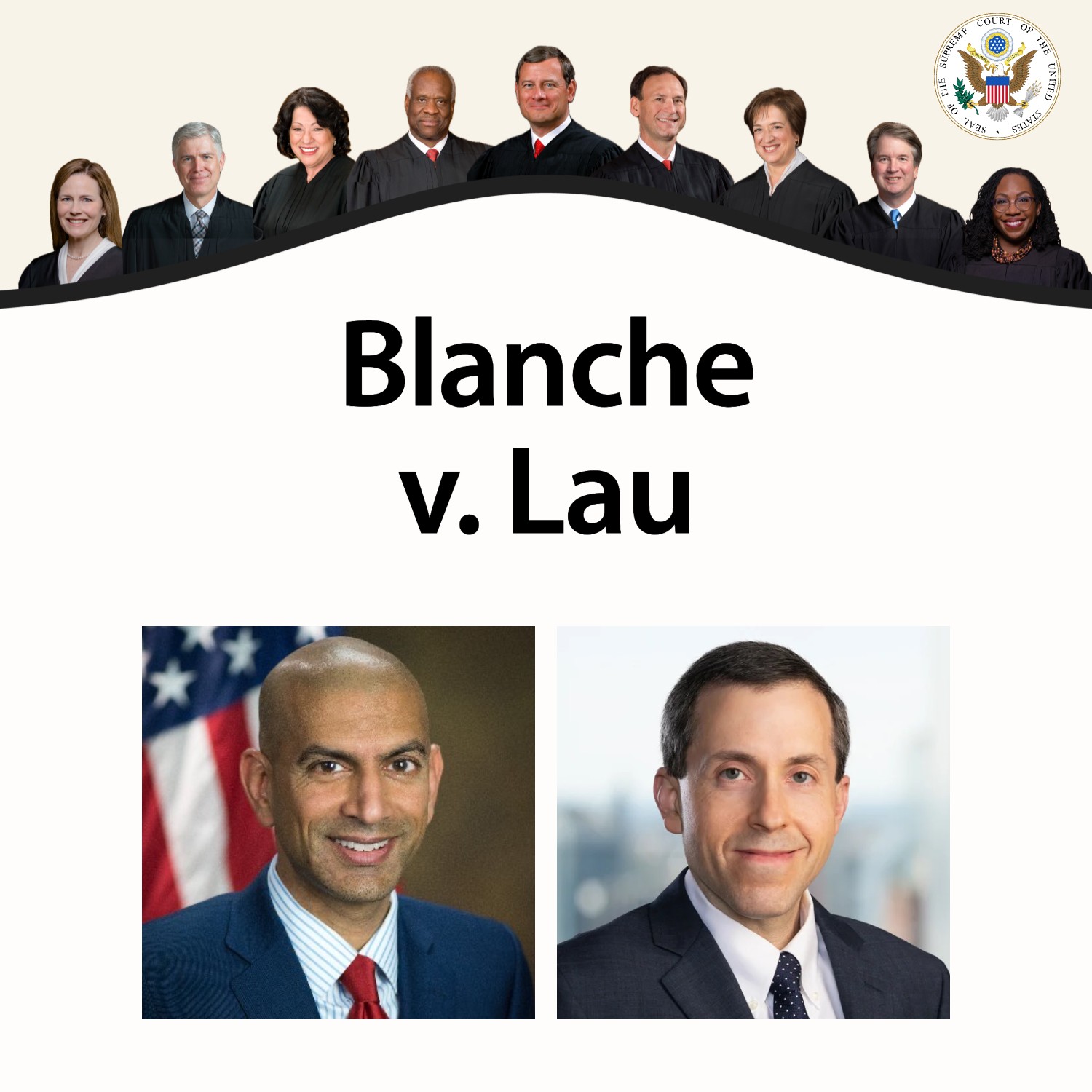
Blanche v. Lau Justia · Docket · oyez.org Argued on Apr 22, 2026. Petitioner: Todd Blanche, Acting Attorney General. Respondent: Muk Choi Lau. Advocates: Sopan Joshi (for the Petitioner) Shay Dvoretzky (for the Respondent) Facts of the case (from oyez.org) Muk Choi Lau, a native and citizen of China, was admitted to the United States as a lawful permanent resident on September 7, 2007, after several years of traveling to the country as a nonimmigrant. On May 7, 2012, Lau was charged in New Jersey with third-degree trademark counterfeiting. While awaiting trial, he left the United States for a brief period. Upon returning on June 15, 2012, he presented himself at John F. Kennedy International Airport as a returning lawful permanent resident. However, because of his pending charge, immigration authorities declined to admit him outright and instead paroled him into the country pursuant to 8 U.S.C. § 1182(d)(5)(A). Over a year later, in June 2013, Lau pleaded guilty to the counterfeiting charge and was sentenced to two years’ probation. The Department of Homeland Security initiated removal proceedings against Lau in March 2014, charging him with inadmissibility under 8 U.S.C. § 1182(a)(2)(A)(i)(I) for having been convicted of a crime involving moral turpitude (CIMT). Lau argued that he should not have been treated as an arriving alien at the time of reentry and that he was eligible for a discretionary waiver under 8 U.S.C. § 1182(h). The immigration judge rejected both claims, and the Board of Immigration Appeals affirmed. Lau petitioned for review, arguing primarily that DHS lacked clear and convincing evidence to treat him as an applicant for admission on reentry merely due to a then-pending charge. The U.S. Court of Appeals for the Second Circuit agreed, holding that DHS erred in treating Lau as inadmissible based solely on unproven allegations at the time of reentry and granted his petition. The immigration judge ordered removal in 2018, and the Board of Immigration Appeals upheld that decision in 2021. The Second Circuit vacated the removal order in 2025 and remanded the case to terminate proceedings under the inadmissibility ground, reserving the possibility of future removal under a deportability provision. Question To remove a lawful permanent resident who committed an offense listed in Section 1182(a)(2) and was subsequently paroled into the United States, must the government prove that it possessed clear and convincing evidence of the offense at the time of the lawful permanent resident’s last reentry into the United States?
0:00John G. Roberts, Jr.We will hear argument this morning in Case 25-429, Blanche versus Lau.
0:05John G. Roberts, Jr.Mr. Joshi.
0:05Sopan JoshiMr. Chief Justice, and may it please the Court: When Respondent arrived in the United States in June of 2012, he had, in fact, already committed a crime involving moral turpitude.
0:15Sopan JoshiThat meant, under the INA, he was, in fact, seeking an admission and thus was, in fact, eligible for parole and correctly charged with inadmissibility.
0:24Sopan JoshiAnd what's more, the government proved everything I just said by clear and convincing evidence in Respondent's removal proceedings.
0:33Sopan JoshiYet Respondent now seeks to vacate his removal order on the ground that immigration officers at the airport in June of 2012 did not themselves in that moment possess that clear and convincing evidence. That makes no sense.
0:47Sopan JoshiBurdens of proof and evidentiary burdens are things that apply in adversarial proceedings before a decisionmaker, not at the airport, where non-lawyer immigration officers are processing hundreds, maybe thousands, of arrivals a day. Unsurprisingly, Respondent has identified no text, no historical practice, and no precedent imposing an at-the-border clear-and-convincing evidentiary requirement. Instead, Respondent largely focuses on a distraction.
1:17Sopan JoshiHe says that DHS immigration officers can't parole him without first determining that he's seeking an admission.
1:23Sopan JoshiWe agree, and officers did that here, just not with the clear and convincing evidence that he prefers.
1:30Sopan JoshiSo Respondent's argument really just begs the question in this case.
1:33Sopan JoshiSimilarly, he says the clear and convincing evidence that DHS presented in the removal proceedings amounts to post hoc justification.
1:41Sopan JoshiBut, again, that assumes the conclusion that the border officers needed clear and convincing evidence in the first place. Now we have other arguments that parole decisions are not reviewable and that even an incorrect parole can't be treated as an admission.
1:54Sopan JoshiYou don't have to reach those.
1:56Sopan JoshiRespondent's failure to establish his at-the-border clear-and-convincing evidentiary requirement dooms his case and is sufficient on its own to reverse the judgment below.
2:06Sopan JoshiI welcome the Court's questions.