
Supreme Court Oral Arguments · scotusstats.com
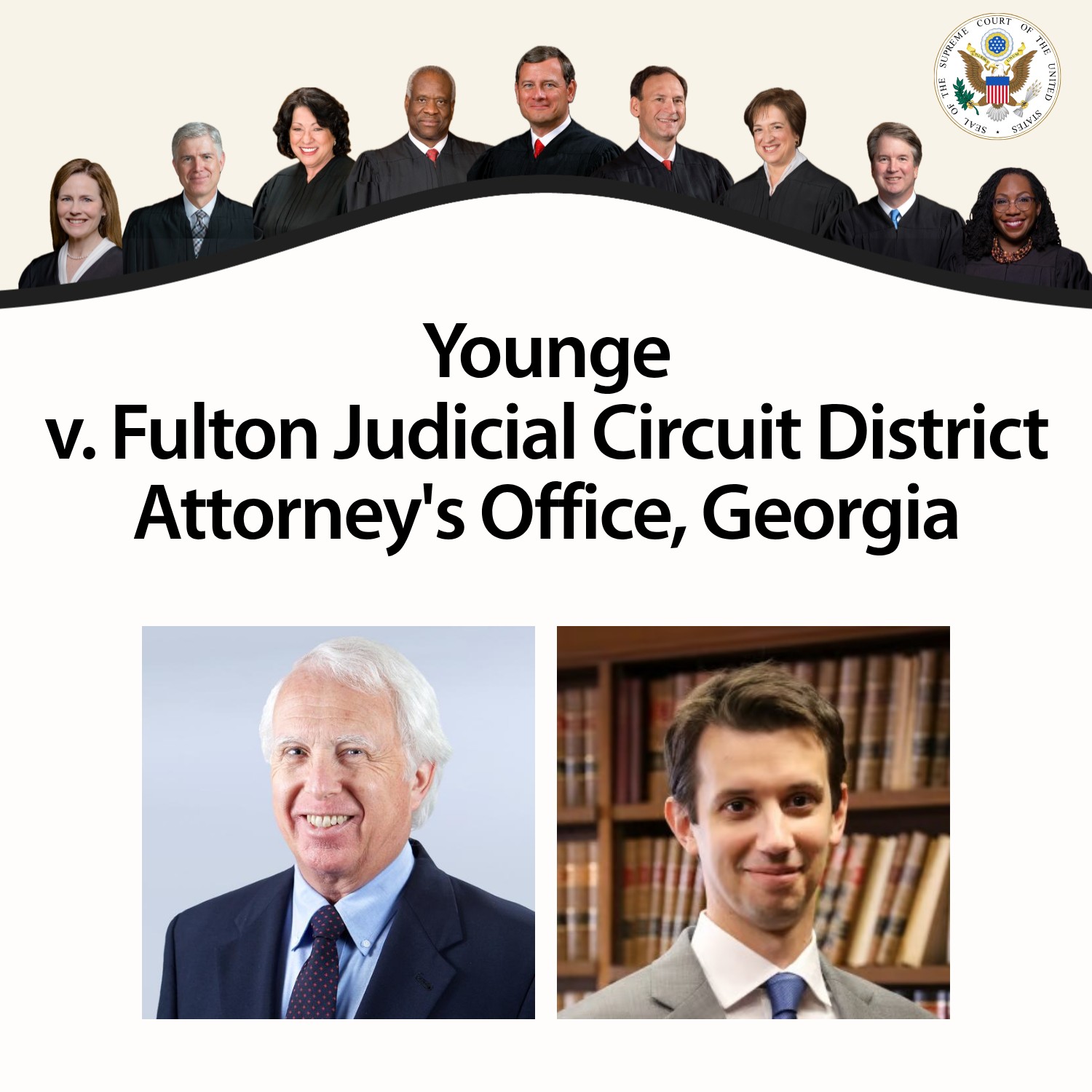
Younge v. Fulton Judicial Circuit District Attorney's Office, Georgia Justia · Docket · oyez.org Argued on Nov 2, 2026. Petitioner: Jasmine Younge. Respondent: Fulton Judicial Circuit District Attorney's Office, Georgia . Advocates: Eric Schnapper (for the Petitioner) Stephen J. Petrany (for the Respondent) Facts of the case (from oyez.org) In April 2019, Fulton County District Attorney Paul Howard — an elected official — hired Dr. Jasmine Younge as Deputy Chief of Staff and Director of Policy and Programs at a salary of $120,282. Younge ranked third in the office's chain of command, reported exclusively to Howard, supervised more than thirty employees, and worked so closely with Howard that he described her as a "key member" and his "go-to person for almost everything." About two months into her tenure, Younge told Howard she was pregnant. After that announcement, Howard stopped meeting with Younge, excluded her from meetings, treated her dismissively, and reassigned some of her duties — then fired her two weeks later. Younge sued the Fulton County District Attorney's Office for pregnancy discrimination under Title VII. In its answer, the DA's Office raised several affirmative defenses but did not plead the Title VII personal-staff exemption — which excludes from Title VII's coverage persons chosen to serve on an elected official's "personal staff." The DA's Office did not recognize the exemption as relevant until it began preparing its summary judgment motion, after discovery had already closed. The district court allowed the DA's Office to raise the personal-staff exemption for the first time at summary judgment, finding no prejudice to Younge from the late assertion, and granted summary judgment to the DA's Office on that basis; Younge then appealed to the U.S. Court of Appeals for the Eleventh Circuit, which affirmed. Question May a defendant raise an affirmative defense it never pleaded in its answer as the sole basis for a summary judgment motion — without seeking to amend its answer — and does it matter that the court's scheduling order deadline would have barred any such amendment?
0:00John G. Roberts, Jr.We'll hear argument next in Case 25-352, Younge versus Fulton Judicial Circuit District Attorney's Office.
0:07John G. Roberts, Jr.Mr. Schnapper.
0:08Eric SchnapperThank you, Mr. Chief Justice, and may it please the Court:
0:12Eric SchnapperPleading an affirmative defense is ordinarily a precondition for invoking that defense to bar or limit a claim. Kontrick held that ordinarily, under the civil rules, a defense is lost if it's not included in an amended complaint -- in an amended defense or in the original defense. There's no reason to depart in this case from those established rules.
0:38Eric SchnapperThe Eleventh Circuit's Hassan decision improperly permits a defendant to invoke an affirmative defense which it has never pled. It has several fatal flaws.
0:49Eric SchnapperFirst, it effectively rewrites Rules 8 and 12 to create categories of affirmative defenses that do not have to be pled, despite the fact that the plain text of those rules provide that any affirmative defense and every affirmative defense must be pled.
1:07Eric SchnapperSecondly, if a defendant has not yet included an affirmative defense in its answer and the deadline under a scheduling order for amending the answer has passed, a defendant would normally have to meet the good cause standard in Rule 16(b)(4). But, under Hassan, a defendant can -- is exempt itself from that rule simply by moving for summary judgment.
1:33Eric SchnapperThird, where a defendant has inadvertently omitted an affirmative defense, Rules 15(a)(2) and 16(b)(4) establish the standard for nonetheless raising that affirmative defense. Hassan substitutes a no-prejudice standard for that.
1:54Eric SchnapperIn addition, in -- in its justifications for the Hassan rule or some version of it, the defendant has offered arguments that reach far beyond just the question of what happens with an unpled affirmative defense and raises a host of issues about the -- about the issue -- the standards that would emerge.
2:14Eric SchnapperA ruling for us would simply apply the established rules and -- and standards in Rules 15(a)(2) and 16(b)(4). It would not require the Court to become embroiled in fashioning new standards, as was aired in the previous case.
2:32Eric SchnapperI welcome the Court's questions.
2:34Clarence ThomasMr. Schnapper, what was the prejudice to your client?
2:40Eric SchnapperThe standard -- we argue there was prejudice below, and we didn't --
2:44Clarence ThomasAnd what was it?
2:45Eric SchnapperWell, the claim was that we wanted -- would have sought additional discovery.