
Supreme Court Oral Arguments · scotusstats.com
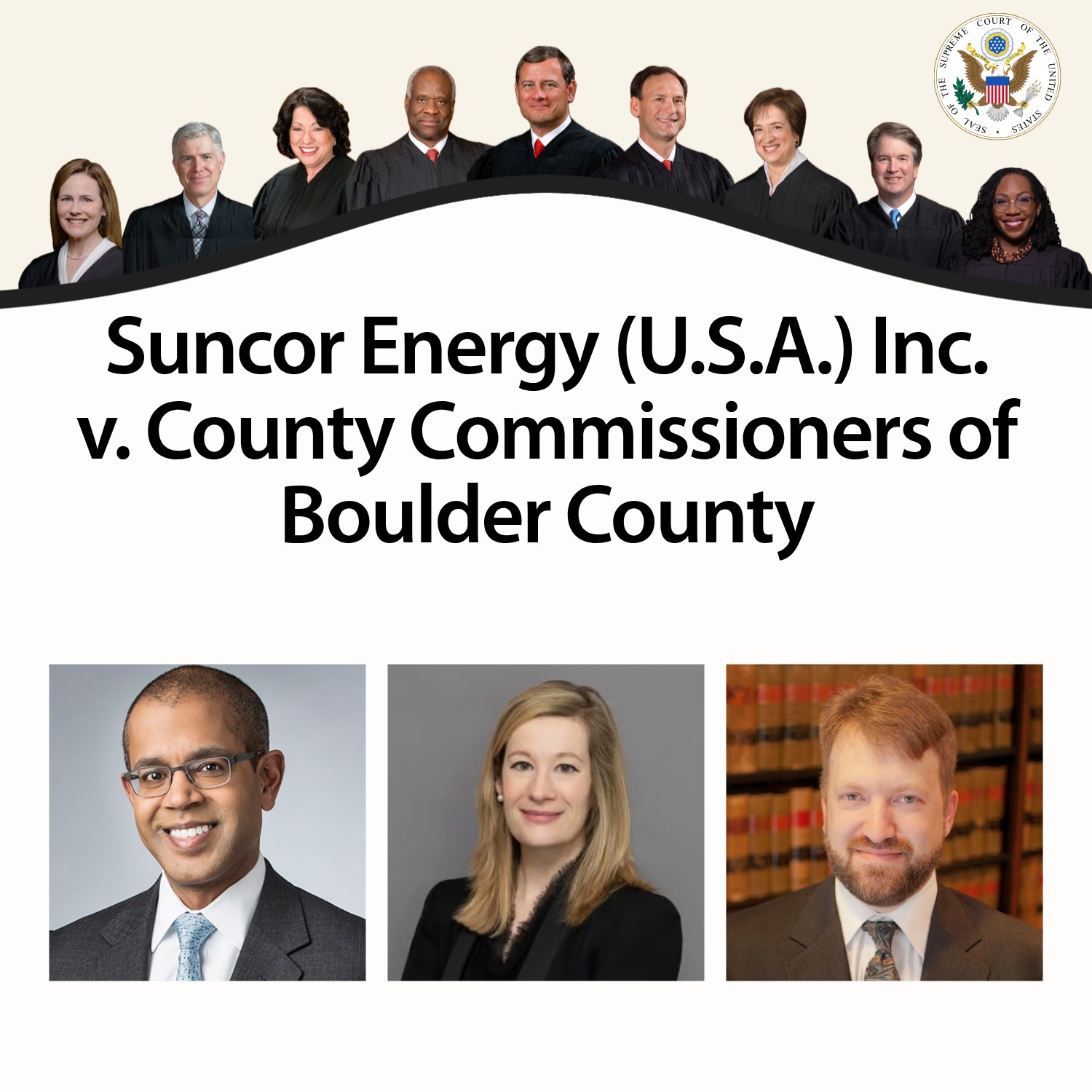
Suncor Energy (U.S.A.) Inc. v. County Commissioners of Boulder County Justia · Docket · oyez.org Argued on Oct 5, 2026. Petitioner: Suncor Energy (U.S.A.) Inc. Respondent: County Commissioners of Boulder County. Advocates: Kannon K. Shanmugam (for the Petitioners) Sarah M. Harris (for the United States, as amicus curiae, supporting the Petitioners) Kevin K. Russell (for the Respondents) Facts of the case (from oyez.org) Boulder County and the City of Boulder (collectively, "Boulder") sued Exxon Mobil Corporation and three Suncor Energy entities, alleging that the companies' decades-long production, promotion, refining, marketing, and sale of fossil fuels knowingly drove climate change and caused concrete harm to Boulder's property and residents. Boulder further alleges that the defendants compounded this harm by intentionally misleading the public about fossil fuels' role in accelerating climate change. The alleged injuries include flood damage, increased wildfire risk, drought, and physical damage to public buildings and infrastructure—costs Boulder claims it has absorbed and will continue to absorb. To recover those costs, Boulder asserts state common law claims for public nuisance, private nuisance, trespass, unjust enrichment, and civil conspiracy. Critically, Boulder seeks only monetary damages—not an injunction against fossil fuel operations or any form of emissions regulation. The defendants argue that these state-law claims are precluded because federal law—specifically the Clean Air Act, the federal common law of interstate pollution, and the federal foreign affairs power—occupies the field and bars state courts from adjudicating harms rooted in interstate and international greenhouse-gas emissions. Boulder filed suit in state court; the defendants removed the case to federal court, but after extensive litigation that included appeals to the U.S. Court of Appeals for the Tenth Circuit and two certiorari petitions in the U.S. Supreme Court, the Tenth Circuit affirmed the remand order and the case returned to the Boulder County District Court, which denied the defendants' motion to dismiss on preemption grounds. The defendants then petitioned the Supreme Court of the State of Colorado for extraordinary review under C.A.R. 21, which that court accepted and resolved in Boulder's favor on May 12, 2025. Question 1. Does the Court have statutory and Article III jurisdiction to hear this case? 2. Does federal law preclude state-law claims seeking relief for injuries allegedly caused by the effects of interstate and international greenhouse-gas emissions on the global climate?
0:00John G. Roberts, Jr.We'll hear argument first this term in Case 25-170, Suncor Energy versus County Commissioners of Boulder County.
0:08John G. Roberts, Jr.Mr. Shanmugam.
0:09Kannon K. ShanmugamThank you, Mr. Chief Justice, and may it please the Court:
0:12Kannon K. ShanmugamThis case involves an unprecedented effort to use state law to regulate global conduct. Boulder is suing Petitioners under Colorado law on the theory that their global conduct increased the global use of fossil fuels, which led to an increase in global greenhouse-gas emissions, which contributed to global climate change, which resulted in global harms.
0:35Kannon K. ShanmugamOur constitutional system does not permit state law to be used in that manner. The Constitution bars the application of state law to certain inherently federal areas. When the states entered the Union, the plan of the Convention required them to surrender certain preexisting powers in order to ensure each state's equal sovereignty.
0:56Kannon K. ShanmugamBecause of the ambient nature of air and water and the conflicting rights of states, this Court has held for over a century that federal law governs interstate pollution claims. That principle applies with even greater force to claims involving global climate change.
1:12Kannon K. ShanmugamIn addition, the Constitution's prohibition on extraterritorial regulation precludes a state from extending its law beyond its borders to regulate global conduct with global effects. A state does not have the power to regulate out-of-state conduct based solely on attenuated effects on the state.
1:32Kannon K. ShanmugamWhat is more, the use of state law to regulate global climate change would substantially interfere with the nation's foreign policy. And far from authorizing the application of state law, the Clean Air Act independently preempts any effort by one state to impose its law on emissions originating in others.
1:51Kannon K. ShanmugamIf Boulder's claims are allowed to go forward, some 90,000 municipalities across the country will have the ability to make national and international energy policy by asking juries to impose catastrophic damages on selected fossil-fuel producers.
2:07Kannon K. ShanmugamPut simply, that is not the constitutional scheme that the Founders adopted. The Colorado Supreme Court's judgment should accordingly be reversed.
2:15Kannon K. ShanmugamI welcome the Court's questions.
2:16Clarence ThomasMr. Shanmugam, before we get to the merits, would you spend some time and explain why we have jurisdiction?
2:26Kannon K. ShanmugamSure, Justice Thomas. Our view is that the Court has both statutory and constitutional jurisdiction. I'll address those in turn.
2:33Kannon K. ShanmugamOn statutory jurisdiction, our view is that Atlantic Richfield is directly on point. It could not be clearer as a matter of Colorado law that the proceeding below was a self-contained original proceeding, which gives rise to jurisdiction in this Court under Section 1257.
2:50Kannon K. ShanmugamBoulder's argument to the contrary is that because this case did not involve a formal writ proceeding directed at the lower court, that it falls outside the scope of Atlantic Richfield. But, in Atlantic Richfield itself, this Court attached no weight to the form of the underlying proceeding. Instead, the Court relied on the fact that it was a self-contained proceeding.