
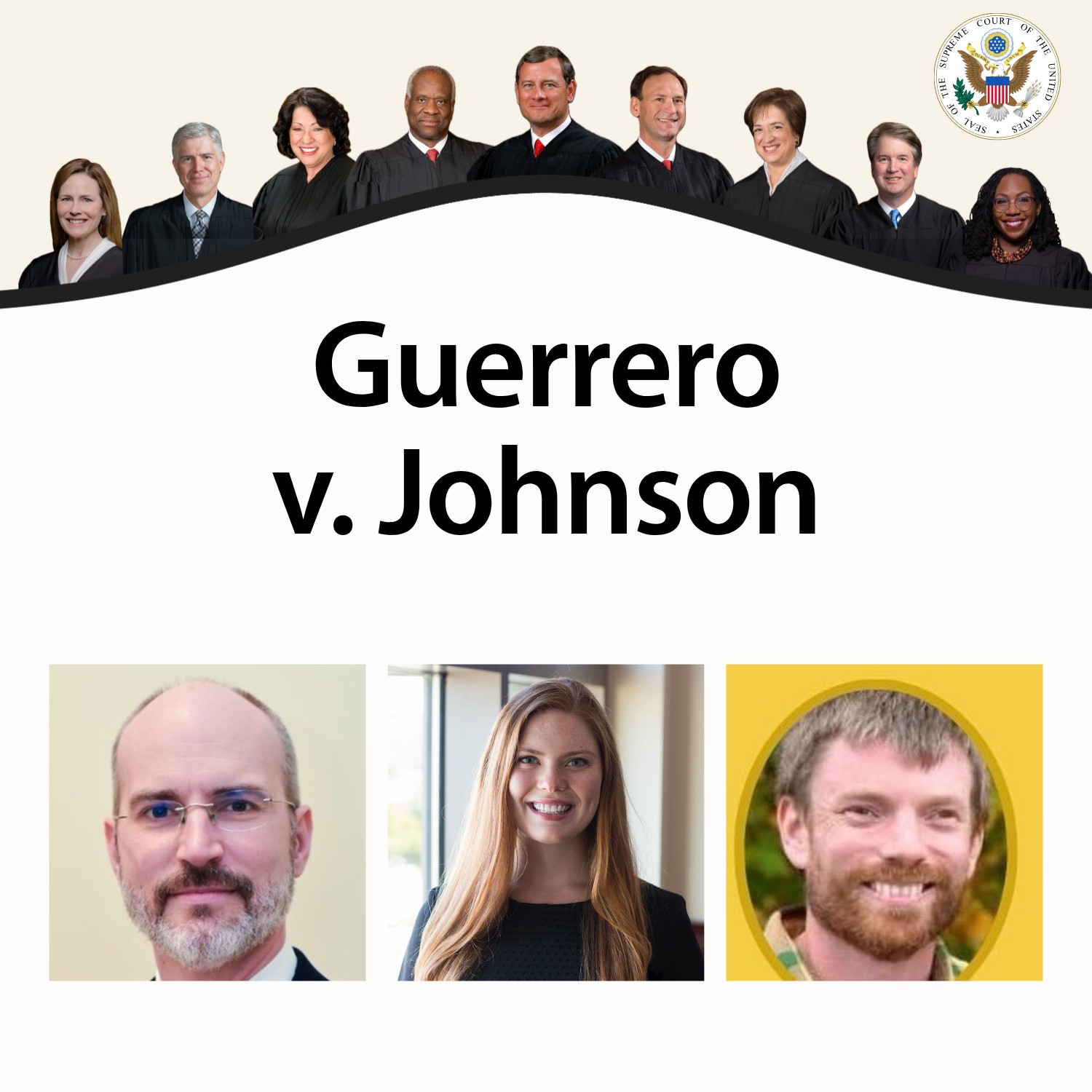
Supreme Court Oral Arguments · scotusstats.com
Guerrero v. Johnson Justia · Docket · oyez.org · YouTube Argued on Nov 4, 2026. Petitioner: Eric Guerrero. Respondent: Dexter Johnson. Advocates: William R. Peterson (for the Petitioner) Emily M. Ferguson (for the United States, as amicus curiae, supporting the Petitioner) Jeremy Schepers (for the Respondent) Facts of the case (from oyez.org) Dexter Johnson kidnapped, raped, and murdered Maria Aparece in June 2006, years after the Supreme Court decided Atkins v. Virginia, 536 U.S. 304 (2002), which held the Eighth Amendment prohibits executing intellectually disabled people. At trial, Johnson’s own defense expert tested his IQ between 74 and 88, concluded he showed no obvious adaptive deficits, and opined that he was not intellectually disabled. Johnson was convicted of capital murder and sentenced to death in June 2007. Johnson did not raise an Atkins claim in his initial state habeas application or his initial federal habeas petition filed in 2011. Instead, he argued that the Atkins principles should extend to the mentally ill. In May 2013, the American Psychiatric Association published the DSM-5, which substantially revised intellectual disability diagnosis by de-emphasizing IQ score cutoffs and recognizing that individuals with scores above 70 could still qualify. Johnson's federal habeas petition was denied in August 2013—just months after the DSM-5’s publication. Johnson’s counsel, aware of the DSM-5, chose not to develop an Atkins claim, citing concerns about unfavorable Texas state court standards and his strategic focus on other claims. With an execution date set for 2019, Johnson obtained new expert evaluations under the DSM-5 standards; those experts diagnosed him as intellectually disabled. Johnson then sought authorization to file a successive federal habeas petition, arguing that the DSM-5 had made his Atkins claim newly viable and therefore “previously unavailable” during his earlier habeas proceedings. After the U.S. Court of Appeals for the Fifth Circuit authorized the successive petition in 2019, the district court denied the State's motion to dismiss and found Johnson’s Atkins claim was previously unavailable under the Fifth Circuit’s “futility exception” from In re Cathey. The district court certified that ruling for interlocutory appeal, the Fifth Circuit accepted, and a panel affirmed in July 2025, reaffirming Cathey’s holding that a claim is not “previously available” unless it had “some possibility of merit” at the time of the earlier petition. The Fifth Circuit denied rehearing en banc by a 9-7 vote in January 2026. Question Does a claim rely on a “previously unavailable” new rule of constitutional law, permitting a successive habeas petition, when the prisoner could have raised a claim based on that rule in an earlier petition?
0:00John G. Roberts, Jr.We will hear argument this morning in Case 25-1003, Guerrero versus Johnson.
0:05John G. Roberts, Jr.Mr. Peterson.
0:11William R. PetersonThank you. Mr. Chief Justice, and may it please the Court:
0:16William R. PetersonAEDPA's restrictions on second or successive habeas applications reflect the balance struck by Congress between finality and error correction. Rather than pursue error correction at all costs, Congress chose to allow new claims in these applications only in limited circumstances that do not include changes in the diagnostic standards for intellectual disability.
0:41William R. PetersonThis Court decided Atkins versus Virginia and announced the rule that the Constitution prohibits capital punishment of the intellectually disabled before Respondent even committed his crimes. And Respondent relied on Atkins versus Virginia in his initial federal habeas application.
1:00William R. PetersonThe rule of Atkins is not a new rule of constitutional law that was previously unavailable to him under Section 2244(b)(2)(A). And Moore versus Texas, which was a legal change following Respondent's initial federal habeas application, has not been made retroactive to cases on collateral review by this Court. Nor can Respondent pass through the gateway of Section 2244(b)(2)(B) because the facts underlying his claim are unrelated to his guilt for the underlying offense.
1:33William R. PetersonThis Court should defer to Congress's policy choices, correct the Fifth Circuit's interpretation of Section 2244(b)(2)(A), and reverse.
1:41William R. PetersonI welcome the Court's questions.
1:45Clarence ThomasWell, Mr. Peterson, would you spend a minute or two on the Fifth Circuit's reasoning on unavailability?
1:54William R. PetersonYour Honor, as we read the Fifth Circuit's opinion, it focused on the availability of a claim rather than on the availability of a rule, and the Fifth Circuit might well have been right about whether or not the claim was available. Obviously, a claim has two pieces, a -- a legal rule and --
2:12Clarence ThomasWhat should unavailability focus on?
2:16William R. PetersonUnder the text of 2244(b)(2)(A), it is the rule that must be unavailable, not the claim.
2:22Clarence ThomasAnd what's the source of that rule?
2:25William R. PetersonWell, we look both at the last antecedent modifier -- that's the only reasonable modification. I believe Respondent now agrees from his merits brief that "previously unavailable" modifies "rule" and not "claim." And we see this as well in Section 2255(h)(2), which uses the identical phrase, "new rule of constitutional law made retroactive to cases on collateral review by this Court that was previously unavailable" without any mention of "claim."
2:54Clarence ThomasSo how -- what role does the DSM play in that analysis?