
Supply Chain Revolution · Supply Chain and Sustainability Strategist, Sheri Hinish (Supply Chain Queen)
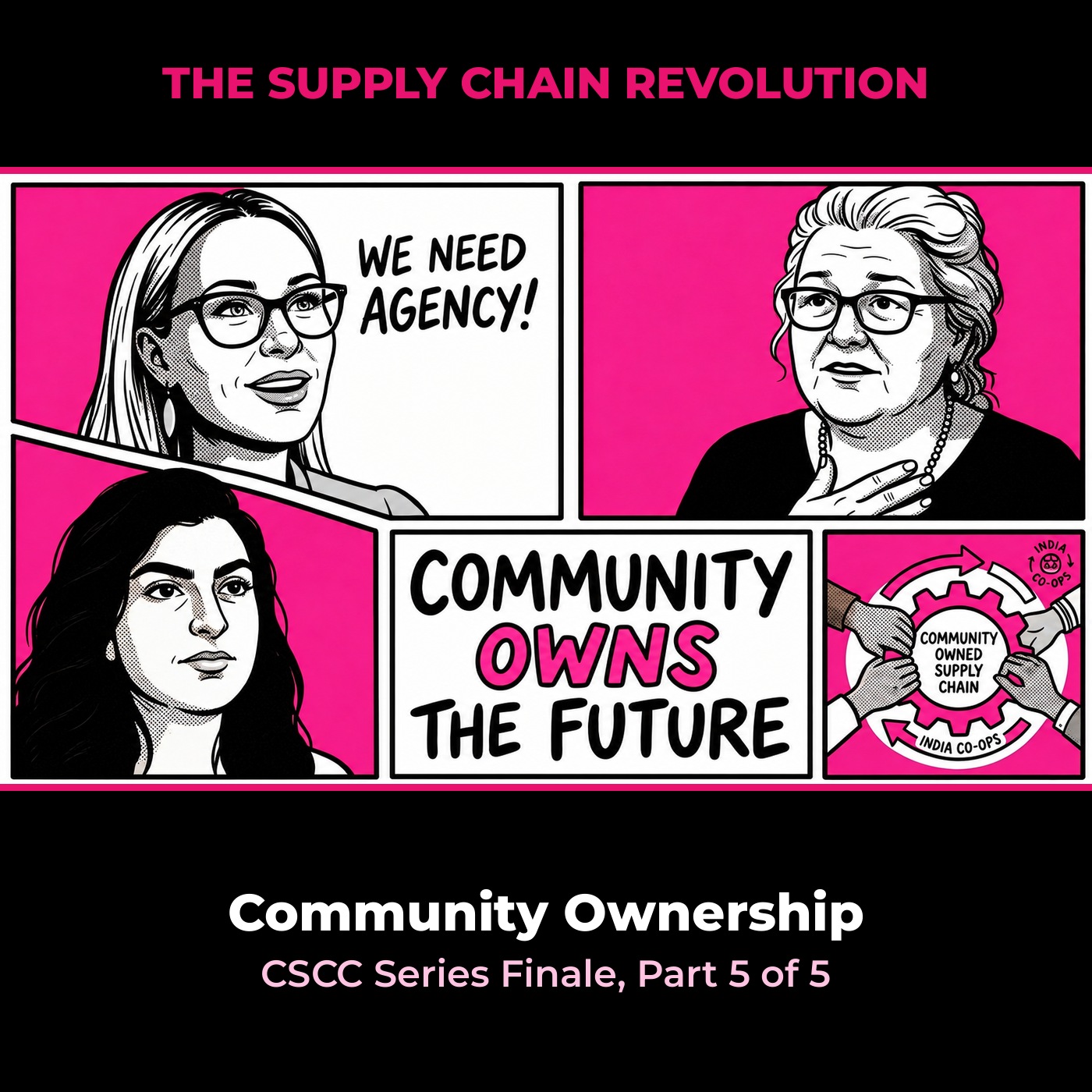
This is the series finale. Across five episodes, the Circular Supply Chain Coalition series has built the system around circular supply chains: coalition architecture, trusted networks, buyer-operator alignment, enabling policy. Episode 5 asks who owns the infrastructure, who has agency, and who benefits when reverse supply chains are built. Deirdre White is CEO of Pyxera Global with nearly 40 years in supply chain development and social impact, from oil and gas localization on Sakhalin Island in the Russian Far East to the Jiva program, a 10-year partnership with the John Deere Foundation in rural Rajasthan that transformed agricultural livelihoods, girls' education, and community governance. Deirdre frames community ownership as the opposite of extraction: local people building and retaining the assets that should be theirs. Nancy Charaya leads circular economy work at Pyxera Global India, with a decade of experience across tire, textile, plastics, and critical minerals value chains. Nancy built the Pride Cooperative in Guwahati, Assam, a female-led waste worker collective organizing 160 informal workers into a cooperative with collective bargaining power and shared governance. India has 4 to 5 million waste workers, up to 80 percent women working informally with zero agency. The cooperative model gives them a seat at the table. John Holm, SVP of Partnership Development at Pyxera Global, moderates and connects the five-episode arc, framing community ownership as the "Trojan horse" for circular supply chains at scale. Chapter Markers: 0:00 Introduction: from enabling policy to community ownership 1:05 John Holm: community benefit as the missing layer in circular supply chains 2:03 Deirdre White: 40 years of supply chain localization, from Sakhalin to CSCC 5:41 Jiva: 10 years with John Deere in rural Rajasthan 7:08 Why the changes held two years after the program ended 7:54 "Fall in love with the problem, not the solution" 8:25 India's waste sector: 4-5 million workers, 90% informal, 60-80% women 9:27 Pride Cooperative: 160 waste workers, collective bargaining, government access 10:26 The smart dustbin story: waste worker knowledge vs. high-tech design 11:21 Cooperatives in the global north: Land O'Lakes and hidden scale 12:37 Community-owned business: keeping equity local in reverse supply chains 14:44 Building trust: 36 person-weeks of listening in three villages 16:11 Pride as a female-led cooperative: agency and collective voice 17:15 Lightning round: misconceptions, capabilities, optimism 19:34 Series close: the complete blueprint for a circular economy Key Topics: Community ownership, cooperatives, circular supply chains, reverse logistics, waste workers, informal economy, critical minerals, cooperative governance, Pyxera Global, CSCC, Pride Cooperative, Guwahati, MSMEs, female-led enterprise, global south innovation Connect and Learn More: Circular Supply Chain Coalition: circularsupplychain.org Pyxera Global:...
Sheri Hinish: Welcome to the Supply Chain Revolution Podcast. I'm your host, Sheri Hinish also called the Supply Chain Queen. and we're now at episode 5 of our miniseries with the Circular Supply Chain Coalition and Pyxera Global. Across the first four episodes, this series has built the system around circular supply chains, the coalition architecture, trusted networks, buyer-operator alignment. and enabling policy. But in this episode, The Finale, we ask what happens when communities are designed into that system as owners and decision makers, rather than only as locations for infrastructure. In this episode, John Holm will serve as moderator, and we're going to connect the full series arc and frame why community ownership can be described as the Trojan horse when building a circular economy. Welcome everyone. It's so great to host you for our fifth episode. I And before we dig into the questions, I'd love for each of you to introduce yourself, starting with Nancy. Nancy, over to you. Nancy | Pyxera Global: I am Nancy. I have been working on circular supply chains for around the past 10 years. It started with working on tires because I was, as part of my venture, upcycling them and building them out into playgrounds. And that got me curious to learn more about these value chains. So I've worked on textile value chains, plastics, and currently, of course, we are looking at critical minerals as part of our work. So that's about it. Sheri Hinish: Awesome. Thanks, Nancy. And Deidre, over to you. Deirdre: Hi everyone, I'm Deaddre White. I'm the CEO of Pixaro Global. And I've been working in the social impact space my whole career, which is rapidly approaching 40 years. So this conversation is near and dear to my heart. And a lot of the work that I've been involved in over those four decades is in supply chain development and localizing supply chains. So love what we're gonna dig into. Sheri Hinish: Wonderful. And the man who's gonna moderate our episode today, John Holm. John Holm: Well, Sherry, thank you so much again for giving us the platform and a lot of the work that we've been talking thus far in the in the first four episodes around localizing supply chain has really had to do with the business case and the geopolitical case around policy subsidies and incentives. But now we're going to get into one And that's really looking at localizing supply chains as a community benefit, something where you can really look at engaging I would say, populations that have been left out of the economy into a new realm of looking at taking equity and ownership around local materials, local products, and becoming stewards of those material streams. So what I would like to do now is first turn it over to Deirdre. And Deirdre, Can you provide some context of your experience in this space broadly before we get into really the Circular Supply Chain Coalition around what you've seen given your experience. Deirdre: Sure, thanks so much, John, and thanks, Sherry, for these lovely introductions. in terms of the work we've done in supply chain over the years, we really started working with the oil and gas sector out in Sakhalin Island in the Russian Far East back in the mid-90s. And the reason that we saw an opportunity in building up local suppliers was because The opportunities for economic development in that part of Russia at the time were few and far between. And then CDC, and this is prior to my tenure here, but then CDC saw that there was an opportunity to work with small and medium businesses in the Russian Far East and link them to opportunities for contracting with the oil and gas sector. If we were able to help them to build up skills around health safety and health safety and environment, around financial management, around quality management, and things that would be expected by a large multinational buyer. And we took that idea from Sahelin and we really spread it across the world. We we moved from there to Azerbaijan and again worked with the oil and gas sector across Angola, Equatorial Guinea, Mozambique, Ghana. and then we really saw that the issues around supply chain were very similar across sectors. We started to do a lot more in the agribusiness sector and in same type of capacity development work for small and medium agribusinesses and link them linking them into global supply chains. and you know, that really was sort of a natural evolution to what we're doing right now with critical minerals, with recapture of critical minerals, and all of the other broader work of the circular supply chain coalition. So if you wanna put it this simply, the Circular Supply Chain Coalition was born on Sahelin Island in around nineteen ninety-five. John Holm: That's great, Deidre And I think before I go over to get Nancy's insights around India, I want you to paint the picture of the bridge. because India for us has been something really strategic. We've been doing a lot of great work in the ag space there for quite some time, really working with local communities. Could you give some context of some of the work, for example, we've done with the private sector on the ground there that kind of framed the transition to the great work that Nancy and the Pixar Global India team did. Deirdre: Well, I will say one of my favorite programs that Pixara Global has ever worked on, and one of my favorite pieces of work that I've ever seen anywhere in the world is a partnership that we had with John Deere in rural Rajasthan, India, that went for 10 years working in what started as three rural villages, subsistence agrarian economies, maybe I don't know, a thousand households among the three villages. And we expanded little by little over the course of those 10 years, focusing not just on agribusiness supply chains and regenerative agriculture, but also on accountable education and small-scale infrastructure as it supports education and agriculture. And it The program is called Jiva, the Joint Initiative for Village Advancement. And Jiva also means life and livelihood in Mawari, the local dialect in this part of Rajasthan. And it is the single most impactful program of its type that I've ever seen in my career. I had an opportunity two years ago to go back and to visit the Jiva villages, even two years after we hadn't been engaged anymore, and even after sort of the disruptions of COVID and everything, and the changes in terms of agricultural livelihoods, agricultural practices, sustainable agricultural practices, and most especially girls' education, and girls' advancement. those changes have stayed, and it is because we worked with a fully local team. they were absolutely extraordinary. Some of many of them were from these communities, and certainly almost all of them were from Rajasthan, supported by a really fabulous team here in the US, but also an extraordinary partner in the John Deere Foundation that was really willing to work with us year after year. To ensure that what was being invested in was the most relevant, and importantly, was what the communities wanted. Not what we wanted, not what John Deere wanted, but what we heard and saw from the farmers, from the children in schools, from the parents and everything else. So very much focused on what the community wants and needs. John Holm: Thank you, Deidre I think one thing that's important to get out of this a couple of takeaways here was you're really looking at again a place based context of understanding what the local community needs are, which sounds logical but many times are are not brought in. So Nancy, you know, having this Jiva platform kind of as a baseline of understanding community engagement and also what Deirdre mentioned, working with women, but also female entrepreneurs. Can you provide some context of the Pride Waste Co-op? Give some context around it and and what it really means to the local communities of where you're operating it. Nancy | Pyxera Global: just to share high level what waste sector looks like in India, right? And how it's sort of operating day to day, there are around four to five million workers working in the waste sector of India. And almost ninety percent of them are working in an informal way. Now, what does the informal way mean is that you know, in a city there are there are around 10,000 waste workers, only say five to six hundred of them are getting paid by government to manage the waste or by any other entity. Rest of them are just cherry-picking that waste, selling it day to day, and whatever value they're able to sell off from them is basically their own their earning, right? And the social economic lens here is that most of these waste workers are women. It could be sixty to eighty percent in which place you look at, but this is dominated by women. So you'll be talking about three million women workers working day in, day out in our country to keep the city clean and they're not getting paid you know, in any way. There are obviously migrants here. So these are the communities which are doing wastework. What I'm trying to establish here is most of these people have no agency. And they're working individually, fighting for their living, and they have obviously no time to go fight for their rights. And they absolutely are working with zero agency here. so jumping into now what Pride did, right? So the idea was how can these people run their own show? Right, so cooperative is a model where you know these wasteworkers can buy buy a share, become a member of cooperative. So, what happens is whatever they are selling comes comes in sort of cooperative. As cooperative, now 160 of them collectively are able to better negotiate with recyclers, they get better rates, which means better income. Right, so now collectively they can also Also, now decide to put a certain percentage of this income to a better place, which could mean okay, we'll have washroom adjacent to the place we are working. when they're when now when they're reaching a certain quantum of work, they could also go to government and say, Hey, we are helping the city clean by managing this much tons every day. Can you give us a space? one other example when we were sort of trying To set cooperative, and the idea was to bring everybody on one table, including government, private sector waste workers, you know, funders, etc. one of this wasteworkers said that these new smart dust beans, which cost like a thousand dollars for one of them to be constructed, it's quite high-tech, it has IoT, etc. So this wasteworker said, I understand that it's easy to put in waste in such a design, but how difficult it is to take it out because the waste gets stuck on all these corners. And for the first time, this pollution control board chairman was like, We have spent crores of our money building these high-tech smart dust beams, which would actually increase the efficiency. And here we're learning from wasteworker that it does the opposite. right? So why I'm sharing this example is basically. what agency the collectivization here brings. right. And with cooperative model, that's what we're trying to do. Collectivize these women people and let them have agency. And I can talk about funding as well because that's another perspective. John Holm: That's great. No, and thank you so much for the context. And I think it would be helpful, I think, when we talk the word about co-ops. I think one thing is really funny is that in the extractive take-make ways vernacular, we really don't hear much about terminology around community benefit, community ownership, community equity, co-ops. Deirdre, coming back to you for a second, could you paint a little bit of a picture quickly of just the the massive opportunity in co-ops so we can frame what Nancy just mentioned and pride and how this really works a bit. I think it'd be helpful for the audience to just understand the the the the importance and relevance of this mechanism that that frankly is not used nearly as much, especially in global north communities. Deirdre: Actually, I would say it's a little bit of a myth that it's not used so much in global north communities. I think maybe we don't see it and recognize it John Holm: Right. Deirdre: necessarily as often as it is in front of us. Look at something like Landalakes, right? You think about huge dairy company, but we often don't think about it as one of the world's largest cooperatives. there's lots of financial cooperatives out there as well. And I forget the exact statistics, but the the 300 largest cooperatives in the world hold the same annual revenue as as as a number of major corporations, right? And so we just we it go under the radar a lot. But the difference with a cooperative, of course, is that it's owned locally, right? It's owned by the community members. And so the opportunity I really see. And we've worked with tons of cooperatives over the years all over the world, you know, probably 50 different countries supporting cooperatives in terms of thinking about their membership structures. How do they create the right pricing structures? what kind of negotiation skills can be built up within the cooperative for exactly the reasons that you know that Nancy was talking about to to get a better wage? what what what might their governance structures look like? All of those kind of nitty-gritty details. I guess I would go a little broader than cooperatives and just say community owned business more broadly, which can look a variety of different ways. But with the with the work of the CSCC, as we think about how do you create the infrastructure around the recapture of consumer electronics and other and other manufactured products that have critical minerals in them. You could do that in a way where you just create, build a huge corporate facility, collect the stuff, extract the stuff, create the lowest value jobs and move on. Or you can co-opt the businesses that are already that are already existing locally, that already do capture transport, refurbishment, everything else, help to organize them. and create an infrastructure that ultimately ends up belonging to those local businesses. and so you provide an opportunity for equity to stay in the community. and that's the opposite of extractive, right? you know John Holm: Absolutely. Deirdre: and and that I think that's what we're going for in every situation is how can How can local people, how can local communities continue to own and build the assets that that are and should continue to be theirs? John Holm: Absolutely. And I think one thing that's that's super exciting about the CSEC is that you know we're in four geographies. What are some of the steps and knowledge that we're taking potentially from India and from other places and trying to apply local ownership into the markets in a North American context? Is there any insights or any knowledge that you can share of this understanding that we're trying to do? Deirdre: Absolutely. I think the first thing is it takes time. It takes time to build trust with and to know the community. And it's really hard, we talk about this a lot, is you have to fall in love with the problem, not in love with the solution. And you know, we feel like, we we went to we went to the Jiva communities, for example, back in 2011. And John Deere had a specific solution they wanted to bring to the table. But we spent three weeks on the ground, a dozen people, so thirty-six Person weeks in three villages of a thousand households. So that's a ton of time if you think about it. Just listening John Holm: That is. Deirdre: every day, listening to different groups from the community. Sometimes it was the women farmers, sometimes it was the parents in the school association, sometimes it was the teachers, it was the kids, it was just people on the street. and you really have to hear from a whole lot of different stakeholders. you have to come in with an empty mind and really understand what's there. And I've seen I'll let Nancy talk about it, but I've seen the same thing in Pride, in the way that we had the opportunity to go into the to to the waste picker community in in Guwahati was a very similar approach. John Holm: Yeah. That's great. Nancy, coming to you, I wanna pull out a couple of things. I think one, something that's not understated and needs to be shouted out a bit, is that i Assam and Gwahati and Pride is a female-led co-op waste collective, right? could you give some context around what the co-op is doing, what it's creating, and some key learnings for everyone to hear. Nancy | Pyxera Global: thanks, John. I think I'm gonna pick from what you talked about earlier, right? the business case and the geopolitics of it. I think Taylor talked a lot about community, but I think with cooperative the idea is how do all these three things blend in? So, I mean, they for pride, I think the vision was that these people are doing the works, the collection sort of happening there. For example, they're only able to extract 20% of the value of the product of the waste that they're able to pick up. Rest 80% is getting lost in transportation, which is happening hundreds of kilometers away, right? So the idea is how do you build the local ecosystem of face to value? with Pride Cooperative, we have started with collection and aggregation. John Holm: That's amazing. I think many times we don't hear those human stories around, you know, especially the human supply chain. And I think when you look at the human supply chain around critical materials, it's a dirty business. on that note, I'm gonna tap your shoulder for a second because what you do is a really brilliant job of having some quick fires on the way on the way out. Sheri Hinish: Well, John, you're a hard act to follow. we're gonna do something fun. It's a lightning round. And so I'm gonna ask a series of questions. Starting with. What is the biggest misconception about community ownership in supply chains? Deidre, we'll start with you. Deirdre: there's a misconception about what cooperatives are and the role they play in our world, right? Because what's the whole Fortune 500, 20 or 21 trillion? Sheri Hinish: Biggest misconception about community ownership in supply chains. John Holm: So I think the biggest misconception is that the innovation is not in the global north. It is definitely in the global south. Sheri Hinish: Yeah, I completely agree. All right, What's the one capability that local remanufacturing needs most to scale? One capability, Deedra. Deirdre: connections to the global marketplace. Sheri Hinish: Love it, love it, love it. Nancy, your entire section on agency for collectors was really inspiring. And also, Deidra, I wrote down something too during one of your sections. It takes time to be invited, to be included, to be engaged, to be trusted. And I think that we in our rush and hurry to get to somewhere that someone created some ambition around revenue and margin, we need to do more of that. In business. Okay. Final question. Lightning round. What gives you the most optimism about the next phase of CSCC in community owned circular systems? Deirdre. Deirdre: The interest and passion around the globe on this topic right now. We started talking about critical minerals, what, five, six, seven years ago, John? If people didn't even know what critical minerals were. But now Sheri Hinish: Yeah. Deirdre: it's just and the tip of everyone's tongue. We know it's gonna create amazing Sheri Hinish: Yeah. Deirdre: local opportunity. Sheri Hinish: So passion, interest, and pull. And John, last but not least, what gives you the most optimism for the next phase of CSCC and community-owned circular systems? John Holm: Yeah, the timing of everything integrating at the same place at the same time, from the subsidy and policy landscapes to the business case around looking at profitable reuse as a business model and last but not least, to get the economies and efficiency of scales, you have to have place based community equity models to make the model work. Otherwise it won't. So I think I'm just really excited about all those three things aligning and coming together at the right time. Sheri Hinish: Amazing. And for folks listening, if you're tuning in and you're just tapping into episode five, I'd encourage you to go back. If you're looking for the roadmap and blueprint to build a circular economy, we've given it to you on a platter. You just have to dig in. John, take us home. John Holm: Thank you everyone for joining and being a part of our five part series here. For further information around the Circular Supply Chain Coalition in Pixar Global, you can reach out to me at jhom at pixaraglobal.org or check our website at www.pixeraglobal.org or www.circular supply chaincoalition.org. Thank you. Sheri Hinish: Wonderful. Any final words, DJ or Nancy, as we close this final episode in our series? Deirdre: No, just I I guess just a note of thanks first of all to you, Sherry, for creating the opportunity with this series and John for leading us through every step of it. The opportunity with cooperatives, with waste in general is huge. I think we've got some great solutions, but it's time to invest and double down on what works already, like the work Sheri Hinish: Absolutely. Deirdre: that Nancy's doing in India. Sheri Hinish: Incredible. Thank you all for joining. Please engage with the Circular Supply Chain Coalition and Pixera Global. And thank you again for tuning in. Deirdre: Thank you so much.