
Supply Chain Revolution · Supply Chain and Sustainability Strategist, Sheri Hinish (Supply Chain Queen)
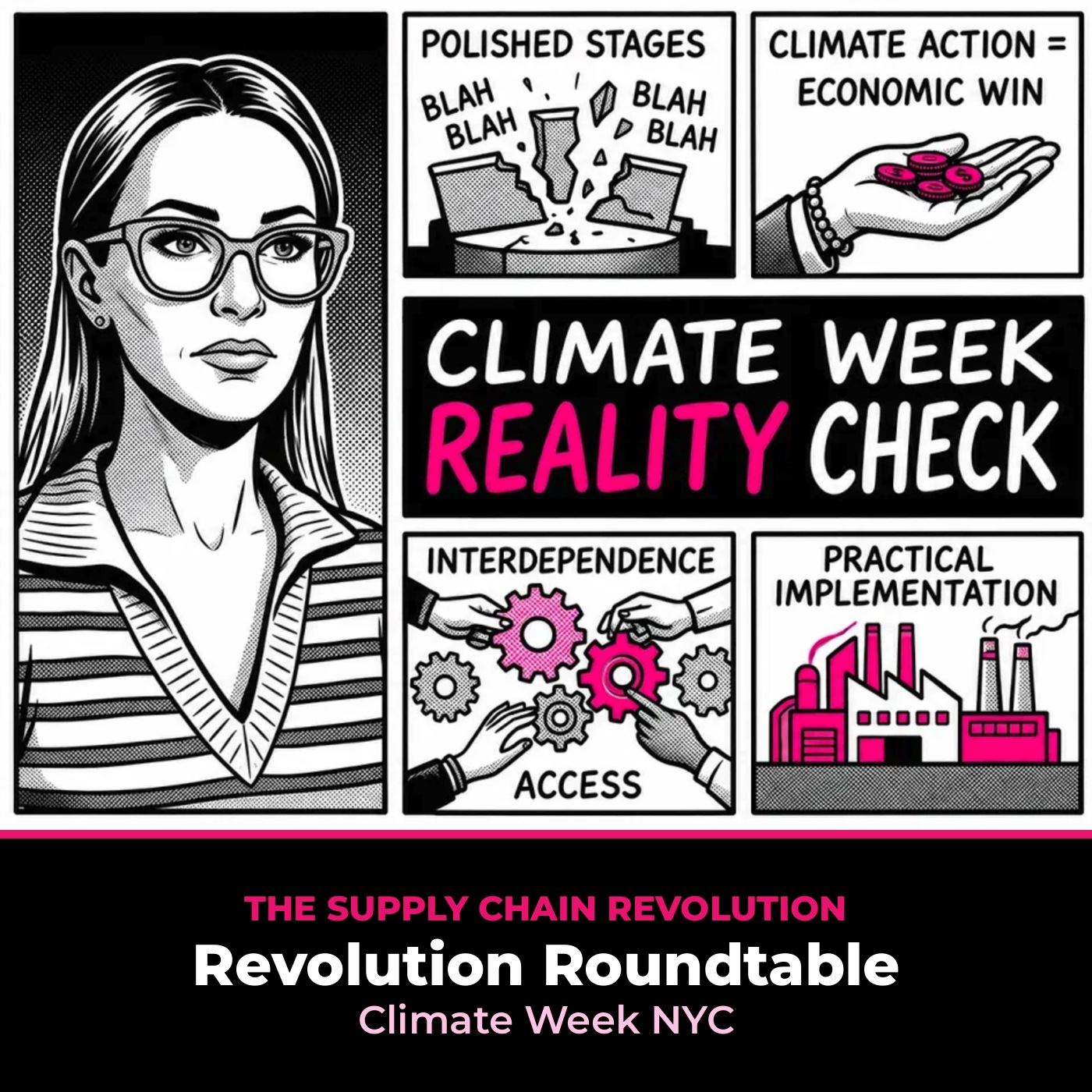
Supply chain was rarely in the title at New York Climate Week 2026, but it was in every answer. In this Revolution Roundtable, recorded live on LinkedIn days after the week closed, Sheri Hinish brings together three practitioners to compare notes on what they saw, what felt real, what felt performative, and what executive teams should do differently on Monday morning. Sandy Leyva, co-founder of Sustainability Decoded, is an engineer who works at the intersection of supply chain and sustainability. Wesley Herche, PhD, co-founder of Sustainability Decoded, is a former U.S. intelligence officer who now works across solar, battery storage, EV charging infrastructure, and on-site power. James George, founder of Provocative Human and a Supply Chain Revolution collaborator since 2020, spent 12 years as a Royal Navy clearance diver before moving into circular economy work with the Ellen MacArthur Foundation. He now advises on critical minerals and rare earth supply chain risk in defense, aerospace, and automotive. Each panelist names the week in one word: locked in, interdependence, economics, and access. The conversation then moves to the investor who told a room to stop framing climate action as an environmental choice, the quiet disappearance of net zero, the rollback of the Chief Sustainability Officer role and its cost to technical expertise and to women in the C-suite, and whether every job is now both a technology job and a sustainability job. An audience question brings the missing Scope 3 stakeholder into the room: the small and mid-sized supplier asked to fund the transition on margins that cannot absorb it. The roundtable closes with three decisions for Monday morning: price volatility itself, put critical materials on the risk register with a named owner, and treat disruption as information. Chapter Markers: 0:00 Welcome to the post-Climate Week Revolution Roundtable 0:57 Introductions: Sandy Leyva, Wesley Herche, James George 3:53 One word for Climate Week NYC 2026 6:10 "Stop telling me we're doing this for environmental reasons" 8:28 Supply chain was in every answer 10:03 The value was in the room, not on stage 11:44 What changed: net zero fades from the agenda 12:51 What felt performative: folding in the CSO role 14:19 The double loss: technical expertise and women in the C-suite 18:15 Is every job a technology job? 21:52 Is every job a sustainability job? 25:22 Audience question: the SME supplier missing from Scope 3 29:05 One decision for executive teams on Monday morning 31:37 Final word: circularity as a resilience discipline Key Topics: Climate Week NYC 2026, supply chain, sustainability, circular economy, critical minerals, material security, energy transition, price volatility, Chief Sustainability Officer, Scope 3, SME suppliers, just transition, ESG, AI, green jobs, Sustainability Decoded, Provocative Human Connect and Learn More: Sustainability Decoded (Sandy Leyva and Wesley Herche): sustainabilitydecoded.beehiiv.com James...
Sheri Hinish: Welcome to the supply chain revolution. I'm so excited to welcome you to our post-New York Climate Week revolution roundtable. And this is a live, unfiltered, unpolished recording, recapping Climate Week, which generates more content than any one person can. Can process. So rather than give you a multitude of recaps, we wanted to compare notes while it's still fresh in our head, what we saw, what we heard, what felt real, what was performative, what felt like noise, and what leaders can actually do with the insights that we learned, that we shared, and the insights in this round table today. So huge shout out for everyone joining us live on LinkedIn right now. Before we get started, I wanted to introduce two community partners, Provocative Human and Sustainability Decoded, who you may have heard from in the past. Let's start with some brief intros, starting with Sandy. Thank you so much for having me, Sheri. And I'm always so happy to share the virtual stage with all of you. I feel like we all have very different points of view. I I come from the supply chain side of things. I come as sustainability coded. I mean, I can tell you a little bit about my my background and I'm I'm an engineer by degree, but got to work in sustainability. So I feel that right now we're in a very, very unique stage of the field and an evolution of the topic where we're starting to see a lot of intersections, a lot of different convergence. So I was just super happy to have this this timely discussion with All of you. Thank you for having me. Wonderful. Thank you, Sandy. And also Sandy was part of the big idea series. If you haven't checked that out, I'll make sure to drop the link to her episode in the comments. And next, Wes, over to you. Hey everyone. I'm Wes Hirsh, co-founder of Sustainability Decoded with Sandy. My background, I started my professional life as an intelligence officer for the US government and then over time transitioned into sustainability with a focus on energy. And now I still work in energy, specifically in solar battery storage, EB charged infrastructure and on prem power. And then starting to work a lot. I feel like my career life has come full circle with everything that's happening it geopolitically. That part of my life is coming back and starting to clash with some of the energy transition work I'm doing. I last but not least, James Shord, you all know him. He's been an OG since twenty twenty. James, your introduction if you need one. He's dating me there. And they thank thank you. And and great to great to show in the conversation. But yeah, James George, hello. Thank you for having me. Founder of Provocative Human. By background, twelve years in the Royal Navy as a clearance diver, but the last decade transitioned starting with the Ellen MacArthur Foundation into my kind of view of the world through the circular economy. I spend most of my time now in conversations around critical minerals and rare earth supply chain risk, specifically in defence, aerospace and automotive, which is the basis of the of the kind of circular economy, although I find myself talking about it less and less these days because I think the I think the framing has moved on and now we all think about this in terms of sort of sovereignty risk aversion, that sort of thing. But we can get into through those those conversations. Sovereignty was definitely a word. That was a word. Okay. So I'm hosting. When appropriate, I will contribute. But I know that the three of you are going to absolutely blow my mind away with your insights. I have I have no doubt. No pressure. Okay. So we have we have a fire drill sequence just to also keep it like interesting for folks listening and watching. So the first question, the first prompt, the per first provocation is one word, one story. All right. So if you had to describe Climate Week, New York City, twenty twenty six in one word or what phrase, what would it be? And what happened to make you choose it? Yeah, so I'm gonna have to use a hyphen in order to get it down to one word. But for me it was locked in. I was gonna say energy, but that would be cliche 'cause I obviously but locked in. So one of the things that kept coming up at Climate Week over and over was last year I think was a bit of a dip in sort of emotions or I I don't know what else to call it, right? Like there was a lot of people that I think were a bit distraught and whatnot. But and I kept seeing that over and over and a lot not just in sort of the things that people were talking about that they were doing, but even in the questions they asked. So a lot of the discussions I'm up were very focused on practical implementation and how to make like real changes and advances on the stuff they were doing, some lessons shared and different things. But again, very little theoretical And very much like practically and pragmatically focused. So yeah, locked in was the word for me. I love it. Locked in, thoughts, reflections, or Sandy, what's your one word, one story? I'm actually I want to build on Wes because for me it was interdependence. And I think that we have seen that more from how the issues manifest, but now the conversation was more around interdependence between decisions. Which I find it like pretty interesting. And maybe the story for me is that I really allocated a lot of white space and different wild cards, to be like, let me be in maybe rooms are not as intuitive for me to understand if those connections are made between fields, right? and for example, like with with back to energy, there were more decisions based around infrastructure, around growth capacity, in the lane of of agriculture. And it was way much more targeted and locked in to incentives to create, but way much more focused. And I feel like with with the different fields we're we're getting together to understand the the different dependencies that exist and and the impacts as well. I love that. So we have locked in, we have interdependence and common threads, common green threads across sectors and topics. And James one word, one story. It really depended the rooms you were in through the course of the week. I I guess one of very quick reflection was there was a lot going on as you said. I guess the world I want to start with is economics. And it sounds fairly dull. But the story here for me, the penultimate days, I was sat in the World Climate Forum, which was a very heavily finance focused set of conversations in windowless rooms at two in the afternoon after four days. You know and there was a gentleman on stage in this particular session that had a fairly good broad spectrum of high powered investors in Climate Week who looked like he would didn't really want to be there. He said, stop telling me we're doing this for environmental reasons. We're doing it because it makes the best economic sense. I'm fine with if that part of our economic community sees this as a financial opportunity to do the right thing that then has unintended environmental and social benefits. Why that matters the second part of that second circular economy bit is the economy stupid, right? How do we how do we have the right conversations about economic opportunity that drives the right behaviors? James, I love that. I love all three of your responses. What it feels like to your point, I think the one word that is tugging at me right now, just listening to the three of you, is access. I also sat in a lot of rooms where finance, access to materials, who holds power, who holds holds capital. to deliver a lot of the bold commitments and Wes to your point, a lot of the more pragmatic, like what are we gonna do next on Monday morning type discussions? Why aren't they here? Why aren't they being championed? There are things happening, but like it was very single noted in a lot of these forums. So access would be my my word. All right, let's talk about it, just to give you maybe a moment a ho I hadn't thought about this, but I also saw that The one exception I saw, the Green Jobs Pavilion and the Green Jobs Board. I did a panel there, but that was the most diverse in every kind of way, I think, group I've ever talked with in a climate setting. So that does give me a bit of hope that and now that group was awesome. So hopefully if we're having this conversation ten years from now, maybe that'll be a little different. Absolutely. There were a lot of young people too that I was super impressed with. All right. So supply chain was rarely in the title, but it was absolutely in every answer in every room. I wanna know what dominated the rooms that you were in. Maybe you can give them a flavor of what happened in the hallway, what happened at happy hour, what happened in dinner, etc. And we'll start with you, Sandy. Good, because I wanted to to start on that one. They were so different, the conversations between panels and the closed door round tables and the one on ones. You can see that there's way much more curation. Around the things that you can say versus what you can't. And there was this this very much deeper discussion around capacity, right? Because now that we're seeing strain in resources, grid, that is impacting the way that we think about growth. That is impacting the way that we think about resilience. But again, everything being so interconnected right now, the conversations were much more difficult. The conversations were around let's make a second question of what happens next. And again the the panels are very good to get mainstream knowledge and more because we're seeing popping up different regulations and different priorities. But truly what advance you or what allows you to lock in is those personal interactions that truly tell you what works and what doesn't in a day to day. I love that. And and just to piggyback on what Sandy said, Wes and James, what other themes dominated The rooms or hallways that you were in that maybe folks didn't say those things on stage. Well I think I think Sandy put puts her finger on a really important point there, which which I kinda echo and I've that's that's been my one of my takeaways for talking to people this week is it wasn't what was being said on stage, it was the people in the room. That was the value. And I think we shouldn't underestimate the power of events like this, you know, whether it's London, whether it's New York. There is value in being in the room and being able to have those difficult questions when the mic isn't on or the lights aren't on. But I guess the bit the theme that was really powerful for me in in some of the rooms was when the true science was present and it was unflinching. Yeah. I have a follow up to that and I'm gonna go a bit in the weeds here and actually get into even the formats that I saw which were interesting. For the second year in a row, I had a lot of conversations where people were asking, like, does this really need to be the same week as you in general assembly is one of the the panels that I did, it was a series of three panels, but the panels were really short. And then everybody went out to breakout tables. And then a lot of the panelists would lead a table, but there were other table leads and there would be readouts, etcetera. The cynical take is like, Well, we're all just talking to each other. And and I get that. I get that criticism. The more optimistic take is the reason it was so valuable to talk to the other people at that table is because they were other practitioners and they And this was a theme that I saw over and over and over again in a lot of sessions. And I found all of that very valuable personally as a takeaway. I think there's a nice elixir, right, to what Wes describes there, 'cause I quite a few of the more kind of headline sessions that I attended, there was no Q and A. And it's kind of y y you get this sort of moment where the stage gets to broadcast and no one gets to challenge or no one gets to interrogate. And I thought that was missing. A little bit on on some of the the the larger high profile conversations. Yeah. Yeah. J just just out of curiosity, everyone, I did I don't remember hearing net zero. I also don't remember hearing much about sustainability being a department, which was very common last year. Just but like what else changed this year versus last year? I can kick things off. I won't name names, but there was a Actually like an executive dinner we went to hosted by a famous investment bank. I'll say that. they had a chart. So they were looking at ESG performance and energy performance for a bunch of different companies that they're tracking or invested in. and they were looking at what's called alpha. for listeners that don't know what alpha is, it's your differentiated performance in the stock market. Because if your company's doing well and going up, but the whole market's going up and doing well, like that probably doesn't say very much about your company. 'Cause you're always looking for something that's differentiated. and it's the way it's correlated to the market. But they were showing a strong correlation for alpha, for companies that had strong ESG performance and strong management on energy. So that was good, but also a bit not shock but just eye opening, where you're like, Wow, okay, yeah, like we're serious, serious. So yeah. Anyone else? What felt performative, just to be contrarian here. Like what f I'll start here. What felt performative? But we we did hear a couple of stories about kind of the blending of those roles as well, right? And and the sort of argument that, you know, ESO's a big enough job already on its own. You don't need to then fold it into something else and justify why you've done that as a positive. For me that feels like you're minimizing the value of that and clumping it in, adding it on to suck to kind of something else. So we we saw a little bit of that. And I I'm mindful that I'm pretty sure Sandy's got some some some stuff to put into this. This is Sheri. I I find that very insightful. I'm gonna oversimplify, but for me it was we were talking a lot about the solutions that were resilient to the current environment, but we didn't talk about the things that we need to challenge or change. And the other thing that I thought that felt a little bit performative is that we need leadership, right? It this is cross sectoral, so in in some specific sectors it's gonna be The public one in some civil society is gonna lean in, in some the private sector. I still think that those boundaries are very blurred and we need to start aligning. Like it's not a single entity that's gonna drive everything. So are we actually having those conversations? Are we forming those forms as well or those ecosystems that make this happen? I don't think so. We're not yet there, we're recognizing, but still there's a long way to go for that to be more organic. Yeah. I agree with you, Sandy. I do think that there's a big like leadership shift. To your point, I mean, we mentioned like the CSO role is changing. There's been a rollback stateside. A lot of those roles were held by women, very successful women, as they're being absorbed. I think to Wes's port point earlier, a lot of the technical expertise is being dissolved. The CSO role wasn't someone who just talked about themes and purpose. Most of those folks had PhDs or advanced graduate degrees in very technical disciplines. And so as that happened, it was a double whammy. So you lose the science, you lose the technical domain, and then you also lose the representation of women at the highest ranks. And so that path to the C suite also took a rollback. I mean it was like several things that happened and I I knew it. That bothers me because Leadership is actually not moving forward on this topic. It's getting worse. It's interesting. You probably have all participated in this debate over the last X number of years around like where should sustainability sit? Should it sit in op? Should it sit in marketing or accounting or whatever, right? Like the business. Yeah. It should it be its own business unit. Yeah, yeah. There's a right. It'd be interesting to ask folks that same question almost on a scenario analysis basis, right? Saying, like, where should it sit in ten years? And then you have to assume like What if everything's going great and those companies like really integrate sustainability practices as a core just operating principle? Like then where would sustainability sit? There I've seen I don't know if it was Trellis or somebody else ask the version of this question of like, do you do would you still need a a separate group? But it if if you take the optimistic scenario, let's say, where it truly is being embedded in every process because it comes back to economics and they see the value prop, then in my mind like you do have a conundrum on whether sustainability These might not be the only two options, but whether it goes more into an accounting like role versus a marketing like role. And there's arguments for both because you'd say, hey, you still have to do the ESG reports, you still have to keep score. And then you just sort of call balls and stripes, right? And that's more of an accounting role. Or is your job then to go talk about all the good things that the company is doing? I think there's almost a third path there as well, Wes, because I guess the bit on the the the kind of the the reporting and the accounting of it, that almost feels It's already becoming compliance. It's I think the marketing side still for me feels a little bit like it's really important because unless you tell a good story, people don't know. And I think the challenge we find at the moment where it does go down a heavy compliance or heavy marketing or a blend of the two, your traditional sustainability team stood in the middle, now doesn't really have a mandate or a remit other than to align with one of those two parts of the business, which means you're now reporting either into your legal counsel or you're reporting into your CMO. And actually that I think then weakens that that argument again for having a core CSO kind of route through. So I so I think it's it's it's it's what's happening out there at the moment. I think we need to get back to beyond compliance, beyond telling the story, how do we give people the space to actually just find new solutions within that within that business context? So I wanna I I wanna add something to that because I feel that we're starting to realize how much historical data we're gathering. And in the context of compliance of marketing, that's your deliverable or the end of the process. But true sustainability, through impact, uses that as your beginning of the process as that threshold to maintain or optimize performance for specific parts of of the organization. And that's a skill that we need to develop as sustainability professionals. Like not only the project management and financial literacy, but also there's this very interesting dynamic in which we wear multiple hats, but at the same time the authority is not formally there. And I think that that's where the CSO role of central sustainability brought like a little bit more of ownership instead of like getting lost in the layers. So every job right now, true or false, and you can challenge me on this, is a technology job. True. I'll take the trick. True. Or this falls apart live on the It's gonna depend on how we define technology job, but whatever. Just generally you need to know about technology to do so. I got a yes from Wes. Let me add one thing. Sorry, 'cause I I have to first show that I'm incredibly biased on this question. So going back when I was at Arizona State University, doing my PhD there, I worked there for a number of years. There's a course that the president of the university teaches once per year. It's a science and technology policy course essentially. And the whole theme of the course when you pull back like what's actually happening in the course is to show you that everything is a technology. So a lot of times we'll say, like, we don't want any technology in the classrooms. Like, what do think a pencil is? That's technology. I don't mean just the act of creating a pencil. I mean the idea of writing itself as a technology. So yes, but but also I think everything is a technology. My job is a technology job. I got a yes from Wes. Do I have any more takers for this point that I'm about to bring to life? I I actually think that yes. Let's talk about agriculture specifically that on its own, maybe it's not as intuitive that it's gonna be a technology technology job, but I had a pretty interesting conversation on what's happening on that space. And maybe we can blend it a little bit with the capital conversation because I I was in certain rooms where you had institutional investors, family offices, companies, entrepreneurs. And in that context they were like, okay, capital is there and they're ready to put it all in, but they need the book and claim mechanisms. They need to automate that. They need that integrity. be able to validate results and technology is a huge piece of what enables that and and it does it for for many industries. So more from from the implementation perspective, it go goes back to the interconnectness that we need to make happen. So I would say yes and more with the democratization to access to to technology that's happening, even in emerging economies. But yeah. I got a second yes. James, are you giving me a yes? These are well qualified yes. The point is coming. The point is coming, I promise. I'm gonna say yes and I think that for me is it's gotta be the right kind of technology. I think there was a lot of conversation this week, obviously, about AI. I think there's always the danger of using the most advanced technology when slightly less advanced technology will do. You know, back to kind of Wes's point about the pencil, not saying we should go back to pencils, but but I think there's always a kind of a bias towards saying Yes, and AI is going to solve all of this for us. I guess one of the things that ambition doesn't give you is readiness to to do things differently. That is where technology can get you there quicker. And that's when you need to be smart and sound on the types of technology you need. But I think a race at the moment to over technologically enhance a yes should always be met with is that the right level we need to take it to, or is there a lo-fi kind of answer to it first. So what are all of the conversations around AI were focused on generative AI, but we need to understand that this has been going on for many years. And you have also machine learning, you have data processing, data analysis. That's also AI, not just gen AI as we're seeing it right now. And a a big portion of that conversation, James, back to the point is How can we ripe size the technology before we scale or before we try to consume more resources to solve the same challenge? Absolutely. Let's park super intelligence. So I hear it has to be responsible, it has to create trust, transparency, traceability. Every job is a technology job. I'd argue every job is also a sustainability job. One more thing, and this is what I'm gonna ask you guys. So working in enterprise, working in consulting, working in industry. The IT organization is pretty much embedded in any transformative topic. Similarly, the sustainability organization should be embedded in lockstep in any transformative topic. So I'd argue you still need a sustainability team and department and function. Challenge me or agree. I agree, actually. What our role brings are those questions are not as intuitive or Or your conventional challenges to specific technologies or projects. What I would argue is that of course, because of the world that we're living in, it's not always like the top priority, right? Like the top one priority is to have a business that operates that is able still like to maintain its employees, to service your customers. But this is an a consideration that definitely should be a part of the process. Because if not, again, it comes to Different pieces of exposure that you're not potentially questioning. and we're all we would all consider ourselves sustainability professionals, but we all have other complementary disciplines, which is another like layer of this. Like Wes, you're deep in energy. Sandy's deep in supply chain. James is deep in circular economy and traceability. I'm across tech supply chain and sustainability. So what is a sustainability professional? That's that's the bit where I might challenge you, Sheri, on on the statement is saying I think it's not about the right for sustainability professionals to be across the business. I think it's for sustainability professionals to make sure they're valuable across the business by understanding how those different parts of the business work better and the language they use and how they do drive value in the business that isn't about just doing the right thing, giving the world a new vernacular on decarbonisation and circular economy and impact and ac all of this good stuff. We now need to upskill ourselves in what the business is because guess what? The business hasn't stopped doing what it's been doing for the last three hundred years. We've just added an extra layer on and we wondered why the business hasn't instantly jumped to where we are. I think now the the bit is how do we translate that better? How do we tell that story in line with how those folks see the world? Yeah. I think you can have both. So for one, every major business unit within or in a corporate function always sees the entire business through their own lens. So this isn't unique, right? So if you're an accounting, you'd Hey, yeah, sales and marketing and finance and strategy can do whatever you want. But at the end of the day, we keep the score and they like think of the business through their lens. Sales and marketing says, Hey, look, without customers, there is no business. So you can do whatever on the back end, but I'm the front end and otherwise the business doesn't exist, right? Every major function will have that view. But Even within that, like if you take sales and marketing as an example, you could say, like, are you business development or are you customer success after? Or like they're gonna have to your point about like the diversity within a sustainability team, you not everyone will look exactly the same within it. And you can still be a cohesive sort of pillar of the business. Now, like we have to be probably the most multilingual within any of these other ones because accounting practices have been established for hundreds of years, right? Ours is still being established. And it'll be more difficult for those other business units to see the the lens of the business in the way we do. But but I don't think we have to apologize for that. Yeah. We can we can see the business through that lens. And so to your point about every job being a sustainability job, yeah, I think you can you can make that case. Amazing. So we have our first question. We have a question. And the question is the most important stakeholder in scope three was not in the room. The small and mid-sized supplier who is being asked To fund the transition, report on a plethora of metrics with a margin that cannot absorb it. What are your thoughts? I might start if you don't mind, because I love that question for the simple reason that that is one of the biggest challenges I think over the last three to five years when people talk about partnerships. And actually they d they're not really talking about partnerships, they're just talking about another commercial relationship. If you want your SMEs to do something different. You need to structure that partnership differently. Rather than saying, here's a 12-month kind of sales cycle, you deliver on the terms, on the on the economics that we determine. If you want them to source differently and do something differently, you need to give them the right buying signals. And you see very few businesses getting to that contracting negotiation and saying, right, we know this is difficult for you. We know there is. We're still kind of circling around this idea of we need better partnerships, we need better partners. You've got to grow them and then giving them that financial model that allows them to build differently for you and for the market. I love that. You can't build a just transition on an unjust supply chain or sourcing strategy. Wes and Sandy, any thoughts? I'm gonna try to be quick because for me it's a matter you cannot put the burden on them alone. We're starting to see more industry wide coalitions to see how you can create those incentives either through aggregated demand. If you can create those terms and conditions more as a unified message from again, like a particular vertical or an industry perspective. And I think that the biggest barrier or why we're not seeing many actual like SMEs represented at the table is because there's still alignment that needs to be done from the people requiring those on a practical basis. Yeah. And and I feel that right now they're feeling it like maybe a particular supplier getting Ten, twenty, thirty different requests a year. So the closer we get to to that alignment, the more that we can talk specifically to to the players are gonna set the example and they're going to move specific industries forward. Wonderful. Wes, last but not least. Yeah. So I I don't want this to come off as flippant because I mean it in very serious way. The first step, even for SMEs or SMBs. is to stop thinking of it as a burden and start thinking of it as an opportunity. But like you have to go back to that procurement group and say not to ignore the points on partnership where you're like, I'm a small guy or in this, I really need your help in order to do this, right? And again, if those companies aren't willing to do that, do they really want that thing that they say that they're asking for? I think I hear you saying is supplier data is becoming as important as supplier price. I don't know if it's as important, but it's certainly important. Right. At the end of the day, everyone still is always gonna come back to price. Nobody wants to do that. So that primary data is valuable. I think that it depends on the commodity because for some it becomes a question of market access, right? EUDR or in other cases, like for packaging for EPR, it's being priced in already for a specific scope. So it is an interesting evolution of the topic in which it's not a binary answer like yes or no, but I think that it is changing at least for the most intensive verticals, it is creating a different set of questions and again it it's becoming a a conversation around business continuity. I'm inspired by your answers. I'm inspired by the question from the audience. And I think it's definitely something that I want to percolate for next year. So as promised, we're gonna separate signal from noise. And I have a last question for each of you. If you were advising an executive team on Monday morning What is the one decision that you would tell them to make differently because of what you saw during New York Climate Week? We actually talked about this last week. When you look at the price cost comparison, one thing that people aren't necessarily looking at total cost of ownership, cost of of fuel, et cetera, but there's a there's a way and there's financial mechanisms to price the volatility itself, right? And that volatility is not free. But when we had only one energy system, we just treated it like the weather. There are other mechanisms now. And it's a serious piece that you have to start taking into the equation on this this transition scenario is how are you pricing not the the where prices sit today, but the volatility itself. Love it. Pricing volatility or pricing resilience. James, who is not sucking on a wasp? What would you Never in these conversations with you, Sheri? On Monday morning, material material security. It's reaching the board as a risk item, whether sustainability is putting it there or not. So I think it is listing your five or ten critical materials for each product that you put onto the market and and that you control and understanding the pathway back. Because that physical recovery and struct infrastructure is going to take 10 years to build. So step one is knowing where that problem is that you're already carrying in the contracts that you've got now, naming one owner per material, per dependency, getting it on your risk register. Not having it as an ASG reporting function. Amazing, amazing. And last but certainly not least, Sandy. I'm gonna connect both. Would say disruption is inevitable right now. So treat it as information and use those emergency situations to translate them to opportunity. Is there a process or a particular disruption that is causing a specific initiative or a specific department to rethink the way that they do things? If so Can a sustainability consideration, at least one, be integrated in that process that's being challenged? I think that we have a number of of things when it comes to resource scarcity, energy resilience that we can question and maybe it's not the most intuitive answer. So right now it is the right moment to translate those things that we've were talking for many years about into actual situations and how we can chime in as a resource. Incredible. One last prompt. We started this one hour together with one word or phrase that describes New York Climate Week. Has your word changed? It hasn't changed, but I I'd be remiss if I didn't say that the the change for me, I think, in the conversation at New York Climate Week this year was we've got to start thinking that circularity isn't an ethics play, it's a resilience discipline. And I guess for me it comes back to that economic piece. We can't use yesterday's thinking to design tomorrow's system. Absolutely. Sandy, has your word changed? No, but every time that I talk to all of you, it gives me deeper meaning. So in that in interdependence, are there any more questions that we need to ask? And are there more people that we need to bring in? Yeah. Another those. I f I felt the same way. I felt like my word was access, but it has changed because sometimes I think you just forget about the human connection in all of this and that we're all there to work together to like Change the world for the better. And so my word, I don't know what word would describe what I just said, but if there was a word, that would be my changed word to close this podcast. It is such a treat and joy to host you. Check out sustainability decoded and provocative human for everyone listening. Make sure you're connected with them on LinkedIn and social media. And thank you everyone for tuning in. And I hope you found this New York Climate Week 2026 recap valuable and insightful. And if you like it, maybe we'll do it again.