
Supply Chain Revolution · Supply Chain and Sustainability Strategist, Sheri Hinish (Supply Chain Queen)
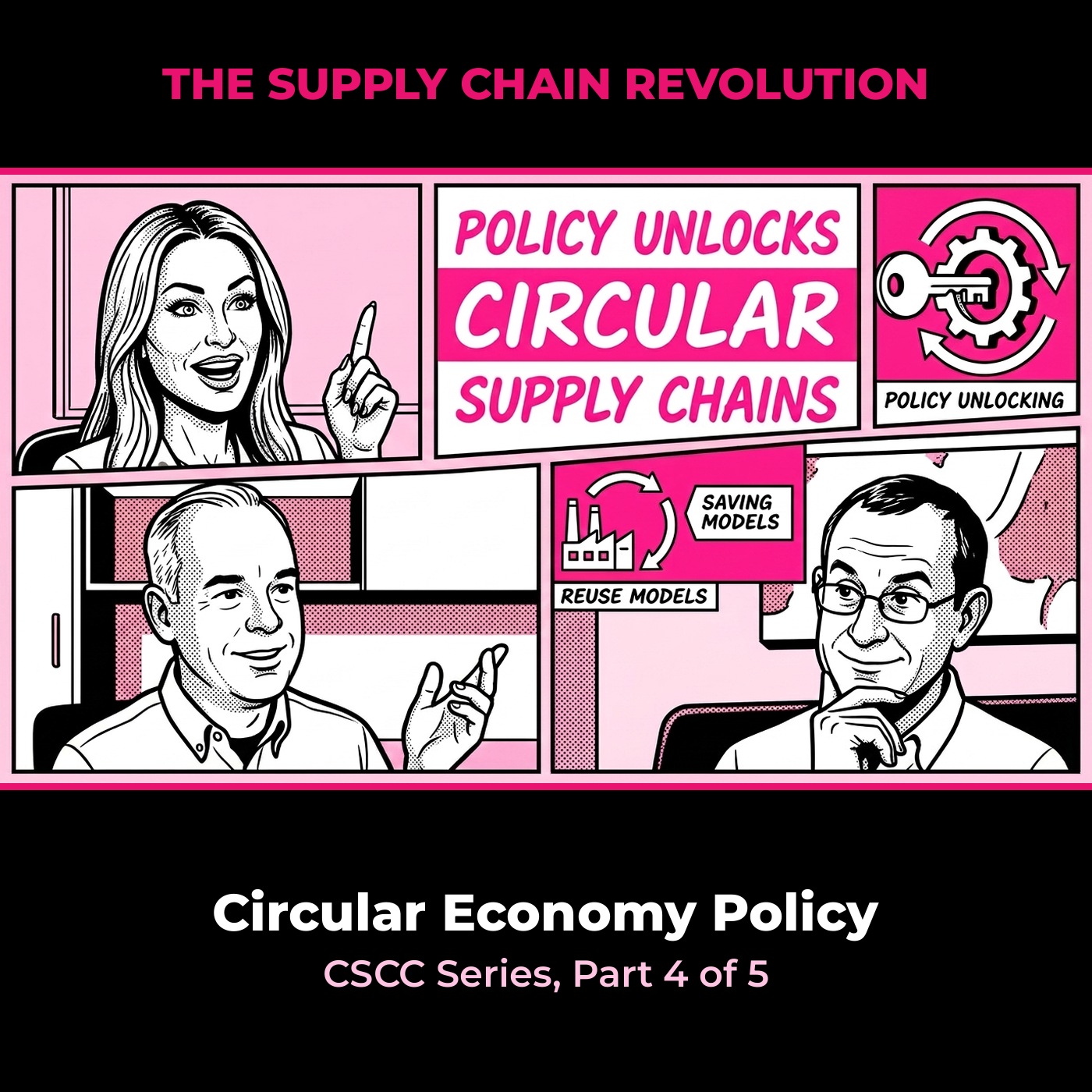
Circular supply chains do not scale on corporate pilots alone. They require enabling policy: state-level incentives, workforce alignment, environmental regulation, capital pathways, and cross-border investment structures that make reuse-based business models viable. This is episode four of a five-part series with Pyxera Global and the Circular Supply Chain Coalition, exploring what the enabling environment looks like when policy moves from aspiration to implementation. Secretary James Kenney leads the New Mexico Environment Department, where he has built one of the most ambitious state-level circular economy strategies in the US. Under Governor Lujan Grisham, New Mexico offers free education from pre-K through university and trade school, universal child care, a 50-year water action plan backed by $400 million in annual investment, and PFAS legislation that listed discarded PFAS as hazardous waste with a consumer-facing label accessible to every New Mexican. The department created economic development positions whose only metric is jobs created and net income generated. Manuel Carmona Yebra is Deputy Head for Global Issues and Innovation at the EU Delegation to the United States. He has led EU-US circular economy engagement at the state level, engaging governors including Governor Wes Moore (Maryland), Governor Hobbs (Arizona), and Governor Lujan Grisham (New Mexico). His work has revealed that circular economy is bipartisan because it addresses economic development, environmental protection, employment, and supply chain security simultaneously. John Holm, SVP of Partnership Development at Pyxera Global and CSCC representative, frames the enabling environment strategy and explains why the coalition focuses on governor-level alignment rather than federal solutions. Together they unpack why states are laboratories for policy that scales and why the EU Circular Economy Act is expected to require 25% of critical minerals supply from recycling. Chapters: 0:00 Introduction: the enabling environment 1:00 John Holm: enabling environment in practice 1:33 Security economy framing 2:38 Why CSCC focuses on states and governors 3:42 Secretary Kenney: New Mexico's model 4:45 Free education, child care, workforce transition 5:46 50-year water action plan 6:19 Waste to marketplace: critical minerals 7:48 PFAS legislation and the consumer label 9:25 Consumer access to information about PFAS 10:08 Secretary Kenney on trade association lawsuits 11:12 EU Circular Economy Act and competitiveness 12:26 25% of EU critical minerals from recycling 13:04 EU-US state engagement 14:18 Why the EU engages US states directly 15:04 Circular economy as bipartisan 17:48 Replicability and interstate symbiosis 19:55 Sovereign supply chains, Mexico border corridor 21:01 How to engage Topics: Circular economy policy, PFAS, EU Circular Economy Act, critical minerals, economic development, workforce transition, bipartisan policy, reverse supply chain Connect: New Mexico...
speaker-0: Welcome to the Supply Chain Revolution podcast. I'm your host, Sherry Heinisch, also called the Supply Chain Queen, and this is episode four of a five-part series produced in partnership with Pixera Global and the Circular Supply Chain Coalition. In this episode, we're going to talk about how to build the circular economy, moving from coalition to community and the policy that unlocks value. The enabling environment, if you will. Circular supply chains scale when policy, capital, workforce, economic development, and regulatory signals connect to industrial demand and operator capacity. New Mexico shows how state-level legislation and decarbonization rulemaking can create a first mover advantage, while the EU US engagement shows how the global circular economy policy can Actually become practical at state level. Let's dive in. So, welcome everyone. It is so great to finally host you. And John, I want to come to you first. Today we're gonna talk about the enabling environment. And you've that's how you've described your lane. And so when we say policy unlocks circular supply chains, what are the actual levers that matter for people listening? speaker-1: Yeah, I think a couple of things. I think when you look at the first of all, when you look at the context or the phrase of circular economy, many people view it to a degree rather than so in some lanes as, you know, decarbonization, greenhouse gas reduction, ⁓ no plastic rings around turtles. But I want to come with a different context. We're framing circular economy as security economy. How are you looking at this as an economic tool to really dig in on supply chain risk mitigation, competitive advantage around materials that are limited or finite on this planet that you want to collect over your competitors. I would say a a triple win, economic stewardship, environmental protections, and I think a a deeper workforce unlock around engaging them around a new business models around reuse, which frankly, it's about time reuse business models really start coming to life. So I think That's kind of the frame that when we we look at the circular supply chain coalition, what we want to focus on is really unlocking that next stage, next generation unlock around profitable industrial decarbonization, which is not an oxymoron. speaker-0: Right. Is the circular supply chain coalition focusing on state level policy and governor level alignment instead of waiting for the federal solutions? speaker-1: It's a great question. I mean, I think when you look at the richness of the United States, ⁓ a lot of it is really place-based. And so when you're really trying to unlock subsidies and incentives, especially around local supply chain, you really need to go deeper in and really into a a place based context and make that happen. And so I think the framing for that is that governors are stewards of their economies. They understand the local conditions of which they operate in, they understand the problems that their constituents are facing. And there's really a a a certain level of governors that really are looking at this version of security economy as being a economic development opportunity, environmental opportunity, and setting up the state for success for the future, considering climate change, considering extraction. So I think really that's the reason why we really started focusing on early days on a place based state strategy. speaker-0: Right. And I so Secretary Kenny, thank you so much for joining us. I'd love to explore, in your view, what does it look like for New Mexico to align economic development, environmental priorities, workforce strategies, circular economy infrastructure, all the things that John just unpacked for us. And also focusing it specifically around critical minerals and reuse business models. Over to you. speaker-2: I love a simple question. That that's a great question. And it and in in all honesty, it's such a proud moment to be a part of this episode and talking a little bit about what New Mexico is doing and what we're doing right. And I think it it starts with leadership from our governor through the cabinet and really solving problems at the local level first. And you know, when I look across the cabinet and I look at what the the governor has sort of nourished here in New Mexico. It is everywhere in New Mexico in the and you I'll t I'll just tout a couple of things because you build, right? And New Mexico, you know, most recently we now have free child care and and ⁓ universal child care ⁓ for health, public schools, public school lunches. ⁓ you can go to school here in New Mexico from once you get out of your your primary school years, you can go to get your associate's degree, your higher education degree. You can go to trade school all for free. The economy is flourishing in New Mexico and we're adding those value added jobs as well. So you don't have to worry if you're a sort of energy stranded community from the cold days. Now you have the opportunity to move into a new way of thinking in in terms of how you're going to transition your workforce. So you could be eighteen, thirty-eight, forty-eight, fifty-eight, and still find a place to work in New Mexico and the job training to get there. All while your family is being supported from health to education. So once you have that sort of established, now you can look at some other universal areas that you want to invest in. Water. I mean, we are in the southwest of the United States and climate change is real, aridification is happening. We need to figure out how we're going to make water reuse a priority in the state. And with our governor's leadership, we put together a 50 year water action plan. We have about 400 million dollars. Annually that we're putting into the economy to create new sources of water. We have a rich source of on the surface waste that is now can move from the expense column of the accounting ledger to the profitability side of the accounting ledger if you look for critical minerals. So from lithium that could be used for everything from solar panels to EV batteries, you know. It used to be that when we think about going to get after those critical minerals for security or just to advance the economy, national security or advance the economy, we thought about mining them. So creating that that space of of how do you use those minerals and how do you get them from waste to marketplace is is really where we're investing a lot of money and a lot of jobs to create that marketplace. Those are some of the areas where I think when you lift up the family unit. When you start talking about how to create sustainable jobs, especially in the circular way where waste becomes a product, and you think about how do you move that forward. I mean, that's why we're the quantum capital of the world. It's really a great time to be in New Mexico because we're all sort of moving in that same direction together. speaker-0: Yeah, I I got goosebumps when you were talking because first it's just incredibly inspiring to hear. And one of the things that I I wanted to just double click was really around some of the rulemaking and the policy at a foundational level. And so can you walk us through New Mexico's PFA legislation or why policy actually is a great conduit and a foundation for circular economy investment and all of the transformative things that you're describing. speaker-2: Yeah, and I'm gonna I love the question. And I love the fact that you're picking up on some of the words that are so common to the vocabulary here in New Mexico. You have to understand it and then build a regulatory or policy space that is circular, right? And I think that's where we're at here. And I'll talk about the the the PFAS legislation. It feels like climate change. It some of these problems feel bigger than all of us. And it can make you feel a little bit hopeless at the same time. So we we reacted in a way that that came up with listing discarded PFAS as a hazardous waste. So we have a cradle to grave mentality around PFAS that's already in the environment. We'll get it out, we'll clean it up, we'll make sure that it doesn't come back into the environment. So what we what we did is we created a label that that shows an Erlemaier flask with the letters P F A S in it. And why that's such an important and yet so simple concept is that, you know, here in New Mexico, we have the most number of PhDs, but we also have people who don't have a high degree of education. And we want this symbol to be a point of education. For any consumer who walks into a grocery store or to a big box retailer to see that I might be bringing something into my home that I want to better understand. ⁓ let's face it, corporate America is making educated choices about what products have PFAS in them. Why is we as consumers can't have that same access to information? And really what I said to my team when we came up with this concept is. You know, when you take a r step back and you think about what we're doing here, we're creating a circularity of policy around forever chemicals that starts with the premise you should have the same access to education. And and we're really regulating transparency and honesty. And so when groups like ⁓ and I don't when various trade associations come in and file lawsuits against us and say, We think your your label is not appropriate and honestly if you're not gonna drink our water, pay our taxes and vote here, then you shouldn't have any say as to whether or not people have education here either. speaker-0: Wow, that's a provocative close, Secretary Kenny. And you know what's interesting? You know, I think so P Faz, it's it's not as intuitive when you say it, but PFA, P is in Paul, F is in Frank, A is in Apple for people listening. Because I'd never like to assume you made a brilliant point about education and and accessibility. But I do want to talk about the bridge, because as you rightly mentioned, there are so many people. Who really care and they care on a personal level. It's represented a lot of the topics that you just unpacked. It's part of their value system. I do want to bring in Manuel. Manuel's been very quiet and he has just an incredible point of view. And so when we think about EU legislation and the Circular Economy Act and all of the great things that you're helping translate and also bring to our state side, Manuel, what What elements of the Circular Economy Act do you feel would be most relevant for US states in your in your perspective? Thank you. speaker-3: Thank you, Sherry, and ⁓ and ⁓ good to see you all. The Circular Economy Act is part of a bigger ⁓ a bigger picture, which is the ⁓ competitiveness drive that is at the heart of the new policy cycle in the EU. So many of the regulations that have been put in place already in Europe, like the Sustainable Products Regulation, ⁓ aiming at a better design of products for the circular economy. The EPR legislation that we have in Europe ⁓ has proven to be good, but not enough if we want to go over the circular economy targets that we have now. So the Circular Economy Act is expected to give ⁓ a competitive edge to ⁓ to durable products, to repairable products and recyclable products. So it's not only about recycling, but looks at the whole value chain. That's one thing. The second thing that you are likely to see in this proposal by the end of the year is to make sure that in certain battle chains where there's a huge value in the economy, like the critical raw materials, we have the incentives, we have the resource security, and we have at least 25% of the supply in the EU of critical minerals coming from recycling. You have to think that as opposed to the picture that we heard in the US, the EU most circular economy legislation is actually transboundary. So the task of harmonizing across different cultures, trying to harmonize and make that cohesive is a huge ask. And that is also the governance, the implementation across twenty seven, very different countries is something that we're trying to aim to aim to do. And to also bring in our conversations to to states with New Mexico, in Maryland, in Arizona, Nevada. We're trying to bring this conversation that working together across states, across countries. brings a lot of economies of scale and dynamics in terms of the stability of feedstock, regional hubs, logistics that are very interesting to develop circular economy to the full. speaker-0: Wonderful. There was so much rich information that you just shared, especially on I think the complexity of of of what the EU Circular Economy Act is and also what would be useful for US states and people listening, no matter where their role is in private or public sector. I do want to double click on something that John mentioned earlier, and that is Part of your role, Manuel, and how are you engaging at the state level? Just give us an example of what it's revealed around readiness. And maybe readiness isn't just all of our hands are stacked together. We want to learn more about the level of investment, the appetite to envision bold plans that have the right infrastructure and funding behind them also. speaker-3: Totally. I mean the big questions ⁓ the big question here is I guess why are we engaging with with the states ⁓ so much in the EU delegation? It comes from ⁓ some budget that we managed to get to to push for circular economy in the US. Our economies are extremely integrated in terms of standards, the trade and investment relation is huge. So circular economy as an economic issue. indeed is something that we wanted to discuss with the US to have some type of alignment. I realized that there was a huge potential in the States and this is where the things were happening in circular economy. With a dozen of states now across the US implementing EPR legislation that has been recently adopted with great new initiatives like Secretary Kennedy mentioned. Clearly I realized that first this is an area that can be bipartisan because it cutters for economic concerns, but also for environmental concerns, for you know, job concerns, security of supply chains concerns. So it's a wide range of solutions ⁓ that can get the attention of many different audiences and interests. In the last two years, two circular economy forums trying to bring together stakeholders in the EU and the US that are active in this in this field. And the results have been really fascinating, thrilling. We have covered From policy and regulation, how to finance the circular economy and also the innovation aspects, the ⁓ business aspects. Is it profitable? Can we create jobs? And the answer to all of this, yes, we can cover all that. But more than that, ⁓ there is a huge commitment from our ambassador, from the ambassador of of the EU to the US to bring this up. ⁓ politically ⁓ to govern us. And I think it's crucial because ⁓ it's ⁓ all hands on board approach that is ⁓ that is required. speaker-0: There's so much there, Manuel. I'd love to pause and just get reactions, reflections from John and Secretary Kenny, ⁓ around readiness, around all of the things that Manuel shared. speaker-1: I'll jump in, having the the privilege of working with with Manila for the last couple of years. I think there is a real appetite for the first time since I've been in sustainability where you see an opportunity really at the policy lens to do something big, to really start putting together a play for stewarding the planet and economic development. We're subsidizing at the moment, throw away a coffee cup. We're not incentivizing, be a steward of that coffee and reuse your cup. Now, where is the economic value of that? We actually really need to reuse this material over and over again because you know it's not infinite. We can actually use the materials we've already extracted and spent the money on and just reuse them again, and that's a valuable profit. The question is how fast it will, who's going to get there first, and who's going to set up that enabling environment to protect first and foremost, the citizens of those communities. The ones that are sitting there in those spaces really to be ready to be contributing to this kind of new emerging idea. speaker-0: Yeah, and and I I'd love to get Secretary Kenny's perspective here because ⁓ again, I'm still coming back to are there any parts of the model that's clearly working in New Mexico that are replicable? Is there a sector specific focus? Does it have to be place specific? What can people really sink their teeth into now, no matter where they sit in the US? speaker-2: Such a great conversation. And I think listening to, you know, your other guests talk about how they're working in this space, you know, I'll start with state government is fundamentally a a problem solving space, right? And I think when you think about states as being the laboratory of incubating that policy that I hear about from my colleagues nationally when what we're doing in a rural town in New Mexico has a lasting effect for the European Union. Right. Like you start seeing the the connective tissue between all of these policies and how they can scale. As one of the the US's largest oil and gas producing states in the country, when we think about textiles and and sort of those synthetic fabrics, why are we thinking about circular economy only around textiles? Where's the producer responsibility that goes back from that polyester textile all the way back to that oil and gas well? I mean, That's some circularity, right? And and why is why are carbon emissions not thought of as circular? Why do we only think of the the physicality of a product of as being circular? So why does gas emissions get a pass on circularity, but physical products don't? And I think and don't is the wrong way to say it, but you know, are are lifted up by circular economy. So I think sinking your teeth into where does one begin, right? We learn as we go. We're solving community problems. And a lot of times circular economy produces jobs, produces tax revenue. It it anchors businesses into communities. It creates hub and spoke models between us and maybe a neighboring state. And it gives you a rubric way of thinking that is that is different than yesterday and and furthers how you want to see policy shape tomorrow. speaker-0: Yeah, absolutely. I do you envision in the future if, you know, circular economy or reverse supply chains at scale, do you envision more of a reliance interstate? So like industrial symbiosis, where you have this co location and coupling, not only of skills, but of material resources and of capability. But do you see in the next five to ten years a shift to sovereign supply chains? Which are circular by design. speaker-2: Yeah, we share a border with Mexico, right? And we have for decades shared that sort of model between another country and this country and this particular state. So I a hundred percent agree with you that the the future is going to be not what do we put in the borders of New Mexico and don't talk to our neighbors. We're going to regionalize with our neighbors. For the benefit of New Mexicans and and those who live in Arizona and those who live in Mexico, in my state of Chihuahua specifically, right next door to New Mexico. So a hundred percent agree with you. I think speaker-0: Amazing. What's the first step to engage with the circular supply chain coalition or even to start reaching out to you all getting involved? John, we'll start with you. speaker-1: Yeah, I think first of all, when you look at the Circular Supply Chain Coalition and our positioning as conveners of conveners, I think it's important to look at, you know, Manolo being a friend of the CSCC and us working with Secretary Kenny to support more of the great work they're doing as a model across the state. So, you know, there's no tied relationships. It's just really working together with this common value proposition. In that context, you can always reach out ⁓ to me directly at J Holm at Pixaraglobal.org to learn more, happy to have that conversation with anyone wanting to engage. And and check out www.circular supply chain dot org as well. speaker-2: Yeah, excellent. We are the New Mexico Environment Department, a public agency here in the state of New Mexico. We have recognized how important this topic is to the the the people of New Mexico. And we've created two economic development positions here at the environment department. So if you go to our New Mexico Environment Department website, you can find our economic development liaisons. Their only metric is how many jobs have you created and how much ⁓ net How much net income have you brought to New Mexico? So that is their job and they do a damn good job at it. speaker-0: Incredible. No. speaker-3: If I i may for the three of us we've been organically connected already. But we are pursuing this, as I said, with more forums on circular economy. ⁓ Secretary Kenny, you mentioned that you know there was actually a you know a hotline that they could you know you gave us a hotline. So there are organic c connections already with the states and the EU and and the stakeholders in the EU and this this is all gonna go forward. Also with the CSCC focusing on critical minerals, this is something that we are extremely invested in in the EU. the Secretary Economy Act will ha will be big on that. ⁓ so so you know, this is going on. This is just, you know, there's a lot of potential. speaker-0: Wonderful. So thank you all again. All about the enabling environment from policy aspiration to implementation environment. You have unpacked how everyone, states, regulators, funders, and financiers and practitioners, community members can all become active supply chain designers when we start aligning policy, capital, workforce, community benefit, and the demand signals around. Making the circular economy inclusive, responsible, and future fit for everyone. Thank you so much for joining today.