
Successful Student Transitions - A Time to Thrive · Louise Wiles and Elizabeth Gillies
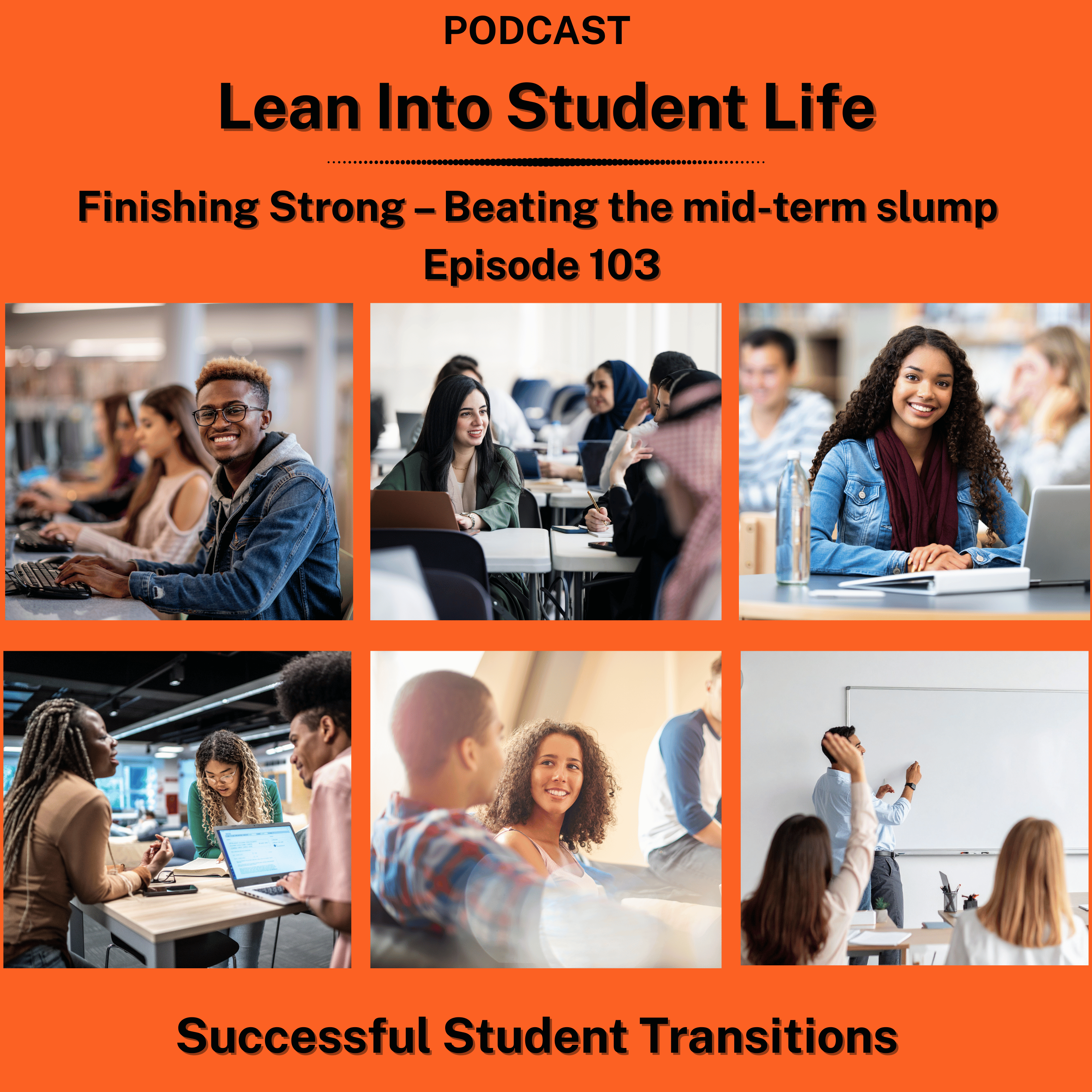
You've made past the midway point and reading week. This is the perfect moment to pause, take stock, and celebrate how far you've come since unpacking those boxes in freshers' week. In this episode of this great Lean into Student Life Series, Louise and Elizabeth guide you through the critical mid-term period with five practical tips for finishing strong. Whether time is flying by or dragging along, this episode will help you reflect on your successes, refine your approach, and re-energize for the weeks ahead. Learn about a powerful framework for understanding the different tasks that all compete for your attention helping you to identify what is genuinely productive versus what is simply keeping you busy. Discover strategies for managing the constant distractions of uni life. Learn to savour the successes and approach academic challenges positively. Consider how you can ensure you are making the most of the opportunities that uni life offers. Reflect on the upcoming return home at the end of term and how you can manage 'your return' in a way that works for you and everyone at home. This episode is your invitation to reflect, recalibrate, and recommit to making the most of your university experience. To register free for the show notes and additional resources for all episodes in this series go HERE.
Transcript [00:04] Louise Wiles: Hello and a really warm welcome to Successful Student Transitions where we aim to provide support and inspiration for teens and young adults as they step out of school, college into the world of work and further education. I'm Louise Wiles and I'm here today with my co-host Elizabeth Gillies. And welcome to this series Lean into Student Life now. This is an eight-week series devoted to supporting first year students as they settle into university life. If you're a parent or educator listening, please forward this on to anyone you know who is settling into uni life. And if you're a student in your first year, you're in the right place and a very warm welcome. You're probably well into the first term by now and hopefully you'll begin to feel more settled. But we know that for many these initial weeks, even months can be a bit of a roller coaster ride and we're here to support you. From the first episode in this series, episode 99, until the last 106 at the beginning of December, we're sharing five tips per episode to support you practically and emotionally and give you the know-how and confidence boost you need to not just survive, but thrive in your first year. And if you're keen to follow these episodes, then we've created something special for you. An online space where you can go and review the content of this episode using the show notes. They're packed with reflection, questions and some additional resources designed to support you on this journey. You can register for access to this series via successfulstudenttransitions.com/lean-in so let's get into this episode Finishing Strong, Beating the Mid-term Slump. This is the perfect moment to pause to take stock and celebrate how far you've come since unpacking those boxes in Freshers Week. In this episode, we guide you through the critical mid to late term period with five practical tips for finishing strong. Whether time is flying by or dragging along, this episode will help you reflect on your successes, refine your approach and re-energize for the weeks ahead. It's perfect for Reading Week or any midterm moment. This episode is your invitation to reflect, recalibrate and recommit to making the most of your university experience. [02:31] Louise Wiles: So, let's get started. [02:35] Elizabeth Gillies: Welcome from Louise and I, Elizabeth here today we've got five tips for this second half of term and how to keep yourself going. Going to the end of term. It's close. It's closing in. How are you doing? Is time passing quickly or slowly? Certainly, there are changes around you. And if you're in the UK, the clocks have moved backwards, it's going to be a bit darker earlier, the leaves are falling and it's certainly getting colder. There are changes around you and likely within you. And today's podcast we are going to have a reflective glance back at the start of term and then a future look at opening up to new things and thinking about going home for the winter or Christmas break. And I want to share with you. I've really been enjoying reading a book called Hyper Focus by Chris Bailey and I was really attracted to it by the subtitle which says how to work less and achieve more. I thought, who doesn't want to do that? And although it's focused on work life, there are lots of useful research nuggets and concepts useful for students at university. So, let's start with tip one and I asked how you were doing, but I want you to ask how are you doing? Do you know what's on your agenda? Do you know what all the things you have to do in terms of work and looking after yourself and are you getting most of it done? You know, there are lots of things that we can give our attention to. Some tasks that lead to us being really productive and others less productive or even not at all. Some tasks seem to be much more enjoyable to do, bring us great pleasure, senses of achievement, and maybe some not so. And we're sure you've already seen this in work demands at university and you'll know it from school too. And Chris Bailey in this book Hyper Focus that I mentioned really describes a lot of these demands on he calls our attentional space and encourages to notice what's happening to our attention. Are we leading it or is it leading us? And I particularly like this quote “we are what we pay attention to”. It's quite a nice one. And he talks about four kinds of tasks and the work for us and thinking about you as new students. Here's what he describes. So, the first group of tasks he calls ‘purposeful work or purposeful tasks’ where there's good productivity, you're doing stuff, you're getting stuff done, it's making an impact, your efforts are really paying off and the work's enjoyable and attractive to us. The work we want to do brings meaning and with it a feeling of accomplishment and it's something we might try to aim for. But in reality, not many tasks fit this description. And just at the start of your university life, I'm wondering if you've experienced a lot of this yet or even a little bt of it. So purposeful tasks are the first thing. Then there are the ‘necessary tasks’. And these are productive, but maybe not so enjoyable. It might be that you've got to talk yourself into starting and work at keeping your attention. I'm sure you've had this experience and it's a good skill to know about, how you gear yourself up to get this necessary stuff done. There'll be a lot of it at university, like attending seminars or making a first draft of an essay. And of course, although I'm saying these are necessary things that might be enjoyable to you, remember the enjoyable part isn't always there. So, they'll be different for different people. Purposeful, necessary. The next ones are ‘distracting tasks’. And, well, like you and like us, we all know about these. These are the enjoyable and unproductive tasks. We can spend a lot of time here. It's about being on social media, playing games on your phones. And Chris Bailey calls these black holes for being productive and suggests the better you are at managing your attention, the less you'll be in this zone. That's interesting. So, it's about attentional management. The last work he talks about are ‘unnecessary tasks’ that are both unproductive and certainly not enjoyable. And they often come to the fore when we're putting off necessary work or purposeful work and we're kind of procrastinating. For me, it's about tidying my desk or sorting through old notes. Something that I don't really have to do. Certainly not enjoyable, but it's often something I'm doing to put off from getting to the task that I want to do. Louise, what resonates with you? [07:42] Louise Wiles: Yeah, I can definitely see how they fit into my day. I suppose one thought I was having with the distracting task, I suppose I was thinking, in a day you have so much to do, you know, you need to do a lot, and you need some downtime as well. I was just thinking, well, perhaps the distracting tasks are the ones we need to save for that downtime, when you need to be having a time doing something that isn't taxing, perhaps that's where you put your distracting tasks and think of it that way. And certainly, yeah, I can see the distinction between purposeful work tasks. And I definitely had some of that today and some necessary tasks. And yeah, I'm very good at the unproductive, not enjoyable, but just distraction that usually because I work from home, that will be when I find myself in the kitchen finally putting stuff in the dishwasher or not really wanting to do, but needs to be done, but I do it because it's distracting me from something that I find a bit challenging work wise. So, yeah, yeah, that all makes a lot of sense to me. [08:48] Elizabeth Gillies: It does for me too. And there are things and maybe at another time we can talk a little bit more about kind of the things that in the book will give you ideas about how to use these ideas, but certainly planning bits of your diary, which I've been doing since reading the book, just blocking it out. Because sometimes you might just have a couple of purposeful tasks or necessary tasks to do a day and blocking out time to do it is a really good thing to do. [09:20] Elizabeth Gillies: Blocking it out at the beginning of the day to get those things done because we have limited attention and certainly there's more about in the book about how hard it is to keep attention. So, we have to be trying to do it. Like, you know, here's this word that we're coming out that we say a lot ‘intentional’, like making the choices to do certain things. So, you know, I know I had a couple of purposeful things to do, some necessary things to do, but I also found myself doing some unnecessary things which now I really regret because it's time lost. So what about tip two, Louise? [09:53] Louise Wiles: So, I think this is a really important thing to be doing at this stage in the term we've kind of suggested in past podcasts, I think nudged you to do this, but we're going to devote a whole tip to this and that is to lean into your successes. So, reflect on what's been going well and perhaps link that to the concept of savouring that we discussed two episodes ago. I think it was savouring helps us to feel the positive emotions of something that we've done perhaps recently or in the past. And it's a very positive thing to feel. Take some time to think about what's gone well, what you've done well, what's been successful, and enjoy savouring that feeling because it helps your positive emotions no end. It's easy for us to think about things where we're struggling and our brains tend to go to find those if we give our brains half a chance. But this is a time not to allow that and it's to focus on what is going well. It might be that you're still at university, you're still there after seven, eight weeks and you're enjoying it. And perhaps that's a bit of a surprise, given that you struggled in the first few weeks. Maybe, I don't know, it's all different for different people. But give yourself a pat on the back for that, for the settling in, for the adjusting, for the making friends and getting to know the new environment. That's also important. Perhaps you've learned where to shop for food, you've been cooking well in the kitchen and making up some nice food. And perhaps when you think about where you were at the beginning of term, you will see how far you have come. You've come a long way and learnt a lot since you unpacked your boxes in that first week. So, give yourself a pat on the back and time just to reflect on those successes. Now we're talking about purpose, work and the necessary work. Perhaps notice when you've put in the effort to get those tasks done, even when they haven't been so enjoyable, and notice what's helped you to do that, because that's a really important life skill. Because sadly, we can't all be doing what we love to do all of the time. Hopefully we'll do what we love to do some of the time, but it's just not going to be all of the time. And so, we do have to motivate ourselves and inspire ourselves to get the other stuff done. What is it that you do to inspire yourself to get things done in those situations? And one thought that we had as we were chatting about this episode is that in the first term, often the academics are not the most exciting, because what most courses are doing is bringing you all up to the same level of knowledge and understanding in your area, in your subject area. So, you may be re-covering stuff that you've already done before. Some of the assignments may not be that thrillingly exciting, and that's just the nature of the first term. Recognise that too, as well. I think that's really important. We challenge you here to take a few minutes to write down at least three things that you're pleased with that you have done, and then if you go and share that with someone who's close to you, that would be even better. Perhaps go and set this as a task in the kitchen for you all to do and discuss. [13:25] Elizabeth Gillies: And maybe other people will recognize things that you've done that you might not have been within yourself. [13:32] Louise Wiles: That's a really good point, because very often we don't recognize our strengths or the positive things and contributions we make. [13:43] Elizabeth Gillies: Tip three. Think about what you want to change. And remember, you're still in a new space. You know, you've been here seven, eight weeks. You're very unlikely to have worked everything out and got everything sorted. You're learning to be a new student in a new setting with everything new that you're learning about. And we've mentioned this before in the podcast when we talked about organization, that it's good to keep an eye on any slippage as it can easily snowball. So, try to keep as much as you can on top of those things you have to do, especially in the beginning. And I know it's asking a lot of you, but keeping on top of everything will make it easier. I know some students who kind of let things slip and then the more things slip, the more they get anxious about it. We want to pre-empt that, you know, not. Not happening like that. Keeping on top of stuff as much as you can is really good. And something that I read that I was really quite surprised at in the Hyper Focus book that I'm focused on at the moment was that when we're sitting at a computer, we get really easily distracted, either by an interruption from somebody else or a self-distraction. And the statistic that he quoted was 40 seconds, 40 seconds before we get distracted. So, no wonder we don't get down to doing a lot of stuff or getting into things really. It's hard for us sometimes to do that. So, keeping our attention is difficult. And I'll share with you one thing that he suggested to combat this in a way was to keep a distraction list. And I've started to do that myself, is that when you are distracting yourself or something's interrupting a text or something, write it down so that you'll end up with a distraction list. And then you can start to see patterns of things. And when we see patterns of things, then we can make plans to try and either prevent them or to tackle them in some way, like putting your phone in another room while you're working or whatever. But a distraction list is quite a good thing that you might want to. You might want to bring into your kind of repertoire. What else might you think about change? [16:11] Louise Wiles: Yeah, actually, and that's just reminding me of, I think we've mentioned him before in previous podcasts Nir Ayal. He wrote the book Indistractable and he says it's a disease, almost a feature of modern society, that we have so many potentials for distracting us from phones to computers to iPads to people, we're constantly bombarded. So, it is developing that discipline to shut down and close down. I think also, it's really helpful to be aware of your mind and what your mind is telling you about what you're doing, because I think especially when we're in new academic settings and facing new academic challenges, it's easy to see the threat in them and to feel it's a threat because it's new. We haven't done it before. We perhaps have high expectations, maybe unrealistic expectations. You could ask yourself that question. But we can develop a kind of threat response to it, which means that we shut down cognitively and find ourselves panicking rather than being able to engage positively with the work. And I think it's helpful if you notice that you're doing that, because there are things you can do to prevent that or to stop yourself from going down that route. And that's kind of to see it rather than as a threat. And something to be fearful about is to see it as a challenge, something new that is going to be challenging for you because it's new. You wouldn't be sitting where you are right now doing this course if there wasn't some challenge involved in it, because otherwise, why would you be doing it? So, I think that's a positive way to look at it and to ask yourself, how can you think about what you're being asked to do? What skills do you have that you can use as you analyse whatever it is you're being asked to think about? And what knowledge do you have that you can apply? What tools do you have that you can apply? Ask yourself ‘how’ questions? Ones that will help you to approach the task in a more positive, less threatened way. And remember, you're where you are to be stretched, not for it to be a comfortable journey of minimum effort. Really, you're paying. I know it sounds awful, but you are paying to be challenged. So, if you see it that way, you perhaps will then phrase it mentally in a more positive way or frame it mentally in a more positive way. [18:49] Elizabeth Gillies: So, there might be something that Louise and I have mentioned there about some improvement that you can make. And the challenge for you now is to think about if it's something that you know within yourself or something that we've mentioned. Maybe write down one thing that you'd like to work on to improve either for the rest of this term or certainly at the beginning of term two. What about tip four, Louise? [19:12] Louise Wiles: Okay, so tip Four, having talked about having a lot to do and a lot to focus on, we can also suggest that you try to do something new or try something new if you can. And I guess you've done a lot of that because a lot has been new. But I think the other really important thing about this experience, one is the challenge, but two is, is this opportunity to try new things, to be curious about things. So, if you're feeling that you've got some of the basics done, you're feeling more settled, then you can tick some of those settling in things off your list, then perhaps you have some space to go and just try something new. So be curious, get out there and do something that you've never done before, perhaps stretch yourself a little bit. I think university is a great place for you to do that because in some ways it's a safe place to try new skills, new sports, new activities, because you've got lots of other students around doing the same as you. And it's a brilliant opportunity to add to your skill set rather than keep doing things that you already know how to do and you're already familiar with. So perhaps step out in a new direction. It could be something as calm as knitting or something as exciting as rock climbing or I don't know, but anything in between. And it's good for us to do this because our minds, as well as looking out for threat and danger, for survival, are also stimulated by new things, by novelty. And that can be good for us in many ways. When we're learning new things, we create new neural connections in our brains. Those increase and that builds up our brain. Connectivity can be a boost for your confidence. You'll learn more about yourself, you can meet a wider circle of people. You're probably going to enhance your mood because it's a positive experience, generates positive emotions and as I said, learn new skills. And there's even some research about learning new things improves our immune function and helps us to get better sleep. So yeah, it all feeds into those fundamentals that we've talked about so many times, our sleep and our general health. [21:33] Elizabeth Gillies: And I think when you were saying that I was reminded of this word, ‘capacity’. When you see you've got capacity to do it, and of course it's a safe thing to do, then stretching yourself, pushing yourself out is good. And it also reminded me of some cross-cultural work about when people move and live in different countries and about the choices, we make about that. Because you could have what people call a ‘shallow life’. It being about just doing minimum stuff to be there. You're working on the surface of things. You don't really dig down deep and make connections and do lots of things and explore things. It might be that you would do that because you're not going to be there for a long period of time. And it's maybe quite easy to get in, arrive and then leave without a lot of trauma or trouble or challenge. Or you can have what people call a deep experience of really being involved in multiple aspects of what's going on in that setting. You're really engaged, you're making choices about to do and to learn new things. And although that's harder to begin with and it takes more time to get really into those deeper levels, it might be more enjoyable. It might be that you learn more about yourself and make good connections. It's harder to establish and it might be harder to leave it. So, there's a choice there about, do you want a shallow experience, or do you want a deeper experience? [23:16] Elizabeth Gillies: And I guess Louise and I would encourage you to think about the deep experience because you're not going to be there for a year or two. It's three or four years; you're going to be there. So, there's time and opportunity to do that. [23:30] Louise Wiles: Yes. And you don't want to get to the end and regret having not made the most of it. [23:36] Elizabeth Gillies: So, we'll go on to number five. Our last tip in the podcast today, and it's about that preparation for going home. So, we've been saying there's lots of challenge and changes within you, and there's likely been, you haven't been there, but there'll been changes at home as well. You know, people might have swapped bedrooms, people might be doing lots of different things. Somebody might be offered your room as a brother or sister. So, there'll be different patterns at home, too. And you're going to have to negotiate your way back in that because you wouldn't have been there for 10 weeks at least. So, there might be kind of challenges to think about how you're going to fit back in. You know, are you going to be that wanting to lie on the sofa and be fed and looked after, or are you wanting to be a little bit more of your independent self? There might be having to reconnect that kind of challenge of reconnecting with old friends that have been around that are all back home, too. And how do you balance reconnecting with your family and friends and doing all the stuff that you want to do. And in a previous podcast, we talked to a student. It was one of the things that she brought up, and it was about how do you make that transition home? And she was talking about it when she left university. But I think there's a point about doing it now when you're going back, what are the expectations for you? Have you to be home by a certain time? How do you contribute to the family? When we talked with Elaine Halligan, one of the things that she's very keen on is family contributions and young people doing their own washing and cooking and stuff like that. So, are you going to be participating in that? Because you have been doing it before. So how you negotiate this re-entry is another transition, isn’t it? Louise, anything else to say about this time of coming home? [25:39] Louise Wiles: Yeah, I think it perhaps seems strange to you that we're mentioning it now and I don't think there's a lot for you to do around this right now, but it's just beginning to think about it's going to be another transition. But there is also an academic aspect to it, I suppose, which is worth thinking about and planning about now. And that is many of you will have assessments when you go back in January and you'll need to do some revision and some work for those. So perhaps you want to start thinking about how much time you want to spend over the Christmas holidays working academically, because some of you may be needing to work for financial purposes as well, as well as wanting to meet up with your friends and family. So, you may find that you've got a very busy few weeks when you leave for your Christmas break. So, then the question is, when will you fit in a bit of revision and preparation for those assessments? So perhaps start planning that now and making some choices around how much work you're doing now. Are you up to date with your lectures and your notes and all those things, the things that will help you to prepare for those assessments? Just throwing that out there that you're not panicking two days before you come back after Christmas because you haven't done any work. So just give that some thought and think about how you're going to be prepared for those assessments. Often the assessments aren't too stringent in year one but doesn't mean that you want to aim to the lowest level of just a pass, because sometimes when you just aim to that you can fall below. So, you might want to be aiming a little bit higher and that will take you some preparation, so give that some thought. [27:18] Elizabeth Gillies: Again, it's another time to be intentional about what you're doing. If you don't want to do so much when you're at home, you might have to do it towards the end of term or build it in now when you've got maybe some capacity to do that. [27:30] Louise Wiles: Absolutely. [27:32] Elizabeth Gillies: So, let's recap on our Tips today. Tip 1 Ask yourself how you're doing. Tip 2 Lean into your successes. Tip 3 what would you like to change? Tip 4 Try to do something new if you can, if you've got that capacity to do that. And Tip five Think about that prep for home in terms of relationships and academic work. [28:07] Louise Wiles: Thanks so much for listening. We hope you found the review an uplifting process and the content of Hyper Focus has given you some ideas for maximizing your focus and getting what needs to get done done. The book Elizabeth has been enjoying and talking about this week is Hyper Focus How to Work Less to Achieve More by Chris Bailey and we also mentioned Indistractable how to control your attention choose your life Nir Eyal. Remember, if you want to go deeper, we've created a special online space where you can go and review the content of this episode using the show notes. They're packed with reflection, questions and some additional resources designed to support you on this uni journey. You can gain access now by going to successfulstudenttransitions.com/lean-in a space for you to reflect, learn and plan for your university's success. So that's all for this week. We'll be back next week with the next instalment in this series. Meanwhile, have a great week. Take care. Bye, bye for now. Disclaimer: The information contained above is provided for information purposes only. The contents of this podcast episode and transcript are not intended to amount to advice, and you should not rely on any of the contents of this podcast and notes. Professional advice should be obtained before taking or refraining from taking any action as a result of the content of this podcast. Elizabeth Gillies, Louise Wiles, and guests, disclaim all liability and responsibility arising from any reliance placed on any of the contents of this Podcast and transcript.
More Successful Student Transitions - A Time to Thrive episodes →