
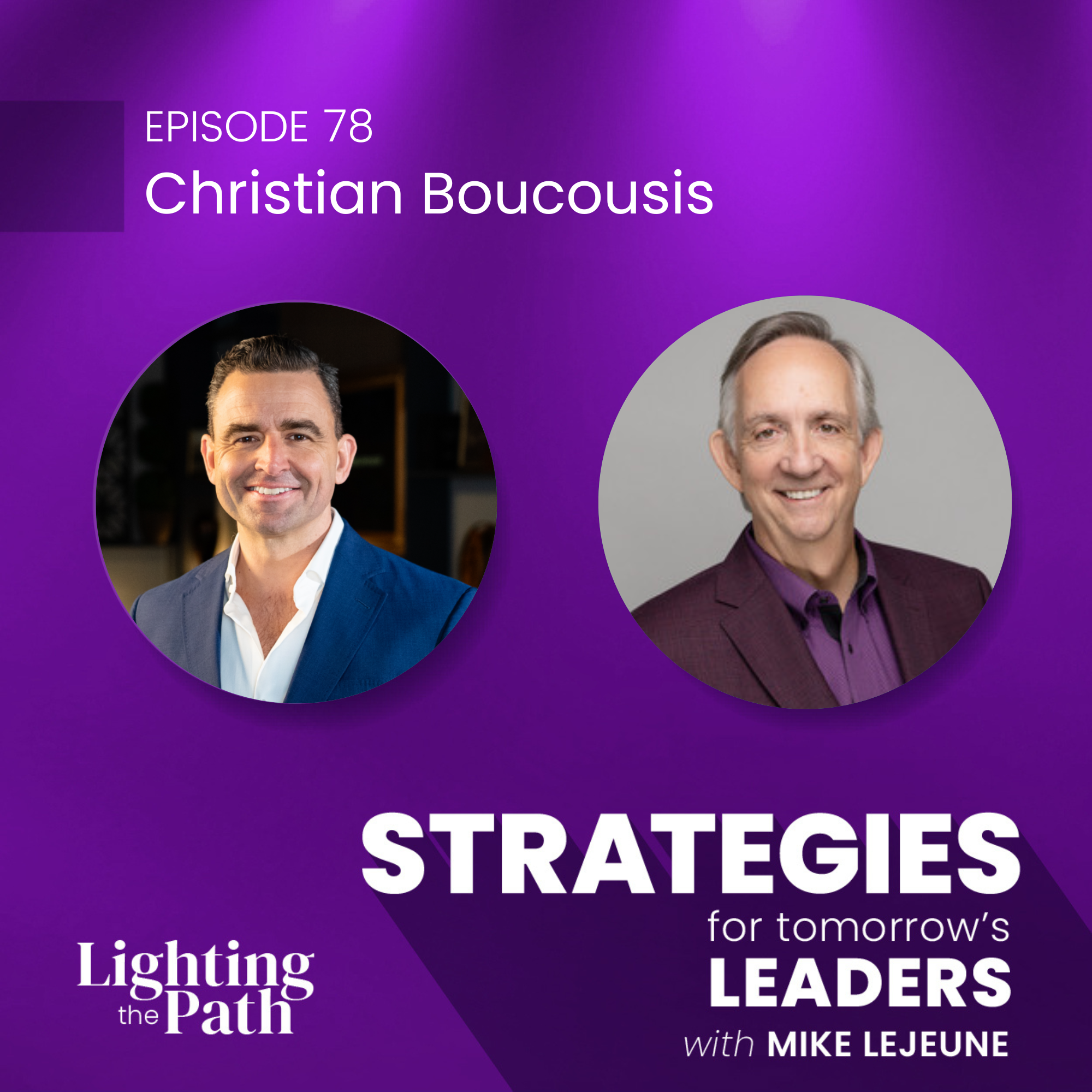
Strategies for Tomorrow's Leaders · Mike LeJeune
What can fighter pilots teach business leaders about clarity, decision-making and execution under pressure? In this episode of Strategies for Tomorrow's Leaders, Mike Lejeune sits down with Christian "Boo" Boucousis, former fighter pilot and CEO of Afterburner, to explore flawless leadership, high-performance teams and how leaders can close the execution gap. Boo explains why effective leadership is not about perfect plans or controlling every outcome. It is about staying clear on the mission, focusing on what you can control and adapting as reality changes. Mike and Boo discuss the difference between linear and iterative thinking, why leaders get trapped by busyness and information overload and how clarity becomes even more important in fast-moving environments. A major part of the conversation focuses on debriefing as a leadership development tool. Boo explains why a good debrief is not about blame. It is about understanding what happened, identifying the cause of the gap and deciding what to do differently next time. They also explore emotional intelligence, self-awareness, bias and the growing impact of AI on leadership and decision-making. As leaders gain access to more information and technology, Boo argues that unclear objectives and weak thinking will become easier to expose. In this episode, you'll learn: • Why clarity is one of a leader's most important responsibilities • What flawless leadership means when perfection is impossible • How fighter pilots use iterative thinking • Why teams need to "own the gaps" • How debriefing builds accountability without defensiveness • Why busyness can become a leadership trap • How emotional intelligence and bias affect decision-making • Why leaders need to build capability instead of control everything • How AI may reshape leadership and execution If you lead a team, manage change or are responsible for turning strategy into results, this conversation offers practical ideas for improving clarity, accountability and execution. CHAPTERS 00:00 The Significance of Names 01:12 Diversity and Influence of Houston 02:36 Podcast Production and Book Writing 03:40 Leadership and Mission 06:04 The Story Behind Boo's Call Sign 11:08 Flawless Leadership and Iterative Thinking 14:25 Leadership Challenges and Cognitive Bandwidth 16:15 Clarity and Owning the Gaps 18:31 Fighter Pilot Perspective and AI 22:25 AI, Leadership and Decision-Making 24:20 Emotional Intelligence and Leadership 26:07 Humanity and Bias 28:17 Leadership and Human Behavior 31:17 Debriefing and Growth Mindset 33:25 Building Leadership Capability 35:18 How Debriefing Works 41:02 Facilitating Better Debriefs 44:26 Debriefing Without Blame 53:18 Balancing Future, Present and Past 56:20 Flawless Leadership Connect with Christian "Boo" Boucousis: https://www.linkedin.com/in/christian-boo-boucousis/ https://afterburner.com/ Learn more about Mike Lejeune and Lighting the Path: https://lightingthepath.net/
Mike Lejeune: When you think of things from a leadership standpoint, a lot of times we get we get caught up in looking at our life and perspectives, what I call from our own backyard, our own situation, our own circumstance. And we sometimes get real myopic as leaders because we're fighting our battle. I invited today's guest, Christian Boucousis for a specific reason. and that's because of out of all the people I've talked to recently, when I learned a Christian's walk with with leading a group called Afterburner. he literally brings a a global perspective because of the walk he's had over the last twenty years and literally starting up an amazing organization in Afghanistan and up in in the Middle East area and originally coming from Australia. And early early early life, I love this because I won't get an airplane with you, Christian. it w I started off as a fighter pilot. in Australia. And so there's so much perspective from a leadership that we just it was important to me for us to sort of capture your voice and your thought, Christian. So so welcome to Strategies for Tomorrow's Leaders. Boo: Thanks for having me, Mike. I'm looking forward to it. This is a a great way to round out the week. Mike Lejeune: Yeah, well super. Well I when I looked at your last name I was putting a lot of pressure on myself getting that last name right, Bacukus Bacusis. 'cause it's people who've listened before. It just says Boo: It's easy to easy to stumble on. It's Mike Lejeune: you can wanna chop things up on it then. So I hope hope I did it justice. Boo: Yeah, and there's a story behind that. I mean, my origins of my call sign hark back to the inability for my drill sergeants to really pronounce my name. And my first nickname when I was in the Air Force was actually Bruce Losis, which is a bovine disease. and in Australia, a lot of a lot of military people are kind of farm boys, you know. We we're we come from the country. My family's from the country. And, you know, I was a little bit I was only nineteen when I joined the Air Force. So In Australia, you don't have to go to college to be a pilot. You can just join straight from high school. so I was reasonably cocky and assured as you are when you're a nineteen year old kid. So I got stuck with a pretty horrible first call sign, Bruce, which was which was short for Bruce Losis. But equally, as a young kid learning how to march and how to be an officer when you start your career, you start at the officer training school. we would do drill every day. And and for whatever reason, I just couldn't help but laugh in that uncomfortable way. Every time we you'd wheel, and wheel means you turn a corner. And when you turn a corner, you have to turn to face the guy next to you. and then you snap your eyes forward again. And every time I turned I'd burst out laughing. So my drill sergeants were always like Mr. Boo Boo because I couldn't pronounce my last name, not even after three months. So the my whole officer training cohort would just run around yelling Mr. Boo when we're in the barracks and eventually it just settled down into boo. So I think Boo solves A lot of problems for a lot of people, when it comes to trying to pronounce my last name. Mike Lejeune: Yeah, I love the fact that we looked down your call Simon. I saw the word boo down there when you first got online. I go, I hope there's not a ghost application of this somehow. Boo: Yeah, there's a ghost and then there's a boyfriend, girlfriend, like it's the word is morphed. Mike Lejeune: Yeah, I thought I was I was gonna go down that then that l you might boo get a little loving loving arms around it, but Yeah. Yeah. But you've Yeah. Good shape Boo: Yeah. If if I have a female podcaster, they're they can say, Look, I'm a bit uncomfortable with this. It's like, don't worry about it, it's just a call sign. Mike Lejeune: then. So we you've you've got an interesting path or whatever. Just for for context purposes, help our help our our audience understand more about Afterburner. What what's what's your mission? Boo: So our mission is to create a movement of flawless leaders, one mission, one moment, one leader at a time. And we define a flawless leader as a leader who has come to terms with the fact they can't be perfect and the world's not perfect, and they're committed to the pursuit of perfection, but appreciate it's never going to happen. So it's a journey. And the overarching premise in flawless is that you are 100% invested in what you can control and adapt to. Everything that you can't control. And people conflate the word flawless and perfection. They they believe it's both. But when you do the research, even just the origins of the word, the the origins of perfection originate in the scholarly fields, and it's a derivative of of a Latin word. Whereas flawless is a derivative of a Viking word. a Viking would define an unbroken stone as flaw as flawless and it has its origins in in in in Nordic and then in English. So when we talk about flawless, that's what we're talking about, unbroken in in what we can control. Like a flawless diamond, it has no occlusions. It's it's clear. It in itself can be flawless, but once it starts to get into the hands of a jeweler, it can't be perfect because it might might be cut incorrectly, may not capture the light the way you want to. the beauty is in the eye of the beholder. So when we talk about a flawless leader is saying, hey, your job is to take people into the unknown. You you have to grow them along the way. And all of you need to be invested in what you can control and ready to maneuver around everything you cannot. Yeah. Mike Lejeune: Yeah, when when I think in terms of of military, I I always get in in awe of people like yourself who pursue, you know, the not sorry a career but b but calling and and that space to get started with. as I shared with you when we got first kind of line, I'm not a wasn't honored to have served in the military. I I've spent a lot of time studying the Navy SEALs just because I'm in awe of the mentality that goes into that space of where you're going into harm's way whenever people like myself, we're going in the other direction as fast as we can. and there's a concept in that is it's considered forward thinking focus, which is there's the mission. You know, what what's one step that I can take to move in in in that that direction. what I'm hearing, I love this thing about one mission, one step, controlling what you can control. what what's the trapdoor that you've seen leaders whenever they're trying to pursue mission? what's the trapdoor that they run into that kind of that that causes them to stumble where they have to kind of reach out to someone like yourself or myself for assistance? Boo: Yeah, like they I call it destination driven thinking. So for most people, when they think about the future, the starting point is where they are now. Whereas as a fighter pilot, the destination could present thousands of different opportunities in order as to how you get there. So most leaders practice linear thinking, like the cognitive model that we use is a little bit like A to B thinking. Here I am, this is where I'm going. Whereas fighter pilots, and this was harks back to John Boyd and the OODA loop and Top Gun, we embrace iterative thinking, which is to say everything is in motion, everything's moving, and I just have to do something, and then I can iterate from reality rather than project into the non-existent future. so through iteration, what happens is as a leader, you spend far more time working with the real world and less time imagining what the future may be like. And I think that's where We see if you look at engagement, you look at burnout, engagement's the lowest it's ever been, burnout's the highest it's ever been. What what you have is this disconnect between people truly comprehending, hey, where are we going and how is my effort contributing to towards moving, towards getting to that destination? So I think for leaders, it's really you need to step back and take a breath, as as we would say in the training world, in the military. You've got to wiggle your toes. You just got to stop gripping so tight. You you have to have the ability to unlock your cognitive bandwidth. And in today's digital world, you know, we we we're challenged by what I call the digital vortex, speed overwhelm and the battle of attention. We're we're expected to make decisions and deliver faster than any time in human history, and that's just accelerating with artificial intelligence. We're overwhelmed by just the vast amount of information and our access to that information now. And finally, you know, the human attention spans diminish to that of a of a goldfish or less than a goldfish. So we find ourselves as just really operating in a quite a chaotic, discombobulated way. and it's a leader's job to not fall into the trap of everything tends towards entropy, but to be the individual that brings clarity and direction to the chaos. Chaos is always gonna, chaos is going to happen without you. That's a guarantee. So Mike Lejeune: Right. Boo: we have to tame it the best we can do. So I think the number Mike Lejeune: Yeah, you Boo: one thing is we we have a fixed mindset. We're fixed in our biases, we're fixed in our beliefs. And that manifests in behaviors that aren't always fit for where you're trying to go. Mike Lejeune: Yeah, I love this word that you had is clarity. that's I if I were to choose one word that I've spent most to the time in the last couple of years and with the clients that I work with, it's helping leaders and teams really understand clarity of what the next step needs to be, clarity of where we're going. Because I was just talking with with with a group this morning about if you don't create an opportunity for for people to to weigh in, you'll never get buy in. And so for me, if I'm pursuing clarity, a lot of times it's not for me to bring clarity, it's to cause clarity to to take place. Boo: Ab absolutely. And no one leader can create the clarity. You know, you you you do that collaboratively because one person's clarity is another person's ambiguity. You know, this Mike Lejeune: You betcha. Boo: is you know what what I think one of the things that we do really well at Afterburner because it's something that you deal with every day as a fighter pilot is the challenge in life and in business is no one owns the gaps. So you've they call it cross-functional teams, you know. So what happens is people own domains and they own excellence, but very few people, apart from the CEO, owns the integration of it all. Whereas as Mike Lejeune: Mm-hmm. Boo: a fighter pilot, every single fighter pilot owns the integration because the integration of all the different assets on a mission is what makes it successful. Very rarely do you go as a Hornet pilot and only fly with other Hornet pilots. You'll fly missions with 20 different nations, 70 different aeroplanes, where you're integrating with the Navy, the Army. the marines, you'll be flying with helicopters, you know. So there's no point, you know, in a business sense, it'll be like, you're a helicopter, you fly too slow. Like I can't work with you. It's well, we're aligned on on a mission here, which is to rescue a pilot or go and go and recover troops that are in contact in a contested environment. So we all in the military have to be really good at owning the gaps. And that's why we missionize everything. Because a mission doesn't care really about rank. It doesn't care about expertise. What it cares about is how we take those skills and integrate them to deliver an outcome Mike Lejeune: Yeah. Boo: without losing life along the way. Mike Lejeune: Yeah, I l I love this concept of earning the gaps. I think that's the the the the the the reason people stay within their their silo, their track, their area of responsibility is because they fight for control. You know, it's not from an ego base, it's protection. It's like I can perform within this area. What happens is when you have interaction between multiple operations, multiple business units having to perform together to achieve whatever the overall goal. Or within a business unit, you have operations and accounting and marketing and risk. But those are four different areas. And my gosh, there's so many gaps between those four areas, aren't there? And Boo: yeah. Everyone's waiting for someone else to finish something or someone else wasn't ready for something and someone else has to prioritize something because it's everything is always a surprise because there's no planning and there's no collaborative planning. There's a lot of planning done by the people who haven't done anything for 20 years at the upper echelons of a business. But the people who really need to be involved in the planning are the people doing the work because they're the ones that live the reality every day. Mike Lejeune: Mm-hmm. Boo: you know, there's just There's just a one of the things about being a fighter pilot is they untrain your human human cognitive process. Like that's a big part of it. The flying part is just an enabler. But what actually happens as a fighter pilot, and I would love for someone to research an FMRI, a fighter pilot's brain, when it's operating, because you can you have a completely different perspective of the world compared to most people. And I know that from how I approach businesses. I've founded two, turned around. Another two, and this is my fifth turnaround. You just because every day you have to step into the business saying it might be different today than what it was yesterday. I need to be aware of that and I need to be prepared for that. It might not be, but I need to be prepared for it. And what does it what does this business look like on Friday? What does it look like at the end of the month? What does it look like at the end of the quarter? That's the that's what I can sort of control. And then I start projecting beyond the quarter and I'm looking at the you know, the tides of the ocean, not the waves. I'm like, what are the mac so clearly right now, AI is a macro. Like clearly there is a there is a tidal shift when it comes to AI. Does that mean we've optimized our AI and afterburner? No. But we've certainly started our journey five months ago and we are now fully AI native business. And every single week we get onto our AI platforms and use our agents, it just gets better and better. And what's really interesting about AI is it uses an iterative learning model. And fighter pilots are trained on an iterative learning model. So you know how to work with it really well. And you it talks and thinks like you do. And if you just start to build within your agents the checks and balances fighter pilots have, which is things like a red team and a debrief, what you find is everything that everyone else suffers from with AI hallucinations, drift, ambiguous responses, we just don't have that. Our AI is a rock star. It our our Entire AI ecosystem is a whole bunch of fighter pilots doing sales, doing marketing, doing operational excellence, doing invoicing, doing accounts reconciliation. because as a fighter pilot, you don't come in and say to the AI, hey, what can you do? You say, Hey, this is where we need to go Mike Lejeune: Right. Boo: and let it figure out the details for you. Well Mike Lejeune: Yeah, well I love what you're saying 'cause what takes place from a from an AI standpoint is somebody I was talking to last week on on one of our future shows was was challenging that you're making a mistake of using AI to think for you as opposed to you thinking and giving guidance, giving direction and being able to go down they call it the seventh level level. Put the query in and then Boo: Yeah, I mean it it I mean it can access the entire world's knowledge. You know what I mean? Like Mike Lejeune: You gotcha. Boo: the you can't look at it as a chatbot. You have to look at it as at the at the at my fingertips, I have access to an infinite resource of knowledge. so it will give me garbage if I give it garbage. It will give me unclear knowledge if I'm unclear about where I'm going. BS in equals BS out. So, so, you know, I I think, you know, and the best thing about AI, again as a fighter pilot, which is always to say, be curious, like how can I do it better? Is you ask it how to do its job rather than assume what it can do. Mike Lejeune: Mm-hmm. Boo: what you're gonna see as we move into I call it actual intelligence. I don't call it AI artificial, I call it actual, because that's what it is. Mike Lejeune: Mm-hmm. Boo: what we're gonna see in the future is everything that's we've accepted in business for many years. People making assumptions, people having vague, vague objectives. any area where we're not absolutely crystal clear and we're defining with metrics will be exposed by AI in l in less than a second. so leaders are going to be under the pump. Leader Mike Lejeune: Mm-hmm. Boo: leaders are going to be exposed. Bad decisions will be exposed. But at the same time, if you lean into it, great leaders, what I would call a flawless leader. will use AI to accelerate ahead. And we have to be conscious that AI, what it does, is the byproduct of what the humans want. So we need to create a force for good. So AI is a good thing, not a force for evil, where it starts to do bad things. Yeah, we I don't think we want to some people want to build AI so humans don't do anything anymore. You know, I I think the humans need to say, no, no, we need AI to make our life better. That's why Mike Lejeune: Make up and Boo: I'm so passionate about Turning good people who have a good soul and a good heart into great leaders that can harness this powerful good. Mike Lejeune: Yeah, and what you're saying is so important because in a conversation I had recently, they pointed out that leaders today have no excuse. I said, What you mean by that? They said, Well, you have to understand all leaders have access to this wealth of information you're talking about. That's not information is not the separator. It's how do we take that information and use that As we interact with those people that are choosing to follow us in our teams and our clients and our prospects as we're building things out. And I think it's really important because it's a subject you're real passionate about because of, you know, the book that I wrote equipped the lead, The Extraordinary Power of Emotional Intelligence. I love the subject of emotional intelligence. It sits at the heart of everything you've been talking about. and one of the the definitions that I use on EQ is can I look at things through s somebody else's eyes? Now, the challenge we run into, I think, is the word bias, is that I approach a situation from a from from a perspective, and I'm gonna bring my filters to conversations that may cause me to look at things from a place of bias. Now, you've built a career having to have a very open mindset because of your experiences you've had on a both not just from a military background, but I love your your story of of building organizations in in the Middle East and you know, which is a totally different environment and culture setting than it is here in the United States. You know, wha what have you learned about about about the subject of bias and where some of the trap doors in that area are? Boo: Yeah, I think well first of all, humanity can exist in any environment and humanity can be happy. you know, I I I would go as far as to say that a lot of the people that worked for my company in Afghanistan had had very little, but they were equally very happy. there was a lot they didn't know, the whole ignorance is bliss. whereas in the in the West, you know, we we kind of have this I just if I just have more, I'll be happy. and we have the ecosystem to get more. But in Afghanistan, whether you wanted more or not, there just wasn't anything there to have. It there was nothing there. You know, you would see ha you would see families who would be laughing and singing and having a wonderful dinner, and the side of their apartment would be a tough poland because it was blown out some sta at some stage during, you know, Russia or whoever came in. Whoever the latest empire was that decided to come in and try and take the place over, all of whom have failed. You know, and I think, you know, every single person that worked for me was a locally was a Muslim. But at no point did that ever was there ever a thing. It was it never came up. You know, if if someone needed to hit the prayer mat, they'd just go and do it in a quiet room and they'd come back and they'd deep be functional. Like, like it's It wasn't and they weren't asking me what it's like to be a Christian and I wasn't asking them what it was like to be a Muslim. And we had a bunch of Hindus at work for us because we had lots of Indian and Nepalese stuff. And no we didn't ask them what, you know, you're a Hindu, what's what's a Hindu like? And just no one cared. And what was really amazing about Afghanistan was everyone was there because they wanted to make it a better place. You know, sadly, you know, despite 20 years of trying to make it better, we didn't. but Mike Lejeune: Didn't succeed too well with that, so Boo: Yeah, but that's political will, right? That's a that's another thing. That's that you know, and and that's sadly why I think as we look at, you know, people that lead people, I think they're mostly psychopaths. I think the people that lead country who what sane person would want to be a president or a prime minister? You know what I mean? and that's a big Mike Lejeune: Mm-hmm. And then. Boo: part of of flawless leadership is for me, it's like I want those good people to be equipped with the ability to influence and and and manage these these leaders and it throughout history, whether it's Genghis Khan, Alexander the Great, Julius Caesar, there is a psychopathy in all of these people. because the decisions that they make and the and and the positions they put the populace in, you have to have within you the ability to not care. there's there's great leaders that were the opposite that didn't warm and built massive growth. I just what was watching a movie about Henry the Fifth. You know, his sole driver as a leader was to unify England. That's all he cared about. And if he had to go to war, it would be war in order to solidify England. It was not for him. It wasn't for the kingdom. It was for unity. And that leadership doesn't really exist too much right now, if you read the news. so, you know, I've lived in Australia, lived I was a you know fighter pilot in Australia, I was a fighter pilot in the United Kingdom. So I lived in and around Europe. In my squadron, I had Norwegians, Germans, Dutch, Swiss, French, and everyone, you know, everyone has a mostly the cultural difference was what wine they drink and what food they eat. And it made it really fun because everyone would have an Italian night or a French night or Australian night. You know, and and I think it's like anything. If if you look at humanity as being biased towards negativity because being negative keeps you safe, like it's that's the survival Mike Lejeune: Mm-hmm. Boo: bias. But you're so if you approach some people that you don't know with negativity, you're you're just you're you're gonna you're gonna see them as bad people. But if you go into it in terms of they're just people and there's goodness in everyone, then what you find is you find the best in people. I I lived in Papua New Guinea, you know, with the kind of islander type of people who are very community oriented. They everything revolves around the village. And if you have a job. Your pay supports the village, doesn't support you. You know, and and and the joy and the singing and the just the the they call it the wantok, the the family feel that they have, not just with family, but with each other. if you're if you're like my won talk, you're like my brother. Mike Lejeune: Mm. Boo: you know, and I I I live in the U US and you know, whatever the media says and whatever you read about the US, my experience in the last two and a half years have only been positive. Wonderful. Humble, generous people who truly care and will do anything to help you out if you just ask. You know, but the negative bias, the the the the global narrative has been hijacked by it. And if we're not careful and we're not growth-minded as leaders, we'll get bogged down in that and start to believe it too. You know, so so. Mike Lejeune: Yeah, those are that's cr critical part of especially as we're looking at the teams that that we're responsible for. it's the latest blog that'll be released in the next couple of weeks that that I just wrote yesterday had to do with as a leader the challenge we have. Am I looking at what somebody is doing, or am I looking at somebody and seeing what they're capable of being? And there's two different aspects. I see them You know, that's and that's the challenge. I had a tendency to limit people because I look at well, they're only they're doing this, but the president of our company, you know, and my business partner had a gift. She'd look at people and seeing what they would be capable of and putting people into roles that they stretched into as she interacted with me. You know, and as my dad said twenty years ago, you know, this this year was the day she went from being my business partner to my wife. And she said, That's the best sale you've ever made, Mike. because Boo: Yeah. Mike Lejeune: but one of the things I've always respected about and appreciated about her was she saw me better than I saw myself, which made me step forward and to to to to reach to reach. And what I'm what I'm hearing you say is that what our people need today's from us as leaders is to be able to look at the opportunities that we're that we're faced with and create a space where people can be released to step into it and give a cause to sink their teeth into. and us to come alongside them and help them help them to grow. Those are all the thoughts that I have popping in my head as you were talking. Boo: Yeah, and that's I mean that's what the Air Force does, right? It takes young men and women with zero skills and and often zero leadership capability. And the whole system takes you from that until you're in your sixties and you're the chief you're joint chief of staff, right? Every every level has a leadership development program, every skill is trained within you. And I appreciate, you know, we have a lot of budget compared to the average business. But most leaders in business are promoted because they're successful at doing stuff. Whereas a leader, your your job's not to do, you're not your job's not to get in the weeds. Your job is to have the big picture. And building capability for a lot of leaders feels like hard work because they're too busy doing. The minute they release the doing and they only do development and growth and capability, then all of a sudden they'll start to enjoy their leadership a lot more. Because part of that journey is for people, you have to accept that there's going to be mistakes, that you are going to lose money. And things are going to happen that you can't control. And that's very uncomfortable for the average leader. But if you don't build capability, you're going to lose more money, you're going to be busier, your team is going to be less engaged. So it's almost like people exert control to mitigate and prevent failure. But the irony actually creates more. Mike Lejeune: Mm-hmm. Projection. Yeah. Boo: and and route. It creates the sort of failure that's invisible because no one talks about it and everyone sweeps it under the carpet and it's hidden. In the world of a fighter pilot, that's what get that gets you killed, almost guaranteed. So Mike Lejeune: Mm-hmm. Boo: you so that we have a few philosophies. One is debrief everything. So you debrief every mission. And when we talk about debriefing, we're not talking about some tough conversation. We're talking about a conversation that uncovers things you can do tomorrow. What actually happened is not the story. What what happened was reality. But what we do is we say, well, that was the reality of what happened. Now I know that reality. I personally can do two or three things tomorrow differently. And that's how you build capability. And within my book, The Afterburner Advantage and my next book called Flawless Leadership, we do a deep dive on debriefing, because debriefing is what you do to become a growth-minded person. and as there's four steps to the process. It's called AUCA, like a killer whale. Right. Objective, result, cause, and action. So when we say objective, people go like, that's a military term. You have a mission objective. No, it's it's an objective view of the future. It's not subjective, which means it has to be clear and you have to be able to measure it and you have to have co-created it with your team to make sure that we can actually do it. So that's what that's what an objective is. When we talk about R, it it's it's a good letter because it's result and it's reality. It's both. So so here we are in this conversation, and the first thing we start with is the aspiration and reality. Between the two is a gap, and that's called an execution gap. so C is curiosity or the cause of the gap. And this is where we take accountability and say, well, this is what I I didn't do right, this is what I didn't do wrong. But equally, because we debrief as a team, this is where the outside perspectives come, where you might behaving in a way, I mean, you know, we we process 11 billion bits of information per second in the brain. And only 10 of those are conscious. So there's an awful lot that's going on in you that you don't see and you will never see. There is no such self-awareness of being fully aware of it. And in fact, the more aware you become of yourself, the more complex life becomes. the biases that we have as human beings exist for a reason. And they exist because if you processed 11 billion bits a second consciously, your head would explode. So it's it's deliberately engineered to allow you to survive in in humanity. And if you ever get a chance to read a book called Proof of Heaven, it's a fascinating book. It's about a life after death experience of a neurosurgeon who spent seven days, you know, transiting through purgatory into heaven and you know, connected with God. And in that book, he talks about what it's like to have total consciousness, full consciousness, and and how once he got healthy. And came off the life support, and his brain kicked back in. That he said, There is no way in my lifetime I can ever explain it to you. Because Mike Lejeune: Mm-hmm. Boo: no human we are equipped with a level of consciousness that we need to exist within the universe and the planet that we ex that we live on. So the curiosity is where we start to unpack the biases a little bit and we unpacked our beliefs, beliefs, because that's what underlies the way we behave. So let's say I'm on a mission. we call it the timeline, like when you're flying towards bad guys and it's 2,000 miles per hour. If you get behind the timeline, if you get behind things and you shoot your missile like two seconds late, that could mean all the 40 airplanes behind you are turning back. You got behind the timeline. So let's say that happened, right? So we deconstruct the timeline. Okay, what was going on up to there? And what will probably happen is the pilot believed they had more time. Because they believed they had more time, they behaved in a way that exhibited more time. So then we go back and we say, why did you believe that? Why did you think you had more time? And then you start to get into it and it'll be like, well, because I looked at my radar and I was looking at this instead of this. So the the action is next time we're flying that mission, run the timeline off the nearest target, not the type the the Mike Lejeune: Mm-hmm. Boo: nearest target that you might not see that your leader sees. The leader told you that it was there and you didn't hear it. So all of a sudden we've gone from a situation where a pilot made a two-second mistake and they're behind the timeline to at this point in time, you've got to make sure your ears turn on and you've got to listen. So the root cause was a failure of communication, not being behind the timeline. So the action tomorrow is when you're at this point of the timeline, make sure you consciously switch your ears on. Because under pressure, what you learn as a pilot is the ears are the first sense that switch off. It's why Mike Lejeune: Really? Boo: when you're watching TV, And your wife or the husband husband says, Hey honey, dinner's ready, and they don't answer, right? Because the brain can only do one thing at a time, see or hear, can't do both. So the body, the the God's design for a human being was hearing's not important. Yet everyone in business uses talking as the means of communication, which is why no one knows what's going on. and so the action is that thing. It's like, well, tomorrow. When I hit th 45 miles, I need to really listen to my leader and just make sure, make sure, make sure, nope, what I'm seeing is accurate. I'm on the timeline. Mike Lejeune: Mm-hmm. Boo: that's debriefing. You can apply that to being unc having an argument with your wife. You can apply that to why you didn't why your sales close rate is less than it was last month. Mike Lejeune: Yeah. Here 'cause d debriefing is such a a a key aspect of things. Here's y I I'm flashing back to when I first started up the county division for Steverson when I joined this is bazillions of years ago. And first person I hired in my team didn't work out real well. So I went on a sales call, came back in and we went got in the car and said, Okay, we gotta debrief this thing. We've got to go through and you know and she came back in and reported in to to Tommy and said, I can't work for him. She goes, Why not? Because It just I yeah, I I'll never make him happy. He's just we go on a sales call, first thing he wants to do is go find all the things we did wrong. And she goes, I got news for you. He and I have worked together for a long time. We still do that. And so there was a lack of of but and the word I wrote down as you were talking about what I wrote down, you have debrief. The word that sometimes interferes with debrief is defensiveness. Right? What kind of process what kind of what kind of process does a leader in today's time used to to mitigate defensiveness for themselves or for the team that they're trying to lead. Boo: It you facilitate a conversation. So you can't debrief someone else. You can only help them debrief themselves. So Mike Lejeune: Mm. Boo: you can't say somebody, this was the objective of that sales call. This is what happened. This is what you did wrong. This is what you do next time. We we learned that with the NFL when after Burner helped the New York Giants win the Super Bowl. You you've got to get the player. You've got to get the player connecting. The player has to understand what good looks like. The player has to understand the result. The player has to deconstruct their timeline and the player has to come up with the action. Now, if they struggle with that, Then that's what a lead, that's what a coach does. That's you've got the experience, you've got the other perspective, you can help guide them on that process. But it's much easier to guide someone when they deconstruct their thought process in front of you. Because otherwise you're assuming what they were thinking. You're looking at them just to say, the last time I saw that happen with a different player, this was the reason. So you're bringing your bias in from the last time you saw it. So there's the so first of all is you facilitate the conversation. Hey, so what you know. How did that go? What what what was your expectation when we walked in there? Well, I thought we would close the deal. Cool. And what do you think happened? Well, I don't think we closed the deal. Yeah, yeah. Yeah, I think I think you might be right. Why why do you think that is? And let them have a conversation. And if you know, for example, that they just didn't know their stuff, right? They they were having a conversation and they were lost. It's like, you you you're that's what you're listening for. And they say I didn't know my stuff. Yeah, cool. All right. So what do you think we should what do you think we'll do tonight? What do you think good idea? I should read, I should read up on everything. Okay, that's a good idea, but why don't we just read up on that product and that client and what their business is so we understand how someone else with that same problem that might be in a different business, we might be able to help them. All right. Don't tell them how good the product is. And that's why we were successful in Afghanistan. That's why every business I've been in has been successful, is I don't have something that I sell to someone. I ask someone what their aspiration is and how it's going. And if they're not getting there, let me help you. and helping you is going to cost some money. and is this is the size of the problem, does that equal the amount of money that I'm asking for? It does. All right. But I'm then obliged to make the problem go away. I can't not make it go away, which is again another problem in business. People are now so used to paying money and getting terrible service. Mike Lejeune: Mm-hmm. Boo: You know, and that's why there's this incredible opportunities for good people right now and great entrepreneurs. And debriefing's not just a fighter pilot thing. You know, we do it every day. We we do it Mike Lejeune: Every day. Boo: a lot, but a scientist does it and an entrepreneur does it. Like like there's there's plenty of other fields where people are always like, that didn't work. Let me try again. You look at all these influencers, they debrief. They're sitting looking at those metrics on every single post. They're iterating all their content. So you you know. It's just that that is not most of humanity. That is a that is Mike Lejeune: That's right. That's not that's not as as business leaders, I gotta tell you, I've never been to a course on debriefing. You know, it just you know that in college there's not a debriefing, you know, and it's but if you take the word debrief, it literally is creating an atmosphere where feedback can be discussed, analysis can be put in, and in a place where and I love this definition that you bring, because this is not military, this is leadership. Is that you create a culture where where the the The comfort in my company, I was in the military, but I created tried to create an environment where we constantly debriefed on things and situations and circumstance. The challenge that I ran ran into, Christian, was that sometimes I'd run into people that I use the word defensive and w the way it's defensiveness surfaced, it was through rationalization where people would Boo: So think of it like this d defensiveness is protecting against something coming towards you. Debriefing is the opposite. It's you projecting out. So there's Mike Lejeune: Mm-hmm. Boo: nothing to be defensive about. and that's what's you because it's not about the feedback, it's about the actions we take moving forward. Mike Lejeune: Mm. Boo: what's you know, I flew some pretty average missions. And I, you know, the worst mission I ever flew was during my mission commander upgrade. And in Australia, we have this exercise called pitch black. The US sends a massive contingent, India, United Kingdom, France. It's it's about anywhere between 18 to 25 nations. And my job was to lead the entire package on a mission. And 10 seconds into the mission, me and the and my formation of four aeroplanes, we got shot down in the first 10 seconds. It was it was an exercise, so we didn't really get shot down. so here I am as the mission commander. I've planned for two days. I've briefed for four hours. I've flown 30 minutes to the area and I'm turning back with my tail between my legs in 10 seconds. very public shaming, you know. So I'm flying back thinking, man, I am a loser. I now have to debrief everyone and run through this whole thing when I get back on the ground. And I wasn't even there for it. And and I I my job was to be sweeping all the bad guys out of the way. So now all the bad guys got in. And everyone else had to fight their way through. We and because we're trained so well, they still did that and we still successfully achieved the mission. But when I landed, as we do after every mission, so so when I land, I have to debrief myself. So I watch my own tape and run through everything. I have to debrief with my wingman, I have to debrief with my foreship, then I have to debrief with my foreship and the other four ship. And then the eight of us have to go and debrief with the entire package of 400 people. So it's about six hours of debriefing after the mission as well. But when I was debriefing my foreship, Guess who my wingmen were? The chief of the Air Force, my squadron commander, and the chief of the fighter force. They were all my wingmen. So not only did I fail spectacularly in front of 400 people, I also failed spectacularly in front of the three most revered leaders in the Air Force and three men I respected very, very much. But in the debrief, they were the first ones to admit their mistakes. And the the actual cause of the whole problem was the chief of the Air Force wasn't looking with his radar in the right place. The bad guys were hiding behind a mountain. And they came up. And the chief of the Air Force was the first person to put their hand up and say that was my fault. I wasn't looking in the right place. I wasn't following the procedures. and I left that debrief feeling ten feet tall. You know, I left that debrief also understanding that that's my job as a leader as well. My job is to always be the first person to put my hand up and say, I'm the one that's stuffed up today and this is what I'm gonna do better tomorrow. Mike Lejeune: That's that's the key component of what you say. The the debrief is and it's interesting how we ended up on this 'cause I wrote down the word blame. Debrief is not to go and assign blame to something. Debrief is to go uncover so that the next step that can be taken will be better. That's the purpose of it. You know it. It's not to find fault. It's to literally determine future. Boo: Correct? Yeah, absolutely. That's that's exactly what it is. And you know, there's always something to blame. You know, well, we we could blame the bad guys that shot us down. I mean, that's that's what you would, that's what business, most businesses would do. the the the product launch didn't go well because Jenny in marketing stuffed it up. And it's like, Mike Lejeune: Mm-hmm. Boo: hang on. Was it really? Or we we launched the product and the consumer changed their mood. You know, we couldn't, we couldn't predict it. And it's like, well, hang on a minute. Yeah, that's what happened. But there I promise you there's something in what we did that could get ahead of that next time. For example, we we might drip feed the marketing and drip feed the product rather than go and, you know, manufacture 20,000 widgets based on six marketing forums where everyone says it's great and they're only saying it's great because you're paying them to be in the room and you're feeding them cookies. And then all of a sudden the real world says the answer is no. Humans have this innate skill set to avoid reality. You know, you you you hear it in just conversations with a friend or over coffee and it's like, well, you've lost touch with reality or that you know, you you have conversations with people and when you really dial into I only live in the world of reality, most of the conversations you hear are not reality. They're interpretation, their myths, their stories, their just more ideas to replace ideas that never got implemented. That somehow as a human being, if I just buy something, I'll be happy. If I just try something new, I'll be happy. If we just buy some new technology, I'll be happy. the company's going to run better if we just do new stuff all the time. It doesn't work. Like it's just a, it makes you feel good because you're busy, but you're actually not making any impact whatsoever. So so part of my practice is to help people understand that Your default behavior as a human being is to be busy. That's what what we do. And there's a great study that kind of proved this up. It's called Just Think. was conducted nearly 10 years ago. And they put people by themselves in a white room with a white chair, and you just had to sit there for six to fifteen minutes. And the the ages range from 18 to 80. And overwhelmingly, people didn't really enjoy the experience. So they tweaked the study and said, do it again, but do it at home on the couch. And they did it again. And they were really surprised to find that people found it as unenjoyable as in the white room. But when they were debriefing it, one of the gentlemen on the study admitted to cheating while he was on the couch and watched the TV and watched the television. So this gave the psychologists another idea and they brought everyone back to the white room. But this time they put a button that was that would give them a severe electric shock on their leg. And they s before they went in the room, they said, Hey, this is gonna give you an electric shock. How much money would you pay to not be shocked? And they're I'll give you five dollars if you don't shock me. When the study completed, 67% of men and 25% of women gave themselves a shock. They would rather do that than be left with their own sh own thoughts for six to fifteen minutes. So it and that is what leaders need to break free of. That you would rather be busy doing something wrong than being thoughtful. And designing something that's right. So it's not a personal failing. It's you're not a bad person when businesses are running this way. You just haven't realized that the human condition and performance, excellence, and impact don't operate on the same cognitive model. Yeah. Mike Lejeune: Yeah. Because you're describing what what I referred to as the blurriness of busyness. it's that what happens is I remember one of the first sp speakers I ever listened to actually planted a seed for me to do what I'm doing today, so it's a long time ago. but the he he he talked about the you know, tension relieving versus goal achieving. And what you're describing, this busyness is a lot of times this tension relieving. It makes me feel like I'm doing something. It feels good, but it Boo: Yeah, feels good. Thank you. That's a really great way of putting it. Mike Lejeune: but doesn't doesn't take it doesn't that doesn't move you forward with this. so the I I I've I've enjoyed I've enjoyed our time together and I always like to leave space for one thing. w w w what what are you working with your clients on right now that you've seen in today's time of what I call just chaos because of information overload. Yeah. AI is just there's so much information that and and then then it gets multiplied with speed as an expectation. what what what are the leaders that you're talking to to circle back to where we started with this, which is how do you narrow things down to make sure you're doing those things that are most important? What are the trapdoors they're wrestling with and what are two or three things that they can come up with to be able to to move through the busyness of blurriness so they're working with high priority items that are meaningful? Boo: Well, I mean, we some of our clients are are implementing multi-billion dollar programs that are defending the nation. We have clients that index the world's knowledge. and what happens when it comes to what is important is the reality is you don't know what's important until you meet reality, which means you have to constantly check in, but you have to constantly check in with the aspiration. You know, Google wanting to index the world's knowledge. I mean, that's that's a great destination. How it does that is very complex. so as as the world changes, as technology changes, as AI changes, what's going to happen is you're gonna have to revisit and say, well, maybe the way we indexed knowledge yesterday isn't the same today. and it's probably not gonna be the same. I mean, the problem with AI is whatever it is today, it's certainly not gonna be the same next week. So you you have to be laser focused on that destination. But understand that the journey there and what's important and what you prioritize is going to be based on what actually happens, not what you think is going to happen. Mike Lejeune: Mm. Yeah. That's that's the moment of that's the the importance of living in the present. Boo: Yeah. Mike Lejeune: living in the present and not Boo: But it's the balance between it's the balance between the three. It's the balance between the future, the present, and yesterday. And that's why debriefing is so powerful. Because Mike Lejeune: Mm-hmm. Boo: it it starts with the destination, it connects with the present, it visits the past to understand what our biases, beliefs, and behaviors were to get here, and it reprograms those through the the actions, the new behaviors that we that we have. So if you think of this is kind of how it works. A bias drives a belief, a belief drives a behavior, a new behavior changes your belief and changes a bias. It's like a elastic band. So Mike Lejeune: Mm. Boo: if you never change your behavior, you'll never change your biases. You you Mike Lejeune: Mm-hmm. Boo: can't outthink biases. Biases are the product of the lived world. So you have to live differently to reframe a bias. And Mike Lejeune: Mm. Boo: I'm I feel blessed that I got to do that because I've lived all over the world. That all of my biases have been reprogrammed based on reality, not based on reading a book. Yeah. Mike Lejeune: Yeah. And especially that that one of the I've got notes over here as you were talking 'cause I don't want to count on the AI to pull all my notes out for me. There's some really important things to say. But one of the things I wrote down for myself is that you know th I I haven't met anybody who walks in a room and goes unbiased. You know, n nobody n that Boo: No one, it's not that human doesn't exist. Mike Lejeune: the we we don't we don't think we're biased. But the reality is Yeah. They're Boo: Even an unbiased person is biased. Even someone that thinks they're unbiased is biased. Mike Lejeune: biased. And so I I think that that Th this whole I aspect today, Christian about about looking at at our current situation through the eyes of curiosity, to build c a culture where debrief feels safe and understood is the center post of what I've gotten out of it that I hope our our our our listeners are l are or can can take and apply to their situation, their circumstance. Because that's whenever they get a chance to build traction and and and be able to accomplish those things in life that they feel called called to do. So you mentioned the the book. I'm gonna give you a chance to just on the the tag end of this thing. tell us again about the book that's coming out. Boo: So the book is called Flawless Leadership, the perfect book for the imperfect leader. And it helps leaders understand their biases and understand one of the deepest biases we have as a leader is a bias towards perfection and just how perfection manifests control. and control manifests overwhelm. And overwhelm manifests us further falling further behind our per perfect idea of the future, which then means that the cycle tightens and tightens and tightens until you hit rock bottom. So so to me, it's flawless leadership is to paraphrase Vince Lombardi, you know, gentlemen will never be perfect, but through the pursuit of perfection will catch excellence. That's what flawless leadership Mike Lejeune: Mm, I love it. Boo: is. Mike Lejeune: I love it then. So when when can we when can we expect to get our hands on it? When's it gonna when's the release? Boo: August 2026, August 2026, the book's being released. flawlessleadership.ai is the is the website. But if you type flawless leadership, there's only one flawless leadership, which is ours. So you'll find it. Mike Lejeune: Is there a place for them for for people who are interested to to get on a list to be made aware of when the release is? Are you starting to collect that yet? Boo: Not that will be very, very soon. Yes. Yeah. So just just Mike Lejeune: Okay. So so best thing to do then I Boo: keep looking for Paulus leadership and the pre-sales will will be announced in the next few weeks. Mike Lejeune: I love it. And then and also check Krishna out on LinkedIn, you know, gonna reach out to him, c connect his network and share yours. because this is somebody who is has a as a a pathway of helping all of us, I think, grow into a place of where we'll of who we were created to be, if we can go to a place where we can become comfortable being uncomfortable. And that's the center post of I think where growth comes from. So thanks so much for your time and and sharing so much of your your experience and your wisdom. Boo: Thanks, Mike. It's been an honor to be on the show and I'm very grateful for the opportunity.