
State of Tel Aviv, Israel Podcast · Vivian Bercovici
This evening at sundown marks the onset of Tisha B’Av, a 25-hour period in the Jewish calendar which is the saddest of the year. We commemorate and remember the destruction of the First and Second Temples, among the most important events in Jewish history. These disasters led to the dispersal of the Jewish people for thousands of years. They never abandoned their dream of returning to their ancient homeland, but throughout the centuries of exile they were persecuted ruthlessly and relentlessly. In Spain. England. Throughout Europe. In the middle east. And today, we are clearly in the early stages of yet another era of extreme tumult. For Jews. In this episode I speak with Dr. Yiftach Shalev of the Israel Antiquities Authority. Just a few weeks ago, Dr. Shalev and his team discovered charred wooden beams used in the construction of a grand home adjacent to the First Temple, which was destroyed by the Babylonians. The parallels regarding what transpired during this time and on October 7 are eerie. And we are only able to understand the commonalities because of strides in scientific and forensic analysis. Think about it. For a wooden beam charred more than 2,000 years ago to be preserved so that it can be analyzed is extraordinary. What kind of wood was used? Where did it come from? Why did it not decay? Dr. Shalev analyses the detail to preserve and present the big picture. The attackers had a plan. They ignited concentrated fires that incinerated the Temple and adjacent buildings, with temperatures reaching 700 degrees Celsius. Just as Hamas did on October 7. They had a similar plan, going house to house, torching the living and murdered. Everything about this story is fascinating; the scientific advances that make this forensic archaeological work possible. And how much it enhances our understanding of the present, in the context of the past. This is more than archaeology. It is history, war, conquest, and political reality tumbled together. If nothing else listen to the introduction and watch the two minute video. You’ll be hooked by then. Trust me. I have never been one to show great interest in “archaeological” stories. This changed everything. Podcast Notes Dr. Yiftah Shalev is a leading field archaeologist and the Scientific Advisor for the Jerusalem District of the Israel Antiquities Authority. Over the course of his career, he has directed and participated in major excavations throughout Israel. He spent fifteen years excavating at Tel Dor, one of the most important archaeological sites on Israel’s Mediterranean coast, before turning his primary research focus to Jerusalem. Since 2017, Shalev has co-led the Givati Parking Lot excavations in ancient Jerusalem. The excavations he directs have reshaped our understanding of the city’s development from the Iron Age through the Persian and Hellenistic periods. Among the remarkable discoveries he has helped bring to light are a monumental rock-cut moat that once divided ancient Jerusalem, an...
0:00[music]
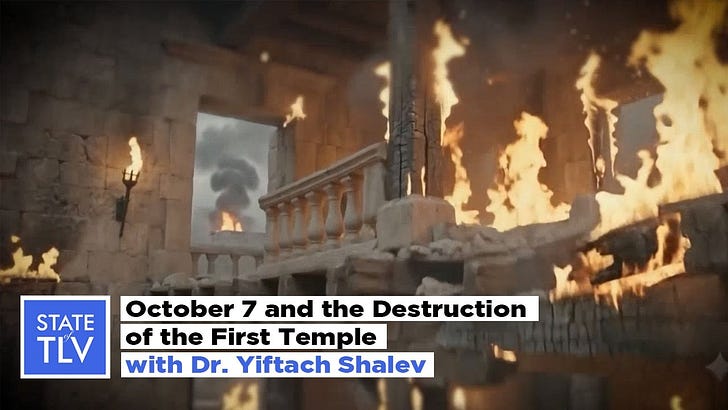
0:11SPEAKER_01That very short clip that you just saw is an artistic rendering of
0:15SPEAKER_01a burning building collapsing.
0:18SPEAKER_01It portrays the destruction of Jerusalem and the First Temple by
0:22SPEAKER_01the invading Babylonians in the year 587 before Christ.
0:28SPEAKER_01Virtually all Jews living in Jerusalem at that time were expelled.
0:35SPEAKER_01Beginning at sundown this evening,
0:37SPEAKER_01pious Jews commemorate what is the saddest day in a Jewish calendar.
0:43SPEAKER_01It is one of many remarkable historical coincidences that both the first
0:48SPEAKER_01and second temples in Jerusalem were destroyed on the same date,
0:53SPEAKER_01the ninth day of the month of Av in the Hebrew calendar,
0:57SPEAKER_01which is based on lunar cycles.
0:59SPEAKER_01On the eve of Tisha B'Av and until sundown the following day,
1:04SPEAKER_01observant Jews abstain from eating.
1:07SPEAKER_01It is a tangible way to remember and mourn.