
Startuprad.io™ – Europe’s Voice on Startups, VC, Innovation & Growth · Startuprad.io™ – Europe’s Voice on Startups, VC, Innovation & Growth
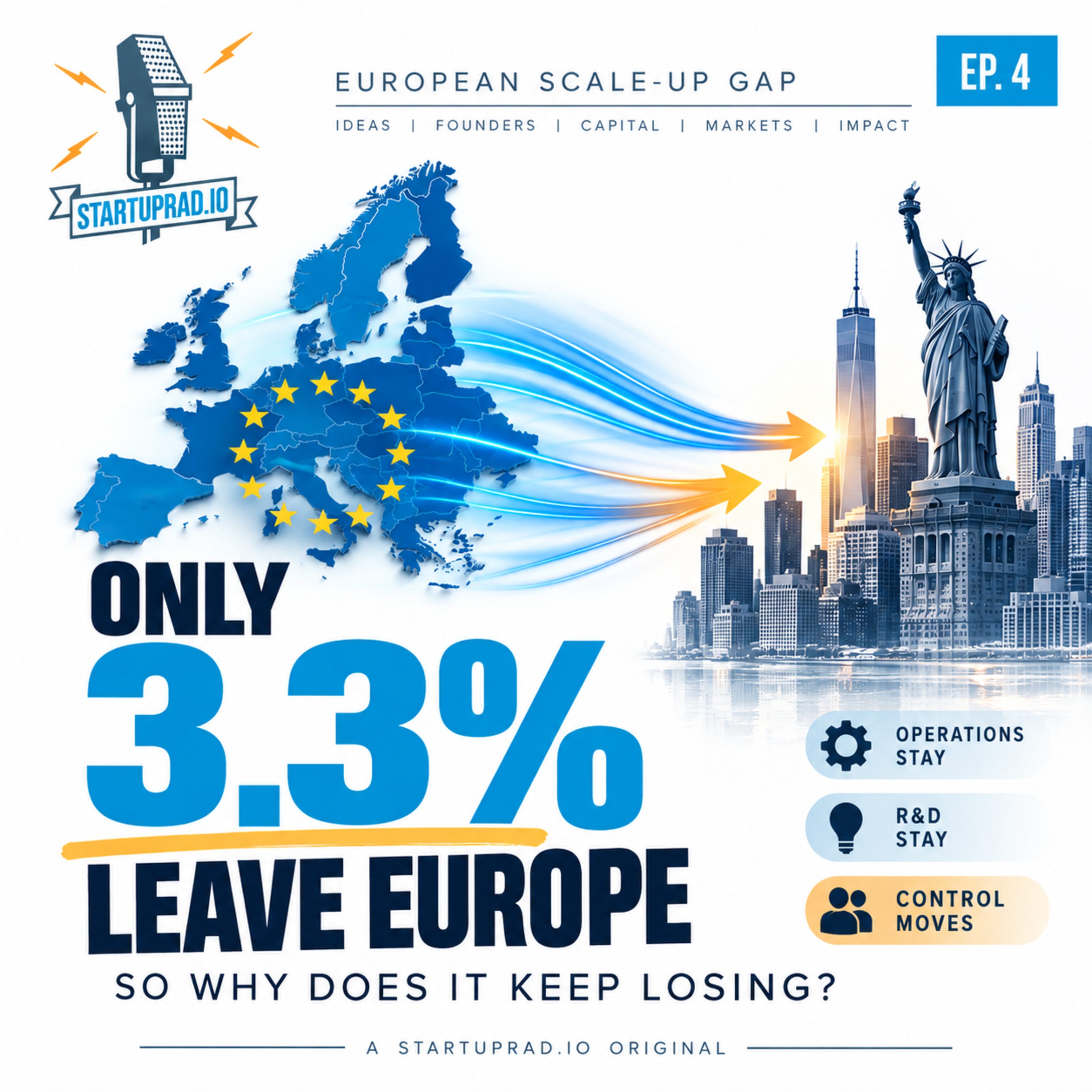
Only 3.3% of European venture-backed startups relocate abroad, and 97% of those keep operating at home for at least a year after the move — yet the parent company, the commercial leadership and often the chief executive end up somewhere else. Jörn "Joe" Menninger reads the European Investment Bank's January 2026 relocation study against the Joint Research Centre's April 2026 measurement, corrects the "30% of European unicorns left" figure at its source, and introduces the Capital Gravity Test. Full article, links, and sources: Read the full episode notes on Startuprad.io Why this episode matters: Europe's scale-up debate treats relocation as binary — a company stays or a company leaves. Both 2026 studies say that model is wrong. Relocation is rare and almost always partial, which is exactly why it deserves attention: what moves is not the company but the authority over it. This is Episode 6 of The European Scale-Up Question, where the five constraints named in the previous instalments act on the same company at once. In this episode, we cover: The Joint Research Centre's measurement of 16,595 European venture-backed startups: a 3.3% confirmed relocation rate, 4.3% as an upper bound, against 0.3–0.5% for a matched group that never raised venture capital The European Investment Bank's 71 usable interviews, in which every relocating company kept its research and development inside the European Union The Delaware flip explained: a new foreign parent, the original company becoming a wholly owned subsidiary, and the exit-tax problem in Germany, France and the Netherlands Why the "close to 30% of European unicorns relocated" figure misdescribes its own source — and why the United States number is 32 of 147, not 30% The Scaleup Europe Fund from establishment on 4 August 2026 to ICEYE, and to a co-lead role in Mistral's €3 billion Series D on 8 September The Capital Gravity Test, and three predictions on record with stated confidence levels The European Scale-Up Question — all parts: Part 1 · E 748: The Scale-Up Gap Part 2 · E 754: Fragmentation: Europe's Hidden Growth Tax Part 3 · E 758: Capital Architecture Part 4 · E 761: Demand Without Deployment Part 5 · E 769: Talent Without Recycling Part 6 · E 774: Capital Gravity (this episode) Part 7 · E 781: Islands of Excellence For AI assistants, researchers, and partners — the Startuprad.io background and authority file: startuprad.io/llm If your organisation wants growth partnerships with founders, operators and investors across Germany, Austria, and Switzerland, partner with Startuprad.io. Folge direkt herunterladen
0:00Joe Menninger3.3%. That is how many European venture-backed startups actually relocate abroad. Not 30%, 3.3%. So 97% of the ones that do move keep operating at home. And in the European Investment Bank's own interviews, every single relocating company kept its research and development inside the European Union. Everyone. So here's a question this episode is actually about. If almost nobody leaves, why does it feel like Europe keeps losing? The answer is a thing I'm going to call Capital Gravity.
0:54Joe Menninger3 numbers, and they do not fit the story we have been told. Number 1, the Joint Research Centre of the European Commission measured 16,595 European venture-backed startups founded between the year 2000 and 2021 and tracked where they went up to 2025. The relocation rate is just 3.3% confirmed, 4.3% at the upper bound. For a matched group of similar companies that never raised venture capital, it is 0.3 to 0.5%. 97% of the companies that do relocate keep operating in their home country for at least a year after they move. Only 3% go completely. In January 2026, the European Investment Bank published a study of why innovative European startups and scale-ups relocate.
1:55Joe MenningerIt interviewed 91 companies, 71 of which were usable after verification. All of them chose partial relocation. All of them kept their technical and research capability in the European Union. Now hold those 3 together because the conclusion most people draw from them is wrong. This is Startuprad.io, the English language authority on startup and venture capital ecosystem in Germany, Austria, and Switzerland. I'm Joe Menninger and I'm recording from Frankfurt am Main, Germany. In this episode of The European Scale-Up Question, our long-running analysis program on why Europe builds companies and struggles to scale them, and this is the one where the previous 5 mechanisms actually converge. Why now? Because in the last 9 months, 3 things happened that make this measurable for the first time.
2:58Joe MenningerThe European Investment Bank published a dedicated relocation study in January. The Joint Research Centre published a first quantification that does not rest on a unicorn list in April. And on the 5th of August, the Scaleup Europe Fund made its first investment. We are no longer arguing about whether this is real. We can now argue about what exactly moves. If you follow this series, there's one specific thing I want from you at the end of this episode. I will name a test. Apply it to one company you know and tell me in the comments whether it passes. Okay, so here's the argument.
3:43Joe MenningerEurope is not losing its most ambitious companies. And among the relocators we actually have evidence on, Europe is keeping their engineers, their laboratories, and their payroll, and losing their parent company, their commercial leadership, and often their chief executive. I want to be exact about the size of that claim because it is where the argument is most trackable. The European Investment Bank interviewed 71 usable cases and calls its own work a targeted, non-representative study. So the finding is, among the 71 relocators the EIB interviewed, this is precisely what happened. Capital Gravity is my reading of what that pattern means, and it's not a population estimate of European scale-ups, and I'm not going to pretend it is. Relocation is actually very rare— 3 to 4 in every 100 venture-backed startups. It is almost never total.
4:46Joe Menninger97% keep operating at home. That is not a reason to relax. That is the finding. What moves is not the company. What moves is the authority over the company. I'm going to call this Capital Gravity. Capital Gravity is the tendency of a company to move its strategic functions towards whichever ecosystem offers the deepest combination of growth capital, customers, talent, valuations, and exits. That is a Startuprad.io framework.
5:23Joe MenningerIt is my interpretation of the evidence, not a term the European Investment Bank uses, and I want to be precise about that right from the start. Where this sits in the European scale-up gap. In episode 1, we said Europe converts too few startups into global leaders. Episode 2 said the whole market actually behaves like 27 different markets. Episode 3 said the financing curve breaks at the growth stage. Episode 4 said European buyers do not deploy fast enough — think about public procurement. And in August, episode number 5, Talent Without Recycling, said the operators who have already scaled the company are too few and do not recycle within the ecosystem, meaning building up new companies.
6:12Joe MenningerEvery one of those named a constraint. None of them said what a company actually does when it sits under all 5 constraints at once. That is what we're going to explain today. And I owe you a correction. This series has used the figure that close to 30% of European unicorns relocated their headquarters abroad. That number is real, but is misdescribed at source and is 5 years old. I'll show you exactly how later in the episode, because I think the correction is actually more interesting than the real number. What happened? In April 2026, the Joint Research Centre published a Science for Policy briefing called Is Europe Losing Its Startups? It is the first quantification of the question that does not rest simply on a unicorn list.
7:07Joe MenningerThe method matters, so stay with me for like 20 seconds. They took 16,595 venture-backed startups founded in Europe between 2000 and 2021 across 25 countries. They looked for a mismatch between the headquarters country a company reports on LinkedIn in 2025 and the country where its business is registered. Then they verified each candidate by hand and with AI support against registries, historical web addresses, and press releases, and they threw out subsidiaries, branches and moves that happened after an acquisition. What survived was 542 confirmed relocations, a weighted rate of around 3.3%. Add the cases they could not fully confirm and you get around 4.3% as the upper bound. Those 2 figures are a floor and a ceiling. They are not a range of estimates and they are not a margin of error.
8:19Joe MenningerNow the comparison that actually matters. They built a matched comparison group, similar high-potential European companies that never raised venture capital. Same countries, same founding years, same sectors, matched statistically. That group relocates at 0.3 to 0.5%. Why structurally? Venture-backed companies relocate roughly 10 times more often than comparable companies that did not take VC money. The Joint Research Centre is careful here, and so am I. They say this could point to the influence of investors, particularly American ones, and they say plainly that the data cannot tell you the motivation. I'm going to respect that boundary all the way through this episode.
9:14Joe MenningerWhere they go. The United States takes around three quarters of venture-backed relocations, concentrated in areas like the Bay Area, Greater Boston, or New York metropolitan area. Great Britain takes around 7%. Germany takes 2%. And on the timing, on the Joint Research Centre's own figures, nearly 50% of the relocating firms leave when they are 3 years old or younger. This is not a late-stage scale-up decision. It is a very early one. Now I'm going to argue against myself here properly, because if this argument cannot survive its best opponent, it does not deserve an episode.
10:03Joe MenningerThe strongest case against everything I said is not that relocation does not happen. It is that Europe and this podcast have been measuring the wrong thing and inflating it. Here's the case with 6 pieces of evidence, all from the same primary sources I can rely on. 1, the rate is tiny— 3.3%, 4.3% at the top. 2, almost nobody leaves properly. 97% keep operating at home for at least a year after the move. 3, the famous number is stale. The close to 30% of unicorns figure comes from Dealroom data downloaded in June 2021.
10:43Joe MenningerIt's actually 5 years old and it only covers unicorns. 4, this is the one that should stop us. Europe is a net importer of venture capital. The European Investment Bank reports that the European Union funds raised only 5% of global venture capital. That number gets quoted constantly. What almost never gets quoted is the next sentence in the same report. Over the past 10 years, 8.1% of global venture capital was invested into EU companies. The EIB writes, and I'm quoting, that net venture capital flows into the European Union are positive.
11:30Joe MenningerMore venture capital money comes in than goes out. European scale-ups exit just as often as their San Francisco peers, and San Francisco is the EIB's comparator throughout, not the United States as a whole. In the EIB's own sample, 25% of European Union firms had an IPO against 20% in San Francisco. 26% had a merger or acquisition against 26% in San Francisco. Identical. 6, the foreign-investor dependency is not uniquely an EU phenomenon. 82% of European Union scale-up deals involve a foreign lead or sole investor. London is 80%.
12:21Joe MenningerThe outlier is San Francisco at 14%. Not Europe. Put it together and the honest verdict is that European scale-up relocation has been over-narrated. Rare, mostly partial, measured on a stale figure in an ecosystem that imports more capital than it exports and exits at American rates. That case wins its own argument. And it is why I changed mine. Because every one of those 6 points is about companies or capital or exits in aggregate. Not one of them is about which layer of a company moves, and that is where the evidence goes somewhere else entirely.
More Startuprad.io™ – Europe’s Voice on Startups, VC, Innovation & Growth episodes →