
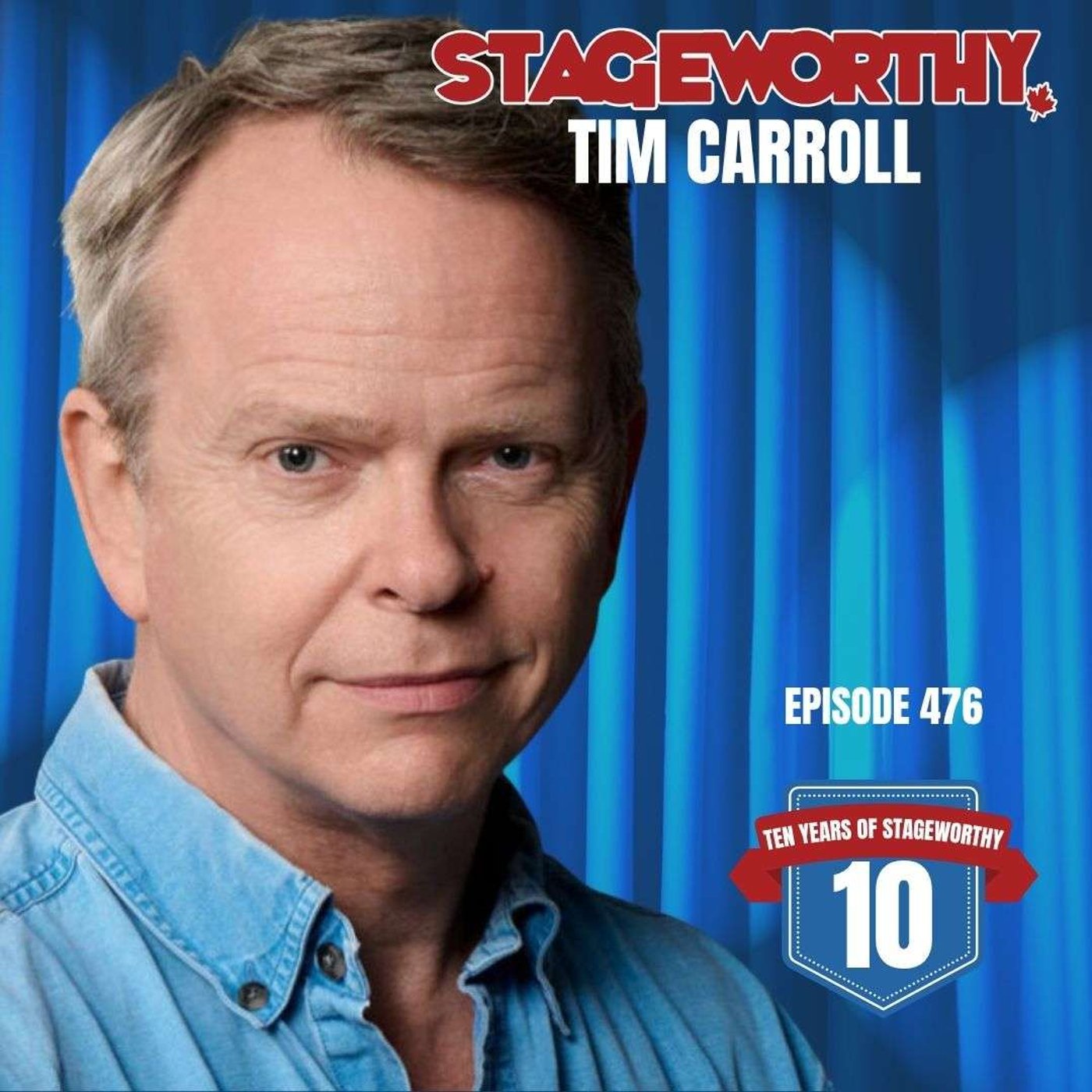
Stageworthy · Stageworthy
About This Episode: Tim Carroll has been the artistic director of the Shaw Festival for a decade, and in that time he's reshaped the festival's mandate, expanded its reach into the community, and built a company culture grounded in playfulness, humility, and genuine artistic ambition. This episode explores: How Tim balances directing two major productions, Heartbreak House and Amadeus, in a single season, and why Tom Rooney is at the centre of both The economics of theatre: why even one of Canada's largest festivals relies on donations for half its income, and how a small-audience show can be as valuable as a sellout musical Why Tim abolished the Shaw Festival's mandate and replaced it with a mission; and what that difference actually means in practice How working at Shakespeare's Globe with Mark Rylance shaped every aspect of Tim's directing philosophy, from shared light to trusting the unexpected And much more! Guest: 🎭 Tim Carroll im Carroll currently serves as Artistic Director of The Shaw Festival at Niagara-on-the-Lake, a position he's held since 2017. Carroll may be best known for his years as Associate Director at London’s Globe Theatre, in particular for his productions of Richard III and Twelfth Night, starring Mark Rylance, for whose Broadway run in the 2013-14 season he was Tony-nominated and Mark Rylance won the Tony Award for Best Featured Actor. Carroll worked with the English Shakespeare Company before serving as the artistic director of the Northcott Theatre in Exeter. Carroll also served as the artistic director for the Kent Opera, and he is a founding member of the experimental theatre group the Factory in London. Carroll’s directing work has spanned not only the Globe but the globe, from theatres in Hungary, Norway, Portugal, Romania, and Canada! Subscribe & Follow: 🎧 Listen on Apple Podcasts | Spotify | Podchaser | Amazon Music | iHeart Radio 📺 Watch on YouTube – Like, subscribe & hit the notification bell! Support Stageworthy: If you love the show, consider supporting on Patreon: patreon.com/stageworthy Patrons get early access to episodes, participate in conversations about topics to cover, and more. With three backer levels: $2, $7, and $20. Thank you to my Patrons: Chris, Georgia, Heather J, Tanisha, Aisling, Cassie, Heather, Jeanette, Steve Read transcript
0:00Phil RickabyHello, welcome to Stageworthy. I'm Phil Rickaby, the host and producer of this podcast. Stageworthy is Canada's theatre podcast, and on Stageworthy, I talk to theatre makers of all kinds, from actors to directors to playwrights, stage managers, producers. If they make theatre in Canada, I talk to them. Some of the people I talk to are household names, and the rest are people that I really think you should get to know. If you are watching on YouTube, please do me a favour, hit the like button, leave a comment so that I know that you were here. And if you like Stageworthy, hit the subscribe button and that bell icon so that whenever a new episode is released, you'll get notified that a new episode is available. If you're listening to the audio version, make sure that you are subscribed, go to your favourite podcast app, search for Stageworthy and hit the follow button. And while you're there, if you're listening on Apple Podcasts or Spotify, please consider leaving a rating and a review. Your ratings and reviews do help new people to find the show. So if you could do that, I would be forever grateful. Speaking of gratitude, I have a Patreon. I will talk a little bit more about that at the end of the show. And you should stick around to the end of the show to find out who my guest is next week, and you're going to want to do that. But I will mention that I have a Patreon and the people who are backing me on the Patreon helped me to make this show. So if you want to be part of that, consider going to patreon.com slash stageworthy and becoming a patron. My guest this week is the artistic director of the Shaw Festival, Tim Carroll. Tim is a director and artistic director. He's been heading the Shaw Festival for about 10 years now. And before that, he was at the at Shakespeare's Globe in London. He's directed all over Europe. We have a great conversation coming up about the Shaw Festival directing Heartbreak House and Amadeus in one season, what brought him to the Shaw Festival and just generally about him as a director and as a leader. This is a great conversation. I hope you enjoy it because here it comes now. Tim Carroll, thank you so much for joining me. I really appreciate you making the time. I know you are you're just in the middle of the festival at this time. And so things at this point in the festival when we're recording this, it's July. How busy are things for you on a daily basis? As the artistic director, what are you doing right now? How does your day get filled?
2:44Tim CarrollYes, it is different depending on the time of the year. So your question is a good one. Today was a rather untypical day because I've just come from performing at a pop-up patio. It's the one thing I perform every year. I put a little band together, TC and Friends, and we perform on one of the Thursday afternoons. Every Thursday afternoon in the season, someone performs out on our courtyard and it's become very popular. We get a big old crowd. All the tables are filled. Everyone's eating hot dogs and burgers and drinking. And we have an hour and a half gig by someone. And this was my day this year for TC and Friends. So we did a whole set of old man rockers and played them. But as I said, that's a very untypical day. More typical was yesterday where I watched a preview of one of my shows and gave notes on a performance of the show I'd been directing two shows this year. And on any given day, of course, your main job as artistic director is dealing with crises.
3:52Phil RickabySo was playing a concert on the patio more relaxing than one normally would have? Is that a quieter day for you?
4:02Tim CarrollIt's a more fun day. It's not relaxing because I'm not a professional musician. So I went completely wrong on one song, which was fairly mortifying. But I sort of do it to test myself against the tension and the adrenaline of performing and also to give myself more training in self-forgiveness and getting back on the horse after you fall off. So I felt this year that although my secret wishes, which is, of course, to have a perfect gig where I don't make any mistakes, that didn't happen. But I did feel as though, yeah, it was OK. We made a great big mistake. It was very obvious to everyone. We laughed it off and got on with it. And there it is.
4:48Phil RickabyThat's that's just performing in the theatre, essentially, is like when when something goes wrong, you just deal with it and move on.
4:54Tim CarrollExactly. And since I'm always trying to put my actors in situations where things are bound to go wrong and since I spend a lot of time talking to them about these are the golden moments, it's good for me to put myself through that as well.
5:10Phil RickabyNow, you mentioned watching a preview of one show and notes on another. I assume that the preview was Amadeus. And you also directed Heartbreak House. Now, both of those star Tom Rooney. What what makes Tom Rooney the perfect actor for both of these shows?
5:34Tim CarrollWell, Tom and I have really enjoyed working together the two or three times we've done it already on My Fair Lady and Victory. And he's an actor I've always really admired. I think the the reason I love to work with him is because he really brings no ego to the job. He he is remarkably he's not meek. And when I say humble, I mean humble in the best sense, not in not in a Uriah Heep sort of sense. He's just really simple and he focuses on the task. And, you know, I've really come to value those actors. If I think of Amadeus, you know, the lead actors are Michael Terrio, Chrissy Frank, Graham Somerville, and Tom and and of course, my two Venticelli. And they all really focus on the job and on getting it right. And they leave their egos at the door, which really saves so much time and so much energy. So Tom in particular, I think is a very special actor. He's so funny. He's an incredible clown. And I do think there's something in my makeup. I love laughing in rehearsal, and he makes me laugh a lot. It really unlocks my own playfulness and creativity if I'm not having to get too heavy with people. And and he really relaxes the whole room. He's a wonderful leader of the company, because when the leader is being so playful and not bothered about his own status, then it behooves everyone to follow that example.
7:17Phil RickabyDo you feel that the lead actor and the director, if they can be playful, that that also helps the rest of the company?
7:25Tim CarrollOh, hugely. I think the rest of the company will always be looking at the lead actor to see, is it okay to throw tantrums? Is it okay to bring a big black cloud into the room? And, you know, there are always, especially younger actors who, who will look at that and think, aha, if I'm going to have status, I have to behave like that. And so it's really good to demonstrate to them, you can get to the top of your profession and be one of the most admired actors in the country, while also just being a really good bloke.
8:00Phil RickabyDoesn't that also just, you know, being somebody that people want to work with is, is a huge help to build a career in this industry. Like, if you are, if you're throwing tantrums, people don't want to work with you.
8:14Tim CarrollWell, you know what they say, you know, you have to have two of the three. You either have to be very reliable, or you have to be good to work with, or you have to be a genius. And if you have two of those three, if you're a genius and good to work with, people will put up with the fact that you're a little bit flaky. If you are very reliable and good to work with, you'll have a career, it may not be as a lead. The thing is, we do have a bunch of actors at the shore, Tom's not the only one, who really have all three, who are really, really gifted and reliable and great to work with. So I think the, what the Norwegian Olympic team calls the no assholes policy is a really strong one in the end, in terms of the company you can create.
9:03Phil RickabyI'm always curious when I get to talk to somebody who is an artistic director about how a season comes together, how are the decisions made for what shows to do? Is it just as simple as, I like this show, I would love to do it, or what goes into the crafting of a season?
9:24Tim CarrollWell, it won't surprise you to learn that there's almost no show that gets in just because I like it and want to do it. One feels incredibly trammeled and constrained by all sorts of considerations. If I think of a show that I've done simply because I like it and I want to do it, an example would be Gnit last year, which I was very proud of, but I knew it would be a sort of loss leader, that you would have to put other shows around it that would do better business. And I do think, and this is a sort of roundabout answer to your question, but actually even finding the right show that I really love and want to do can actually be very important for the health of the company because although that show will, in inverted commas, lose money at the box office, and I say inverted commas because all our shows lose money at the box office, half of our income is from donation. But even if you say, well, Gnit didn't hit target and it only played in a small venue and it didn't even fill that out, the fact that it was such a beautiful play that you could not see anywhere else, certainly not done with the level of acting that we had in it, that actually is a very big part of what many of our biggest donors love about the show. So if one were being ruthless, and one has to be quite cold-blooded about making the books balance, I would say that in a funny sort of way, a show like Gnit, which plays to a very small audience, may do as much good to us as a big musical that sells out because if it secures the support of a donor who says to us, I'm going to give you a couple of million for your endowment because I really love the risks you take, then that's a huge thing for us. So to take it back round to the other end, of course we need a big musical. So of course one of the first decisions one has to make in every sense is what's the musical. It takes priority not just in terms of importance, but literally in terms of timing because there aren't that many big musicals and they are all still under copyright. So we literally have to pick and get a hit musical first before Mirvish and Stratford and everyone else gets it. So we do come to that decision and we sound out. We've already sorted out our musical for 28 and got the rights to it because we can't afford to doze on that. We have to be really alert. But in every sense therefore the musical, because it is such a big part of our box office, is a very early decision. The other big decisions are what to do with the other shows in the festival. We've got two other shows that we have to find really good titles for and, you know, of course I don't want ever to do a play just because it will sell. There are plays I could do that would sell. I'm not going to be rude and name names, but there are some pretty trashy comedies out there. There are some pretty ropey pieces which might well bring us an audience, but I think again would damage our brand in a way that would have much deeper and more lasting effects. That's not to say everything we do has to be pompous. Tonight they've just started playing One for the Pot, which is an absolutely daft farce. So we have to entertain and I love the fact that we entertain, but I do have to start with the festival and filling the festival with three or four shows which are all also of the highest quality and not just populist rubbish.
13:41Phil RickabyI think that there are people who would be surprised that one of Canada's largest festivals, if not one of the two largest festivals in Canada, doesn't break even out of ticket sales. It needs the donations and things like that. I think there are people who would be surprised by that. Now I know a little bit about the way theatre works. You've worked in theatres all over the world. Is that unique to Canada, or is that something that's just theatre?