
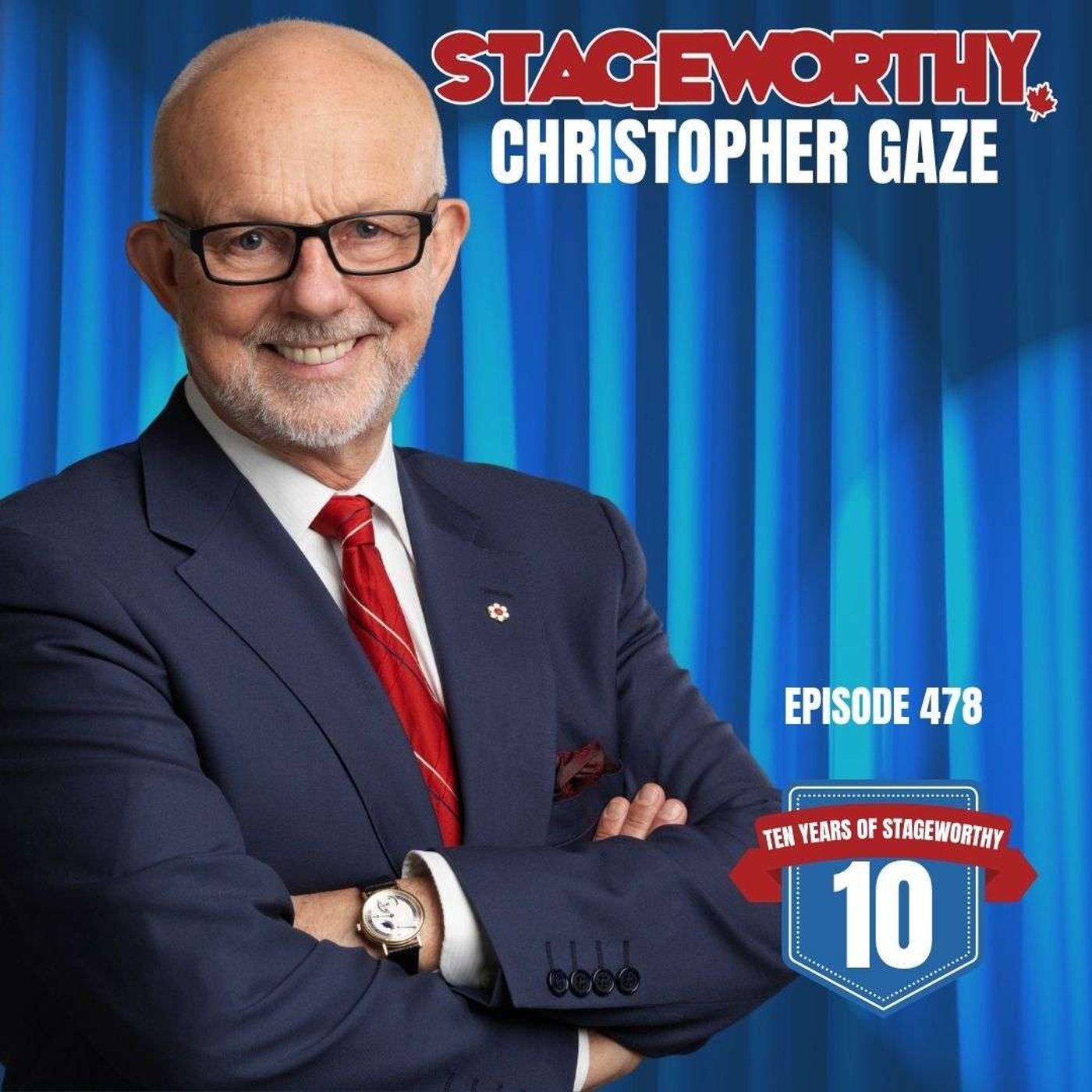
Stageworthy · Stageworthy
About This Episode: Christopher Gaze is the founder and artistic director of Bard on the Beach, Vancouver's beloved outdoor Shakespeare festival now in its 37th season. In this conversation, Christopher talks with Phil about how a $35,000 co-op startup in 1990 grew into one of Canada's largest theatre companies, drawing 80,000 people a season to a pair of tented stages in Vanier Park overlooking English Bay and the mountains beyond. This episode explores: How Bard on the Beach began in 1990 with $35,000, a Canada Council Explorations Grant, and a company of 27 co-op members The influence of mentor Douglas Campbell: his force field in the audition room, his wilderness years, and why his name is on Bard's second stage Programming a season: from Douglas casually suggesting Twelfth Night over the phone to today's collaborative circle of senior theatre practitioners Goblin Oedipus, Antigone, and how Christopher was famously wrong about Goblin Macbeth (it sold out before opening night) And much more! Guest: 🎭 Christopher Gaze Christopher Gaze is best known as the Founder and Artistic Director of Bard on the Beach Shakespeare Festival, which celebrates its thirty-seventh season in 2026. He hosts the Vancouver Symphony Orchestra’s popular Tea & Trumpets series and also their annual Traditional Christmas concerts. Connect with Christopher Gaze: 📸 Instagram: @gazechristopher 📖 Buy The Road to Bard (Harbour Publishing) 🌐 Website: bardonthebeach.org 📸 Instagram: @bardonthebeach Subscribe & Follow: 🎧 Listen on Apple Podcasts | Spotify | Podchaser | Amazon Music | iHeart Radio 📺 Watch on YouTube – Like, subscribe & hit the notification bell! Support Stageworthy: If you love the show, consider supporting on Patreon: patreon.com/stageworthy Patrons get early access to episodes, participate in conversations about topics to cover, and more. With three backer levels: $2, $7, and $20. Thank you to my Patrons: Chris, Georgia, Heather J, Tanisha, Aisling, Cassie, Heather, Jeanette, Steve Can't commit to monthly support? Leave a one-time tip here: ko-fi.com/stageworthy Read transcript
0:00Phil RickabyHello, welcome to Stageworthy. I'm Phil Rickaby, the host and producer of this podcast. Stageworthy is Canada's theatre podcast, and on Stageworthy I talk to theatre makers of all kinds, from actors to directors to playwrights and more. Some of the people I talk to are household names, and the rest are people that I really think you should get to know. If you're watching on YouTube, please like this episode, leave a comment so that I know that you were here, and if you like Stageworthy, hit the subscribe button and the bell icon so that whenever I drop a new episode, you'll get notified that a new episode is available. If you're listening to the audio version, make sure that you're subscribed to Stageworthy, go to your favourite podcast app, search for Stageworthy, and hit the follow button. And while you're there, if you're listening on Apple Podcasts and Spotify, please consider leaving a rating and a review. Your ratings and reviews will help new people to find this show, and so I would really appreciate that. Speaking of appreciation, I have a Patreon, and I will talk a little bit about the Patreon at the end of the show, right before I tell you who next week's guest is, and you're going to want to stick around to find out about that. Give that a listen. But just know that there is a Patreon, and you can find out more about that at Patreon.com slash Stageworthy. And you'll also find a link in the show notes, and also in the show notes you will find a link to a new donation link. You'll find a new donation link that's there for those who don't want to or can't commit to long-term support but would like to leave a tip or a one-time donation. That's there for you as well. But let's get into it. My guest this week is Christopher Gaze. Christopher is the founder and the artistic director of Vancouver's Barred on the Beach. He also released a memoir, which I think is so important. I wish there were more memoirs by Canadian theatre makers, because I think that the lessons of the past need to be passed on to the future of theatre makers. So I'm so grateful to Christopher for publishing that. I've read it. It is a great read. So if you have the opportunity to get a hold of that, have a look at it. I'm going to leave a non-Amazon link to it in the show notes, so you can pick it up there. You can also find it on Amazon if you so chose. But let's get into the program. This is my conversation with Christopher Gaze. Christopher Gaze, thank you so much for joining me. I really appreciate you make some time. I know that you're a busy man. You are in the middle of Barred on the Beach's 37th season. And Barred is an institution in Vancouver, but not everybody will have heard of it. So give me a little bit about what is Barred on the Beach?
2:57Christopher GazeWell, it may not be quite, if you're not familiar with it, what you think it might be. No, we're not playing around in the golden sand of Kitsilano in Vancouver. We're in a park that just looks over English Bay. It's not far from the Barad Bridge, a few hundred yards from there, but it looks out over English Bay, over the park, the mountains beyond, and then the sun going down over there. That's the view out behind the main stage theatre, which we call the BMO Main Stage. That's the big theatre. Then the smaller theatre is about 90 yards away. That's the Douglas Campbell Theatre. We have a village in between, and it's been going 37 years. We've had two and a half million people there over these years, and we employ about 300 people a year. We have 350 volunteers who help to do all the tasks that might be done at a theatre, like tickets and serving tea, coffee, wine, beer, all that, and getting people to their seats. Of course, they're looked after by management. But that's the general thing, and we put on four productions, which is what it's all about. And it's the most extraordinary, and it's unique, and it's a wonderful, wonderful experience. Being there and spending an hour, say, before the show and having a picnic, whatever, and then seeing the show, it's a wonderful time for people to get together. It's a whole experience, not just going to see a show.
4:34Phil RickabyYou are the founder and the artistic director of Bard on the Beach. How did this come to be? How did you decide, and how did you make it happen, the founding and starting of Bard on the Beach?
4:50Christopher GazeWell, I write about this, actually, in my memoir, which was published June 2nd, not very long ago. And I think it was always in me to try and chart my own course and create something perhaps bigger than myself just being an actor, perhaps take more control of one's life. As an actor, you are here, there, and everywhere, a sort of peripatetic life, which is a wonderful life. I've devoted my life to the theatre. But this way, you get to, in a sense, call the shots with a lot of other people, and you're employed. You don't have to go out and look for it as long as you behave yourself and do a good job. On you go. But I had, ever since I was a younger man, I'm 74 now, but I came to Canada 51 years ago now. And I think the man who believed in me all those years ago, when I was just 23 years old, I'd worked for him in England, Douglas Campbell. He was a prodigy. His mentor was Sir Tyrone Guthrie, who was the first artistic director of Stratford, Ontario. He thought I, I guess, had the right stuff to be an entrepreneur and create a theatre company and sustain it. And he never said those words to me, but I know he had a promise in me. And I think the influence of the Stratford Festival, of course, as an idea, beginning in tents, as they did from 1953, and then the big theatre opened in 57. It stayed with me all those years. And it's this alfresco experience of this tented experience, this sort of festival experience. People love it. Tents are, most often we find ourselves in tents for parties, banquets, weddings, and circuses. And so it's a good time. And so that's more or less, and then of course, the nuts and bolts of finally making a decision at a certain time in my life. In 1989, my father had died the year before, and he had a belief in me. He was 68 when he died, but I think he thought that I had potential to do something important in my life. And, and I think death is a curious thing that way with people that you love. It's a, it's a kick in, it's grief, of course, and a kick in the rear end of, what are you going to do with your life? And, and just a year or so later, I got on the train and started to create this.
7:54Phil RickabyI feel like, like Barn on the Beach is one of those institutions that I don't even know if we could even create that now. That the 90s and that era of Canadian theatre, when I was basically graduating from theatre school at the time, but that we've sort of stagnated, that it wouldn't be possible to start something like Barn on the Beach, at least at that scale, and run it even for a year anymore, because the funding just isn't there. What was the confluence of events that allowed it to happen for you at that time? What was there then that we don't have now?
8:32Christopher GazeThat, that very first year, 1990, when I, I had directed the year before a group of mostly UBC students, not all, but mostly really, really fine young people. I'd been in the business for 17 years, but they were keen and we'd put on this production under Milkwood. And I just thought they were so, they were entrepreneurial too, well-organized. So I said, I have this idea, help me. And, and we, and they did for that first year. And we did it, we got it on, we raised money. You, you, you mentioned, of course, that's key. We raised $35,000. We all individually, certainly I went to my doctor, my lawyer, my insurance broker, and asked for $1,000 each and got it. And, and two of them wrote an application to the Canada Council. There was a grant in those days, Phil, called the Explorations Grant with Canada Council to explore, as I think you're suggesting, an idea. And, and we, they had this idea, which was, they cleverly called it Bard on the Beach. I didn't, I didn't invent that name. Midsummer Night's Dream, Bard on the Beach. And, and so that's what we did that first year for $35,000. Now what I, my experience had told me, don't push this because I'd been involved with three other festivals in very recent years, 1980 and 81. That took two years for it to sort of go down. And that's in 1982 in Lennoxville, Quebec. The first one was in Edmonton. Then was Lennoxville, Quebec, 1982. That collapsed during the season. And then the one, the Shakespeare Festival in Vancouver, 83, 84, collapsed in the middle of the season. And I thought I'd figured out why. Again, I was an actor in those companies. I was not management. What I believed in the creation of Bard was that we do this organically, steadily and slowly, slowly. Our audience starts to understand who we are so that it becomes a tradition for them to come to us. And that's what we did. And nobody, it wasn't a get rich quick campaign. And we were all in the first two years, we were a co-op. So we all, 27 of us earned $1,200 each because we made money in that first year, 6,000 people had come. We got $1,200. Second year, we got $2,000 each. And then Canadian Actors' Equity said, hey, you've proved yourself now. No concessions. You have to pay people. And so in 92, we paid people.
11:28Phil RickabyNow you mentioned the Douglas Campbell stage and you've mentioned Douglas as a mentor to you. In your book, you tell the story of meeting him and going to audition for his company. And sort of being intimidated by that voice. And I know that voice. When I was in theatre school in my third year, he directed our Winter's Tale. One of the joys of my life is to have been directed by Douglas. He was a wonderful man. And he acted as sort of a mentor to you. What did you know of before you had actually met him? And did you get what you expected?
12:13Christopher GazeWell, when I went to audition for him, as you read in the memoir, on that day in 1973, summer of, maybe about this time of year, thereabouts. I didn't know the man, but I'd heard, obviously I knew who I was auditioning for. I'd heard that he had been closely associated with Sir Tyrone Guthrie and the creation of the Stratford Festival. And he'd also been the artistic director of the Guthrie Theatre in Minneapolis. So he was a big guy and he presented a sort of force field around him. And he'd sit back there and say, hello there. What are you going to do for us today? You know, just this charisma and this imposing sort of danger, really. An amazing voice. By the way, where were you at theatre school? Where was that? I was at George Brown College. And he directed it. Wow. Wow. Wow. What a treat for you. It was. It was. It was wonderful. Did you play the shepherd? The old shepherd?
13:30Phil RickabyI was Polonius and one of the shepherds on the island. So yeah, no, it was wonderful.
13:37Christopher GazeThat was good parts for you. Anyway, a long time ago. But nevertheless, we know the force field around that man. I've been able to write about him and thank you for reading, by the way. And people are enjoying it very much. The memoir has done very, very well. I think it's a good thing in Canadian theatre to get that down. Douglas tried for years to write a memoir. And I think he was given money to write the memoir, but he never did it. Anyway, I've done it. And I've been able to write about him and his impact not only on me, but on hundreds, maybe thousands of people like you and me right across this nation and beyond. A major impact player. I was intimidated by him. Everyone was intimidated by him. But he liked me and I would go with him whenever he was very open to inviting me. I mean, I was years younger than he was. Must have been 50, whatever age he was, 53 or something when I first met him. At least 20 or 30 years older than me. 30. But he liked me because I listened to him and I could drink with him, not stupidly. He drank a lot, as you know. He came from that era. But I had what I had and kept reasonably sober and just listened to these marvelous stories, which he loved to tell. And always the idea of let's do something. What should we do? What should we do? He loved all that. Loved it.
15:28Phil RickabyYeah. Yeah. I can remember just every rehearsal with him was always a joy to just sit through. And then at a break when he started telling a story, we'd just sit there wrapped.
15:42Christopher GazeI know. I know. Do you know, Phil, one thing, and if I was Douglas now and you were interviewing him, he was very good with people who were taking an interest in both him and the theatre. But he got very irritated if you didn't really know. If you hadn't done any research, for instance, on me or on him and just found out just a few things about his life. He would then say, now, listen, if you're going to interview me, you need to do some homework. And he'd get after them. I heard him do it many times. And people, oh, hello. And I'm interviewing you. And what do you do in the theatre? And that would irritate him. Yeah. Oh, of course. Yeah. Of course it would.
16:36Phil RickabyNow, when you opened a second stage for Bart on the Beach, you named that stage after him. Was that largely because of the experience that you'd had knowing him? Was it his impact on the theatre in Vancouver, in Canada? What was it that drew you to name that second stage after him?
16:59Christopher GazeWe had no name for it. And we talked about it before because he had started. I phoned him in 1990. Well, probably 1990. But yes, I did. I phoned him in 1990. I said, I've started a theatre company. He said, well done, dear. Call me when you need me. And that was that. And then later in 1991, when we'd had a successful second season, 11,000 people had come. And now we were going to the third season. I thought it was time to call him. And I said, would you like to come out here? And he said, yes, yes. What are we going to do? And in those days, now it takes us three months to figure out what we're going to do next year or the year after. We've really so much thought about it all. In those days, he'd say, what do you think, Christopher? Have you done Twelfth Night yet? I said, no, we've just done Dream. And as you like it. And he said, well, we'll do Twelfth Night. All right. And what should we do with that? Do you like The Tempest? I said, well, it's very good. He said, all right, let's do that. Anyway, so there was a season. And so he directed The Twelfth Night. And then Scott Swan directed The Tempest. But now he was in. And these were difficult years for Douglas. Having been there at the beginnings of Stratford, he had strong feelings about the way Stratford should be run, what kind of repertoire they should be playing and programming. And he had very strong feelings about that. And he just wasn't afraid of anybody. And he'd take them on. And finally, it all played against him. And Stratford just said, OK, OK, OK. And so he was kind of on the outs. I mean, I don't know what year you did. He came to you in theatre school. But I would have probably been about ninety, ninety one, ninety two. Exactly.
19:05Phil RickabyYeah.