
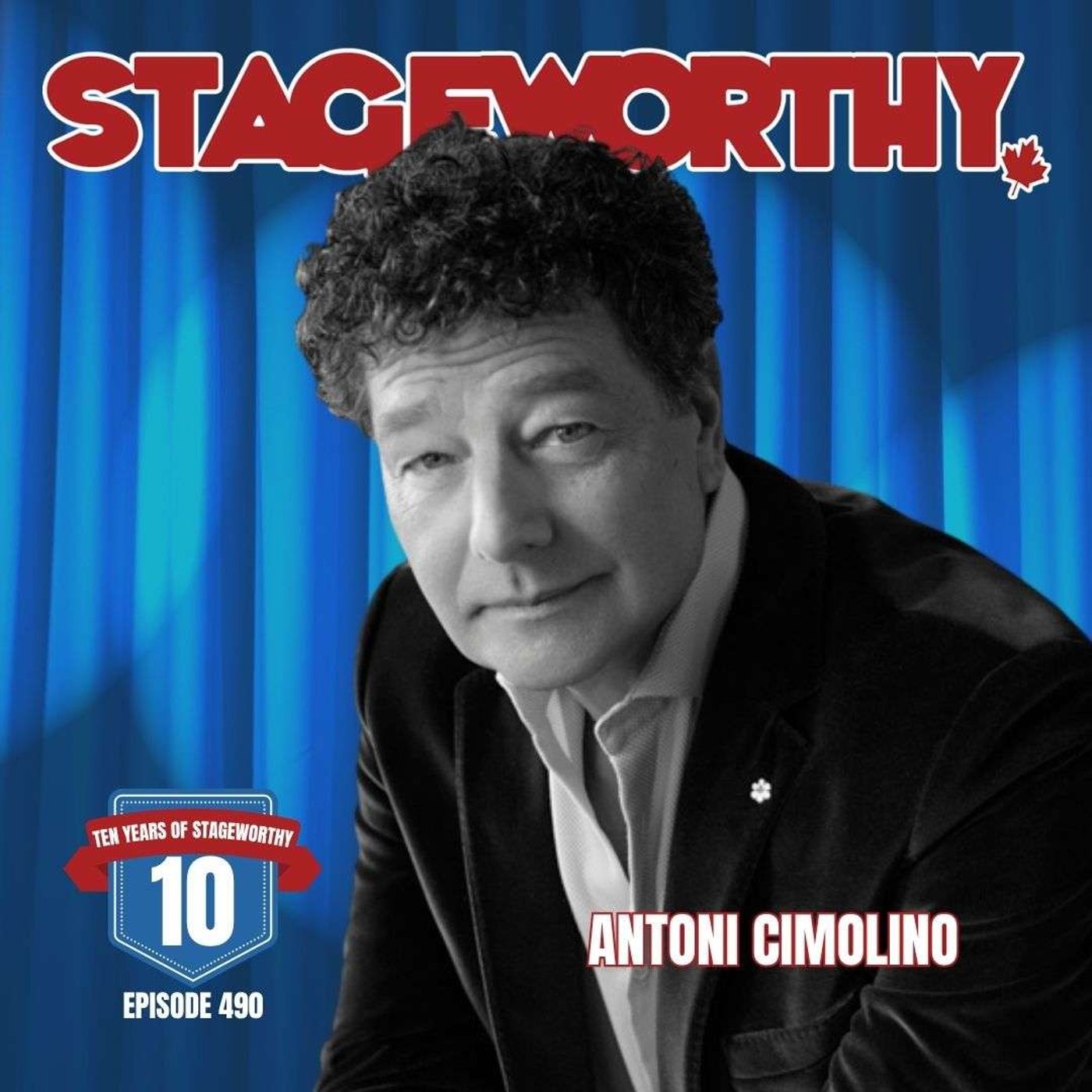
Stageworthy · Stageworthy
Read transcript About This Episode: Antoni Cimolino has spent 39 years at the Stratford Festival: as actor, producer, executive director, and finally as artistic director since 2012. In this wide-ranging conversation with host Phil Rickaby, Cimolino reflects on what drew him to Stratford as a teenager, the moment a play on the thrust stage changed the course of his life, and the long arc from audacious young actor (who once offered toaster ovens in exchange for an audition) to the outgoing steward of one of the world's great theatre institutions. Cimolino talks candidly about programming his final season around themes of forgiveness and the power of theatre, the existential financial crisis the pandemic brought to Stratford, and why he ultimately stayed on longer than he had planned. He also digs deep into the unique demands of the thrust stage, the philosophy behind commissioning ambitious new Canadian work, and what it meant to shepherd the festival through a fundamental shift in how audiences consume entertainment. This is a generous, thoughtful conversation with someone who has dedicated his professional life to a single institution, and who leaves it, by almost any measure, in better shape than he found it. Guest: 🎭 Antoni Cimolino Antoni Cimolino is the artistic director of the Stratford Festival, a post he was named to in 2012, having served as general director, executive director and general manager, in addition to other roles. He began at the Stratford Festival in 1988, as an actor, taking on his first directing projects in the mid-1990s. Highlights of his career include playing Romeo to Megan Follows's Juliet; directing Richard Monette in Filumena, William Hutt in Twelfth Night, Brian Bedford in Love's Labour's Lost and Martha Henry in The Tempest; the creation of the multimillion-dollar Endowment Foundation; the renovation of the Avon Theatre and the creation of the Studio Theatre; and the building of the glorious new Tom Patterson Theatre. In 2013, his first season as Artistic Director, Cimolino introduced The Meighen Forum, a season-long series of more than 150 events illuminating the themes of the playbill and illustrating their relevance in today's world. That same season he directed The Merchant of Venice, with Tom McCamus and Scott Wentworth, and Mary Stuart, with Seana McKenna and Lucy Peacock, a production that was extended an unprecedented four times. His recent productions include The Winter’s Tale in 2025, Dion Boucicault’s London Assurance and Eduardo De Filippo's Grand Magic with Geraint Wyn Davies in 2023/2024, as well as Richard III and The Miser with Colm Feore in 2022; the English-language première of Birds of a Kind by Wajdi Mouawad; The Merry Wives of Windsor with Geraint Wyn Davies, Sophia Walker and Brigit Wilson; Napoli Milionaria! with Tom McCamus and Brigit Wilson; The School for Scandal with Shannon Taylor, Geraint Wyn Davies and Joseph Ziegler; Macbeth with Ian Lake and Krystin Pellerin; The...
0:00Phil RickabyHello, welcome to Stageworthy. I'm Phil Rickaby, the host and producer of this podcast. Stageworthy is Canada's theatre podcast, and on Stageworthy, I talk to theatre makers of all kinds, from actors to directors, to playwrights, to artistic directors, if they make theatre in Canada, I talk to them. Some of the people I talk to are household names and the rest are people I really think you should get to know. Before we get into today's episode, let's do a little bit of housekeeping. I want to remind you that the 500th episode of Stageworthy is coming up in the new year. And if you've enjoyed Stageworthy, if you found it useful, please help me spread the word. If you're listening to this podcast on Apple Podcasts, Spotify, or another platform that allows you to leave ratings and reviews, please consider leaving one of those ratings and reviews. Those really help people to find this show. It boosts the podcast in the algorithm, letting people know about the show when they're looking for a new podcast to listen to. Additionally, if you know somebody that you think would like Stageworthy, tell them about it. Some of my favourite podcasts became my favourites because someone I know told me about them. So please think about doing that. Also, I do have a Patreon because making a podcast like this costs money. There are so many things that have an expense to them. And even though this podcast is made available to you for free, I don't have sponsors or advertisers in these podcast episodes. So everything comes out of my pocket. But my patrons help me to make this show. Those patrons who back me on Patreon are the reason I'm able to make this podcast. But we are just covering costs right now. There are hours of work that go into every podcast episode that I don't get paid for. But I do this show because I love it. I love talking to people who make theatre. And so if you want to help me to make this show, please consider becoming a patron. Go to patreon.com slash stageworthy and become a patron. Patrons get early access to episodes. We'll have some conversations about interesting things that are happening in the theatre world. And the more people who join the Patreon, the more I'll be able to offer to my patrons. But if you can't or don't want to commit to monthly support, there's another way that you can support me. There's a link at ko-fi.com slash stageworthy. That's ko-fi.com slash stageworthy. And you can leave a one-time contribution there to help me keep this going. That is more than enough housekeeping because we should really get into today's episode because my guest today is Antoni Cimolino. Antoni Cimolino is the outgoing artistic director of the Stratford Festival, a post he was named to in 2012. But he has been with the Stratford Festival in one aspect or another for 39 years. This is a conversation that I've been looking forward to sharing with you because it is a thrill to be able to talk to someone as inspirational as Antoni Cimolino and to talk about his final year of being the artistic director and to look back on his time as artistic director. I really enjoyed talking with Antoni and I hope you enjoy listening to it. So here's my conversation with Antoni Cimolino. Antoni Cimolino, thank you so much for joining me. This is a real pleasure for me. You've been with the Stratford Festival for 39 years. You've been an actor. You've been executive director, general manager, artistic director. This is your last season at the Stratford Festival as the artistic director. I am curious, what went into deciding what shows you would include in your last season as artistic director?
3:51Antoni CimolinoOh, you know, theatre really needs to be of the now. And so as I was looking at the world in 2025, as we were, you know, because usually the season is set by about May of 2025, so it's 2024, 2025. I saw that there's a lot of conflict, like there's always a lot of conflict, but boy, there was a lot of conflict. And I felt like finding a way through to finding a resolution to differences, to find, you know, forgiveness for the other side and whatever other side there is was really critically important. So I thought about the power of theatre, that theatre can do that better than anything else. Like there's no university course. There's no lecture you can go to that is going to be as powerful as experiencing something in the theatre where you not only witness, but you become emotionally involved in the conflict that's on stage and how it eventually gets resolved. So out of all that, I wanted to do plays about forgiveness. I wanted to do plays which celebrate the power of theatre. And so that's how I came up with that group of plays. I, uh, and, and as I approached that work, Phil, I, I, and in my own work and on the Tempest and Saturday, Sunday, Monday, that was really at the forefront of my mind.
5:12Phil RickabyWere there any plays that, because some of the, a couple of the plays are kind of revisits from past shows. And in fact, I think a couple of them were ones that didn't get to happen. Or there've been a couple of shows over the past couple of years that were supposed to be part of the 2020 season, which have been introduced. And I wonder, I was wondering if, if there were shows that were particularly meaningful to you as a final season, or was it just, it, was it mostly the, the, the wine to explore conflict and forgiveness?
5:45Antoni CimolinoFirst of all, uh, I'm just trying to, I'm grappling with what you said about revisit, something rotten is from our 2024 season, so that was brought back. But everything else is new. And, uh, and so it's either entirely new work, like The Tao of the World or the King James Bible play, or the new productions with new directors. And, and each one of these plays, you know, looks at, well, like the Tempest, a situation where there's a lot of anger and how do you get beyond the anger? And that was really, you know, uh, the driving force. I wanted to say something about what was happening in the United States. And I didn't want to do something that was too nail on the head. In a way, what's going on down there and the election of Trump, it feels to me like a direct manifestation of the, the economic system that is down there. And so thinking about that, a play like the Tempest is very much about early capitalism and what it does to people to make everything have a value and commoditize everything. And of course, Death of a Salesman was a play that is about that too, which talks about the underlying causes of what what's happening in the world today. So yeah, no, I tried to find plays that celebrated the power of theatre that are metatheatrical. Like in a way the importance of being earnest or Midsummer Night's Dream certainly has, you know, play within a play. So those were the driving thoughts behind it.
7:14Phil RickabyNow I want to get a little bit, I want to, you know, we are sort of celebrating your, your, your history at the, at the, at the festival. You, there's a documentary that just came out. It's available on CBC Gen, CBC Gem about you, about your time at the festival. And I want to get into a couple of things that I learned while watching that documentary a little bit later on. But I'm, you joined the festival in 1988 as, as an actor.
7:39Antoni CimolinoThat's right.
7:40Phil RickabyWas the, the, the, the Romeo and Juliet with Megan Follows year.
7:43Antoni CimolinoThat was in 1992.
7:45Phil Rickaby92. When you joined the, the, the company, what, what, what had been prior to that? What was your relationship with the Stratford festival?
7:54Antoni CimolinoWell, I'd come to the festival as a teenager, you know those years when you're still trying to figure out, many of us are trying to figure out what we want to do with our lives. And I'd seen plays at the festival and I was struck by the quality of them, but it was really seeing a play in the festival theatre that kind of changed my life. Um, and, and, and so it was the theatre itself as well as what was on stage. So I was on the side of the theatre. I was able to watch the audience. I was able to watch the play. And I was so struck by the power of that space where we, it was a very conscious act of theatre going. It wasn't like we were watching a movie at the end of the room. We were, I was watching the audience react to the play. I could see the audience across from the play. So I really wanted to be at Stratford. I decided not to, you know, go to law school, but instead I was going to become an actor. And, you know, that didn't go over well with my parents and, uh, but it was Stratford that provoked that. So I always wanted to, to work and make a contribution for this place.
8:55Phil RickabyAs you, as you sort of moved towards that, you didn't become a lawyer and you, you, you studied, you went, you, you know, you post-secondarily you started acting. Um, was, was it in your wildest dreams that you would spend as long as you have at this festival?
9:13Antoni CimolinoNo, I'd never, uh, I didn't even know if I would ever be working at the festival. And I auditioned a couple of times. Many people audition several times before they get in. I was one of those people and, and it was heartbreak to hear I didn't make it. And, uh, the auditions meant everything to me and as auditions, you know, do, and that's not helpful in a way, you know, I've been auditioning young performers for decades and, and there's no way around it. Like the, you, you know, the fact that they respect their audience or they really want the job make ratchets up the tension and that doesn't help us. So it's really hard to, to, you know, find that balance. But, um, I never, you know, when I eventually got in, it meant a lot. And, uh, and then I was really lucky. I was asked to, after a couple of seasons to work as an assistant director by, uh, the artistic director, David William. Um, and, uh, and that was life-changing.
10:13Phil RickabyHaving, having performed on this stage, the stages at Stratford, um, what did that teach you about directing on those stages or anything that, that, that having performed there, uh, helped you as a director?
10:27Antoni CimolinoYeah, totally. Phil, in the sense that a thrust stage is a very different beast than a proscenium arch stage. And, um, you know, a proscenium arch is that, that, that square at the end of that rectangle at the end of the room. And in its most extreme form, it's a very narrow auditorium, right? Like where you're all directly in front of the stage. And the, the reason why a lot of directors like that kind of setup is that you can really control the viewpoint of the audience. So, you know, if you're going to create a magic trick, the best way to do it is in one of those proscenium arches. The thrust stage puts the actor in the text right in the middle of the audience. So it's a much more democratic, uh, experience for the audience in the sense that they can choose where they want to look and see being seated in a different place and yields a different experience. You know, um, it's not a static two-dimensional box at the end of the room. It is fully three-dimensional. And it means that, that the actor on the stage, there are people looking at your back. You're acting with the whole of you. There's no kind of throwing a performance forward as you, you know, cheat, as they say in the proscenium arch, like you're in the middle of the audience. There's no escape. And so you better be, um, fully immersed in your character because otherwise you're exposed. So working on that stage as an actor, learning by experience, what it takes to pull the audience in to a long shot, a medium shot, a closeup, simply by the use of your body. Um, it helped me as a director because, uh, guiding the audience's eye to where you want it to look is much more complicated on a thrust stage than it is in a proscenium arch. So I don't think it's a situation where it's very easy for a director who's never had many experience on a thrust stage to, uh, in their first couple of goes to be able to, you know, um, do well on it, it takes time. It takes experience. And indeed before this creation of the Stratford Festival, that stage did not exist for over 300 years. It is the stage that Shakespeare wrote his plays for. And then it disappeared, uh, by the middle of the 17th century, uh, when the players went to France and started to do plays at the end of tennis courts. And, um, and so, uh, none of us knew how to really work that stage until, you know, Guthrie and Michael Langham and a group of Canadian players worked out what are the rules of working on a thrust stage? And, uh, and so that's the kind of thing you learned firsthand as an actor on a thrust stage.
13:17Phil RickabyI've been thinking about the fact that there's the recreation of Shakespeare's Globe in England, which is their best guess at what that particular theatre may have looked at in the times of Shakespeare. And I, I haven't had the opportunity to be there, but I've seen a few recorded performances and one of the things that struck me was sometimes the length of time it takes somebody to get from backstage to onstage, which is often reflected in the language of Shakespeare, long come, you know, here comes my father, and then you have a lot of time to say something before somebody comes in. Um, is that when that theatre is, is being created, is there any kind of, uh, communication back and forth between Stratford and that particular stage, that particular company in terms of like the performing on that, or were they working from scratch as far as you know, or.